• Required reading for all forum users!!!

    Welcome!
    Register to access the full functionality of the GSResources forum. Until you register and activate your account you will not have full forum access, nor will you be able to post or reply to messages.

    A note to new registrants...
    All new forum registrations must be activated via email before you have full access to the forum.

    A Special Note about Email accounts!
    DO NOT SIGN UP USING hotmail, outlook, gmx, sbcglobal, att, bellsouth or email.com. They delete our forum signup emails.

    A note to old forum members...
    I receive numerous requests from people who can no longer log in because their accounts were deleted. As mentioned in the forum FAQ, user accounts are deleted if you haven't logged in for the past 6 months. If you can't log in, then create a new forum account. If you don't get an error message, then check your email account for an activation message. If you get a message stating that the email address is already in use, then your account still exists so follow the instructions in the forum FAQ for resetting your password.

    Have you forgotten your password or have a new email address? Then read the forum FAQ for details on how to reset it.

    Any email requests for "can't log in anymore" problems or "lost my password" problems will be deleted. Read the forum FAQ and follow the instructions there - that's what we have one for...

  • Returning Visitors

    If you are a returning visitor who never received your confirmation email, then odds are your email provider is blockinig emails from our server. The only thing that can be done to get around this is you will have to try creating another forum account using an email address from another domain.

    If you are a returning visitor to the forum and can't log in using your old forum name and password but used to be able to then chances are your account is deleted. Purges of the databases are done regularly. You will have to create a new forum account and you should be all set.

Cu head gasket

Lorenzo

Forum Mentor
Past Site Supporter
I would like to attemp making the h.g. in copper;
my question is: which thickness should I use, bearing in mind, I do not own (like most of us) a rolling mill - or a mill for that matter - to bring the plate to the exact tickness, so will have to be in one of the commercial measures i.e. 1mm 1,5mm or 2mm.

Could the heat treatment matter, I think in the hardened state, it would be eassier to manufacture, what do you reckon?

Also, do you think that, going all copper, I still need the two studs viton o-rings?

Thanks very much for your help.
 
Last edited:
Reason for going against widely accepted wisdom, is a somewhat bothersom seep, which had me already change two sets (base, head, tappets cover).

Original gasket is 1,5mm (1/16") so I'll be able to find the correct copper sheet;

from what I've gathered, work in a crude state and anneal before install.
 
Last edited:
As a general rule for making copper gaskets.
Cut the copper as bought and then anneal.
Heat to cherry red and either let cool naturally or quench .
Both methods have the same result but quenching removes the oxides.
Use Loctite 3020 spray as a sealer.
 
some ideas? .I vaguely remember a few things from my Seagull outboard. You will want to practise a bit first so here's a few vague ideas to try on a scrap ......I think folds and crimps in a copper gasket are hard to completely remove completely so be careful. A sharp blade can be better than shears on SOFT copper but is harder to control. ...Without a perfect "cutting mat" ,punching into a tough piece of wood's endgrain,might give the cleanest hole.

Also, do you think that, going all copper, I still need the two studs viton o-rings?
Why wouldn't you? I seem to remember my suzuki block is recessed for it there but I could be mistaken....
 
Copper head gaskets are for racing vehicles and are prone to weeping. You sure that's what you want?
 
No mat no punching; the cutting is gonna be made by a saw frame for the piston holes, trimmed by half round file.
OK for the spry, absolutely no silicon RTV, just a spry on both surfaces, Loctite 3020, as Zed1015 suggested, or KW Copper Coat or Hylomar for copper head gasket, or perhaps, any copper flange spry, allowed to get tacky, for about two hours, and is paramount that the mating surfaces are flat, no warping (max 0.05mm (0.0019") and with an almost mirror like finish, with very shallow peaks and valleys.

Also important, to re-torque the bolts, after a complete heat cycle, which involves heathing the engine with no load, and letting it cool for a night, after which, the head can be retorqued.

This is what I gathered so far, hoping of it being the correct procedure.

Still uncertain 'bout the Cooper rings (being copper washers clad in viton rubber. being originally mounted in a non copper gasket, so, whith a copper one, there should be probably no use for them (?).

Any suggestions welcomed.
 
Last edited:
Use O rings - but make sure they're thicker than the gasket.
1.5mm copper, I'd use 2.0mm O rings - ensuring they fit reasonably snugly in the holes.
And lightly countersink the holes you bore for studs etc.
 
Thanks GregT;
Anyone happens to have the said rings at hand, so I can order them in the meanwhile, getting the correct OD?

I suppose I could determine it by taking the head off, but in a cosy and rather crowded environment, leaving as less stuff around, the better... Or, perhaps, measuring the holes in the old gasket and accounting for a mm or two, for the squash? First option would be better.

In case, the 40x20 cm ( 15,7"x7,8") of the gasket, does not add with the use of a fretsaw, I think I'm gonna cut the gasket in two parts, leaving the big rectangular o-ring to take care of the cam-chain tunnel.
 
Last edited:
It's not clear why you're doing this when the OEM gasket is easily available and has a far greater odds of success. If the OEM gasket isn't sealing, you have some other problem, and copper will make things worse.

It has become pretty clear that the available aftermarket gaskets are very poor quality, so it's always best to use OEM.


If you have a peek at some Allen Millyard videos, he makes and anneals copper head gaskets and paper base gaskets for his six cylinder and other franken-engines.

This one goes into great detail. He uses 1.2mm 99.9% pure copper sheet.
https://www.youtube.com/watch?v=ZZvDnOMf8C0

The correct Swiss army knife appears to be essential...

On McMaster-Carr here in the states, a 0.05" (1.27mm) sheet of 101 copper (99.9% pure) in a size I think would work for a head gasket (6"x24", about 150x600mm) is close to $50, plus shipping. Wherever you are, it's expensive stuff.
https://www.mcmaster.com/89675K745
 
Last edited:
We have copper;
I think I'm gonna start with something easier or rather, simpler, just to cut my teeth and re-aquaint myself with the material.

 
Laying out the shape


sawing the outline


the shape of things to come


annealing

 
Last edited:
One question; I know it has already been discussed, even here on this thread, but somewhat, the (affirmative) answer, does not fully satisfy that "knowledge-bug" inside my head, as to the way, other than the obvious "if Suziki made it, must be needed".

On the fiber gasket, around the outside studs of cyl. #1 and 4, there are rubberized washers (generally called o-rings, but really flat washers dipped in -oil and fuel resistant- "oring" material, maybe PTFE or VITON);
since they appear to be magnetic, under the surface, probably soft iron, if I do the gasket in copper, do you reckon I still need them and why, what's their purpose, I mean why only on the outer studs?
Thanks
 
Last edited:
The areas around the outer 4 studs are oil passages, so they need to be sealed. In other words, these studs sit in the middle of the oil passages.
 
The areas around the outer 4 studs are oil passages, so they need to be sealed. In other words, these studs sit in the middle of the oil passages.

A premise: I appreciate all the help given here, and I want to affirm that, I do take responsability for what I carry out, so the blame will be put on anyone else but me.


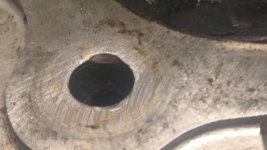
So, do the small bevelled nicks on one side of the stud hole, in the cylinder head hints to an oil passage?

Cannot copper provide the necessary seal?

I'll post a picture of the "nicks" later on.

Still' it beats me, where the oil is supposed to be going from there, if there is an o-ring, it means it can only go upwardly (or downwardly).

I guess I need to "study" the head and cylinders as a unit.

P.S. they seem to coincide with the doomed chromed bolts (2) on each side of the outer head, and the fact that they are backed by copper washers, would point to an oil passage.

Does this imply that if copper washers are good for the top side, an all copper gasket (no o-rings) could do for the side facing the cylinders?
 
Last edited:
Here is the pic of the stud hole with the "nick";
also visible the oil passage.

IMG_20210609_144318.jpg

So, is the nick designed to break the capillarity or what?
 
Last edited:
Here is the pic of the stud hole with the "nick";
also visible the oil passage.

View attachment 62924

So, is the nick designed to break the capillarity or what?

Never seen a cutaway like that before. It's not as received from the factory anyway.

Bwringer explained it clearly. Oil comes up the four corner stud holes to lube the head. O rings around the stud holes are required to seal the area.
I(n an ideal world, the copper gasket would do it - but the head and gasket expand at different rates so there's movement at the surfaces.
This movement allows oil to seep past hence the O rings as a seal.

Clear now ?
 
@gGegT

Look at me, as a modern day don Quixote, fighting his own ignorance and engineering dogmas.
Thanks
 
@gGegT

Look at me, as a modern day don Quixote, fighting his own ignorance and engineering dogmas.
Thanks

That's fine. After 40 plus years of doing this stuff, I'm ready to put my feet up - and Rocinante is already out to pasture.
 
In obeisance to your pluri-decennal experience, I might concede in employing the "VITON" ring;

still, it still beats me why, in the "fiber" gasket, nearby the studs in question, there is the Cooper ring, (which I found being made of soft iron) and then another ring, of four mm circa, of copper, bound to the fiber part.

So. how does it go, with the differing expansion rates of alu and copper...?

A little effort morre, from the keen reader, the real question arises:

tesis: the Suzuki thech. has choosen this arrangement, because they, for practical reasons, had to use fiber (not because of copper shortcomings);

In retrospective, had they used a full red gold gasket, whould still have put the rings?

For syllogism, if copper and alu have different termal rates, they should not have put the 4mm copper rings in the fiber gasket alltogheter.

The GSresources riddle of the day!


;););)
 
So. how does it go, with the differing expansion rates of alu and copper...?

Aluminium and copper/bronze have very similar expansion rates.
This is why copper was the original popular choice for head gaskets and also why when fitting bronze valve guides there is no reason to heat the head.
 
Back
Top