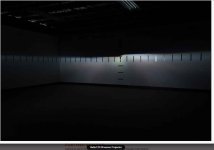
• Required reading for all forum users!!!

    Welcome!
    Register to access the full functionality of the GSResources forum. Until you register and activate your account you will not have full forum access, nor will you be able to post or reply to messages.

    A note to new registrants...
    All new forum registrations must be activated via email before you have full access to the forum.

    A Special Note about Email accounts!
    DO NOT SIGN UP USING hotmail, outlook, gmx, sbcglobal, att, bellsouth or email.com. They delete our forum signup emails.

    A note to old forum members...
    I receive numerous requests from people who can no longer log in because their accounts were deleted. As mentioned in the forum FAQ, user accounts are deleted if you haven't logged in for the past 6 months. If you can't log in, then create a new forum account. If you don't get an error message, then check your email account for an activation message. If you get a message stating that the email address is already in use, then your account still exists so follow the instructions in the forum FAQ for resetting your password.

    Have you forgotten your password or have a new email address? Then read the forum FAQ for details on how to reset it.

    Any email requests for "can't log in anymore" problems or "lost my password" problems will be deleted. Read the forum FAQ and follow the instructions there - that's what we have one for...

  • Returning Visitors

    If you are a returning visitor who never received your confirmation email, then odds are your email provider is blockinig emails from our server. The only thing that can be done to get around this is you will have to try creating another forum account using an email address from another domain.

    If you are a returning visitor to the forum and can't log in using your old forum name and password but used to be able to then chances are your account is deleted. Purges of the databases are done regularly. You will have to create a new forum account and you should be all set.

Cyclops 3800 H4 LED Headlamp Bulb

posplayr

Forum LongTimer
Past Site Supporter
TGSR Superstar
I decided to start another thread to document information I have been finding out in my search for the Ultimate LED headlamp (today as it will change in 3 months).

This was prompted by these other recent threads and the trials people have been making using the ADVMonster.

This is the link to the Cyclops 3800. It is designed for ON Road use; what I just ordered for my GS1100ED.There is a 10% discount if you enter the "ADV" promotion code.

http://www.cyclopsadventuresports.com/3800-Lumen-H4-LED-Headlight-bulb-_p_83.html


There is older 3600 which has an Off road pattern. FirstTimer posted about these and brought them to my attentions and claims they are a huge improvement (over a crappy dual sport light). The 3800 has a true "dip" whereas the 3600 just goes from bright to brighter. Dip refers to an angular change in the beam when shifting between Lo and Hi.

I just got off the phone with Sales at cyclopseadventuresports.com and they stated that the LED's generally work well with the typical parabolic reflector (think radar antenna) that our older UJM's have. I will have to do some testing once I get mine; (just ordered). While these apparently work very well, with some fine tuning of the precise locations (using 0.015"-0.080" spacers or O-rings) of the bulb depth into the reflector, the beam pattern can be further modified to improve the horizontal cut off(what keeps the lights out of oncoming drives eyes and what is so important for DOT certification).

In order to know what you are getting, I'll provide a brief description of the principal things to look out for.


There are a lot of these LED bulbs on the market right now, the latest ones use what is called the XML-2 Cree LED emitter. This LED is about 20% brighter than a similarly packages XML cree LED from the last couple of years. So unless it says CREE XML2 it probably is not one. With the CREE XML2 it is now possible to achieve 55W HID light levels with lower cooler temperatures and lower power in a standard H4 installation. This is really the breakthrough event that has spurred me to shell out for a $60 bulb.

The next thing to look for is the number of XML-2 emitters there are. The older style LED bulbs would only have 2 emitters at about 10 watts per for a 20 watt total. The newer XML-2 produce more light at what is also basically about the same 10 watts per bulb. Cyclops use a 13V baseline so 10 watts /13V=.77 amps per bulb. Most of the latest bulbs have 3 XML-2 emitters for as much as 30 watts when on HI. LO is generally running the same LED's at a lower power. Luminance (light output) goes up as more current is run through the emitters. The typical is nominally about 1 amp per emitter but the are rated at up to 3 amps, however no product on the market runs that high. It generates too much heat and the efficiency is actually less (conversion of amps to luminance). The Cyclops 3800 seems to have the largest number of XML emitters (total of 4 ) of any other H-4 bulb replacement on the market (40Watts and 3.0 amps in HI and 20Watts 1.5 amps in LO).

The next thing to realize when comparing bulbs, is that the LED type bulbs while running cooler are essentially a piece of electronics and must be kept much cooler than a burning piece of metal in an evacuated glass bulb. (i.e. Halogen and HID). As such, large heatsinks are necessary at 20 Watts, and fans become standard equipment once get to 30 watt level. At 40watts you need a smart LED driver (sometimes referred to incorrectly as a "ballast"). These are really current controllers. They can sense the amount of current in the LEDs and maintain the level as required. If there is too much current and therefore to much heat the controllers can backoff on the commanded current. This is basically what the Cyclops does if for example there was a fan issue.

While nothing lasts forever, especially a fan, I was assured that these Cyclops fans were of the highest quality with ceramic bearings, and you should absolutely not spray anything in to them like WD40 or the like.

I think in evaluating your purchase you need to understand that you "pay for what you get", the main challenge is to understand "what you are trying to get". Hopefully the discussion above helps in that regard.


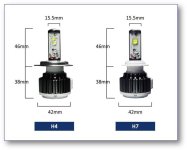
Size is a primary concern so first off I want to list the dimensions for the Cyclopse 3800. Apparently this 3800 is slightly smaller than the AVDMonster rev 2.

_______________________________________AVDMonster___________Cyclopse 3800
Axial length of heat sink (from H-4 mount)____ 1 11/16"______________1.5"(38mm)
Diameter of heatsink_______________________1 13/16"______________1.65"(42mm)

Thank you Grand Rouge for the measurements who can verify that the AVDMonster will fit inside of the 8" Trainlight back shell (the piece of metal that the reflector is mounted inside of). That being the case it looks like the Cyclopse 3800 with somewhat smaller dimensions will fit as well.

______________________________________Cyclops 3800 in H4/H7
attachment.php


The Cyclopse 3800 LED drive is quite small. The basic dimensions excluding the harness/connector are 1.1"x1.6"x0.5" (WxLxH). I'm hoping to mount this inside of the headlamp back shell (bucket) as well.
 

Attachments
  • Cyclopse3800Dimensions_zpsnrodsx63.jpg
    Cyclopse3800Dimensions_zpsnrodsx63.jpg
    29.5 KB · Views: 0
Last edited:
Other threads for reference

http://www.thegsresources.com/_forum/showthread.php?227458-LED-headlight&highlight=ADVMonster

http://www.thegsresources.com/_forum/showthread.php?231260-H4-LED-conversions

http://www.thegsresources.com/_forum/showthread.php?230241-Any-updates-on-the-ADVmonster-H4-LED

These are all 20Watt bulbs:


The ADVMonster Rev2 (the new one) is a 25Watt (on high beam) bulb and it does use a LED driver.

http://stores.advmonster.com/h4-led-headlight-rev2/

But all of these are part of the new wave of 30W models using the Cree XML-2 LED Emitter

http://www.amazon.com/Astra-Depot-Power-Motorcycle-Headlight/dp/B00PQDUOSO/ref=pd_ybh_16

http://www.amazon.com/Astra-Depot-3000LM-Motorcycle-Headlight/dp/B00PNK0IY0/ref=pd_ybh_17

http://www.amazon.com/Power-3000LM-6000K-XM-L2-Motorcycle/dp/B00PNKHW4E/ref=pd_ybh_15


The Cyclops 3800 is a 40 Watts Bulb in Hi (20 watts on lo)

As a bench mark, I have measured Halogen and 55W HID bulbs and the draw right at 5 and 4.5 amps respectively. The Cyclops 3800 on High beam will be still only be 3 amps and only 1.5 on low beam.

Recall that without blinker and brakes the total load for a charging system is about 14.5-15 amps. 3-4 amps is charging your battery. The rest is 11-12 amps for your electrical system. Brakes, blinkers and tail light can be as much as 10 amps by themselves (total O/G circuit).

If you swap out your signals with LED's like these expect a drop in current to about 1/8 of the incandescent current draw.

These are 1156 bulbs to use in the rear stock blinkers (Qty 2)
http://www.amazon.com/gp/product/B007BSG760/ref=ox_sc_act_title_1?ie=UTF8&psc=1&smid=A15H3UKRB6RHF9

These are 1157 bulbs to use in the Brake Light and Front stock blinkers (Qty 3)
http://www.amazon.com/gp/product/B00MHQ9826/ref=ox_sc_act_title_2?ie=UTF8&psc=1&smid=A15H3UKRB6RHF9


These are Shorter 1156 bulbs to use in the Tail Light (also lights the license plate) (Qty 1)
http://www.amazon.com/gp/product/B007J0V7MO/ref=ox_sc_sfl_title_1?ie=UTF8&psc=1&smid=A3US98LJH5LOGM


Remember do not start swapping out LED's for other lights unless you have a SERIES R/R. The old SHUNT R/Rs will divert the current savings away from the electrical system by shorting the stator even more :(. You will burn out you stator even quicker.


With these LED's and the 40Watt Cyclops figure on a dropping your current demand for the electrical system in 1/2. That means less electrical load and stress on everything and now we can enjoy that with even better / more light.
 
Last edited:
I received the Cyclops 3800 and did a quick comparison of three different bulbs that I now have when installed in an 8" H-4 reflector. The comparison is of
  1. an Halogen bulb (Candle Power 4270HD H4 12V 60/55W)
  2. A DMM Tuning Xenon 55W H/W HID (5000K) (single beam with a mechanical shade)
  3. Cyclops 3800 20W/40W LED based on CREE XML-2 (4 emitters mounted horizontally Color temp 5500K)

http://www.amazon.com/CandlePower-H4-Quartz-Halogen-Bulb/dp/B000WJFN3S

http://www.ddmtuning.com/Products/MOTODDMDDM-35W-55W-Single-Motorcycle-HID-Kit

http://www.cyclopsadventuresports.com/3800-Lumen-H4-LED-Headlight-bulb-_p_83.html


In order to avoid any subjective artifacts due to the road scene, I chose a method that attempts to actually take a slice out of the beam at a distance of about 25" from the front of the lense. You can see the setup in the two pictures below. Interestingly, the light pattern is pretty apparent when doing this. You can also get some sense of brightness as the amount of illumination and how much the lettering on the cardboard background is washed out does give some indication of relative intensity.
I used a Canon SD-630 Digital camera in Manual mode. Not sure if it really worked but the images do seem consistent. I tried to avoid moving the camera and tried to keep the reflector in the same position. All tests were done at 14.5V
The nominal current of the Halogen and HID are 5 amps. The LED is about 2.2 amps on HI and 1.1 amps on Low. It calculates out to be about 32 watts if you multiply the supply voltage times the supply current. So the little DC to DC current source tries to maintain a constant power to the LED. When voltage drops current increases and visa versa.
If you are willing to sacrifice a ballast, you might be able to change the setpoint and drive the LED's even harder.

I initially started using a cheap test lead, that was barely holding on with the high beam, as the wire heated up (increasing the voltage drop across the wire) the voltage at the LED input dropped so the controller cranked up the amperage to 5 amps (almost double what it should be at 14.5V) to keep the light output constant. This is something to watch out for. I dont know what the max current limit is, I hope it is 5 amps and no more.

IMG_83751_zpshtseyqmf.jpg


IMG_83761_zpsmrbpenml.jpg


Here are the side by side comparisons (Hi Beam on top and Low on the bottom for each of the three bulbs).

General observations of the Halogen:
The Halogen high beam has a "BoeTie" shape (horizontal rectangle with side notches) which I assume is what Steve refers to. The Low beam is more of an intense spot with with definite spill over around the spot but distinctly contained below a horizontal cut-off (see the heavy black line for reference). On high beam the cut-off rises about a full 1/3 of the High beam height. There is more vertical spreading of the beam, with somewhat of a horizontal compression. The high intensity of the low beam below the cut-off is no where to be found in the high beam.

From memory this bulb tends to raise the high beam too much and lights up a lot of the sky rather than a focused point down the road. The yellowish heu is also quite evident and strongly reflects the color I observed directly.


General observations of the 55W HID with mechanical Blind.
The HID beams are interestingly is somewhat the opposite of the Halogen beams. The Low beam is pretty well contained at a rather high horizontal cutoff, but has much higher vertical height that the Halogen. In high beam, the horizontal cutoff off is unchanged but the beam is squished. This behaviour really makes you wonder if the beam would not work better mounted upside down and swapping Lo for Hi and visa versa??? The high beam has a lot of intensity just below the cut-off very similar to the Halogen low beam just not as concentrated. The HID low beam is much more spread out and has the largest vertical spread. The real perplexing question about the HID is this fact that as configured the cutoff is basically fixed, even though the brightest part of the beam does move up and down somewhat similar to the Halogen.

I have never installed this bulb due to concerns for the high current (about 4.5 amps and the high heat). After I had seen these patterns I have even more reservations.

General observations of the Cyclops 3800 LED 20/40W.
The Cyclops does not seem to have an overwhelmingly more light than the other two bulbs, but on close inspection may have a better placement of the light than the other two. First thing to notice is that the color of the HID and LED are very similar and sharply contrast with the yellow of the Halogen. The next thing to notice is that the LED has more of a conventional beam (i.e. like the Halogen) albeit absent of any BoeTie shape. In low beam both the Halogen and the LED are well contained below a cutoff line. While the halogen is very intense right at center, the LED has wider more even spread below what is a very similar cutoff. On high beam the LED does not exhibit the Boetie but rather increase the cutoff bay about 2/3 as much as the halogen.

Comparing the HID to the LED we have what looks like the swapped patterns, HID-L is more like LED-H and visa versa. But despite this reversal, the LED seems to maintain almost as much peripheral light as the HID, and although the HID seems more intense right on center, the LED has a much higher cut-off. In low beam, the LED seems much more confined below a cutoff with a broad intense beam. The LED beam intensity below the cut-off in low beam certainly looks much brighter and broader than the HID.

PRELIMINARY CONCLUSIONS:
For most low beam riding, the LED low beam would appear to be the best of the three. It has a broad high intensity shape well defined below a cutoff. The HID is too spread out and the Halogen is too focused.

For most high beam, high speed riding, the HID might be the best as it seems to have a very focused spot right on center(you are less likely to out run this beam); more focused than the Halogen, but also not as spread out as the LED. It is hard to determine if HID is really a lot brighter on center than the LED, or if it's just an illusion due to the narrow area of high intensity. The LED is certainly much broader while still being well contained and is at least close in intensity to the HID direct on center if not just as bright.

I still have to do some road tests to give a subjective interpretation of how the LED looks at night. I don't think I will bother to install the HID on the bike, but I might do some outside testing to get an idea of what the throw is right on center looking down the road.

One last comment, bulbs are rated in terms of Lumen which is a measure of the total light output from the bulb. A standard 55/60W H-4 Halogen has approximately 1100/1500 Lumens. The ratings of the 55W HID is 4500 (high and low) Lumens and the Cyclops 3800 is 4400 Lumens in High (1/2 that in lo beam). If there is any truth to these numbers , then the HID and LED are far above the Halogen in terms of gross light power but also comparable. The deciding factor for visibility is then the pattern, which this figure strongly supports the Cyclops as having a better beam pattern for both Hi/Lo riding. Given the low current requirements for the LED, the power draw is only 1/2 of the HID and much cooler as well, it would appear as if you can get the best of both worlds. If you really to to shine some light on the road, additional purpose built LED's can easily double the light output at the same power level as the HID.


BeamPatternCompare_zpsj4r1zyxe.jpg
 
Last edited:
Very interesting indeed. Think I'll spring for this one over the ADV Monster soon. Thanks pos!
 
Looks like the 8" lens is a flat cutoff on dip - not surprising as it was for the world market, and not uncommon on Japanese bikes of the day.
Many of the LH/RH-specific lamps have a kick-up on the side of the low beam that would illuminate footpaths, pedestrians, dogs, parked cars, etc, and a well-designed reflector/lens assembly can make a world of difference to results.
Bottom line is; nobody really knows what the results will be until they get one and try it in their own headlamp, but there's no doubt (in spite of BS lumens claims from makers and sellers) that LEDs make better use of the electrons.
 
Looks like the 8" lens is a flat cutoff on dip - not surprising as it was for the world market, and not uncommon on Japanese bikes of the day.
Many of the LH/RH-specific lamps have a kick-up on the side of the low beam that would illuminate footpaths, pedestrians, dogs, parked cars, etc, and a well-designed reflector/lens assembly can make a world of difference to results.
Bottom line is; nobody really knows what the results will be until they get one and try it in their own headlamp, but there's no doubt (in spite of BS lumens claims from makers and sellers) that LEDs make better use of the electrons.

Agreed. The pattern noted in this evaluation may not be indicative of the results from another parabolic design. I have a 6" L-series headlamp in both my bikes and I would doubt that the focal points are the same as an 8" train headlamp. My bet is that the beam patters would differ significantly. It would be nice to see a comparison of beam patterns based on different lens assemblies. 6" L v/s 7" general v/s 8" train.
 
I have what looks like a headwind led but not branded as one. Very bright but not much focus on dip and very little difference on main beam. Had it in a 7 inch clear lens lamp, now in a Bosch lamp and need to try it again.
 
Agreed. The pattern noted in this evaluation may not be indicative of the results from another parabolic design. I have a 6" L-series headlamp in both my bikes and I would doubt that the focal points are the same as an 8" train headlamp. My bet is that the beam patters would differ significantly. It would be nice to see a comparison of beam patterns based on different lens assemblies. 6" L v/s 7" general v/s 8" train.

When I spoke to sales at Cyclops they said that the cut-off beam patterns can be "tuned" by using a spacer. I did not include that in the first set of test pictures as that represented to many variables. However, late last night I gave it a shot to see what happens. At first I removed the retaining clip completely from the bulb and just pulled the bulb back from where it would rest. Amazingly the diffuse edge of light at the cut-off appeared to come into more into focus and became more defined. If I pulled it too far that focus went away.

The next problem is how to hold the bulb in a position other than intended? Cyclops is working on spacers and they even suggested using some type of O-ring. The tabs on the bulb really have no flat surface to stand on so I came upon the idea of using zip tie around the neck of the reflector and the OEM retaining clips. It improved the focus and definition of the cut-off but there is still quite a bit of spill over above the cut-off; it is not a perfect line.

After having some time to play with it I will repost comparing the focused Cyclops to the H-4.

IMG_83771_zpsdabrvypk.jpg
 
Last edited:
Looks like the 8" lens is a flat cutoff on dip - not surprising as it was for the world market, and not uncommon on Japanese bikes of the day.
Many of the LH/RH-specific lamps have a kick-up on the side of the low beam that would illuminate footpaths, pedestrians, dogs, parked cars, etc, and a well-designed reflector/lens assembly can make a world of difference to results.
Bottom line is; nobody really knows what the results will be until they get one and try it in their own headlamp, but there's no doubt (in spite of BS lumens claims from makers and sellers) that LEDs make better use of the electrons.

Technically there are no DOT or Euro approved drop in H-4 LED bulbs. To be legal you have to have a purpose built and approved reflector and bulbs as Steve has in the TruckLight Series. Unfortunately I think it will be a very long time before anybody makes a purpose built LED headlamp for the 8" lenses. Cyclops, the maker of the 3800 assured me that generally their 3800 did not do "too bad" and actually did "pretty well" in a standard (parabolic) Halogen H-4 reflector; this is obviously a generalization, but one of experience having done many installations. Certainly you could do worse, and I think these pictures bear that out.

With a drop-in bulb replacement, the best that can be hoped for is to approximate the Halogen bulb cut-off and dip. In reality I think the Cyclops 3800 does pretty well in that and maybe even improving in some ways to the standard bulb patterns.

As noted in the pictures and as can be seen in some of the pictures posted by Steve, The standard H-4 bulb really broadcasts a lot of light up in the sky on High Beam. The Dip has what would appears to be too much subtended angle and too much vertical beam extent. The Cyclops reduces both of those. I have yet to compare the cut-off of the 3800 after performing the focus, but from what I can see the cut-off's are going to be pretty similar. Certainly not like a projector, but hopefully sharp enough to avoid blinding drivers.

The ability to focus the beam as it were by adjusting depth of the bulb in the reflector adds another dimension to being able to better approximate the stock beam cutoff with the other benefits of the LED light. I suspect, that with this technique, anybody can probably obtain similar results with a 7" or perhaps even 6" reflector. If really ambitious, you could cut out the reflectors and insert projectors as many have documented across the internet.


For reference, here is a link explaining what an HID Projector system is as well as pretty good pictures of the cut-off and beam pattern

http://www.theretrofitsource.com/knowitall/hidprojectors.html/

This is an example of a Projector retrofit and then a purpose built Projector. A Halogen reflector will never produce these levels of cut-off regardless of the bulb.

In order to get a distinct beam pattern on cardboard, I have to hold the cardboard no more than about 2 feet from the lens. Any further and the diffuse light blurs out any distinct pattern. These projectors are capable of precise focus of light even at 25 feet as shown in the pictures. In round numbers the projector offers precise control light in excess of 1/10 (the range ratio) that of the H-4 bulb.
HellaE55BixenonProjector_LOWBEAM_zpsd123gyli.jpg


LHDBeam_X_RProjector_zpsgoiwhhnu.jpg
 

Attachments

  • HellaE55BixenonProjector_LOWBEAM_zpsd123gyli.jpg
    HellaE55BixenonProjector_LOWBEAM_zpsd123gyli.jpg
    63.5 KB · Views: 0
Last edited:
That's impressive control of cut-off. Otoh, too much cut-off renders the area above/infront of it almost black and I find a bit of spill is preferable. Even in the 60s some of the Cibies were criticised for having too much of a light cut-off.
 
That's impressive control of cut-off. Otoh, too much cut-off renders the area above/infront of it almost black and I find a bit of spill is preferable. Even in the 60s some of the Cibies were criticised for having too much of a light cut-off.

I suspect that you are correct; there is a wide margin between spill over blinding to the oncoming traffic and having just enough to be able to see street signs at 12 feet.
 
It would be nice to see a comparison of beam patterns based on different lens assemblies. 6" L v/s 7" general v/s 8" train.
I don't have a train light handy, but will soon be able to compare a 6" L, 7" standard and a rectangular Hella (200mm).


The tabs on the bulb really have no flat surface to stand on so I came upon the idea of using zip tie around the neck of the reflector and the OEM retaining clips.
Ichiban would be proud of you. :encouragement:

But he might argue that green ones would have been better. :-k


... a purpose built and approved reflector and bulbs as Steve has in the TrainLight Series.

Truck-Lite, but that's OK. :oops:

.
 
That's impressive control of cut-off. Otoh, too much cut-off renders the area above/infront of it almost black and I find a bit of spill is preferable. Even in the 60s some of the Cibies were criticised for having too much of a light cut-off.

Here is a link to a simple experiment to see the effect of a cutoff when used with LED lighting. Apparently the type of light doesn't really matter in creating the sharp cut-off.

http://www.candlepowerforums.com/vb...t-experiment&p=2680597&viewfull=1#post2680597

Here
 
Ichiban would be proud of you. :encouragement:

But he might argue that green ones would have been better. :-k

.

I have been trying to source the proper green zip ties, but was wondering if it really matters after applying the waterproof assembly tape?


All joking aside, the 3800 really runs quite cool. The air coming out of the fan after running on high for 1/2 an hour even feels a little cool. When Cyclops Sales talked about using a rubber O-ring as a spacer, I was also skeptical. I now realize it just doesn't matter; there is very little heat conducted out of the bulb to the reflector. It all dissipates through convection and through the cool forced air of the fan.

The DC to DC controller on the other hand gets pretty warm (130 DegF). When I install the unit, I will bond the amplifier to the headlamp bucket for conductive flow away from the little unit. I'm debating whether to use the Ichiban approved zip tie or use a thermal epoxy? :friendly_wink:
 
Last edited:
Cyclops 3800 H4 LED Headlamp Bulb 8" reflector

Here is a video showing the effect of focusing your LED Drop bulb-in by adjusting the depth into the reflector. Certainly worth playing with a bit before completing your install. At least on this reflector, the cutoff seems to be improved and there is a reduction in spill over to the driver's side.

https://youtu.be/APQxf_JluuI


Picture of the Zip tie used to space the bulb further back in the reflector which changes the focus of the cutoff and other hotspots (as seen in the video).

UPDATE: I figured a way to use a piece of Schedule 40 3/4" white PCV pipe. Use the band saw and belt sander to make a 3.75mm spacer. It fits perfectly behind the H-4 mounting plate. The large rubber seal fits without cutting; just install it (over the LED side) before mounting the spacer and H-4 mount.

The additional depth of the back of the Cyclops FAN is about 7.5mm more than the stock halogen bulb with the stock H-4 plug. There is some room (1/8") to grind off the back of the fan shroud without effecting anything. I will have to see how that goes which is the next step.

I tried to optimize the Lo beam cutoff of the Halogen; did no good. It just seemed to get worse as I pulled it back. After focusing the Cyclops 3800 had a noticeably better cutoff than the Halogen.

IMG_83771_zpsdabrvypk.jpg
 
Last edited:
OK This is a quick run down of the mods to make to focus the Cyclops 3800 to optimize the low beam cutoff and also make it only 1.5mm (0.060") longer than the stock Halogen/H-4 connector. I think the optimized cutoff is even better than a stock Halogen and certainly better than the HID.

In my application 83 GS1100ED with 88 GSXR front end the ignition switch virtually goes into the opening at the back of the headlamp shell. Clearance is at a premium so staying as close to stock is very important else I will have lots of headaches with reorganizing my fairing. In order to get the focus correct, I also had to add an extra 0.140" (3.75mm) so I have no choice but to take off the fan cover at the back of the 3800.

So basically what you do is take out the two screws that are holding the cover down, then take out the two screws on the cable strain relief. I then used a Dremel cutoff wheel to separate the cover from the back 1/2 of the strain relief. I then reassembled the strain relief with the cover cut off. I put a couple of drops of super glue into the groves that support the strain relief . It doesn't move now; it shaves off 0.29" or 7.3mm for the plastic cover. You are left with these two extra screws and can even replace the cover in the future if you wish.


IMG_83821_zpsia0ni5v1.jpg


I made a spacer out of 3/4" Schedule 40 PVC pipe. It fits perfectly and even centers on the premolded grooves of the bulbs plastic housing. In my case teh spacer is 3.75mm and it gives a nice cutoff. Any 8" lamp will probably be about the same. If you have a 7" it is probably closer to 0.060" as per the experience Cyclops have.


IMG_83851_zps6pnog5fq.jpg


You will need to fit the spacer under the H4 metal tabbed adapter. In order to do so you will need to get longer screws. I happened to have nearly the same size screw just longer. be careful not to break out the holes. I pre drilled and test fit the screws being very careful. Now that you have predrilled the holes for the plate screws and test fit them you are ready to assemble the bulb.


This picture shows the order of assembly, The rubber cover comes first over the LED emitters. then the spacer and then the H-4 adapter plate. Make sure it is in the correct direction.The hollow side goes out or back.

IMG_83861_zpsqhopvhsi.jpg


Carefully pull the rubber over the bulb and pull it back so you have access to the emitter end of the bulb. Slide the ring over the top.

IMG_83881_zpsquiufigl.jpg


Carefully install the new longer screws into the old holes. The original holes are self tapping so probably best to just find some longer ones.

IMG_83911_zpsk79gjdth.jpg


This is the back and what you will see from the back of your headlamp.

IMG_83921_zpsijgnvbrd.jpg


here is the distance/length you get as modified (37.5mm)


IMG_83891_zpsbrvyeufe.jpg


This is what the original Halogen Bulb and an OEM connector measure to (36.0mm). The moded 3800 is 1.5mm longer or 0.60".

IMG_83901_zpsbrup14kr.jpg
 
Last edited:
The final steps are to mount the bulb into the reflector. Spread the retaining clip bit to get it around the rubber cover, then insert the bulb into the recess of the reflector (carefully).

IMG_83941_zpsdyeuvaeh.jpg


From there it is easy to clip it in and pull down the rubber ready to install :).
REMEMBER: That little amplifier gets pretty hot (130 degF) and it would be well to mount it so it can conduct heat into something with some thermal mass. I plan to thermally bond it to my headlamp shell (what wraps around the refector). That should keep it much cooler and add substantially to the lifetime of the setup.

Also remember to keep the contacts clean as if there is a voltage drop to the amplifier it will cause more current to pass and I have see nit almost triple the current from 2.2A on Hi up to 5.5 amps (max). This characteristic will apply to any LED with a controlled current amplifier.

IMG_83961_zpsxg8olxia.jpg
 
Last edited:
Back
Top