• Required reading for all forum users!!!

    Welcome!
    Register to access the full functionality of the GSResources forum. Until you register and activate your account you will not have full forum access, nor will you be able to post or reply to messages.

    A note to new registrants...
    All new forum registrations must be activated via email before you have full access to the forum.

    A Special Note about Email accounts!
    DO NOT SIGN UP USING hotmail, outlook, gmx, sbcglobal, att, bellsouth or email.com. They delete our forum signup emails.

    A note to old forum members...
    I receive numerous requests from people who can no longer log in because their accounts were deleted. As mentioned in the forum FAQ, user accounts are deleted if you haven't logged in for the past 6 months. If you can't log in, then create a new forum account. If you don't get an error message, then check your email account for an activation message. If you get a message stating that the email address is already in use, then your account still exists so follow the instructions in the forum FAQ for resetting your password.

    Have you forgotten your password or have a new email address? Then read the forum FAQ for details on how to reset it.

    Any email requests for "can't log in anymore" problems or "lost my password" problems will be deleted. Read the forum FAQ and follow the instructions there - that's what we have one for...

  • Returning Visitors

    If you are a returning visitor who never received your confirmation email, then odds are your email provider is blockinig emails from our server. The only thing that can be done to get around this is you will have to try creating another forum account using an email address from another domain.

    If you are a returning visitor to the forum and can't log in using your old forum name and password but used to be able to then chances are your account is deleted. Purges of the databases are done regularly. You will have to create a new forum account and you should be all set.

Easy Stator/RR Replacement for '77 GS550?

  • Thread starter Thread starter JE550B
  • Start date Start date
J

JE550B

Guest
Hi guys,

I've been reading a lot of threads here on the subject and my head is starting to spin. I did the tests and stator definitely needs replacing. I'm still running stock rectifier and regulator so figured now is a good time to replace that with an R/R unit as well. Folks seem to like the SH775 unit but it sounds like a complicated hack to fit into my single fuse, mostly stock '77 GS550 wiring and I just don't have the time. There was one thread that seemed to discourage the use of the ElectroSport R/R though the ES stator seems to be received well. Can anyone suggest more of a "plug and play" solution for stator and R/R on a '77 GS550 so that I can try and fit a longer ride in before the end of the season?

Thanks.
 
Not sure which stator but the SH775 is the R/R to use. There shouldn't be anything complicated about it, you're just replacing two boxes with one. Wire the stator directly to the R/R (bypass the loop up to the switch), ground the R/R well, and connect the red wire to wherever the rectifier currently connects on the harness.
 
Not sure which stator but the SH775 is the R/R to use. There shouldn't be anything complicated about it, you're just replacing two boxes with one. Wire the stator directly to the R/R (bypass the loop up to the switch), ground the R/R well, and connect the red wire to wherever the rectifier currently connects on the harness.

Yup. Bypass the factory wiring for sure. You can even take the R/R positive output straight to the battery. Nothing complicated about it.

For the stator I think Ricks is best. Some of the Chinese stators are high current units, which sounds good on paper. But they will just further overcharge the system which doesn't nobody good, particularly if you go with a shunt R/R.
 
Yup. Bypass the factory wiring for sure. You can even take the R/R positive output straight to the battery. Nothing complicated about it.

For the stator I think Ricks is best. Some of the Chinese stators are high current units, which sounds good on paper. But they will just further overcharge the system which doesn't nobody good, particularly if you go with a shunt R/R.

If the r/r is regulating regardless if it is shunt or series is not going to "overcharge" anything.
 
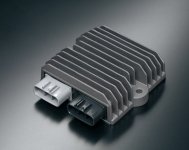
Thanks for the replies. I guess I was most worried about the wiring coming from the R/R unit itself. Does the SH775 typically come with wiring or do I have to hunt down some specialty connectors just to get some wires to work with? Most of the images I have found online show only the unit with no connectors/wires (see image below).

SH775.jpg
 
Thanks for the replies. I guess I was most worried about the wiring coming from the R/R unit itself. Does the SH775 typically come with wiring or do I have to hunt down some specialty connectors just to get some wires to work with? Most of the images I have found online show only the unit with no connectors/wires (see image below).

View attachment 35914

Search the threads for Triumph connector. It fits perfectly, easy to get from a Triumph dealer, and less than 10 bucks.
 
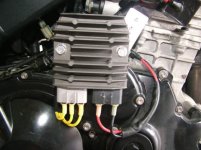
The triumph connector adds to the bulk of the SH-775 install image.jpg- to save space you can just used female spades
 
If the r/r is regulating regardless if it is shunt or series is not going to "overcharge" anything.

Maybe "overcharge" is not the right word. As you have taught us here, excessive stator power is shunted back to the stator itself (when using a shunt type R/R). This excess power then causes the stator to overheat. Unless someone is running accessories like heated riding gear, I wouldn't run a heavy duty stator because the bike just doesn't need the extra power, and in fact the extra power will be shunted back to the stator and increase it's thermal load. Not good. Of course, as you have also taught us, a series R/R avoids shunting extra power to the stator, so in that case the type of stator isn't as important as when using a shunting R/R.
 
Maybe "overcharge" is not the right word. As you have taught us here, excessive stator power is shunted back to the stator itself (when using a shunt type R/R). This excess power then causes the stator to overheat. Unless someone is running accessories like heated riding gear, I wouldn't run a heavy duty stator because the bike just doesn't need the extra power, and in fact the extra power will be shunted back to the stator and increase it's thermal load. Not good. Of course, as you have also taught us, a series R/R avoids shunting extra power to the stator, so in that case the type of stator isn't as important as when using a shunting R/R.
Yes........and the Op should not consider anything else than a series r/r unless perhaps the Honda 6 wires that have given so much good service.
 
Thanks for all the good info on the R/R unit and wiring. A Rick?s stator was suggested and it seems they offer a rebuilt 12-pole stator for $195 and or a new 18-pole stator for $140. It seems the best practice is to replace a stock 12-pole unit with an 18-pole which, of course, will require an 18-pole rotor as well. Unsurprisingly, this fix is escalating. I didn?t see any rotors listed for my bike on Rick?s. Can anybody advise on an 18-pole rotor that would match a Rick?s 18-pole stator? Alternatively, would anybody suggest going the ?rebuilt? 12-pole stator route?
 
PM member Steve- he works with guy who can rewind a 12 pole (or 18 pole) stator, then you can skip changing over the rotor. Or if you are reckless like me, buy a used 12 pole stator off eBay or junkyard.
with a decent stator and the SH-775 r/r, happy motoring awaits .
 
*UPDATE*

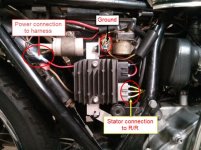
Thanks everybody for all the good advice. I ended up going with an Electrosport 12-pole stator and the SH-775 R/R unit. Sure enough, when I opened the cover one of the poles of the previous stator was a melted blob. I could tell someone had been in there before due to the ruined screws and liquid gasket on the starter motor cover so my best guess is that the original stator had been replaced with an OEM part but the regulator and rectifier units had not been replaced causing another stator failure. I was able to replace the stator without incident and fabricated a mount for my gigantic new R/R. Stator wires are connected straight to the R/R, unit is grounded nearby, and power is connected to the same wire in the harness that the previous unit was connected to. Then came testing...

IMG_20140905_224922.jpg

With key on motor off my first voltage measurement at the battery was 13.3. Turning the headlight on dropped the voltage to 12.9 volts. With the motor running I was getting 13.1 volts at 2500 and 12.9 volts at 4000rpm. Since my previous setup had been 10 volts I (possibly prematurely) congratulated myself on a job reasonably done and decided to go for a test ride. I started with a full battery as a benchmark and after 30 minutes of riding expected to return home full. Surprisingly, my three-dot battery gauge dropped a dot over the duration of the ride and the voltage at the battery was 12.8.

Today I went out to run through the stator test on BassCliff's website. Key on motor off voltage was 12.8. Disconnected stator resistance was 0.8 ohms all around. Zero measurable ground to frame. AC voltage at 4000rpm was 2.4... wait, wtf? Even with my old melty stator I was getting a couple of readings in the 40-50 volt range. Obviously, I was doing something wrong, but it's not that complicated of a test: positive and negative leads connect to the stator output wires in no particular order, auto-read the volt meter. All three readings were 2.4 volts AC.

So... is it possible that I damaged the relationship between the stator and rotor? Wouldn't I hear some terrible noise if the rotor was hung-up and not turning? What could possibly cause a consistent 2.4 volt reading from the stator? Does anyone have any ideas what might being going on here?

Thanks in advance.
 
*UPDATE*


View attachment 36287

With key on motor off my first voltage measurement at the battery was 13.3. Turning the headlight on dropped the voltage to 12.9 volts. With the motor running I was getting 13.1 volts at 2500 and 12.9 volts at 4000rpm. Since my previous setup had been 10 volts I (possibly prematurely) congratulated myself on a job reasonably done and decided to go for a test ride. I started with a full battery as a benchmark and after 30 minutes of riding expected to return home full. Surprisingly, my three-dot battery gauge dropped a dot over the duration of the ride and the voltage at the battery was 12.8.

Your picture looks good; It is easy to see you went right back into the harness with the red(+) and you are using a solenoid mounting bolt for the SPG. Is the other ring lug on the ground going to the battery or the frame? You should have one of both. Make sure the B/W ring lug goes to the same place or is well secured to another bolt on the same plate.

Just focus on the section above. Don't do any stator tests.

The tests show your battery is in very charged condition but you are barely putting out anything charging.


You have dirty connections somewhere between the battery and the R/R Have you cleaned those connections using contact cleaner. Probably need some Naval Jelly as well to clean the grungy stuff.

You have pretty much graduated to Revised Phase A Stator pages (see my signature for links in GS Charging Health).

I would probably still do the quick test again to see if you are getting closer to 14.5V before chasing down the last of the dirty connections.

Again connections are between battery and R/R , so for example no connections in the headlamp bucket matter.

You mentioned before that you do not have a fuse box? It is only an inline fuse? Make sure that is cleaned up.
 
Last edited:
PM member Steve- he works with guy who can rewind a 12 pole (or 18 pole) stator, then you can skip changing over the rotor.
Yep. Don't have any in stock right now, but there are 4 of them being rewound at this time.


I ended up going with an Electrosport 12-pole stator and the SH-775 R/R unit.
Too bad I did not have any in stock, I probably could have saved you a bunch on the stator.

Maybe next time.

.
 
Your picture looks good; It is easy to see you went right back into the harness with the red(+) and you are using a solenoid mounting bolt for the SPG. Is the other ring lug on the ground going to the battery or the frame? You should have one of both. Make sure the B/W ring lug goes to the same place or is well secured to another bolt on the same plate.

I'm not sure I understand the quote above. I have one ground wire connecting the R/R to a bolt on the starter relay plate (which is suspended from a bolt to the frame). Do I need two ground wires leaving the R/R? There is a B/W wire grounded to the bolt on the opposite side of the starter relay which, according to my chart, connects the lighting circuit through the harness. How should I manage a negative connection to the battery when the battery negative is just a connection to the frame anyway?

You mentioned before that you do not have a fuse box? It is only an inline fuse? Make sure that is cleaned up.

Yes, just a single inline fuse. I just pulled all of the various positive red wire connections between the R/R and battery apart and cleaned them up. I'll give the battery voltage another test tonight if I can get clear on the "you should have both" grounding comment.

Thanks
 
The single point ground collects return currents from
battery
harness
frame

and
then runs them to the r/r(-).

I have described this in a grounding thread. If you do this you minimize the voltage drops on the ground side between the battery and r/r.

you do not want to relay on the engine ground strap for a frame ground involving charging currents. There is typically 10 amps being supplied to the electrical system from the r/r. It only takes 0.1 ohms to get 1v drop. How much resistance does a dirty oily bolt on a painted frame have?

There has been a recommendation on the website going on 10 years to add a discrete ground wire between the battery and the r/r.

right now you are apparently losing 1.5 volts so the connections are dirty somewhere.
 
"What could possibly cause a consistent 2.4 volt reading from the stator? Does anyone have any ideas what might being going on here?"
this makes no sense, unless stator was internally connected wrong during winding. You still get .8 ohms lead to lead but no running output.
 
"What could possibly cause a consistent 2.4 volt reading from the stator? Does anyone have any ideas what might being going on here?"
this makes no sense, unless stator was internally connected wrong during winding. You still get .8 ohms lead to lead but no running output.
I would attribute the 2.4 v to "auto scale" mode. Test on a house outlet first.
 
I would attribute the 2.4 v to "auto scale" mode. Test on a house outlet first.
If it is, it would be an auto-scale problem on that meter. :-k

I have never had a problem with auto scale on my old Fluke 77.

I am wondering if those measurements were 'open circuit' or was the R/R connected?

.
 
Back
Top