• Required reading for all forum users!!!

    Welcome!
    Register to access the full functionality of the GSResources forum. Until you register and activate your account you will not have full forum access, nor will you be able to post or reply to messages.

    A note to new registrants...
    All new forum registrations must be activated via email before you have full access to the forum.

    A Special Note about Email accounts!
    DO NOT SIGN UP USING hotmail, outlook, gmx, sbcglobal, att, bellsouth or email.com. They delete our forum signup emails.

    A note to old forum members...
    I receive numerous requests from people who can no longer log in because their accounts were deleted. As mentioned in the forum FAQ, user accounts are deleted if you haven't logged in for the past 6 months. If you can't log in, then create a new forum account. If you don't get an error message, then check your email account for an activation message. If you get a message stating that the email address is already in use, then your account still exists so follow the instructions in the forum FAQ for resetting your password.

    Have you forgotten your password or have a new email address? Then read the forum FAQ for details on how to reset it.

    Any email requests for "can't log in anymore" problems or "lost my password" problems will be deleted. Read the forum FAQ and follow the instructions there - that's what we have one for...

  • Returning Visitors

    If you are a returning visitor who never received your confirmation email, then odds are your email provider is blockinig emails from our server. The only thing that can be done to get around this is you will have to try creating another forum account using an email address from another domain.

    If you are a returning visitor to the forum and can't log in using your old forum name and password but used to be able to then chances are your account is deleted. Purges of the databases are done regularly. You will have to create a new forum account and you should be all set.

Fusebox Melted - Advice Needed from Electrical Gurus

  • Thread starter Thread starter Suzuki_Don
  • Start date Start date
S

Suzuki_Don

Guest
I hadn't ridden the 550 for a month or so and so I took it out on Friday to have it checked for rego. While riding to the check station I noticed the volt meter only charging at 11v instead of the usual 14.5v.

When I got back home I did a few electrical tests and the generator and R/R seemed to check out ok.

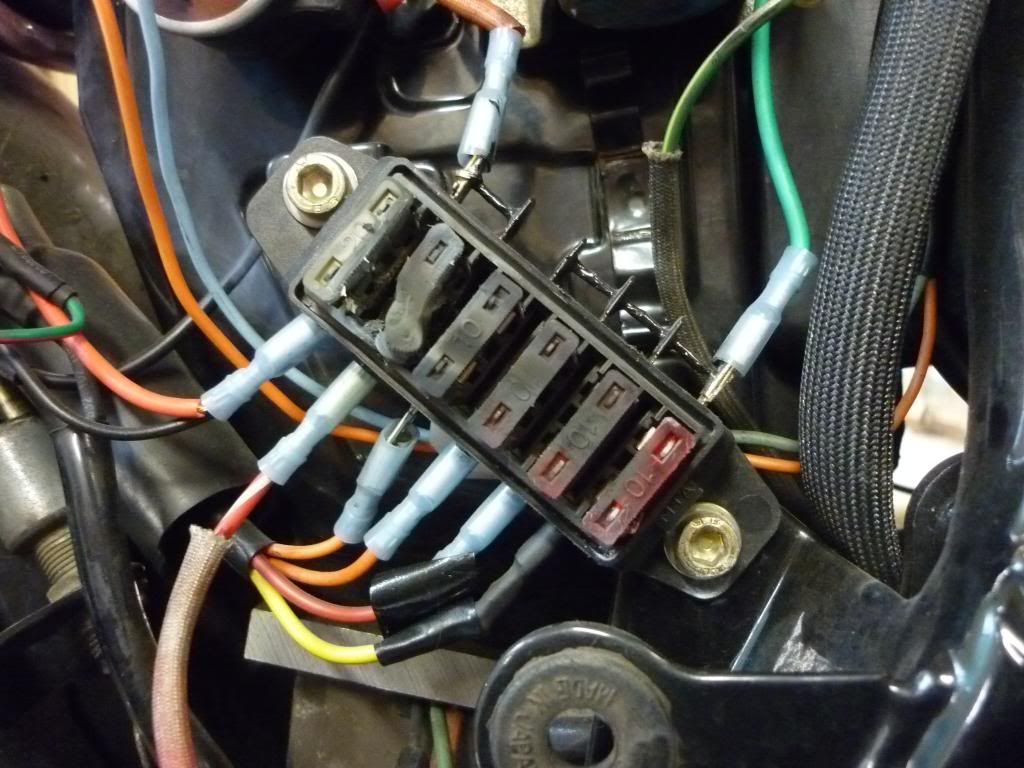
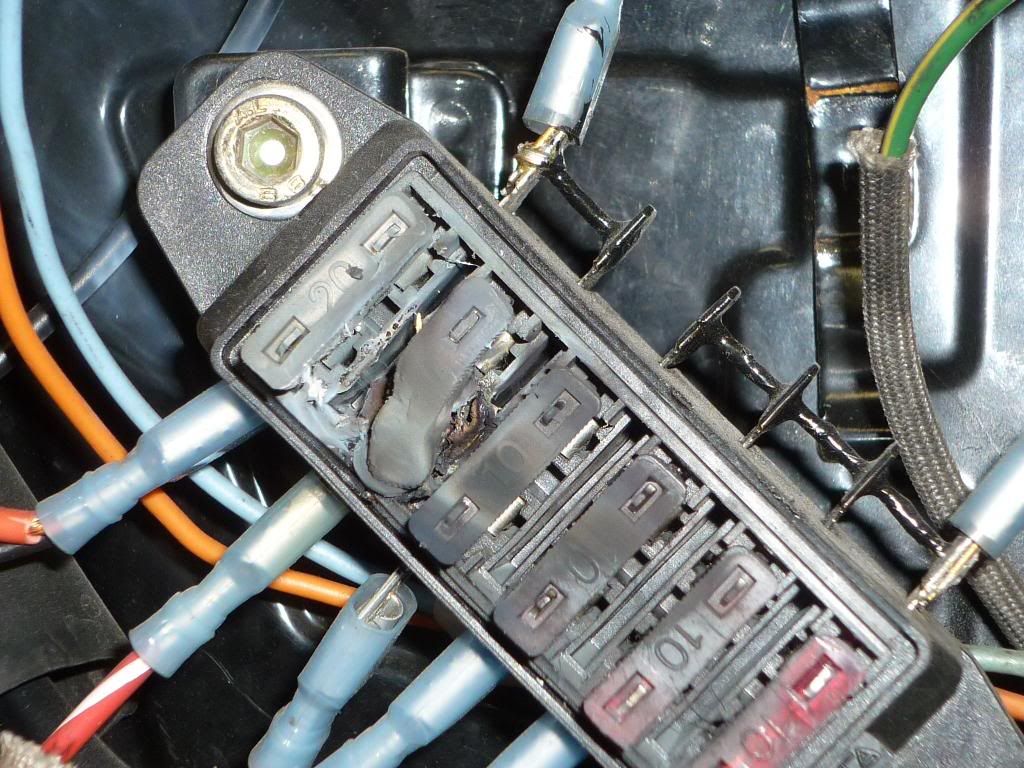
When I pulled the side cover to check the fuses this is what I found.


The culprit is the fuse between the R/R red wire and the other wire going to the starter solenoid that then goes back to the battery.

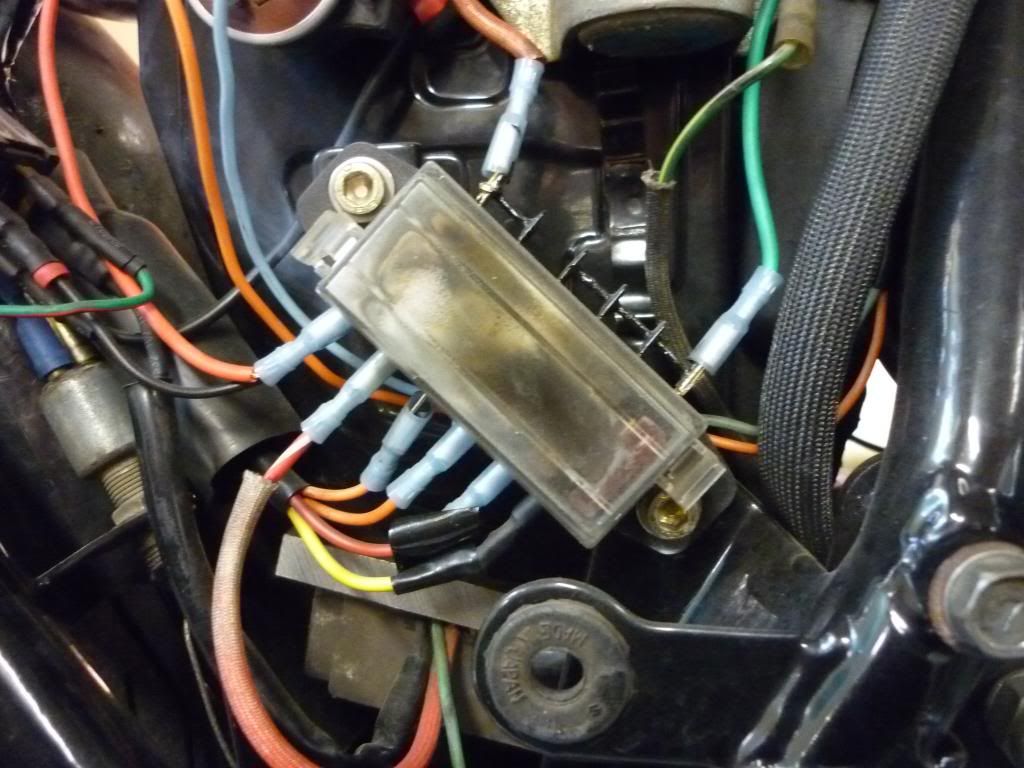
The next picture shows that none of the wires or connectors are melted or have even got hot by appearance.
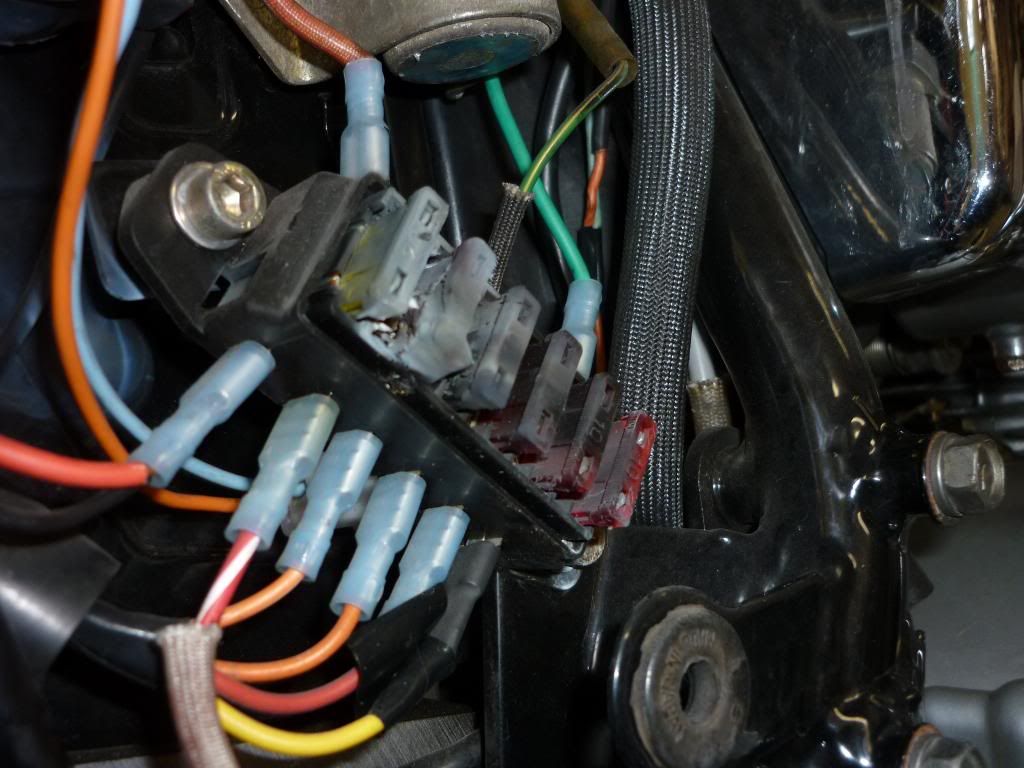


The picture below shows the two left hand wires at the bottom of the fusebox are connected to the red wire above them that runs to the solenoid. The RH wire of these two at the bottom runs to the R/R and the wire on the LH side runs up to the ign switch.

BTW when I was riding the bike there were no malfunctions of any kind with ign, blinkers, coils, etc.
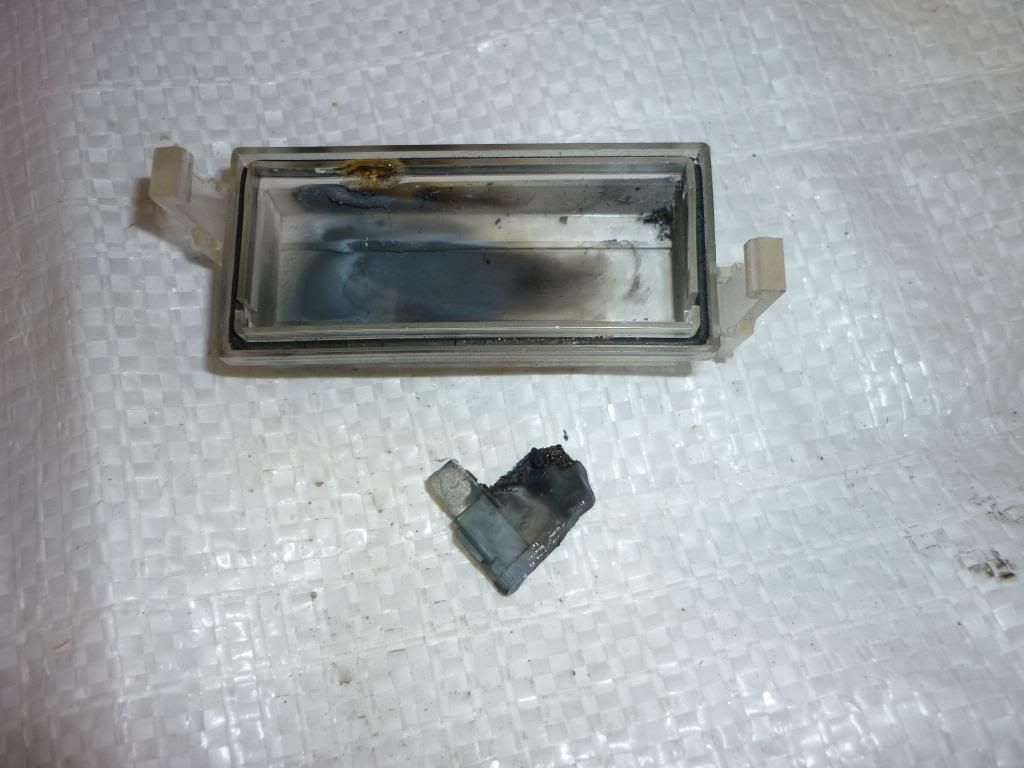


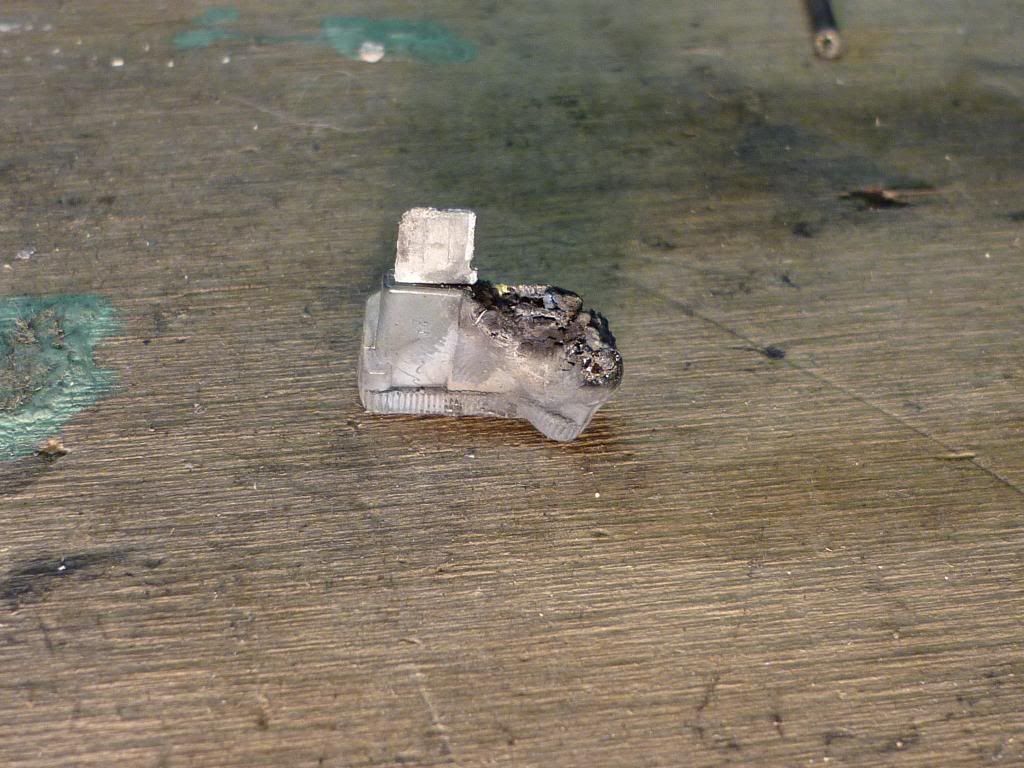


My question is if there was this much heat through the fuse why didn't it blow and save the fusebox especially when the heat didn't have any effect on the adjacent wiring.

Any ideas. Also what has caused this problem in the first place? Where did ALL this heat come from?

BTW I was using a 30A fuse with the thought that the current coming from the R/R might require a heavier fuse.

Comments please.

Also I removed the three wires that were involved at the LH end of the fusebox and ran them through another spare fusebox I had and the bike started fine and charged at 14.5v at around 3000rpm.

Thanks for any help offered.
 
My 85 750 stock fuse box has nothing higher than 15 amps in it. Geussing that 30 might have been the problem:-k
 
You might want to look at the bridging method also, a cold solder joint there might have set up the scenario. Jumpers with double spade connectors might have been a better solution. Fuse the R/R separately and look for a higher amperage rating for your fuse block, not that you want to use a 30A fuse, but one that could take one would be better quality.
 
Don,
It looks like you have too much resistance in he contacts associated with that fuse; probability just a dirty fuse contact. :(

There is quite a bit of current flowing through that main fuse even if the average current is relatively low. Any time the R/R shuts off (either by SHUNTING or opening a SERIES device) the battery has to make up for the deficit by providing 10+ amps. It is always less than 15 amps so no need to increase the fuse size. But you do need to insure that the fuse contacts are clean and or any crimps inside the fuse box.

If you have say 10 amps at 25% duty cycle going through that fuse , you would calculate the power as

P_fuse = I^2 * Duty_Cycle * Resistance = (10)^2*.25*R
= 25*Resistance watts

So if you have 1 ohm then 25 watts, or .1 ohms 2.5 watts

Not hard to see what I always recommend soldering the crimps in fuse boxes to keep corrosion out of the crimps. Also clean your fuses and use dielectric grease of a contact cleaner like Detxit.

Jim
 
My question is if there was this much heat through the fuse why didn't it blow and save the fusebox especially when the heat didn't have any effect on the adjacent wiring.

Any ideas. Also what has caused this problem in the first place? Where did ALL this heat come from?

BTW I was using a 30A fuse with the thought that the current coming from the R/R might require a heavier fuse.

Comments please.
The first culprit would have been dodgy connections inside the fuse box. Current trying to flow through dirty areas will create heat.

The second culprit would have been your choice of a larger fuse. There is no time in the normal operation of the bike that more than 15 amps will be going through that fuse (in either direction), which is probably why the factory chose to install a 15 amp fuse.

Since you chose to install a fuse that was twice the capacity of what the factory engineers felt was adequate, it was able to handle a LOT more current (read that as HEAT) before it blew.

Your note that the other electrical systems continued to work only highlights the fact that the stator and R/R continued to work. The fuse that melted is between the R/R and the battery, not the R/R and the rest of the bike, so it should all work until the engine is turned off. Once turned off, it will need a connection to the battery as a current source, but the melted main fuse will prevent that.

.
 
What they said , but also if the bad connection was on the hot side of the fuse box, before going through the fuse , it would not have blown either
 
30 Amps!
Whoa! That's the potential for allot of current to go through that fuse box. Even if the fuse didn't blow the fuse box probably got so hot (providing the amperage was there) it just melted and possibly shorted. Lucky you didn't fry any wiring. A standard household outlet wiring is only rated 15 amps at which it usually pops the circuit breaker.

The largest fuse in my GS1100E is only 15 amps.

 
The first culprit would have been dodgy connections inside the fuse box. Current trying to flow through dirty areas will create heat.

The second culprit would have been your choice of a larger fuse. There is no time in the normal operation of the bike that more than 15 amps will be going through that fuse (in either direction), which is probably why the factory chose to install a 15 amp fuse.

Since you chose to install a fuse that was twice the capacity of what the factory engineers felt was adequate, it was able to handle a LOT more current (read that as HEAT) before it blew.

Your note that the other electrical systems continued to work only highlights the fact that the stator and R/R continued to work. The fuse that melted is between the R/R and the battery, not the R/R and the rest of the bike, so it should all work until the engine is turned off. Once turned off, it will need a connection to the battery as a current source, but the melted main fuse will prevent that.

.

a dirty fuse with higher resistance will burn, putting a larger fuse in would not cause that unless it was also dirty. If 10 amps wants to flow, then a 30 amp fuse will not produce more current.

Same thing happened to Redman: Dirty fuse.

http://www.thegsresources.com/_forum/showthread.php?t=209029
 
Last edited:
Thanks everyone for the input.

Jim I was glad to read your post on dirty terminals as it gives me an easy solution without having concerns about issues with the R/R over-charging or problems in the wiring elsewhere on the bike. You'll remember I rewired the 550 completely about three years ago and it does not get a lot os use. Just used on club runs, maybe once a month.

Good idea Jim of yours to solder any crimp connections I can get to within the fusebox.

I know it is an el cheapo fusebox, but we don't have the large selection of good quality fuseboxes over here as you guys do in the US.

So I think a new fuse box and a 15A fuse should do the trick.

Thanks again.
 
a dirty fuse with higher resistance will burn, putting a larger fuse in would not cause that unless it was also dirty. If 10 amps wants to flow, then a 30 amp fuse will not produce more current.
I agree. I was presuming that the dirty connections were not at the fuse, but deeper inside the fusebox.

The point that I was trying to make was that the amount of current that might have caused the melting might have blown the stock 15 amp fuse.
Installing a 30 amp fuse allowed even more current to flow, causing even more heat.

.
 
I agree. I was presuming that the dirty connections were not at the fuse, but deeper inside the fusebox.

The point that I was trying to make was that the amount of current that might have caused the melting might have blown the stock 15 amp fuse.
Installing a 30 amp fuse allowed even more current to flow, causing even more heat.

.

I think I got that part the first time.

It is entirely possible for a standard current load to also melt the fuse box (assuming dirt crimps or fuse contacts). Redman's melted fuse box is a recent example that out along with many other examples bear this out.

Based on my calculation it is easy to see why a fractional ohm resistance will dissipate enough to melt plastic. This is not a design flaw but a maintenance issues. As Don explained there was no indication of electrical fault other than the burned box. People just need to ensure the crimps are maintained (or soldered) inside the fuse box and keep the fuses clean and treated with some type of anti corrosion protection.

This is one of the areas that is my pet peeve about the old stator pages and why I revised the Phase A portion to test the voltage drops ate 5000 RPM when there is full load. It is hard to measure these small resistances unless you run current through them and see voltage drop.

If Don was only seeing a 0.2V drop across that fuse box (with 10 amps flowing) that would be 2 watts dissipated.
 
Here's a pic of mine...nothing larger than 15.

picture.php


Lots of good electrical info on this thread.

Ed
 
Here's a pic of mine...nothing larger than 15.

picture.php


Lots of good electrical info on this thread.

Ed

That is a pretty crusty old looking R/R :-s Have you you done the grounding mods? It all looks very stock.

If you think it is charging OK, then see if you can pass the revised Phase A tests.

Make sure you do these two tests and report the results for diagnosis.
STEP #2 MEASURE POSITIVE LEAD VOLTAGE DROP
STEP #3 MEASURE NEGATIVE LEAD VOLTAGE DROP


Link to Revised PHASE A of Stator Pages:
http://www.keepandshare.com/doc/3970459/stator-papers-phase-a-pdf-may-13-2012-10-43-am-55k?da=y
ORIGINAL_STATOR_PAGES

The most important thing to do checks at 5000 RPM which is typical cruising speed. You might find that you will need to clean your fuse box to get the positive side voltage drops below 0.2V at 5000 RPM. In steps #1 above you should of gotten most of the connections between the R/R(+) to battery (+) in good shape except the fuse box.
 
Yay!

Yay!

That is a pretty crusty old looking R/R :-s Have you you done the grounding mods? It all looks very stock.

If you think it is charging OK, then see if you can pass the revised Phase A tests.

Some feedback! Thanks.

I haven't really messed with checking it but the bike is being ridden. Which basically means, something is bound to GIVE.

I haven't done anything to this set-up but it seems like I will have my work cut out. On to some research...

Thanks again for the info.

Ed
 
An R/R is a quick swap and something you want to fix before it takes out your stator.
 
There should only be one 15 Amp fuse, to the headlight IIRC.
 
There should only be one 15 Amp fuse, to the headlight IIRC.

In stock setup the MAIN is only 15 amp.


THe OP wiring and fuse arrangement is not stock. He has more fuses than stock, so has things divided up differently.


Don,
THe heat is not necessarily caused by too much current. The heat can be caused by a normal amount of current flowing thru a bad connection (some resistance, where should be no resistance). Current thru a resistance is an electric heater, like a toaster element.

Looks like you need a replacement fuse block, or at least for that one circuit for sure. And the some of the others look suspect now with the smoke residue.

.
 
Last edited:
In stock setup the MAIN is only 15 amp.


THe OP wiring and fuse arrangement is not stock. He has more fuses than stock, so has things divided up differently.


Don,
THe heat is not necessarily caused by too much current. The heat can be caused by a normal amount of current flowing thru a bad connection (some resistance, where should be no resistance). Current thru a resistance is an electric heater, like a toaster element.

Looks like you need a replacement fuse block, or at least for that one circuit for sure. And the some of the others look suspect now with the smoke residue.

.

Yes Redman, I will definitely be replacing the whole fuse panel with a new one.

Thanks for all the contributions -- Good Info all round.
 
Back
Top