• Required reading for all forum users!!!

    Welcome!
    Register to access the full functionality of the GSResources forum. Until you register and activate your account you will not have full forum access, nor will you be able to post or reply to messages.

    A note to new registrants...
    All new forum registrations must be activated via email before you have full access to the forum.

    A Special Note about Email accounts!
    DO NOT SIGN UP USING hotmail, outlook, gmx, sbcglobal, att, bellsouth or email.com. They delete our forum signup emails.

    A note to old forum members...
    I receive numerous requests from people who can no longer log in because their accounts were deleted. As mentioned in the forum FAQ, user accounts are deleted if you haven't logged in for the past 6 months. If you can't log in, then create a new forum account. If you don't get an error message, then check your email account for an activation message. If you get a message stating that the email address is already in use, then your account still exists so follow the instructions in the forum FAQ for resetting your password.

    Have you forgotten your password or have a new email address? Then read the forum FAQ for details on how to reset it.

    Any email requests for "can't log in anymore" problems or "lost my password" problems will be deleted. Read the forum FAQ and follow the instructions there - that's what we have one for...

  • Returning Visitors

    If you are a returning visitor who never received your confirmation email, then odds are your email provider is blockinig emails from our server. The only thing that can be done to get around this is you will have to try creating another forum account using an email address from another domain.

    If you are a returning visitor to the forum and can't log in using your old forum name and password but used to be able to then chances are your account is deleted. Purges of the databases are done regularly. You will have to create a new forum account and you should be all set.

GS(X)1100E turbo EFI

All right, time for summary of this riding season.

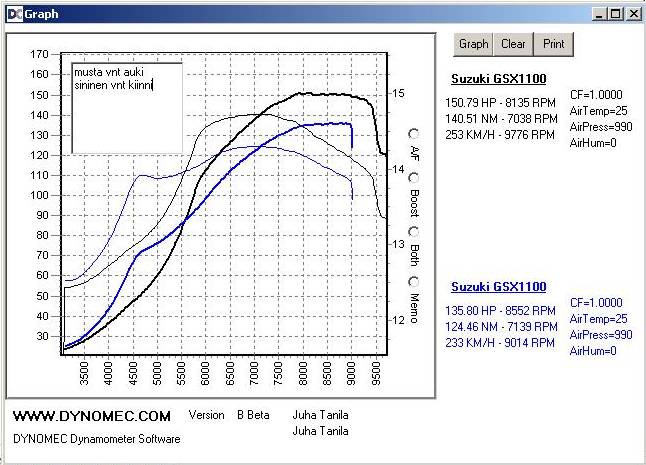
After some work I managed to get the VNT and fuel tuning to pretty good state. This work was finished on a dyno of my friend. We spent a good part of a day by testing all kind different things. Though power figures were slightly disappointing it was very useful and interesting session. I got about 150hp on normal road outfit and 157hp without silencer. Both numbers were at 0.75 bar (11 psi) boost. Effect of the silencer was slightly surprising. Without it torque was improved over whole boosted rev range and the turbo also spooled up earlier. I knew that turbo engines are sensitive for post-turbo exhaust pressure but I thought that my silencer wouldn't make any restriction at these power levels.

Here are graphs with (black) and without (blue) the silencer:
putki_vert.JPG


Most likely the compressor of the turbo just wasn't able to produce any more flow.

And just for general interest a graph that shows effect of the VNT system. VNT vanes fully open (black) and closed (blue):
vnt.JPG


After the tuning was finished the bike was a real pleasure to ride and it saw plenty of road during the summer. Unfortunately my riding season with it ended up too early when the output shaft bearing gave up during a holiday trip, in the middle of the woods couple of hundreds miles away from home.
rikki1.jpg


Since it was already quite late summer I decided to not fix the engine before winter but concentrate building another engine instead.
 
Well! That was fun while it lasted! I would be a little disappointed with only 157 HP @ 11 psi! We see over 200 at the rear wheel with 10 psi all the time. Is the engine overly restricted? Part of it could be losing power because the turbo shaft was going I guess?! Good luck with the rebuild this winter. What is the other project??? Ray.
 
A small clarification: It was the transmission output shaft bearing (behind the front sprocket) that broke. The turbo is still fine.

Yes, power figure was pretty low. I think that's mainly due the compressor of the turbo. Based on information that I have found it's limit is around 175hp at significantly higher boost (it's a diesel turbo). So probably it just cant push enough flow at lower boost. Turbine side seems to be fine since I was measuring exhaust pressure on the dyno and it was staying at the same level with boost. Dyno calibration might be slightly conservative too, it's home made one and newer calibrated officially. My friend measured 94hp from his Kawa GPZ750 turbo at the same day when it went 10.6s / 125mph on quarter mile.

The another engine is a 1150 engine that I'm building for this bike. More about it a bit later. Stay tuned :D
 
Stay tuned :D


I just read this whole thing. I am totally subscribed now. Took bad on the bearing going but at least it's at the end of the season instead of the beginning. You have all winter to get things sorted out!
 
All right then, let's start building a new engine.

The goal is to get 250-300hp with nice smooth power output that is suitable for street riding. And since this is a street bike that will see plenty of road reliability should be as good as possible. Of course power and reliability are somewhat contradictory features but I will do every possible thing to improve reliability. Within reasonable budget.

And here is a short plan how to achieve the goal:
-start with an 1150 engine that is in decent condition
-break it in pieces and build up again to stand reliably some 15 psi boost and 300hp power
-bolt on some suitable ball bearing turbo
-build or modify all necessary supporting parts needed for the goal
That easy! :D
 
So let's start the practical implementation that may be a bit more complicated than the short plan.

The first step. Dig out an 1150 engine from corner of the garage.
EFE_kone.jpg


Then some other parts that I have already collected.
palikat.jpg

-IHI VF34 ball bearing turbo that should be good up to 350hp power
-exhaust headers made by Proboost
-Aquamist 2D water injection system, including a fast solenoid valve so I can use the ECU to control amount of injected water
-straight cut primary gears
-38mm throttle bodies off from 2001 GSX-R600

Then just tear apart the engine. And look what I found there:
1230_lohko.jpg

A fresh set of 77mm (1230cc) Wisecos. :dancing: Also all other parts in the engine were looking really good. Actually that was expected, the engine was supposed to have pretty low mileage.

At the moment the crank and clutch basket are waiting at crank builder. The crank will get overall inspection, straightening, welding and fitting the straight cut gear. And I'm fiercely making a detailed plan for rest of the engine.
 
more awesomeness. keep up with the updates so everyone else (such as I am right now) can drool all over their keyboards!
 
Very nice. I'm currently in winter project mode with mine, planning on doing the same thing you have done with MegaSquirt and a custom made surface mount board.

I saw your timing trigger system; was that something you brewed up yourself? Would you be interested in sharing the design with me?

Are you sticking with the Mallory fuel pump, or do you have a different one in mind?

Any notes or consideration I should be taking into account on getting MegaSquirt up and running on a GS1100?

Thanks much, I will keep a close eye on how you are proceeding. I don't plan on shoving in a turbo for some time to come, so it's a lot of fun seeing how yours is progressing!
 
Yes, the trigger system is completely my own work. It uses two hall sensors and tiny magnets as triggers. Send me a pm if you like to get more detailed information.

The Mallory pump should be good up to 350 hp so I will use it. It's quite smart unit, provides good amount of flow with reasonable current draw.

Hmm, of course there is plenty of small details related to Megasquirt installation but can't form a good summary from them right now. So I just throw out some random thoughts ;)
-There isn't too much extra current available from the GS generator so it's better to look after current consumption when putting together an EFI system. In practice that means selecting a suitable fuel pump since the pump is the biggest consumer in the system. Some car pumps may draw over ten amps which is way too much.
-Don't use too large throttle bodies. They are difficult to install properly and are likely to result jumpy throttle response and difficult tuning.
-For engine temperature it's best to place the sensor on the head or cylinder block. Oil temp rises too slowly.

That's all what came to my mind right now. Feel free to ask if you have some specific questions.
 
You aren't going to use those Wisco pistons are you? Those are 10.25 to 1 compression & will be too much for a turbo. A custom set of CP Pistons, made for you in a turbo configuration will make the most power, live the longest & be the most trouble free. I am a CP dealer & can help you out if you are interested. I know you are in a different country but am still willing to help if interested. Ray.
 
I'm not completely sure about the pistons yet. One option is to machine shallow dishes on the piston tops, open up the combustion chambers a bit and maybe add slightly thicker base gasket. I have to do some further measurements to see if it's possible to get 9:1 compression ratio this way while maintaining proper piston crown thickness and squish band gap. Based on initial measurements it looks doable.

Another option is to sell these pistons with the block since they are in very good condition and get another block and set of custom pistons. So thanks for your offer Ray. Any rough estimation how much a set of custom pistons would cost?
 
There is NOT enough material to reduce the compression of those pistons like you would need to do. A turbo piston needs to have a MINIMUM crown thickness of .300 of an inch to be safe. This is VERY important also, a turbo piston needs to have the top ring land moved down on the piston to make it more durable. The pistons you have are for a naturally aspirated engine where they move the top ring land up to get the best power. I can get you custom CPs, made to whatever specs YOU choose, with good pins, rings & clips, for $700.00 US. Ray.
 
Last edited:
Yes, proper turbo pistons would be the best choice. Especially moving down the top ring would be useful since the most common piston failure seems to be broken ring land. On the other hand that's quite lot of money so I have to consider it carefully since this engine build will cost huge pile of cash anyways. And I'm pretty sure that these Wisecos will do fine if I can keep the engine away from detonating. But first I have to check how much I have to machine off from piston tops. If it looks too desperate I will get set of custom pistons.
 
You aren't going to use those Wisco pistons are you? Those are 10.25 to 1 compression & will be too much for a turbo. Ray.

wow, what a thread. Well Arttuh, first let me say you have done a ton of work over quite a long time and I congrats you on the progress and dedication to the project. Many would have fled long ago. I am embarking on the same build for my katana and your experience will be invaluable to me so keep it coming. I would be very interested in your data logs on a/f through the rpms. Also, are you running a wide band O2, hi or low impedance injectors?

I will be running Hillborn throttle bodies and I have hi and low injectors and SDS controller. Are you running stock stator or electrosport (20% more output) Thanks for the tip on fuel pumps. I have been researching them for low amp draws.

Ray, I just got an email from Mr Turbo. I had asked them about the 10.25 pistons and their systems. I was told that the pistons would be fine up to 8psi on pump gas (93 octane) but they recommend some octane boost for 1/4 mile runs. I also know of several Busa and zx14's running stock pistons with turbos with out issue at low boost. I believe they are 11:1 comp. I am told that the older stock pistons don't hold up very well and forged pistons are a must.

There seems to be two camps on this subject for which I am always looking for more experienced input. on one hand higher static comp is touted as better off boost performance less lag (low boost) and low comp better for 1/4 mile hi boost full throttle runs.

Since holing pistons is expensive I want to get it right the first time. What camp are you in and why?
 
Last edited:
Thanks for your kind comments Katman!

Current engine has high impedance injectors and probably I will use high impedance ones with the new engine as well. The plan is to use the GSX-R injectors (about 250cc/min) as primary injectors and add another set of 500-600cc injectors as secondary injectors. Secondary ones will be set to come up with the boost.

I have Innovate wideband o2. I use it for closed loop mixture correction at partial throttle but its main function is to provide information for data logs. I will dig up some good example of A/F data logs and post it here a bit later.

I'm using the stock alternator but have a home made r/r unit that may improve output slightly.

The optimal compression ratio is quite complex topic. In theory compression should be always highest possible without getting in detonation with planned boost level. But it's very difficult to estimate what would be safe compression / boost combination since there are some many factors affecting to this. Like fuel, sizing of the turbo, combustion chamber shape, intake air temperature and so on. Busas and other modern bikes are quite much different to the old GS in this sense. They can tolerate significantly higher boost / compression levels since they are water cooled and have better combustion chambers.

A rule of thumb from a very experienced turbo bike builder around here:
Calculate (Compression * Boost (in bars)) + Compression. For maximum reliability the result should be 16 at maximum, 18 is still relatively safe and you can stretch it up to 20 if you don't mind to change some pistons every now and then ;) So 9:1 compression and 15psi boost would result that relatively safe factor 18. This corresponds quite well to my experiences. I have been running about 9:1 compression with 12psi boost without any intercooling nor water injection and haven't noticed any detonation.

The fact is that if you want lots of power, which means more boost, you can't use very high compression. Unless you are going to use alcohol or some other very high octane fuel. But there is no reason to drop compression extremely low. I think that 7.5:1 values that traditional turbo pistons tend to have are excessive low for any use except the most extreme race engines. That low compression may provide some extra safety if you can't control fuel mixture and ignition timing properly which may have been common situation in old days when these pistons are developed. But if you can keep the mixture correct and use water injection or intercooling 9:1 should be fine for more than 15psi boost.
 
Here is that log snapshot from a dyno pull:
dyno_afr.jpg


MAP = Manifold Air Pressure (kPa)
MAT = Manifold Air Temperature (Deg. C)
TP = Throttle Position (%)
 
Time for update though I haven't got much done. Or actually I have done plenty of all kind background work, planning, gathering parts and so on but all this hasn't gained much visible progress to show. But let's see those few visible steps.

Fitting the throttle bodies. First disassemble the package in the smallest possible bits.
TB_collection.jpg


Throw away useless parts.
TB_leftover.jpg


Then rearrange remaining parts. Narrow down outer pairs by 2mm, widen the center by 14mm and move throttle cable mechanism from the end of the package in the middle. Sounds simple and actually it was quite simple. But took quite many iterations before everything lined up correctly.
TB_mockup1.jpg
 
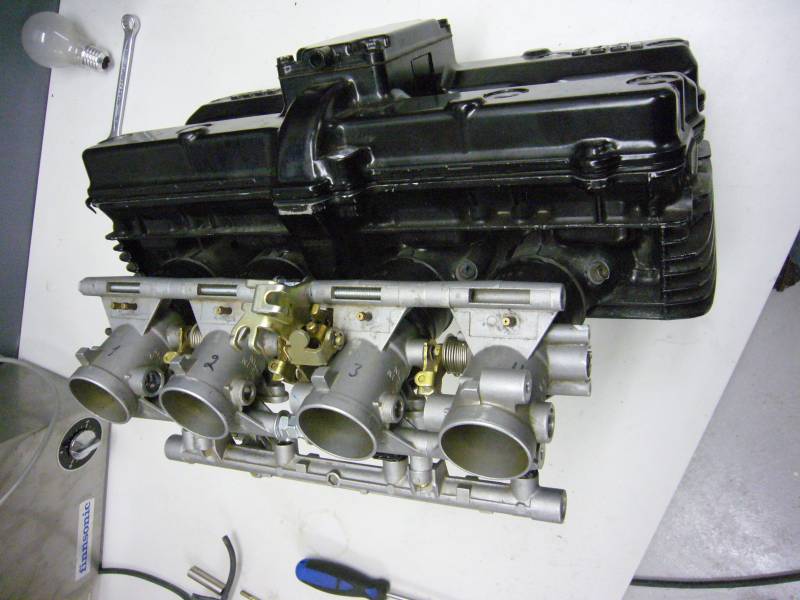
After that the package fits nicely on the head.
TB_mockup2.jpg


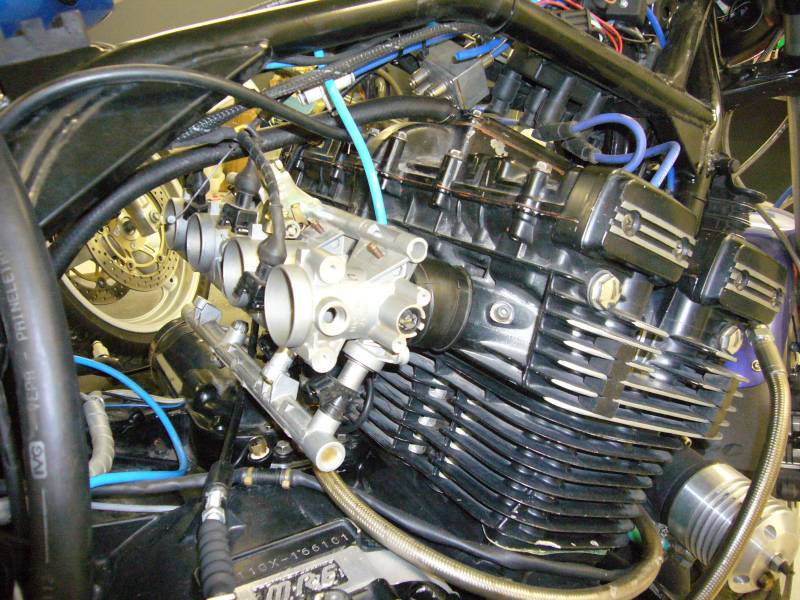
And on the bike as well.
TB_mockup3.jpg


After this I have to extend the fuel rail, replace those nuts and washers with proper spacers and plug holes of the secondary throttle shafts. Most of this is already done.
 
Then some head work. I smoothed all sharp edges from the combustion chambers and opened them up slightly. On the left result after raw shaping and stock one on the right.
CC_compare.jpg


I hope that smoothing around valve seats should improve flow as well. After shaping I checked chamber volumes and surprisingly they were right away very close to equal.
CC_volume.jpg


Then careful cleaning and putting all bits back in the head and it's ready for machine shop. It will get new exhaust guides, seat work, checking the valves and maybe some port work too.
head.jpg


I also tried some rockers from oil cooled Gixxer. I have been told that they increase valve lift and since I have to replace some rockers anyway I thought that maybe I should replace all of them with Gixxer ones. Well, they fitted in, so and so, but didn't gain any extra lift. So I will just replace the worn rockers with new/better stock ones.
 
Back
Top