• Required reading for all forum users!!!

    Welcome!
    Register to access the full functionality of the GSResources forum. Until you register and activate your account you will not have full forum access, nor will you be able to post or reply to messages.

    A note to new registrants...
    All new forum registrations must be activated via email before you have full access to the forum.

    A Special Note about Email accounts!
    DO NOT SIGN UP USING hotmail, outlook, gmx, sbcglobal, att, bellsouth or email.com. They delete our forum signup emails.

    A note to old forum members...
    I receive numerous requests from people who can no longer log in because their accounts were deleted. As mentioned in the forum FAQ, user accounts are deleted if you haven't logged in for the past 6 months. If you can't log in, then create a new forum account. If you don't get an error message, then check your email account for an activation message. If you get a message stating that the email address is already in use, then your account still exists so follow the instructions in the forum FAQ for resetting your password.

    Have you forgotten your password or have a new email address? Then read the forum FAQ for details on how to reset it.

    Any email requests for "can't log in anymore" problems or "lost my password" problems will be deleted. Read the forum FAQ and follow the instructions there - that's what we have one for...

  • Returning Visitors

    If you are a returning visitor who never received your confirmation email, then odds are your email provider is blockinig emails from our server. The only thing that can be done to get around this is you will have to try creating another forum account using an email address from another domain.

    If you are a returning visitor to the forum and can't log in using your old forum name and password but used to be able to then chances are your account is deleted. Purges of the databases are done regularly. You will have to create a new forum account and you should be all set.

GS(X)1100E turbo EFI

I wasn't especially interested to minimize piston weight since I'm not going to spin the engine extremely high. Probably I will set the rev limiter to 10k which should be quite safe.

I checked the head gasket briefly and didn't notice anything suspicious. I also added a very thin layer of sealant around the oil holes for extra safety.

Actually I guess that those HD bearings itself would do fine without shields but but the gears and and shift forks may suffer if they lost pressure lubrication.
 
Suprised to see that you are increasing the overlap by advancing the inlet cam like that. Is this the timing that you ran on your earlier turbo motor?
 
Hehe. Actually I was going to set the cams to 110/110? but I hadn't slotted the intake sprocket enough for that. When I found that out I was too lazy take the cam off again. :D

With previous engine I tried several cam settings from 104/106 to 111/113 and didn't notice any huge difference. So I will start with this setting and maybe change it later if it seems beneficial.
 
Hehe. Actually I was going to set the cams to 110/110? but I hadn't slotted the intake sprocket enough for that. When I found that out I was too lazy take the cam off again. :D

With previous engine I tried several cam settings from 104/106 to 111/113 and didn't notice any huge difference. So I will start with this setting and maybe change it later if it seems beneficial.

I only asked because I believe that most forced induction engines don't benefit from increasing the overlap between the valves. Turbos might be more accepting of increased overlap because of the inherent lag down low, but supercharged engines happily blow raw fuel out the exhaust at lower rpms.
 
I only asked because I believe that most forced induction engines don't benefit from increasing the overlap between the valves. Turbos might be more accepting of increased overlap because of the inherent lag down low, but supercharged engines happily blow raw fuel out the exhaust at lower rpms.

It seems that optimal cam timing with a turbo depends a lot of turbo sizing and other details of the setup. If the turbo is sized so that exhaust back pressure doesn't exceed boost significantly cam timing affects pretty much the same way than on N/A engine. If there is more exhaust pressure than boost then it might be beneficial to reduce overlap. And if the boost is clearly higher than exhaust pressure it might be good idea to reduce overlap too, just like with a supercharger, but this isn't too common situation with turbos.
 
Hey!

Wow, I'm suprised you wanted more boost on an 1100 anyway, but neat setup! I really like the custom manifold.

The beginning of the thread looked like it wasn't under use yet, and my only advice is that you should add a water cooling setup to the turbo.
I have a turbocharged volvo 740. 2.3L makes 195lb-ft of torque and 170~ish hp.

In their discovery of the awesomeness of MOAR BOOST, they found that watercooling the turbo made a huge difference in oil temps in the engines.
I think it will really be worth it to you to protect the engine and turbo's bearings to add a water jacket setup. Turbos add massive heat energy to the system, and the bike is air cooled. That, plus the shared oil for engine, turbo, and transmission makes me think the bike is going to eat oil like it does gas.

I'd either add an oil cooler and reservoir to the setup, or water-cool the turbo.
There is a small-ish (for a 2.3L) turbo that's available on the 85-89 volvos. I think it's a Mitsubishi TD04, the TD03 is a larger one. The only reason I mention it is that it has a built-in waterjacket and cooling setup.

I really like the project though :D Hope you finish it up.
-William
 
Hey!

Wow, I'm suprised you wanted more boost on an 1100 anyway, but neat setup! I really like the custom manifold.

The beginning of the thread looked like it wasn't under use yet, and my only advice is that you should add a water cooling setup to the turbo.
I have a turbocharged volvo 740. 2.3L makes 195lb-ft of torque and 170~ish hp.

In their discovery of the awesomeness of MOAR BOOST, they found that watercooling the turbo made a huge difference in oil temps in the engines.
I think it will really be worth it to you to protect the engine and turbo's bearings to add a water jacket setup. Turbos add massive heat energy to the system, and the bike is air cooled. That, plus the shared oil for engine, turbo, and transmission makes me think the bike is going to eat oil like it does gas.

I'd either add an oil cooler and reservoir to the setup, or water-cool the turbo.
There is a small-ish (for a 2.3L) turbo that's available on the 85-89 volvos. I think it's a Mitsubishi TD04, the TD03 is a larger one. The only reason I mention it is that it has a built-in waterjacket and cooling setup.

I really like the project though :D Hope you finish it up.
-William

Good feedback William. I've never bothered with turbos on bikes for the very reasons you have mentioned.

You would need to arrange a decent pressurised holding tank and a small radiator along with a reliable pump. This would add quite a bit of weight and affect the handling of the bike.

I think I would be opting for more oil capacity and better oil cooling as a safeguard.
 
Hi William.

The bike has been turbocharged with the original engine for three active riding seasons. Hopefully I will get this new engine in use within next few weeks.

As far as I know water cooled turbos are developed mainly to prevent heat soak after engine shut down. This is a problem in many car installations. The turbo is really hot after driving since it's crammed in the middle of the engine bay so it gets very little cooling air flow. And when the engine is shut down cooling oil flow to the bearings stops and glowing hot turbine side starts to heat bearings. This makes remaining oil to boil and result is carbon build-up on the bearings. Water cooling helps to keep bearings cool enough in this situation.

On bike installations the turbo usually gets plenty of cooling air and thus it survives fine without water cooling. My current turbo has that water cooling jacket and originally I planned to route the oil cooler line through it. But required plumbing was looking too challenging since there is quite little space between the turbo and engine so I gave up the idea. Separate water cooling system for turbo would be way too complicated.

With my previous set-up I hadn't any special problems with oil temps. Temps were higher with turbo but even adding tiny GS1150 stock cooler was enough to drop temps to original level. So I think that this new 13-row cooler should be enough to keep temps on reasonable level.

And then some project progress. The engine is in the frame :dancing:
engine_on.jpg
 
BeaU-teeful! I like the paint on the engine.

Just so long as you addressed it. I was worried about oil degrading faster, but you do have a point about the turbos being exposed. And the heat soak was one reason for going water-jacket on the turbos, but I thought the other was just general cooling capacity of oil... No clue which was more important.

Looks like the point is moot though :D

So how does it ride? Does it fly through the gears? Is it the original transmission, or did you swap it out with one with longer gears?
And is the turbo wastegated, or always on? I would assume it's got a built-in wastegate, but it's off a diesel.

And I didn't realize the engine was water cooled... :D whups. Guess it'd be a lot more of an issue with a strictly air-cooled bike like my 650.

Ride on!
William
 
Update time!

After getting the engine in the frame there was plenty of bolting on accessory bits, routing hoses, connecting wires and so on. Generally huge amount of small things that take plenty of time in the end. One funny surprise was that new engine sits in slightly different position in the frame. And naturally I had fitted most of new parts very tightly with the old engine :mad: I almost went nuts when I realized that one of the injector connectors just wont fit since it interferences with the frame. Fortunately slight re-shaping of the fuel rail fixed the problem.
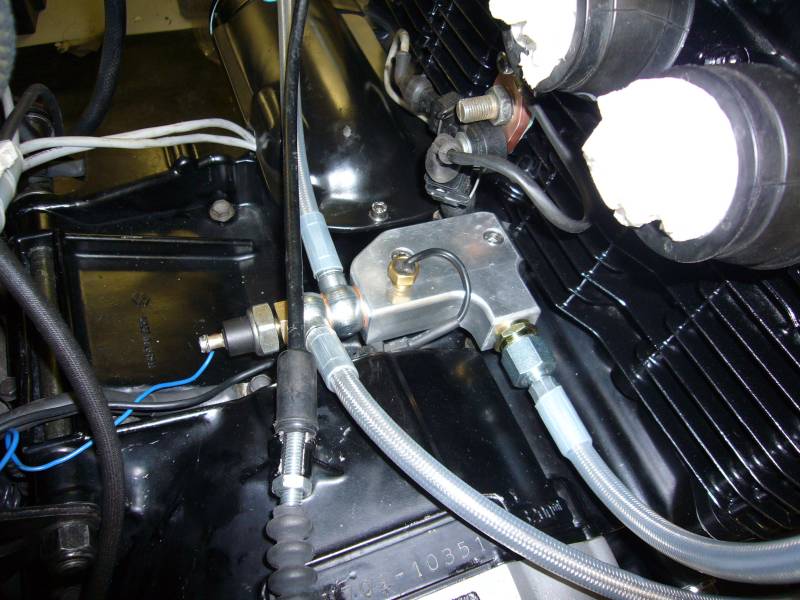
Oil distribution was quite interesting topic too. I decided to add external oil feed to the head since original oil passages are now restricted by HD studs. And turbo needs oil supply too. So at first all the oil coming from the filter is captured by this distribution block.
oil_dist.jpg


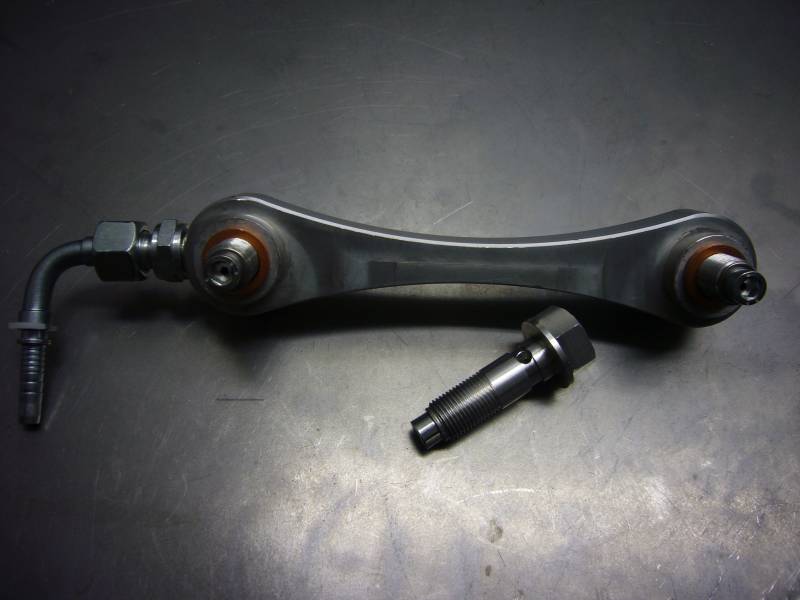
The block has a 3mm hole to bleed part of the oil directly to the crank and transmission. Rest of the oil goes to the head and turbo. And since the turbo requires some pressure additional restrictors were needed to prevent oil escaping too easily in the head. So I added 2.5mm restrictor plugs on bolts of the oil rails.
oil_rails.jpg


Seems to work pretty well though a bit less restriction would be good since the oil pressure goes slightly too high at top rpm. Actually the ball bearing turbo shouldn't need much pressure for lubrication but cooling of the bearings is designed for typical car oil pressure (30-60 psi). Therefore I think it's good idea to get a bit more pressure for it than standard <7 psi in these engines.

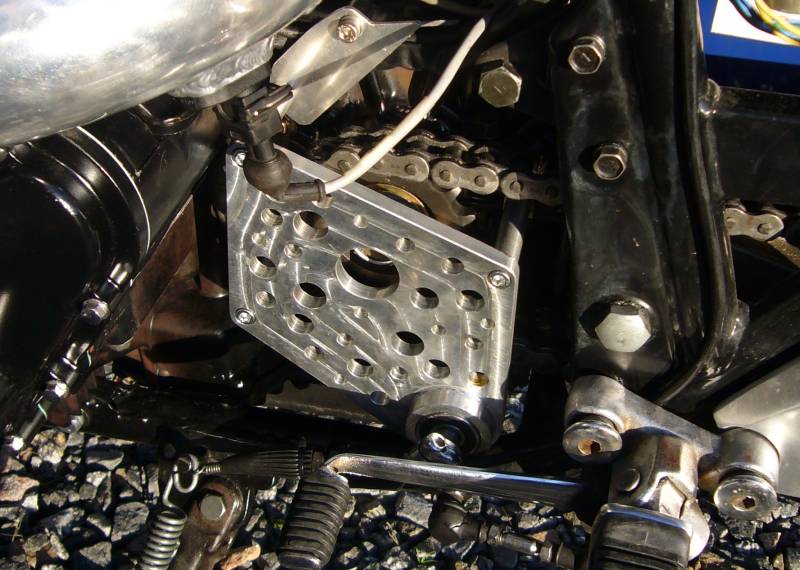
One additional surprise was that the sprocket covers aren't interchangeable between the 1100 and 1150 engines. And I had just a 1100 cover. Fortunately one helpful Suzuki-enthusiast from England delivered quickly this nice piece of milled aluminium that fixed the problem.
sprocket_cover.jpg
 
I also upgraded the processor of the ECU to MS2-version. It took few hours to go through all the new settings and determining some sensible starting values for them. By this far I'm pretty happy with the upgrade. Not a huge leap from the MS1 but almost everything is improved more or less.

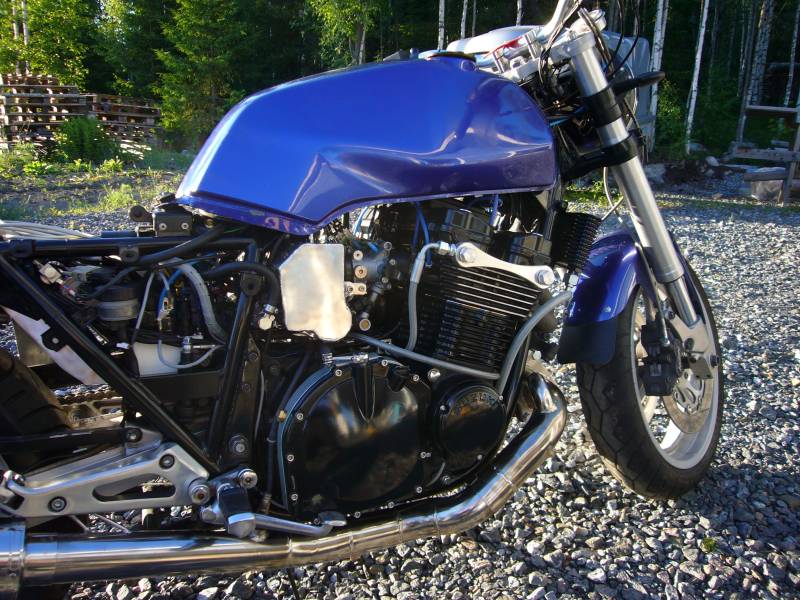
Now the bike is almost complete. I'm going to add some kind shield for the air filter to prevent road dirt blasting directly on it. Otherwise all the bits are on their places.
melkeinvalmis2.jpg

melkeinvalmis.jpg


By this far I have done just few quick test rides and tuning is still way off. But everything seems to work like expected and the engine responds really nicely at low rpms. Tickover is pretty noisy due to rattling lock-up arms but that smooths nicely when you get moving.
 
Restriction

Restriction

I don't know about restricting oil for any good. The turbo was designed to be pressure fed with up and maybe more than 100 psi. Is there a restrictor in the housing? And oil to the head I feel should not be restricted either. It was always lacking to begine with. I would just hate to have the head ruined by not enough oil. I think that at high rpm, the GS only makes 10 psi? My reasoning for removing the restrictors. Just my thought.
Laters
G
 
Just for clarification, I didn't add any extra restriction for the turbo. The idea was to increase pressure for the turbo from stock 5-10 psi to about 30-60 psi. Just to guarantee sufficient oil flow through the turbo. There is a very small restrictor hole in the turbo centre housing, about 0.04". But it's integral part of casting so I can't alter it.

I'm not too concerned about oil starvation on the head. Since the pump is constant volume type all these restrictors shouldn't affect much to total oil flow. Only drawback is that pump takes now more power since it's working at higher pressure. But it should be capable for that since the same pump is used on 750 with high pressure oil system. So the engine should get the same amount of oil than in stock configuration, minus small amount that the turbo takes. And since I'm using 750 gears there should be enough flow to cover the difference.

Only question is if the balance between the crank and the head is good. And if I'm loading the pump too much. I guess that I will open up the restrictors a bit at some point because now 60 psi pressure gauge pegs at 6000 rpm. That's slightly too much, I think.
 
Tuning starts to be in decent state and the bike has been in regular use without major hiccups. Though I have been fighting with surprisingly high amount of small random problems like oil leaks, fuel leaks, charging problems and so on. Fortunately all of these have been easy to fix. Typical shake-down process, I guess.

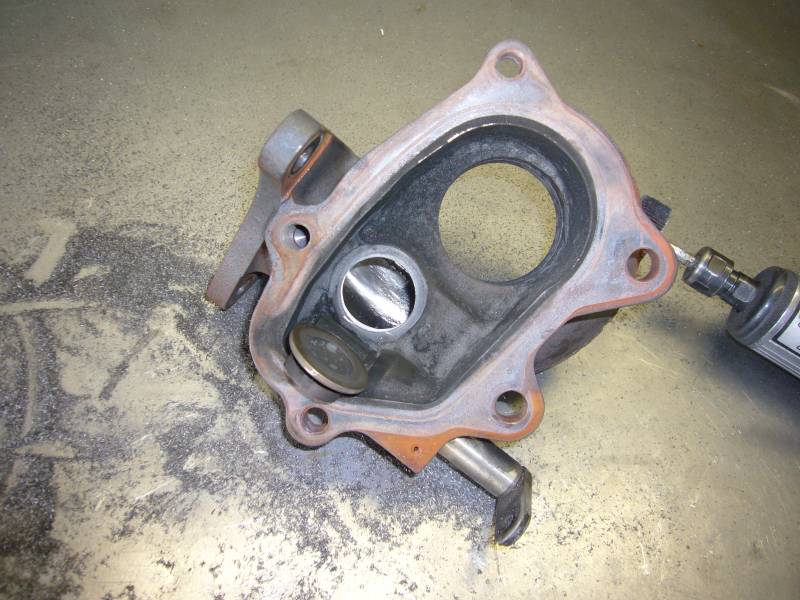
I have done quite a lot work with boost control. At first I noticed that integral wastegate of the turbo is apparently too small. The gate starts to open at 0.5-0.6 bar (8-9 psi) and initially boost stayed at that level. But the boost creeps up as the revs go higher and on higher gears it even reached over boost fuel cut at 1.2 bar (18 psi). So I took the turbine housing on the work desk ported the wastegate hole as large as the valve allowed. This helped quite well. Boost still creeps but stays below 1 bar (15 psi). Good enough.
WG_mod.jpg


Then I have tried to get the boost controlled by ECU with pneumatic solenoid valve. Unfortunately it hasn't been easy to find good settings for the Megasquirt to get the boost rising quickly and stay steadily at the target. It either rises slowly or overshoots and fluctuates. Might be because I'm using rather old firmware that is rated as "stable". Later versions that are still under testing phase should have significantly improved boost control functionality. So probably I should upgrade.
 
Last edited:
Any ways, I got the boost control working well enough for some dyno testing.

At first I tried to find knock limit for ignition timing by listening the engine with "electronic stethoscope". But I wasn't able to notice any knocking even though I disabled water injection and increased ignition advance by ten degrees from my guesstimated safe values. So I ended up to increase advance by five degrees from initial values and that gave about 15hp power gain.

Slightly surprisingly the engine produced couple of ponies more power without water injection but on the other hand intake air temperature rose about 40 ?C (104 ?F) higher. With these numbers I'm happy to continue using water injection as safeguard. Maybe I should try slightly smaller water jet, it could result better balance between power and air temps.

After all this tuning I got 212hp with 1 bar (15 psi) boost. Not very dramatic numbers but nice improvement from old engine. And calibration of that dyno is still unclear since it is home made unit. In practise this power seems to be enough since the bike wants to wheelie heavily on three first gears. So I guess that next improvement will be a longer swing arm :p Here is the dyno graph, blue curves are the old engine with 0.8 bar (12 psi) boost, for comparison.
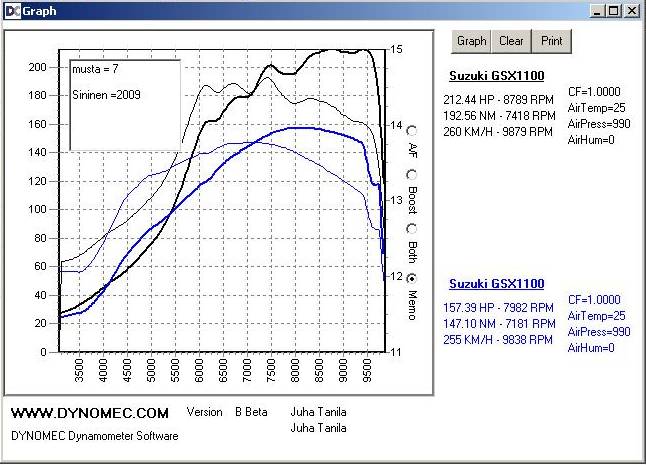
dyno_09vs10.JPG


I also tried slightly higher boost and got some 230 hp with 1.2 bar (18 psi) but then we noticed a slight leak between the head and cylinder block. Fortunately the leak was minimal and occurred only under full boost. Later on I re-torqued the head nuts and noticed that they were loosened quite much for some reason. So I hope that the gasket is now fine after re-torquing. At least there aren't any signs of leak.

Here is a crappy video from one dyno pull: http://www.youtube.com/watch?v=xLI_jAyCCek
 
Last edited:
Too MUCH boost? Creeping

Too MUCH boost? Creeping

Hello Arttu
May I ask a really stupid question? Are you sure that the wastegate valve is completely open???? Maybe it is not and that is causing the boost creep? Perhaps the actuator doesn't have enough travel? Then shorten the lever arm on the valve. Maybe, open the wastegate hole and make a larger flapper plate? Or perhaps the flow from the valve is getting blocked by the flow coming out the turbines exhaust?
Did you "O"-ring the sleeve tops? This helps to keep those gasses in.
I would also suggest some porting of the head and a proper valve job and throating of the seat. Maybe some small drop-in cams too.:cool:
Okay, laters
Greg
 
Hello Greg.

Yes, I checked that the wastegate opens completely. I discussed about this with guy that sold the turbo for me. He has installed several of these turbos on bike engines and according him it's typical that boost creeps up. Now I opened up the wastegate hole as far as the flapper valve allows and that helped quite well. I may install a larger valve during next winter, if I have too much spare time :)

No, I didn't o-ring the block. Just plain multi-layer steel gasket. I hope it will hold now with properly torqued head nuts. Before re-torquing the nuts were so loose that I'm not wondering why it leaked under boost. I'm just wondering why the nuts were loosened since steel gaskets shouldn't compress much.

Actually the head is mildly ported and the seats are throated. That gave about 10% increase to flow bench figures. I think this power is pretty much enough for me, for some time ;)
 
Boosting

Boosting

Hello Arttu
Okay. I imagine that when the turbo was used in it's original application, the stock exhaust had enough back pressure to control the boost. When it is removed, I see the problems. Is your blow off valve large enough? I think make the wastegate valve larger when you can. Maybe it will be allright then? Just make sure the weld is very good as the heat will let it pop off otherwise. Get's rather toasty there.
I am surprised about the loosening too. Maybe the gasket does need to squash over time more than once thought. Perhaps the base gasket is fiber too?
Porting always helps. Especially on the older sidedraft heads. Big valves and cams too.
Hope you are having fun with it.
Laters
Greg
 
Trust me on this, you NEED to oring the cylinders &, when you do, make sure you use STAINLESS wire or piano wire! I use piano wire on all of mine & have no problems. If you use copper wire for the cylinder orings it will crush & eventually leak. You also need to use a copper head & base gasket. Ray.
 
Back
Top