• Required reading for all forum users!!!

    Welcome!
    Register to access the full functionality of the GSResources forum. Until you register and activate your account you will not have full forum access, nor will you be able to post or reply to messages.

    A note to new registrants...
    All new forum registrations must be activated via email before you have full access to the forum.

    A Special Note about Email accounts!
    DO NOT SIGN UP USING hotmail, outlook, gmx, sbcglobal, att, bellsouth or email.com. They delete our forum signup emails.

    A note to old forum members...
    I receive numerous requests from people who can no longer log in because their accounts were deleted. As mentioned in the forum FAQ, user accounts are deleted if you haven't logged in for the past 6 months. If you can't log in, then create a new forum account. If you don't get an error message, then check your email account for an activation message. If you get a message stating that the email address is already in use, then your account still exists so follow the instructions in the forum FAQ for resetting your password.

    Have you forgotten your password or have a new email address? Then read the forum FAQ for details on how to reset it.

    Any email requests for "can't log in anymore" problems or "lost my password" problems will be deleted. Read the forum FAQ and follow the instructions there - that's what we have one for...

  • Returning Visitors

    If you are a returning visitor who never received your confirmation email, then odds are your email provider is blockinig emails from our server. The only thing that can be done to get around this is you will have to try creating another forum account using an email address from another domain.

    If you are a returning visitor to the forum and can't log in using your old forum name and password but used to be able to then chances are your account is deleted. Purges of the databases are done regularly. You will have to create a new forum account and you should be all set.

GS250T SH775 conversion

fbody_mike

Forum Mentor
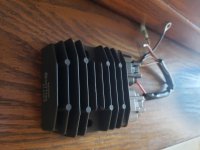
One of the smallest GSs, it is going to be a little hard finding a spot for the big regulator. Got a new sealed beam too.
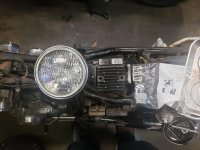
20191226_164154.jpg
 
Those bullet connectors are very likely to be corroded. If you want to keep them you shoudl chemically clean (Naval jelly) and treat (Deoxit) and flow some solder in to block the return of corrosion to the crimps.

You can omit that mating connector by using spade Female connectors directly to the SH-775 males.

You shoudl measure your voltage drops when you are done to see how much voltage you are losing. With 10 amps minimum flowing, all it takes is 0.1 ohms of resistance to drop a full volt (0.1 ohms resistance is the minimum resolution of most multimeters). That means instead of charging at 14.5V you would be at 13.5V which is a very slow charge and can leave you stranded if you use the starter excessively.
 
Last edited:
According to the wiring diagram on Basscliff's website the 250 has the same bad-news stator loop through the hand control as so many other GS's so that must be eliminated for long term reliability. Feed the three stator leads straight into the R/R, bypassing the stock wiring. Second, the R/R ground should go the battery, not to the frame because of resistance buildup that inevitably builds up. The + output can go to the bullet feeding the main harness and fuse box but do as Jim states and check for voltage loss. This is easy to do: get the bike up and running and then put one voltmeter probe inside the bullet and the other on the + battery post. You should see no more than .1 volt loss compared to measuring straight across the battery. If you haven't cleaned the connectors for the fuse box then you WILL see more loss than this so it's best to just clean them straight away and be done with it.

SH775 Install by nessism, on Flickr
 
Thanks for the advice on the resistance and voltage drop I will check it. I will bypass the stator wire for the light switch too, very easy on this harness. I'm a EE but I do appreciate the advice. Easy stuff to forget when your busy trying to get new parts to fit.

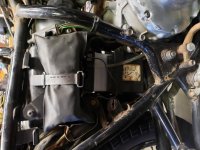
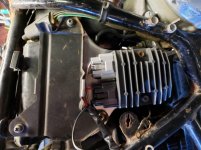
This is where the new sh775 will go. Should have some air flow. And the side cover still fits. 20191227_091828.jpg
 
Thanks for the advice on the resistance and voltage drop I will check it. I will bypass the stator wire for the light switch too, very easy on this harness. I'm a EE but I do appreciate the advice. Easy stuff to forget when your busy trying to get new parts to fit.

This is where the new sh775 will go. Should have some air flow. And the side cover still fits. View attachment 59817

Well then you will appreciate that to achieve a 0.2V drop that that is about 20 milliOhms total resistance through fuses and grounds where each connector is at least three 3 faying surfaces. I use 10 amps as a basis assuming you maintain the stock configuration for R/R(+) and use a single point ground. If you use Nessism's schematic then you are maintaining the stock R/R(+) but are now talking about 15 amps on the negative return side.

All return current have to get to the R/R(-) under charging conditions so as he has it the full 15 amps has to go between bat and R/R.
The SPG lowers this return current to charging currents only which is about 4 amps max with lower corresponding voltage drops.
 
I kept a single point ground at the negative battery terminal. Found corrosion on the positive rr bullet, cleaned it, bypassed the stator light switch wiring.

Getting a steady 14 volts at idle and stays at 14 all the way to 6k rpm.

Actually the 10 amps is fairly reasonable. At idle the harness is pulling about 5 amps and revving the motor gets 3 or more amps flowing. This is with the battery at full charge ofcourse, a low battery can probably pull a few more amps while charging.
 
I kept a single point ground at the negative battery terminal. Found corrosion on the positive rr bullet, cleaned it, bypassed the stator light switch wiring.

Getting a steady 14 volts at idle and stays at 14 all the way to 6k rpm.

Actually the 10 amps is fairly reasonable. At idle the harness is pulling about 5 amps and revving the motor gets 3 or more amps flowing. This is with the battery at full charge ofcourse, a low battery can probably pull a few more amps while charging.

Standard loads excluding charging is about 10 amps. 5A headlamps, 2.5A for ignition and 2.5A for misc but directionals add 5A and brakes add more. These are all incandescent loads, so going to LED's really helps reduce the overall load. Fortunately with the series R/R you can do this as the Shunt would stress the stator even more with a reduced electrical load.

The set point on the SH-775 is 14.5V so you should still measure the voltage drops from the SH-775 connector to the battery terminals to see where that 0.5V has been lost.
 
I didn't know it was 14.5 volts. I'm betting the fuse holder is the drop, it's clean but I bet it's the same metal that was used by Yamaha in the early 80s. I will look for the drop.
 
If your battery is weak you'll see 14.0 VDC at the battery with a SH775. I've learned this after testing a good many SH775's on my KZ750. With a properly charged battery 14.5 VDC shows though.
 
If your battery is weak you'll see 14.0 VDC at the battery with a SH775. I've learned this after testing a good many SH775's on my KZ750. With a properly charged battery 14.5 VDC shows though.

So if the battery has low SoC(state of charge), the charging system is a situation of being "supply limited". The stator can only produce so much power for a given RPM. This limits the total current produced which in turn limits the total charging current for the battery. If you can not produce sufficient current (based on SoC of the battery) then you will not achieve the full 14.5V.

It is clear from yours and other data that the more modern R/R's (especially SH-775 and CF) are able to regulate to much tighter tolerances than the OE GS R/Rs.

may
 
IIRC the typical battery capacity is 14 Amp-hr so the 3-4 amps of charging current correspond to .21C - .28C charge rates once you get above 2-3K RPM.

That is a fairly moderate charge rate where 0.1C is typically a very safe low charge rate for any battery.
 
I should have prefaced by saying my bike works like mentioned. A GS250 may be different.
 
Maybe the battery wasn't as fully charged as I thought during the initial testing. I was playing with the aim of the new headlight so maybe. I took it out for a good ride and got back, checked the voltage drop across the ground wire and the drop across the positive to the positive terminal of the battery and could not find nothing more than a few mV. But the voltage was now 14.3 at idle and 14.4 at 5k rpm. Not too bad for some old 14 gauge wires.
 
Maybe the battery wasn't as fully charged as I thought during the initial testing. I was playing with the aim of the new headlight so maybe. I took it out for a good ride and got back, checked the voltage drop across the ground wire and the drop across the positive to the positive terminal of the battery and could not find nothing more than a few mV. But the voltage was now 14.3 at idle and 14.4 at 5k rpm. Not too bad for some old 14 gauge wires.

Sounds like you did a good job on cleanup :)

You could still do the leg-to-leg and leg to ground stator tests at 5K to see if there is any evidence of stator insulation break down.

BTW, you did do the voltage drop tests at 5K RPM?
 
I did the voltage drop measurements with it at idle, one hand for each probe, no one to help twist the throttle.

The original stator pages specified the voltage drops this way. It shoudl be obvious that with more charging current the voltage drops will be worst which is why I advocated and changed in revised stator pages the RPM to 5K.
 
Back
Top