• Required reading for all forum users!!!

    Welcome!
    Register to access the full functionality of the GSResources forum. Until you register and activate your account you will not have full forum access, nor will you be able to post or reply to messages.

    A note to new registrants...
    All new forum registrations must be activated via email before you have full access to the forum.

    A Special Note about Email accounts!
    DO NOT SIGN UP USING hotmail, outlook, gmx, sbcglobal, att, bellsouth or email.com. They delete our forum signup emails.

    A note to old forum members...
    I receive numerous requests from people who can no longer log in because their accounts were deleted. As mentioned in the forum FAQ, user accounts are deleted if you haven't logged in for the past 6 months. If you can't log in, then create a new forum account. If you don't get an error message, then check your email account for an activation message. If you get a message stating that the email address is already in use, then your account still exists so follow the instructions in the forum FAQ for resetting your password.

    Have you forgotten your password or have a new email address? Then read the forum FAQ for details on how to reset it.

    Any email requests for "can't log in anymore" problems or "lost my password" problems will be deleted. Read the forum FAQ and follow the instructions there - that's what we have one for...

  • Returning Visitors

    If you are a returning visitor who never received your confirmation email, then odds are your email provider is blockinig emails from our server. The only thing that can be done to get around this is you will have to try creating another forum account using an email address from another domain.

    If you are a returning visitor to the forum and can't log in using your old forum name and password but used to be able to then chances are your account is deleted. Purges of the databases are done regularly. You will have to create a new forum account and you should be all set.

Help reading plug chops & jetting - '77 GS750 pipe + K&N

Chuck78

Forum Sage
Past Site Supporter
I did my first plug chop yesterday, as I felt the bike should definitely be a little faster, and I have been changing needles, needle heights, and trying to get the right jets into it. Before it seemed too lean on the 105 mains from 3/4 to full throttle (peak power at 3/4 throttle), and I have since rebuilt the carbs, ditched the stock airbox with foam filter for a pair of K&N dual oval RC2222 open element filters, retaining the same 4-1 exhaust with free flowing baffle. I had swapped needles around just trying to get a good feel for the powerband and flat spots. Got it fairly good for now but not perfect (pilot screw/jet changes to play with).

From 3/4 to full throttle, it wasn't much of a noticeable power increase while twisting the throttle but more than the previous incarnation of the bike, so I figured something was still off with the main jet sizing. I was ready to take out the 122.5 main jets and swap in 125's after looking at the top of the plug after a WOT chop reading, as I hear that is a common size to put in a modified GS750. Today I am reading that the WOT plug chop must be read at the base of the insulator, requiring the plug to definitely be physically cut to see clearly for the WOT reading.

On plugs that I have been running all year (but just cleaned them a few hundred miles ago, but not terribly thoroughly at the base of the insulator!), running wide open throttle for 30 seconds up a long desolate hill in the countryside (took me an hour of cruising to find an appropriate straight desolate uphill road where I don't have to worry about hitting 115mph in a short blast, sheesh), I hit the kill switch and the clutch simultaneously. I don't think I closed the throttle immediately though, but I only saw this mentioned on the bike cliff plug chop instructions, not the jets r us page http://www.jetsrus.com/FAQs/FAQ_spark_plugs.htm


attachment.php


looks like my mains are a slight bit too large I suspect, as long as the open throttle as the engine spun to a stop with kill switch in the off position didn't taint the reading, same for not having new plugs. Is the base only colored by deposits from wide open throttle positions? The Jets R Us link shows that, idle is at the top of the insulator, mids in the middle, WOT at the base

The center plug from that link in this photo is the correct AFR at the base of the insulator according to jets r us, and mine looks like 2 to the left but a little darker on the base. the shiny marks are where my bandsaw blade hit the carboned up area and scraped off the deposits, so ignore that. Think a 120 is in order? or is it a wise choice to pick up 120's and 117.5's?
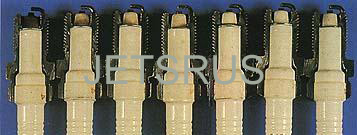
photo_spark_plug_reading.JPG


EDIT: also found this - http://www.xs11.com/xs11-info/tech-...arbs-by-reading-spark-plugsthrottle-chop.html and unfortunately locally no one has a full matching set of 120's in stock! I did grab some EBC/RD 117.5's for $10 just for the heck of it to test. When I do the big big bore upgrade this winter, they may work well for that if they don't now. pending rain this evening, so I will test them another day.
 
Last edited:
To complicate things further, I suspect I am a little lean around the transition from the pilot circuit to the needle. I was feeling like it was too rich on the pilot screws at 1-1/4+ turns out, idle would become erratic after 30 seconds (starting to foul?), but at 1-1/8 turns it runs pretty steady but is harder starting and I get an occasional lean pop out of the carbs - especially #1, maybe fuel levels need checked? Air screws showed best colortune flame at 1-7/8 with 1-1/4 on the fuel screws. at 1-1/8 on the fuel screws, I set the air screws by ear at 1-3/4. I set the floats to 78-79 spec at 24mm, and had fuel pouring out of #4. it's +/-1mm, so when I swapped a good used needle seat in (replaced needle valves already with new), I set the floats to 25mm because I feared that it didn't have enough pressure on the seat to shut off the fuel as the float at 24 was nearly hitting the carb body. 77 spec was 26mm but I have 78-79 spec #15 pilot jets and 1.5 cutaway slides vs the 1977 22.5 pilot and much larger slide cutaway spec of 2.2 or something. I have not physically checked the fuel height with an adapter and hose,nor have I vacuum synched the carbs due to a dent in the exhaust that I was afraid would affect that cylinder's synch. maybe not at low engine speeds during synch? 15%+ restricted on one cylinder.

I am reading a list of lean symptoms, and this popped out:
Engine surges or "hunts" when cruising at part throttle
If I'm on the throttle just a little into the needle range, it seems fine, but if I let off a very slight bit while cruising at 4500-ish, the engine sound jumps around a lot which this sentence above seemed to describe pretty well. This led me to think that either the 1/16th turn out on the fuel screws that I suspect I need may actually be a bigger jump than I thought, or else the stock needle in the 4th position from the top still doesn't start the taper quite soon enough to compensate for how much air these unique and very large K&N filters flow, and I need to stick my nose in the Mikuni needles chart again and find one that starts tapering slightly sooner? Or else raise this one up to the highest position and hope that the upper midrange doesn't richen too much?

I should also add that the previous owner said "the motor's been bored out" but didn't know anything about the bike that he received from his buddy as repayment of a debt. Looking in the plug hole, they appear to be GS850 pistons, not Wiseco's as I had hoped, but they even could just be GS750 65mm+1.0mm oversized pistons. Who knows, but I suspected 850's as the bike was really darn fast for just having a MAC 4-1 and a 105 main.
 
Last edited:
Go the 125s and see how it works. You can always go smaller if that's what it needs, but I don't think so at basically sea level in Ohio.


What method did you use to set the pilot fuel screws?

It should be able to idle well just about forever if the fuel and air screws are both adusted correctly.
 
I had the fuel screws a bit too rich at 1-1/4 (trying to make the transition to the needle circuits smoother), but it would only idle okay for about 30 seconds and then start to foul and stumble and drop rpm's. I am at about 1-1/8 turn out on the fuel screws now. Once warmed up, it will idle all day long, but doesn't do so well for the first few minutes of warm up. I have been told that VM's on GS's are just prone to acting up until warmed up. Maybe so, or maybe I am just not tuning them right.

I used the Gunson ColorTune plug to adjust the air screw from there for a perfect blue flame, but due to time constraints, I just did one cylinder and then set the rest to that approximate setting. The air screw at the setting to give the best looking flame color did not seem to change the engine rpm much at all, although the color of the flame did change. This confused me, and made me think that I am still off a bit on the fuel screw setting.

I also got the bike to hiccup a little out the cyl 1&2 shared air filter at least twice (slight popping backfire?), which I had read was a symptom of a lean mixture, but maybe I am confusing my symptoms and causes. Other than that, I was thinking I should have taken advice from the guys on here that said start at 5/8 of a turn out on the fuel screws, or the VM Carb Rebuild Tutorial on the GS site which says 1 turn. I thought with these incredibly free flowing air filters and exhaust, that I would need a lot more fuel. I think I am probably still too rich at idle, and I think my mains are still needing to drop from 122.5 down to 120's. I am afraid to just jump down to the 117.5's that I have without first doing a plug chop on the 120's that I have yet to acquire.
 
THIS FROM JETSRUS.COM SEEMS TO INDICATE I NEED A 17.5 PILOT! JUST ORDERED 120 MAINS!!!:

If unable to obtain a smooth idle with pilot screw, increase the pilot/slow jet until a smooth idle can be obtained. A larger pilot/slow jet will eliminate or reduce popping that occurs when letting off wide open throttle. The pilot/slow jet will also improve cold weather starts. Go up 1 pilot/slow jet at a time, don't skip sizes. After installing a larger pilot/slow jet, re-adjust the pilot screw. Now take it out and test ride at 1/4 throttle. If the pilot/slow jet is correct it will be easy to maintain a steady speed. Lean symptoms - if the bike surges, carb spits when throttle is opened, exhaust backfires or pops when throttle is closed, or the engine has trouble idling down, engine needs a larger pilot or slow jet to correct. If the engine idles rough, fouls plugs, or is hard to start, pilot is to big, or rich.

I have less but still persistent popping when closing from WOT down to minimal throttle position, and although it starts with the choke on 3/4 to full on most of the time on the first kick, it won't run well for several minutes with the choke off until it warms up.

I thought maybe I was fine with #15 pilots, but now i am confused. 120 mains are on the way however.

Is it best to tune from WOT and main jet sizing and then work your way down the rpm range? JetsRUs.com say to start with idle, then pilot jet, then main, then needle and midrange.
 
I used the Gunson ColorTune plug to adjust the air screw from there for a perfect blue flame, but due to time constraints, I just did one cylinder and then set the rest to that approximate setting.
I love it. :-\\\

You have the perfect tool, but not the time to use it?

The rest of us have to GUESS and strain to listen to changes in engine speed, while you have the perfect tool to look inside the engine and adjust the mixture PERFECTLY, then choose to ignore it and guess about the rest of the carbs.
icon_shrug.gif


Just keep in mind, while you do that, not all carbs are exactly the same. The settings that work for one carb won't necessarily be the settings that work for the next carb.


Those plugs look good except for the main which is lean.

And it looks like your main jetting is a bit too large.
Decisions, decisions. :-k

.
 
I didn't realize the plug was cut so far to the bottom.
Dale is probably right.
I cut my plugs so you can see all the porcelain.
 
yeah I didn't have a cut off wheel to cut them up and down so I just cut them down to the base of the insulator that is exposed to the combustion. I did accidentally scrape off some of the black at the bottom with the band saw blade. I was thinking they were too large based on that and have a set of 117.5's but I think I would rather wait for the 120's to come in and try them first. if I had more time I would have used the color tune on all four cylinders but I didn't even know if I had the fuel screws set right. if I had more time I would have also tried the 117.5 and did a plug chop on one of those. too darn busy lately!


for the idle and pilot jet, I think I am figuring it out. I am a little confused as to where the fuel screw should be set because it seems as if I could get a perfect blue flame with adjusting the air screw no matter where the fuel screw is set within reason. so it seems as if I need to tune it to where it feels the best and then use the colortune to set the air screw once I figure a perfect fuel screw setting. Correct? I'm guessing somewhere between 3/4 and 1-3/16 out on the fuel screws with a stock #15 pilot jet.

the tips from jets R Us seems to indicate that if I had excessive popping on deceleration that I needed to upsize my pilots. the popping on closed throttle/low throttle from deceleration from hard exceleration has subsided quite a bit compared to the previous settings before the rebuild but its still there
 
Last edited:
The pilot jet flows fuel. The larger the diameter, the more fuel it's capable of flowing. The pilot fuel mixture screw is what opens and closes the 'idle' fuel passage. A fully open pilot screw used with a #15 pilot will not flow as much fuel as a #17.5 will. A #17.5 pilot will not flow as much fuel as a #20 pilot will.


You get to decide which pilot jet will give the requisite amount of fuel necessary for proper operation. If you need to open the pilot screw (fuel screw) past say 4 turns (don't quote me on this) to get enough fuel for proper operation at idle and up to about 1/4 throttle, then you will need to up the pilot size to bring the mixture screw back down to a more reasonable adjustment range of 1 to 2 turns 'ish. You can only turn the pilot screw out so far before it fall out. :D

Got it?
 
I'm getting it, but determining the correct pilot fuel screw setting is still a bit of a mystery. I hear 5/8 up to 2 turns out, adjust air screws then, but... what determining factor do I use to achieve the best fuel screw setting? Just the feel of it while riding and transitioning to the needle jet and needle range? Like I said, seems as if I could get perfect combustion at idle with the fuel screw in many different positions. The amount of fuel/power to transition up in the throttle range I think is what I am after. Also, what throttle opening amount (height of slides) dictated by the idle speed thumb screw on the cable linkage is appropriate to tune the carbs? I think it says start at two turns after contact if reading the VM carb rebuild tutorial guide on this site.
 
You're over analysing the pilot circuit on your VM26 carbs.

Those carbs will run well with either #15 or #17.5 pilot jets. Both can be set in the 0.75 - 1.25 turns out, and still perform ok. The trick is setting them to give steady idle with clean/strong transition onto the needle. And that is where the fun begins.

For a road machine to run great, you must balance the pilot fuel setting with the needle shape and transition starting position. Fortunately, Mr Zuki did a lot of research and found a pretty good performance package. With SMALL tweaks, it can be improved on, but not by much.

Suggestion........fit #15 pilots, one turn on the fuel screws, 2 turns on the airs. This will give a good starting point. Try a set of 5DL36 needles in the middle clip position. This is half a position richer than on my 900cc engine, running a modified airbox with a free flowing filter. Your mains should probably be around 115 -117.5. Mine are still 105's. On the dyno, I dropped 2 hp when running 108 mains.

FWIW, I tried 17.5 pilots and they went well, but I have the cleanest/strongest transition on #15's.

Spend more time doing the basics right, and you'll save yourself time and grief!! Just tuning to one cylinder is courting gross inconsistency.

I tried setting my pilot circuit with a Colortune too, but found the best performance was achieved on the richer side of their ideal colour. I discarded it all together for my final tuning.

Have fun.;)
 
I'm thinking that a 5DL31 needle might be the best bet for me. its skinnier than the stock 5F21 & thicker than the 5DL35 and 5DL36. with that or the stock 5 F 21, with that,I might be able to get away with running in notch 3 a lot better & have the taper start sooner than with the 35 or 36, so that I don't have to have the pilot screw set as rich. does that make sense?the 35 or 36 will need to be set a little lower because they have such an aggressive rapid taper, but that means the taper won't start as soon inalower setting, relying on the pilots more. the needle jets come into play in this range as well but they are outrageously expensive. I have a set from some junk GS 1000 carbs, but the carbs are in rough shape and had water in I'm not sure if they will be usable
 
1903565 said:
http://www.dragstuff.com/techarticles/reading-spark-plugs.html

New engines or engines that pump a little oil may show a thin oily line way down inside on the porcelain where the porcelain meets the metal wall of the plug. This oil line has nothing to do with the air/fuel mixture but may be confused with the fuel ring you are looking for.If you are having a hard time figuring out if what you are reading is correct or because you are not sure if the plug heat range is correct then tow the car back to the pits and drop the headers and look inside the pipes. If they are black then you are too rich, if they are light gray or white then you are too lean. The pipes should be a medium to dark gray or tan color.


How does one differentiate between an oil line coloration and the fuel ring on the insulator? Tkent I think recommended just trying the 125's as they sound just about right to him and some other pod&pipe gs750 owners. I am pretty sure I am on the rich side, but just wondering about visible plug differences between an engine that burns a little bit of oil, versus too rich of fuel mixture.

My 4-1 header has been black on the insides, not tan, but I have never pulled it after a wide open throttle run like a plug chop to check the color, as referenced by the automotive drag racing website link that I included in the quote above.
 
Last edited:
Rain today, but tomorrow I think I may throw in the 120's and one brand new B8ES plug and do a chop on that. Unfortunately I don't know what to expect, as I have gone from a Mikuni 105 main originally (was way too lean with stock airbox and free flowing 4-1) to K&N free flowing open element dual oval filters and an EBC/RD Mikuni style 122.5 mains (supposed to be exacting OEM tolerances) and now the 120's I have to install are JetsRUs's "OEM equivalent" which is half the price as Mikuni and according to them, the exact spec of the Mikuni's. The 117.5's are EBC's, and the local shop has Mikuni 115's in stock...

EBC's youtube video on their jets makes it sound like they are made to very precise tolerances as OEM, but who knows, jumping around brand names, I might get surprised from the inconsistencies in flow ratings and diameters even when 2 different manufacturers/distributors claim exacting tolerances. I have a machinist's drill index with bits from .039" and up in about .003" increments, so I typically check the jet sizings with those. The jet sizes vary approximately .002-.004" per size jump in the Mikuni range I am shopping in. Mikuni's are "flow rated," Dynojet and RD jets are hole diameter size rated. Therefor the sizes do not cross over from one brand to the next. Keihin carb jets use a completely different rating system of unknown measurement.


Great links on this subject:

http://jetsrus.com/FAQs/FAQ_spark_plugs.htm

http://www.xs11.com/xs11-info/tech-...arbs-by-reading-spark-plugsthrottle-chop.html

http://jetsrus.com/FAQs/FAQ_rejetting_101_how_to_rejet.htm

http://www.strappe.com/plugs.html

http://www.dragstuff.com/techarticles/reading-spark-plugs.html
 
Pulled this from a thread on sohc4.net, thought there was some good info there

sohc4.net Carb FAQ said:
>>>Typical lean conditions:
*Poor acceleration - feels flat
*Engine doesn't respond when throttle is snapped open - picks up speed as *throttle is closed
*Engine runs hot, knocks, pings and overheats (end result- hole in piston)
*Engine surges or "hunts" when cruising at part throttle
*Popping/ spitting through carb when throttle is opened, or popping and *spitting through pipe on acceleration with a closed throttle (classic lean *pilot circuit symptoms)
*Engine runs better in warm weather, worse in cool
*Performance gets worse when the air filter is removed

>>>Typical Rich Conditions

*Acceleration is flat, uneven
*Engine will "8 stroke" as it loads up and skips combustion cycles
*Throttle needs to be opened continuously to maintain acceleration
*Engine works better when cold
*Black smoke from the tail pipe
*Poor fuel economy
*Engine performance improves when air cleaner is removed
*If the pilot screw is overly rich, idle is rough and the engine won't return to idle without blipping the throttle
*Black sooty plugs, sooty exhaust pipe
 
Back
Top