• Required reading for all forum users!!!

    Welcome!
    Register to access the full functionality of the GSResources forum. Until you register and activate your account you will not have full forum access, nor will you be able to post or reply to messages.

    A note to new registrants...
    All new forum registrations must be activated via email before you have full access to the forum.

    A Special Note about Email accounts!
    DO NOT SIGN UP USING hotmail, outlook, gmx, sbcglobal, att, bellsouth or email.com. They delete our forum signup emails.

    A note to old forum members...
    I receive numerous requests from people who can no longer log in because their accounts were deleted. As mentioned in the forum FAQ, user accounts are deleted if you haven't logged in for the past 6 months. If you can't log in, then create a new forum account. If you don't get an error message, then check your email account for an activation message. If you get a message stating that the email address is already in use, then your account still exists so follow the instructions in the forum FAQ for resetting your password.

    Have you forgotten your password or have a new email address? Then read the forum FAQ for details on how to reset it.

    Any email requests for "can't log in anymore" problems or "lost my password" problems will be deleted. Read the forum FAQ and follow the instructions there - that's what we have one for...

  • Returning Visitors

    If you are a returning visitor who never received your confirmation email, then odds are your email provider is blockinig emails from our server. The only thing that can be done to get around this is you will have to try creating another forum account using an email address from another domain.

    If you are a returning visitor to the forum and can't log in using your old forum name and password but used to be able to then chances are your account is deleted. Purges of the databases are done regularly. You will have to create a new forum account and you should be all set.

Home stator rewind

  • Thread starter Thread starter Smokinapankake
  • Start date Start date
Size Diameter Cross-sectional area Weight
AWG inches cir. mils sq. inches lb/1000 ft

18 --------- 0.04030 ------- 1,624 ------ 0.001276 ----- 4.917

That's the wire weight of 18AWG copper, which means your 300' is
only about 1.639lbs. Which, if I recall correctly, is not enough.
Now, I ended up not needing the rewind upon retesting, so I'm not sure,
and its been a year, so I don't remember the exact math, but you might
want to make sure you have enough wire there to get the job done with one
piece. At the time of that post, I was a project manager for an engineering
firm, and I was ordering from McMaster and MSC and the like daily. I don't
recall why I didn't buy from them, but I think it had to do with the net
cost to get the amount needed vs just getting one from the guys in NH.

Good luck!
 
BTW I have a brand new high performance stator for sale in the sale section A LOT cheaper than oem, even cheaper than what they wanted for a used one at the salvage yard.
 
I just did a rough calc on wire and it breaks down like this:

2" of wire per turn * 35 turns + 6" for start and end splicing = 76"

18 poles * 76 = 1,368" / 12 = 114' of wire needed.

Did I miss anything? Ok guys... Tear this apart. Go ahead. It won't hurt my feelings.
 
has anyone considered or tried using a smaller GA wire then typical, but using two thinner strands to wind the stators instead of one thicker GA strand? I'd think that maybe you could pick up a lil extra current without picking up extra voltage. Any thoughts?
 
has anyone considered or tried using a smaller GA wire then typical, but using two thinner strands to wind the stators instead of one thicker GA strand? I'd think that maybe you could pick up a lil extra current without picking up extra voltage. Any thoughts?
My thoughts are that thinner wire will allow more turns, giving you more voltage. However, you did say you would be running multiple wires in parallel, cutting the voltage and adding a bit of current. :-k Not sure how the additional current would compare to simply using larger wire, though.

I am going to try rewinding a couple stators, one using 18ga wire, the other using 17 ga wire to see what the difference is. I expect that the one with the 17ga wire will not charge until the engine is at a slightly higher RPM, but I will be using an FET regulator, which charges a little better at lower RPM, so it might balance out. :D

.
 
I am going to try rewinding a couple stators, one using 18ga wire, the other using 17 ga wire to see what the difference is. I expect that the one with the 17ga wire will not charge until the engine is at a slightly higher RPM, but I will be using an FET regulator, which charges a little better at lower RPM, so it might balance out. :D

.
It looks like you and I are doing parallel projects. :D

(received the old dud stator from Mr. Basscliff, Thanks much !!!)
 
I think once you actually wire one you will realise that winding two wires at the same time by hand is going to be very hard to do. I think that is why no-one has done it.;)

If you are planning to rewire your own send me a PM if you want a copy of the guide I wrote up when doing mine. In actual fact I now have two unusable spare iron stator frames left and only got it done properly 3rd time around. The actual rewinding of the copper is really the least of you problems. Using the correct enamelled copper and resin/epoxy and preparation of the stator is the most important part if you want to have it last a while in a hot oil bath.:)
 
I think once you actually wire one you will realise that winding two wires at the same time by hand is going to be very hard to do. I think that is why no-one has done it.;)

If you are planning to rewire your own send me a PM if you want a copy of the guide I wrote up when doing mine. In actual fact I now have two unusable spare iron stator frames left and only got it done properly 3rd time around. The actual rewinding of the copper is really the least of you problems. Using the correct enamelled copper and resin/epoxy and preparation of the stator is the most important part if you want to have it last a while in a hot oil bath.:)

Voice of experience :)
 
My thoughts are that thinner wire will allow more turns, giving you more voltage. However, you did say you would be running multiple wires in parallel, cutting the voltage and adding a bit of current. :-k Not sure how the additional current would compare to simply using larger wire, though.

I am going to try rewinding a couple stators, one using 18ga wire, the other using 17 ga wire to see what the difference is. I expect that the one with the 17ga wire will not charge until the engine is at a slightly higher RPM, but I will be using an FET regulator, which charges a little better at lower RPM, so it might balance out. :D

.


Well, my thought ( coming from an electonics engineering background but not a motorcycle background) the larger the diameter of wire, the more dead space you have between wires when stacked even at an optimal winding pattern. My thought is that the smaller diameter wires ( if wound just right in parallel) would stack better together to take up lesser space ultimately while providing a higher surface current area. And considering the same windings ( im actually considering about an extra 3-5 windings per post) your V would remain constant while alowing I to increase to an extent making it worth the effort. But you gents know a HELLUVAH lot more about motorcycles and their finicky idiosyncrasies then I do. I'm only proposing the theory that id like to try. but if you guys think that id be waisting my time, then im gonna listen.. lol..
 
Yeah, I have electrical/electronics background, too (but not engineering), but have not (yet) wound a stator. I understand the denser packing theory, I just don't know if you will have enough area increase (current-handling capacity) to offset the smaller wire. It would take a bit of experimentation to find what size wire could be doubled, then wound around the poles, having about the same number of turns.

.
 
Last edited:
well ive still got the programs stashed away somewhere ( or i can just go to one of my usual engineering websites or just to the math myself which isnt too hard.) I just dont want to be the idiot who didnt listen to the voices who know and might have tried or heard of something similar before. but according to traditional electronics theory, the benefit would be pretty significant.. but in actuallity, i have no grounds for the justification as it compares directly to the manula labor equation.. lol. having never done this to a motorcycle, im at a loss for that experience, but ive wound many a generator before. Another thing.. someone said something about the stator being in an oil bath.. uhhhh... there was no oil under that cover unless im SERIOUSLY drunk or mistaken... please confirm?
 
Last edited:
There is oil there, the oil lubricates your starter clutch, starter gears and bearings, splashes over the stator and cools it. There is even a gasket and a rubber oil seal to keep the oil from leaking out!:eek:

You are refering to a GS I presume?
 
well then im just going to assume that im wrong and "mis-remembering" that lil item.. and try not to stress about it until i pull the cover off today when i get home lol.. but i still do want to know if anyone has ever heard/ done the rewinding with a smaller GA wire doubled up.
 
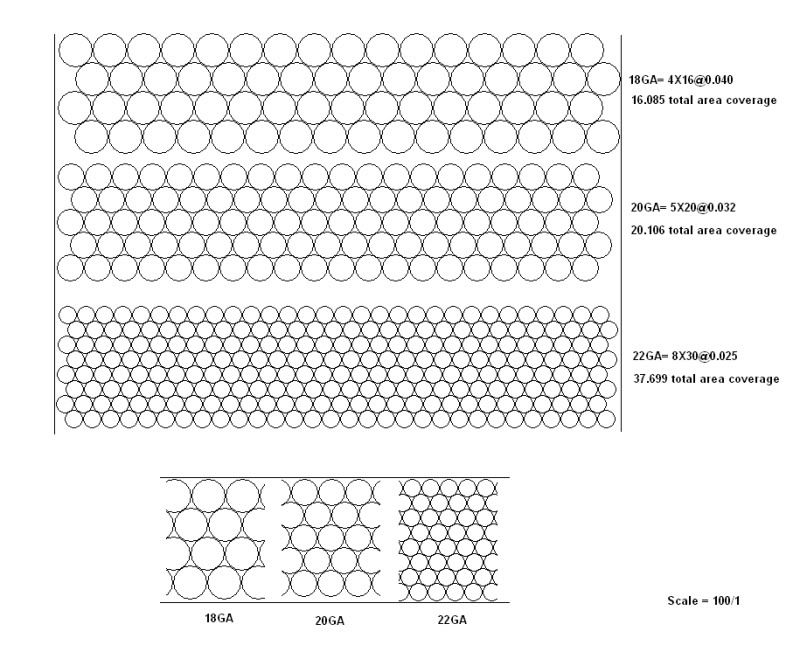
Ok guys, here's the technical stacking as done in a pixel based 100/1 scale CAD drawing with ACTUAL stacking justification results.

I think this will work. Making potentially up to twice the current with the same voltage if I use two wires per post of a 22GA instead of a single 18GA. Granted I don't want twice the current by any means, but 1.5 times sounds VERY plausable to me. Any other comments or thoughts? LikeI said, if ya'll say HELL NO DONT DO IT, then I'm gonna drop it. But if there is any additional supporting evidence that this theory will work as I'd expect logically, then I might just go ahead with it.

Coildiamtest.jpg
 
Last edited:
Interesting. :-k

Not getting into hard numbers, but I have always heard the rule of thumb that doubling your wire increases the current-carrying capability equivalent to three gauge sizes. Therefore, doubling your 22 gauge would be about the same as a 19. That seems to be a bit less than 18. :o

A couple other questions. What are the numbers for "total coverage area"? They seem to be rather low if they are supposed to be the percentage of the area covered by wire. The picture for the 18 gauge sure seems to cover more than just 16% of the area. :-k

Also, look at how many more windings you are getting in there. With the 18 gauge, there are 64 turns. With the 20 gauge, there are 100 turns, but since you are splitting that into two wires, there would be 50 turns each. Not sure if the fewer turns would produce enough voltage at lower rpm. Maybe the extra efficiency of an FET regulator might compensate. With the 22 gauge wire, you have a total of 320 turns. Again, split into two wires, that's 160 turns for each. :eek: Two and a half times the original.

Seems that the 20 gauge might work, if an FET regulator compensates for the lower output at lower rpm, and the doubled 20 gauge would be the equivalent of a 17 gauge wire.

Thanks for taking the time to work that up, it's something I would have had to actually wind with wire.
For all the effort of the extra wire, I think I will just stick to a single 17 gauge wire.

.
 
Smaller wire = (heat) = Less Conformal coat on wire = More chance of short/breakdown etc... Just a thought and somthing i'm seen various times.. Just a thought... Balance A stators got to know it's limitations !!! As Dirty Harry would say !!! LOL
 
Interesting. :-k

Not getting into hard numbers, but I have always heard the rule of thumb that doubling your wire increases the current-carrying capability equivalent to three gauge sizes. Therefore, doubling your 22 gauge would be about the same as a 19. That seems to be a bit less than 18. :o

A couple other questions. What are the numbers for "total coverage area"? They seem to be rather low if they are supposed to be the percentage of the area covered by wire. The picture for the 18 gauge sure seems to cover more than just 16% of the area. :-k

Also, look at how many more windings you are getting in there. With the 18 gauge, there are 64 turns. With the 20 gauge, there are 100 turns, but since you are splitting that into two wires, there would be 50 turns each. Not sure if the fewer turns would produce enough voltage at lower rpm. Maybe the extra efficiency of an FET regulator might compensate. With the 22 gauge wire, you have a total of 320 turns. Again, split into two wires, that's 160 turns for each. :eek: Two and a half times the original.

Seems that the 20 gauge might work, if an FET regulator compensates for the lower output at lower rpm, and the doubled 20 gauge would be the equivalent of a 17 gauge wire.

Thanks for taking the time to work that up, it's something I would have had to actually wind with wire.
For all the effort of the extra wire, I think I will just stick to a single 17 gauge wire.

.

Well, for my design model, I had to find the closest form factor packaging to accommodate a closer variance factor to better illustrate the difference in total area coverage of the cross section of each wire. The picture demonstrates that, while occupying the nearly identical volume of space, (the wires at 100x magnification) there is a higher concentration/density of copper in the 22GA wire windings then the 18GA wire. In this example, the 18GA wire cross section occupies 16.085 in^2. Whereas the 22GA wire cross-section occupies 37.699^2 while taking up the same amount of form factor real estate. The theory is the only option demonstrated here. I am aware that the heat would increase exponentially from a lesser gauge carrying the same current/voltage as a higher gauge wire of the same turns and length. However, the illustration was to demonstrate the cross sectional benefit of additional conductive material able to fit into the same original form factor. As the scale illustrates, the cross sections displayed are 100/1 enlargement. This shows us in in^2 that using SIMILAR amount of windings, we can use less wire, taking up less space, and reaping the benefit of additional surface valence conductivity AND throughput valence conductivity. So to sum this up: to use two (2) 22GA wires in parallel, instead of one (1) 18GA, I find that there is BOTH a greater surface area AND cross-sectional area through which current can flow. This is proportional on a parabolic level to the heat loss for the same surface and cross-sectional area of an 18GA with significantly reduced surface valence. The result: hotter wire is the single 18GA according to heat equation. the form factor can be reduced in size to allow for identical passage of current, however, since I'll be using the FH10BA 50A rectifier and I want a few running lights, I'll need a lil higher output to accommodate this. Therefore, a slightly increased voltage output is prefered while maintaining a similar or even lessened thermal effect from identical or even increased current. I'm just asking questions here. But my theory ( I feel) is not yet disproved. Maybe I'm just THAT GUY that wants to be some stupor hero.. I dunno. but so far as I can see, the theory is sound. Effort is not a part of my equation here. It's going to suck to rewind my stator either way... But if I can make it better, why wouldn't I?
 
Last edited:
Back
Top