• Required reading for all forum users!!!

    Welcome!
    Register to access the full functionality of the GSResources forum. Until you register and activate your account you will not have full forum access, nor will you be able to post or reply to messages.

    A note to new registrants...
    All new forum registrations must be activated via email before you have full access to the forum.

    A Special Note about Email accounts!
    DO NOT SIGN UP USING hotmail, outlook, gmx, sbcglobal, att, bellsouth or email.com. They delete our forum signup emails.

    A note to old forum members...
    I receive numerous requests from people who can no longer log in because their accounts were deleted. As mentioned in the forum FAQ, user accounts are deleted if you haven't logged in for the past 6 months. If you can't log in, then create a new forum account. If you don't get an error message, then check your email account for an activation message. If you get a message stating that the email address is already in use, then your account still exists so follow the instructions in the forum FAQ for resetting your password.

    Have you forgotten your password or have a new email address? Then read the forum FAQ for details on how to reset it.

    Any email requests for "can't log in anymore" problems or "lost my password" problems will be deleted. Read the forum FAQ and follow the instructions there - that's what we have one for...

  • Returning Visitors

    If you are a returning visitor who never received your confirmation email, then odds are your email provider is blockinig emails from our server. The only thing that can be done to get around this is you will have to try creating another forum account using an email address from another domain.

    If you are a returning visitor to the forum and can't log in using your old forum name and password but used to be able to then chances are your account is deleted. Purges of the databases are done regularly. You will have to create a new forum account and you should be all set.

My gs450L starter motor does not respond

dennco2

Forum Mentor
I have not ridden my 450 in many months because it wouldn't start but now that it is warm ... I want to fix the starter problem. I ordered a starter motor repair kit with new brushes, etc. for $14.

Last fall, the 450 was running just fine and then I suddenly had a starter motor issue. I could hear the starter relay clicking ... but no starter motor spinning. My assumption is a bad starter and I want to pull it and apply 12 volts to it directly to see if my assumptions are correct .... UNLESS there is a better way to determine starter motor condition in the engine case?

THE BIG QUESTION IS: On the 450L model, do I have to loosen the 2 carbs and tilt them up (or take them off) to get clearance for the removal of the starter motor? I have taken the carbs off 2 to 3 times previously (for cleaning) .... and would love not to do it again if not needed!
 
put the bike in neutral and just short the solenoid across the two big bolts with a screw driver...that'll test starter.

OR take one step back in the system and apply + voltage with a piece of handy insulated wire from Battery + to where you see a yellow/green striped wire connected to solenoid..this'll test solenoid and starter together which will leave you with bad connections or bad switches at button and clutch-safety switch.

all that said, a weak battery can be your problem too...check water level in a wet battery, charge it .. Sealed batteries are a slightly different animal. But they die too.

it's been awhile but I think for sure the cam-chain tensioner will want to come off to get the starter out... I don't remember removing carbs.
 
Last edited:
all that said, a weak battery can be your problem too...check water level in a wet battery, charge it .. Sealed batteries are a slightly different animal. But they die too.

Agreed, start with the basics and work your way from there, if the battery is good then go to the starter relay jump test Gorminrider mentioned.
 
yes-I should have put battery first maybe...it can make the solenoid click but poop out when the starter makes its big demand.

.. AND then there's "ground"- always, the "grounds"...your solenoid grounds through the base plate then to frame then to battery neg so be sure that it is cleanly bolted to the frame. ....the clutch safety switch and starter button and on These bikes, the kill switch too are all inline to deliver + through the solenoid coil and finally to ground.
 
So far, I have charged the 2 year old battery and I get 12.44 volts. I tried to short a screw driver across the relay terminals .... no spark. I think I momentarily shorted the + to some other nearby metal and got a big spark. I tried to short the terminals with a long insulated wire with small clamps on both ends ... and no spark with ignition ON or OFF. Then with the ignition ON, I pressed the starter button and could hear and feel the relay working, but the clicking sound seemed weak. Nothing so far even budges the starter motor.

So why is my attempts to short the relay leads not working? Why does the starter button seem to be delivering voltage to the relay .... but nothing to the starter motor?
 
Previously, I remember removing the starter relay and cleaning up the mounting plate and screw areas ... with the intention of improving the ground to frame. I don't suspect that as a problem but will take it off again if you think it is a problem.
 
So far, I have charged the 2 year old battery and I get 12.44 volts. I tried to short a screw driver across the relay terminals .... no spark. I think I momentarily shorted the + to some other nearby metal and got a big spark. I tried to short the terminals with a long insulated wire with small clamps on both ends ... and no spark with ignition ON or OFF. Then with the ignition ON, I pressed the starter button and could hear and feel the relay working, but the clicking sound seemed weak. Nothing so far even budges the starter motor.
.
.
.

All good test.
Seem to be pointing the the starter motor not being a starter motor any more.

You mentioned having a voltmeter, so for a final test: Take the cover off the starter motor cavity, so have access to the cable to the starter motor. Test for voltage at the starter motor termional when try to start it.
If have voltage at the starter motor termional, but no cranking, then you know everything else is okay and the starter motor is not a starter motor anymore.
Check th voltage with the meter negitive on the battery-, and then again with it on the engine cases just to verify the engine case is grounded.

Also: I am kinda wondering how you knew to get a 2 brush rebuild kit OR a 4 brush rebuild kit without habeing taken out the starter.


.
.
.
. . . . . . . . Why does the starter button seem to be delivering voltage to the relay .... but nothing to the starter motor?

Do you actually know is not voltage at the starter...? Or just saying that because starter doesnt turn....?


.
.
.
So why is my attempts to short the relay leads not working? ....

Beacuse the starter motor is not a starter motor. Is no path for the current to flow. Probably brushes worn so short that they are not making contact with anything.
 
Previously, I remember removing the starter relay and cleaning up the mounting plate and screw areas ... with the intention of improving the ground to frame. I don't suspect that as a problem but will take it off again if you think it is a problem.

You say the solenoid is clicking when push the button, so the solenoid must have a ground or it would not even click.
 
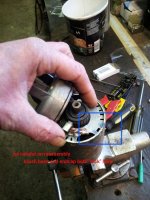
I tried to apply 12 volts directly to the starter motor bolt terminal with the cover off and ground to the starter case. Nothing happened. So after pulling the cam chain tensioner off I was able to pull the starter motor out with 2 bolts and slide out. I pulled the motor apart and nothing looked bad. The brushes looked like about 25% worn. The commutator surface was black and coated. I sanded that caked on junk with 1000 grit and then installed the starter motor rebuild kit but mostly just the 2 brushes and new plate. I had trouble getting it back together but finally got it and applied 12 volts. Again nothing! No spinning. The motor seems to be difficult to turn over by hand.

I checked my leads to make sure they were carrying current and they were. Apparently I have a dead starter armature?? How do I confirm my suspicions? Looks like I have to buy a good used one on Ebay?
 
12.44v on a freshly charged battery isn't good, you might want to pull it out and have it load tested. Pretty much any place that sells batteries should be able to do this for you.
 
12.44v on a freshly charged battery isn't good, you might want to pull it out and have it load tested. Pretty much any place that sells batteries should be able to do this for you.

Yeah, I might need a new battery too .... but I am trying to see if I need a new or working starter motor right now. I tried to spin my starter motor using a spare car battery ... but no movement at all. I am pretty sure I put the motor back together correctly ... but now am wondering if I had the brush plate oriented correctly? I assume there is only ONE way to reassemble that part? I'll try to pull up a youtube video. My mechanic know how and skills are marginal :(
 
I had trouble getting it back together but finally got it and applied 12 volts. Again nothing! No spinning. The motor seems to be difficult to turn over by hand
It's re-assembled badly. Take it apart and do it properly.. the motor should not be hard to spin with your fingers...it won't ever spin free like a brushless motor will, but it should not be hard to do..the brushes are the only thing that touch the armature, excepting the bearings at each end of the armature shaft.

I know it's harder than it sounds fighting the magnets and so on but pay particular attention to" locating tabs"-so important, I kept a picture...and I think I remember it's possible to get the brush plate in "wrong-way out"

Replacing StarterBrushes.jpg
 
Last edited:
Thanks for the huge tip there Gorminrider. I pulled the end cap off to inspect my work and saw the alignment tabs and the brush plate settled in there better than before and the end cap had that same tab to lock onto and not rotate out of alignment. The brush plate aligned to prevent rotation, but could be pushed up and down relative to the width of the commutator. Because of the pressure of the 2 brush springs pushing from 1 side ... the plate wanted to tip out of alignment and I am not sure it self-centers after re-installing the end cap. The motor case and caps popped back together easier this time and the long screws aligned and tightened with no problem. However, the motor still turns over by hand rather stiff ..... but now works with voltage applied!

Is it possible that the brush plate (and brushes) are not aligned to the com. I assumed the end cap would auto-align the plate when reassembled ... unless the plate was pushed to far away from the cap?
 
well, "stiff to turn" is hard to compare... but you have it spinning and that's good! It should really buck when you apply power from a good battery
the plate wanted to tip out of alignment and I am not sure it self-centers after re-installing the end cap.
hmm hard to know-like a fridge's light bulb!- but I think it'll be ok..in doubt? put a little piece of folded paper or thin cardboard in to jam the plate in place...cut away any excess of course

I'm assuming you have the same starter as in the picture...that dimple-indentation on the shell is not so obvious in my picture but IT will hold the brushes and the endcap in correct alignment....when it's together right, it has a certain feel and fit that is perfect.

a general thing that might apply since I don't have the scheme of the motor to hand...sometimes there are shims or spring-washers on the end of the armature that can bind if not in order...

"strike-up" marks with a pencil or chalk on all three shell parts also help to tighten the thing up in the correct alignment...and Should have been made before taking it apart...tut-tut. (I suffer from the same hubris and I'm reminding myself yet again...)

Yet another tip....kind of obvious but if you loosen the long screws a little and twist the motor a bit...when the screws are perfectly aligned, they will be at their "straightest" with the most bolt showing out the holes and that's where you tighten them....

there's some other general stuff that you might find helpful.....when a DC permanent magnet motor is shorted,(when the insulated connection (+) is grounded to the shell), it becomes harder to turn....the more "windings" the armature has, the harder it will be to turn. Since starters generally have few windings and I don't have a suzuki one at hand now I can't guarantee yours will feel differently but if you do find that it's easier to turn unshorted than shorted that's a clue about whether you have the insulated connection correct...(it can also be a clue your windings are shorting too but you'd need another similar motor to compare with...)

well, belay that. Not enough windings in these! I went out a pulled out a spare to see.... And they are stiff to turn but not "hard"-he springs on the brushes are strong.
 
Last edited:
Yes, I had taken a black marker pen to mark the outsides of both end caps and case previously and that got me oriented properly ... but since the brush plate wasn't full seated the end cap did not lock in the 1st time.

I charged up the battery again using a different slow charger and then got 13.15 volts. I just installed the battery in the bike again and this time when I press the starter button, I get a "buzzy" sounding starter solenoid ... not a clear cut click noise. Maybe the internals of the solenoid has corrosion? I cleaned all the battery connections. Maybe the starter button needs to be cleaned again? I'll try that but then I am bamboozled what to try next? I might try applying 12 volts directly to the starter motor again. I had used a variable voltage power supply to run the motor. The old car battery wouldn't turn it at all even tho my cheap HF multi meter said it had over 12 volts. I am slow charging that one too but it had been sitting for years.

When viewing the solenoid as it sits on the bike .... is the green/yellow wire positioned on the right side next to the big terminal?
 
Last edited:
"When viewing the solenoid as it sits on the bike .... is the green/yellow wire positioned on the right side next to the big terminal?"​
Yes, that's the trigger wire to activate solenoid . Apply 12 volt positive to it and solenoid should click in - make sure solenoid frame has good ground. Make sure you're in neutral!
its ok to run jumper cables from a NON running car to boost bikes battery.


"When viewing the solenoid as it sits on the bike .... is the green/yellow wire positioned on the right side next to the big terminal?"​
Yes, that's the trigger wire to activate solenoid . Apply 12 volt positive to it and solenoid should click in - make sure solenoid frame has good ground. Make sure you're in neutral!
its ok to run jumper cables from a NON running car to boost bikes battery.


My spare car battery is dead and won't even light up a test light or run a 12 volt motor ... and yet my cheap HF multi meter shows 12+ volts!!? The green and yellow trigger wire lights up a test light when the ignition is ON and I press the starter button. I cleaned the starter button ... but it did appear to not really need it (again). When I short across the big terminals on the solenoid, it just sparks and no clicking of relay now ... and NOTHING happens and no sounds when I hit the starter button. I have not pulled the solenoid frame off again to check for good ground. but I did that last year. It seems that would be the last potential problem before deciding the starter relay is no good and have to get another?
 
Last edited:
My spare car battery is dead and won't even light up a test light or run a 12 volt motor ... and yet my cheap HF multi meter shows 12+ volts!!
yes, but test the voltage when the battery is loaded and it'll be a different story....even the crappiest battery can show 12 or more volts when the only "load" is a multimeter!


You could line up a bunch of tiny AAA batteries to get 12volts but that won't start your bike....and that's a pretty good analogy for the condition of the car-battery you are using...You need a decent battery to go forward.
 
My spare car battery is dead and won't even light up a test light or run a 12 volt motor ... and yet my cheap HF multi meter shows 12+ volts!!?
Not uncommon with a bad battery. It's kind of like having a buch of lazy people. You might have 12 bodies (volts), but they are unable to do any work. You need 12 willing, able bodies. Is this dead motorcycle your only means of personal transportation? If not, park your car near your bike or drag your bike over to your car, use jumper cables to connect your bike to your car, but MAKE SURE THE CAR IS NOT RUNNING. Repeat your tests to see if the starter works. On the other hand, if your only transportation is Uber, Lyft or a bus, you'll have to find a friend with a car. :oops:


The green and yellow trigger wire lights up a test light when the ignition is ON and I press the starter button.
Good. That shows that your IGNITION fuse, kill switch, starter button and clutch switch are all working properly.


When I short across the big terminals on the solenoid, it just sparks and no clicking of relay now ...
When you short across the big terminals, there should not be any clicking of the relay. That will only happen if you connect the yellow/green wire to a positive source. Since you see sparks when shorting the big terminals, you KNOW there is a load downstream, which means the starter is connected. However, you don't know at this point whether the starter is locked up physically and is unable to turn or if the power from the battery is insufficient to do anything more than just make sparks.


... and NOTHING happens and no sounds when I hit the starter button.
Just a little bit ago, you said you at least had power on the yellow/green wire when you pushed the starter button. Do you still have it? Move your test light to the big terminal that goes to the starter, push the starter button. You should see it light up, too.


I have not pulled the solenoid frame off again to check for good ground. but I did that last year.
If the solenoid clicks when you apply power to the yellow/green wire, it has a good ground. No need to remove it to verify.


It seems that would be the last potential problem before deciding the starter relay is no good and have to get another?
Repeat the test just above this: apply power to the yellow/green wire, see if the starter terminal on the solenoid lights up. If it does, your solenoid is likely good. If you feel that you still might need a new solenoid, go to Lowe's, Home Depot, Ace Hardware, any place that sells lawn mowers, get one for a riding mower. Brand new, about $15, will bolt right in, using the same mounting holes.

.
 
yes, but test the voltage when the battery is loaded and it'll be a different story....even the crappiest battery can show 12 or more volts when the only "load" is a multimeter!


You could line up a bunch of tiny AAA batteries to get 12volts but that won't start your bike....and that's a pretty good analogy for the condition of the car-battery you are using...You need a decent battery to go forward.


Agreed ... that old car battery needs to be thrown out. The battery in my Van is the one to use ... to get extra jump to what I THINK is a good motorcycle battery. But I have not load tested it ... as yet. The poor battery and bike sat for 9 months because it suddenly wouldn't start last fall and I decided to fix it when the weather warmed up again. My other bike is a Honda Nighthawk and has gotten me thru the winter with occasional riding just fine. I enjoy riding the GS450 more than the Honda around town ... for being lighter and more quiet and just a better feel and body position while riding. The Suzuki has also been a big pain in the a** .. due to parts quitting on me at inopportune times. It hasn't been very well taken care of by previous owners.
 
Back
Top