• Required reading for all forum users!!!

    Welcome!
    Register to access the full functionality of the GSResources forum. Until you register and activate your account you will not have full forum access, nor will you be able to post or reply to messages.

    A note to new registrants...
    All new forum registrations must be activated via email before you have full access to the forum.

    A Special Note about Email accounts!
    DO NOT SIGN UP USING hotmail, outlook, gmx, sbcglobal, att, bellsouth or email.com. They delete our forum signup emails.

    A note to old forum members...
    I receive numerous requests from people who can no longer log in because their accounts were deleted. As mentioned in the forum FAQ, user accounts are deleted if you haven't logged in for the past 6 months. If you can't log in, then create a new forum account. If you don't get an error message, then check your email account for an activation message. If you get a message stating that the email address is already in use, then your account still exists so follow the instructions in the forum FAQ for resetting your password.

    Have you forgotten your password or have a new email address? Then read the forum FAQ for details on how to reset it.

    Any email requests for "can't log in anymore" problems or "lost my password" problems will be deleted. Read the forum FAQ and follow the instructions there - that's what we have one for...

  • Returning Visitors

    If you are a returning visitor who never received your confirmation email, then odds are your email provider is blockinig emails from our server. The only thing that can be done to get around this is you will have to try creating another forum account using an email address from another domain.

    If you are a returning visitor to the forum and can't log in using your old forum name and password but used to be able to then chances are your account is deleted. Purges of the databases are done regularly. You will have to create a new forum account and you should be all set.

Rhythmic pop or stumble when idling (with video)

  • Thread starter Thread starter Guest
  • Start date Start date
G

Guest

Guest
Hi all,

My GS1000G (all stock) has gone through a pretty extensive (for me) overhaul over the past couple seasons: carb cleaning (detailed teardown/rebuild, following all the directions here), full set of o-rings, new intake boots and pipes, new fuel and vacuum lines, airbox carefully resealed, valve clearances adjusted, carbs synced. Pilot screws on 1&4 are all the way out (4 turns), while 2&3 are about 3 turns out. Runs and accelerates just fine, but some popping/backfiring when letting off the throttle. If I open the choke a bit while riding, this popping goes away. So, I know I'm still running lean, don't have more room to open up the pilot screws, so I probably haven't found all my GD intake air leaks. Will pull and inspect plugs this weekend.

Having said all that, after a couple quick spring shakedown rides, I've noticed a rhythmic stutter/pop when fully warmed up and idling. This video is after a 20 minute ride: https://youtu.be/RtOr66E8EqQ. If you listen carefully, you can hear a soft popping sound every half second or so. (Also, when I rev the throttle at the end, you can hear the louder off-idle popping I'd mentioned above).

What are your thoughts on the idle popping... likely a side-effect of exhaust detonation because I'm running lean? Or maybe an exhaust leak? I should add that I do have a sporadic exhaust rattle on one side (not heard in the video) which tells me that there are rust issues going on in there, but I don't want to swap out the exhaust unless as a last resort.

Thanks in advance!
Chris
 
Those pilot screws are set really high, are you running stock jet sizes?
 
Yep, confirmed stock - when I had them apart, I checked the jet stamps.

I agree, they are really far out, and I'm assuming I'm missing an air leak somewhere...
 
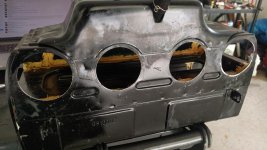
Have you checked the airbox? The filter cage foam can be renewed with weatherstrip foam if it's deteriorated. The airbox side covers must also be air tight too. Foam can be used as needed for that as well.
 
Have you checked the airbox? The filter cage foam can be renewed with weatherstrip foam if it's deteriorated. The airbox side covers must also be air tight too. Foam can be used as needed for that as well.

Hey Ed - btw, thanks for the Carb tutorial, it was a huge help!

Yeah, I've had the airbox apart twice now (though not yet this season). Both times, I'd sealed it up with foam weatherstripping, both around the filter cage and the side covers. The thing is, I can see that there's a slight amount of warping along the front face of the airbox - the openings for the boots aren't all evenly round, and I suspect that the box may have been bent by a drop at some point in the past (I know it had been dropped, based on a crack in the original Suzuki-branded fairing, I just don't know whether it would have affected the airbox).

Last season, I went as far as to add some silicone seal around the boots, but I'm wondering if sitting in the garage all winter has compromised whatever seal the silicone may have added. I'm guessing it's time to pull the box again and give the weatherstripping a close look.
 

Attachments

  • IMG_20180801_145332.jpg
    IMG_20180801_145332.jpg
    97.2 KB · Views: 0
I am going to quote some of your statements, but leave out a bunch of extra "stuff". :-k
Pilot screws on 1&4 are all the way out (4 turns), while 2&3 are about 3 turns out. ...

If I open the choke a bit while riding, this popping goes away. So, I know I'm still running lean, ...

What are your thoughts on the idle popping... likely a side-effect of exhaust detonation because I'm running lean? Or maybe an exhaust leak? ...

I'm assuming I'm missing an air leak somewhere. ...

I'm guessing it's time to pull the box again and give the weatherstripping a close look.
It's nice that you gave Ed thanks for a great tutorial, did you also notice the advice in his signature?
"To measure is to know."

You are doing quite a bit of assuming and guessing.

First, why are your pilot screws at those settings? I am not saying they are wrong, I'm just wondering why you have them set there. Not every carb will have the same settings, not even in the same rack. I did a set of carbs for my son several years ago. Three carbs were in the 2 1/4 to 2 3/4 range, but the fourth one needed to go to almost 4 turns. Might have been due to a smaller pilot jet, I never did check.

Because of the way our carbs work, opening the "choke" does not always richen things up. Moving that plunger adds fuel AND air. You might have a rich mixture to start with, adding "choke" adds just enough air to lean it out a bit. When the throttle is closed, there is enough vacuum to pull fuel from the float bowl, but when it's open, you will likely get mostly air. You need to read the spark plugs to see what is actually happening.

I listened to the video. The popping could be a RICH mixture that is hanging around in the pipe and the next hot flash that comes by is igniting it. You need to read the spark plugs to see what is actually happening.

You might have an air leak, but you need to read the spark plugs to see what is actually happening.

Read up on the procedure to to plug chops. A new set of plugs makes it easier, and there is no actual dissection of plugs involved, just "chopping" the throttle after running at specific throttle openings and killing the ignition at the same time while coasting to a safe place where you can remove a plug and check the color. ("To measure is to know.") No numbers involved in that measurement, just read the color.

I guess the bottom line is: You need to read the spark plugs to see what is actually happening.

.
 
It's nice that you gave Ed thanks for a great tutorial, did you also notice the advice in his signature?
"To measure is to know."

You are doing quite a bit of assuming and guessing.

Agreed :)

why are your pilot screws at those settings?

Last season, when I'd balanced the carbs, I'd installed a new set of plugs, and #s 1&4 were a bit whiter than 2&3, hence some of my assumptions. But I have not yet done a chop test, so your concern about my jumping to conclusions prematurely, lacking data, is very valid.

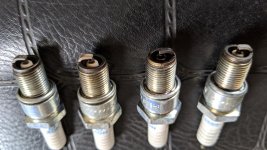
For what it's worth, here's how those plugs are looking today (not after a chop test) - note the order in the photo is #4 on left, #1 on right:
IMG_20190420_141118.jpg

If anything, #2 looks rich (to my untrained eye)

I'll pick up a new set of plugs, perform a chop test, and then will hopefully have some better data to work with. But, before I do, I'm wondering if I should start by dialing back the mixture on that #2 cylinder first?
 
I will confirm that #2 is, indeed, rather rich, but will have to ask, under what circumstances were those plugs running? :-k

That is what is important with the plug chop test. To save some research, here is the basic concept.

Mark your throttle. Put some tape on the housing and the throttle grip. Make matching marks at idle. Move the throttle to full open, make a mark on the housing there. Measure between idle and full, make a 1/2 mark, repeat for a 1/4 mark.

IMG_3646.jpg


Warm up the bike so you don't need to use the "choke". Install a fresh set of brand-new plugs. Start the bike, let it idle for a couple of minutes, turn it off. Read the plugs. Pictures at this time are great for documentation.

With the plugs back in, find a place where you can ride and hold the throttle very steady at 1/8. It does not matter much whether you are in second gear or fifth, the important part is 1/8 throttle. Hold it there as long as possible, a full minute would be great. Pull the clutch, hit the kill switch, coast to a stop where you can safely remove the plugs. Take a picture of the plugs, continue on your ride.

You may have to find a small hill, but repeat on 1/4 and 1/2 throttle settings. Using a higher gear will allow you to hold 1/2 throttle longer, 30 seconds will be a decent opportunity for coloring the plugs.

Finally, find somewhere where you can safely get up to higher speed and also has a pull-out area where you can read the plugs. Get into fifth gear by about 30-35 MPH, then hold the throttle wide open. It should only take 10-15 seconds to get a good reading, but you will proably be doing well over 70 by that time. Again, read the plugs.

Each of the throttle settings will determine which jets are in use, and they all overlap a bit, so we need to see them all. For example, with your one picture, if that was at idle, I would guess that everything might be pretty close, but your petcock diaphragm was leaking, allowing extra fuel. If that was after a run down the drag strip, your main jets would be entirely wrong, but mostly in just one carb. That is why it's important to know what was happening just before those plugs were pulled.

.
 
Steve, thank you very much for such a clear and detailed explanation! While I have read about the "chop" test before, it was not obvious to me how the sequence of tests corresponds to the four stages of carburetion, or how the results indicate the mixture at each throttle position. I will perform these tests this week.
 
So, I haven't yet run my chop tests, but I first decided to re-do my "highest idle" test. And, since I had my tank off, figured it wouldn't hurt to check that the carbs were still in balance.

Well, I was surprised to see that, even though I'd balanced my carbs last season, when I hooked up the Carbtune, #1 and #2 (especially #2, which is the one with a rich-looking plug) were out of whack, with the bar for #2 being significantly higher than the others. After I rebalanced, they now hold at the expected levels (nearly flat, with 1&4 a bit higher)

I then went through the highest idle test, starting at 2 turns out. I think I now have #s 1, 3, and 4 dialed in pretty well (I'm estimating that they're all at <3 turns).

Here's the odd part, though. The #2 pilot screw doesn't seem to make any difference to my idling rpm, whether I dial it all the way in or out. Yet, I can see from the Carbtune that the vacuum levels are good, so it's not like there isn't any fuel/air flowing through the pilot circuit, right? Could it be that, by having to make an adjustment to #2's throttle opening when rebalancing, I've effectively cut out the pilot system on that carb?
 
Did you plug the vacuum port on #2 when you were balancing?
 
Did you plug the vacuum port on #2 when you were balancing?

This.... and check that the vacuum line into the #2 carb isn’t leaking fuel.

I plugged the vacuum line with something very similar to a golf tee, and the tank was off, so no chance of a fuel leak from the line. And the Carbtune plug into the #2 port felt snug. Though I suppose it's possible that the seal on either the hose or the port might not have been 100%.

The funny thing is, I just got back from a nice long shakedown ride, and she's now running better than ever since I bought the bike. So, whatever is (or was) going on with that #2 carb isn't causing any noticeable problems <shrug>

I'll still do the chop tests - probably will be more useful now that they're at least balanced...
 
I meant leaking fuel while hooked up and running. The diaphragm in the petcock might be leaking a bit, hence #2 looking rich.
 
I meant leaking fuel while hooked up and running. The diaphragm in the petcock might be leaking a bit, hence #2 looking rich.

Ah, sorry, that makes sense. I don't think so, the petcock is pretty new, and I've checked it for leaks in the past, though it certainly won't hurt to check it again. Thanks for the suggestion!
 
Back
Top