• Required reading for all forum users!!!

    Welcome!
    Register to access the full functionality of the GSResources forum. Until you register and activate your account you will not have full forum access, nor will you be able to post or reply to messages.

    A note to new registrants...
    All new forum registrations must be activated via email before you have full access to the forum.

    A Special Note about Email accounts!
    DO NOT SIGN UP USING hotmail, outlook, gmx, sbcglobal, att, bellsouth or email.com. They delete our forum signup emails.

    A note to old forum members...
    I receive numerous requests from people who can no longer log in because their accounts were deleted. As mentioned in the forum FAQ, user accounts are deleted if you haven't logged in for the past 6 months. If you can't log in, then create a new forum account. If you don't get an error message, then check your email account for an activation message. If you get a message stating that the email address is already in use, then your account still exists so follow the instructions in the forum FAQ for resetting your password.

    Have you forgotten your password or have a new email address? Then read the forum FAQ for details on how to reset it.

    Any email requests for "can't log in anymore" problems or "lost my password" problems will be deleted. Read the forum FAQ and follow the instructions there - that's what we have one for...

  • Returning Visitors

    If you are a returning visitor who never received your confirmation email, then odds are your email provider is blockinig emails from our server. The only thing that can be done to get around this is you will have to try creating another forum account using an email address from another domain.

    If you are a returning visitor to the forum and can't log in using your old forum name and password but used to be able to then chances are your account is deleted. Purges of the databases are done regularly. You will have to create a new forum account and you should be all set.

Setting the timing properly

I'm happy you found out what's going on. Your taking it off the pistons, not the head, right? It would be better if you could mill it off. Balance issues and what not, I wouldn't touch the top of the combustion chamber. You should weight each piston and make sure they weight the same.

It's always better to take your time and be ultra careful. It's not only time and money, but effort and experience, and the thrill when you go down on that much hotter bike that give you that incredible feeling when you riding on an engine you rebuilt. It's addictive. I've been lucky and have built a few, including a couple of Lycoming Engines(When I was training for an A&P license), 4.5 liter Mercedes V-8, a straight 6 dual overhead cam 280C Mercedes engine, and a few more bike engines. The feeling is addictive, makes you want to jump into another one.
 
Well the plan was to take off of the head as thinning the pistons would make them a much weaker area, I also learned that 750 pistons wouldn't fit properly either because of the layout in the 650 head,

what I'm going to have to check is if the spark plugs would interfere at all because it'd be a waste to dremmel out areas of the head only to find out the spark plugs interfere.

But yes, it'd be the head not the pistons, I've already asked about if it could cause an air pocket and make for an inefficient combustion. I don't know if I will start the process today and I might try to find other solutions, I could make my own gasket that is much thicker but I think the problem with that is since the valves don't interfere it would make it to where it's a lower compression going on.
 
I could make my own gasket that is much thicker but I think the problem with that is since the valves don't interfere it would make it to where it's a lower compression going on.

With the pistons hitting the head you would summise that even with clearancing the chamber in that spot the piston may then hit elsewhere or the compression may be too high anyway and beyond that once you have a non contact situation between the piston and head you will then need to ensure you have the combustion chamber volume to achieve the correct compression ratio and sufficient valve to piston clearance which will most likely lead to the piston pockets needing relieving too.
What you should really do first is space up the head until the pistons clear the closest point of current contact by 1mm / 40 thou (This is the clearance you need to account for rod stretch etc at high rpm) and then fit a spacer or a base gasket of the same additional thickness to allow the head to be bolted down and the cams etc installed and timed.
Only then will you really see what's going on and be able to measure piston to valve clearances, combustion chamber volumes and clay the pistons etc so you can then make the correct alterations without blindly going from one problem to another.
Also how much was skimmed from the head ?
Are you sure it is the 'O' rings holding the head off the block and not the two location dowels at either side now being too long to allow the head to seat..
 
Last edited:
Check mcmaster-carr for matching metric orings in buna-n rubber. Planing the head results in retarded can timing. Check the cam timing with a degree wheel. It's a study in itself but will save you from wondering later on. I found a great tutoral on it when I checked my CB160. It was 10 deg. retarded, set up by the markings but the pressed on sprocket had rotated off position.
if all else fails, return to stock!
 
if all else fails, return to stock!

Well I'd have to get another pair of cylinders lol as they are already bored out.

there's a note on the site saying that these are a different design so I think they are designed to have the head machined. We will see what happens, still thinking and deciding what I'll do aswell as taking measurements and such.
 
I would consider doubling, or tripling the cylinder base gasket(s) to get the clearance rather than messing with the combustion chamber. If you use Yamabond 3 4, they will never leak. You could do this dry. There is now way on any motor I have ever rebuilt that I would mess with the top of the combustion chamber, so much could go wrong, and it just may never run right. IMHO :)
 
I would consider doubling, or tripling the cylinder base gasket(s) to get the clearance rather than messing with the combustion chamber.)

You really shouldn't stack fibre/paper base gaskets to gain the clearance as the tolerances will be inconsistent and alter when they are compressed.
The correct method is to use an aluminium block spacer which will accurately retain the required height adjustment.
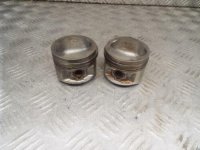
The problem with this 740cc Cruizin Image kit (which they should stop selling) is well known as it uses GS750 pistons with hemispherical domes which don't match and interfere with the 650's bathtub/twin dome combustion chamber design.
See attached pics in this and the next post of the differing pistons.
The only solution is either machining and cc'ing of the combustion chamber, spacing of the barrel or a combination of both to achieve sufficient clearance and appropriate combustion chamber volume.
As stated in my previous post the block needs spacing 1mm / 40thou from the closest point of piston to head contact as a baseline before any other work is undertaken.
Once this is done you need to cc the cylinder at TDC to establish the combustion chamber volume and then calculate the current compression ratio to determine if any other or alternative work is needed.

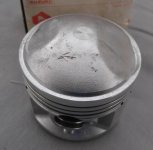
650 PISTONS
You can see the reliefs either side of the dome that clear the squish band in the head.
Click image for larger version  Name:	s-l500 (1).jpg Views:	0 Size:	37.7 KB ID:	1710057
 
Last edited:
That was my thinking aswell, if I put a larger gasket it'd be the easiest solution but then my compression ratio would presumably be lower as the spacing between the pistons and valves would be larger, and in a sense make this bore kit pointless.

The idea is to take out metal from the cylinder head itself, the way i plan to ensure that it is done properly is to put the cylinder head on the cylinder walls without the gasket, ensuring it can spin freely like that, and then i will know there is enough space once the gasket is back on.

The guy I mentioned before joe is the one who let me know to do it like this. And i guess if i take ojt to much ill just have to use some type of hardening compound to make up for the area lost.
 
That was my thinking aswell, if I put a larger gasket it'd be the easiest solution but then my compression ratio would presumably be lower as the spacing between the pistons and valves would be larger, and in a sense make this bore kit pointless.

You cannot presume anything.
The pistons do not match the head and you have no idea of the compression ratio.
The distance between the valves and piston have no bearing on the compression ratio, it's the combustion chamber volume..
You cannot just fit a thicker gasket and cross your fingers.
Doing THAT really WILL make fitting the "big bore kit" pointless and you are likely to end up with a worse engine than you started with for all that wasted time and expense.
If you don't have the knowledge, skill or means to take the correct measurements and perform the appropriate modifications then you really should consider either handing the work over to someone who can or return it back to stock..
 
Last edited:
I suggested gasket as a measurement tool, (and also a viable a fix, as it would work, it's been done before), in reality they do not crush as much as you seem to imply. Better than aluminum, would be to make a Copper gasket. You can reheat those and use them over. I would do anything except grind the inside of the combustion chamber head. Unless you have a milling machine and can make a form tool to get the exact same combustion shape, the motor will be a mess. There was another thread on this forum here the poster was worried about head gasket compression and was shocked that it only compressed something around .01 to .015" of an inch. These gaskets to do not compress that much, they just compressed enough to seal, but that's it. A Copper base gasket can have pressure ridges formed to help in sealing it, and that gasket will compress only so much. That's why a sealer like Yamabond # 4 works so well. That will further seal the surface, while that gasket takes off the shape. There are no gases down there, you're sealing oil, and crankcase pressure. I don't think taking off a millimeter will affect that strength of the piston at that part of it. That work would be best done only a lathe or milling machine, where you can reproduce what you have done consistently. If isn't done right, will be hard to sync, as what would be the proper syncing where each combustion chamber is slightly different? The engine will be lumpy and never make you satisfied. You'll end up hating the effort you put into it.I don't have a horse in this race, I just don't want to see you make some fundamental errors that will come back and there's nothing worse than putting a motor together and realizing that something you did halfway through the build wasted your time, and money. At this point, if you can make a bike that runs strong, you'll be ahead of the game. IMHO. :)
 
i mean its either go back to stock which i will not be satisfied with or do some sort of machining to get these pistons to work.

i could take out part of the pistons but since these are already aftermarket and we haven't had somebody really put them to the test, that could really make them a weakspot.

the reason im thinking about the cylinder head is because the guy that has been helping me was talking about that, id only be doing a little at a time to ensure im not taking out to much or misshape it, it seems like everyone but him is saying not to do that but as far as i can tell itd probably be the best way to go through with this kit, if im honest im not too worried if i screw it up, i mean ive learned so much from this bike and the help from everyone that i could just find another solution to get this motor going well, or just put a whole different motor in the frame.

if i go through with the dremmeling itll probably be tonight, ill talk it through with him, i mean he builds dragbikes and has had plenty of experience doing these things, i know that doesnt mean i do and i wont be as good as him but if i never do, ill never get better at it.

this bike has honestly been more of a learning experience than a bike, and as far as im concerned ive learned more than i ever could off of this bike than i ever thought.

i basically know everything there is to know about diagnosing and fixing and tearing apart/ rebuilding on this particular model, so much that anything ive worked on bike, boat, whatever has been nothing but a success. the next step is modification, if i screw up oh well, it takes me doing one annual service on somebodies boat to get 3 cylinder heads for this bike.
 
i mean its either go back to stock which i will not be satisfied with or do some sort of machining to get these pistons to work.

i could take out part of the pistons but since these are already aftermarket and we haven't had somebody really put them to the test, that could really make them a weakspot.

the reason im thinking about the cylinder head is because the guy that has been helping me was talking about that, id only be doing a little at a time to ensure im not taking out to much or misshape it, it seems like everyone but him is saying not to do that but as far as i can tell itd probably be the best way to go through with this kit, if im honest im not too worried if i screw it up, i mean ive learned so much from this bike and the help from everyone that i could just find another solution to get this motor going well, or just put a whole different motor in the frame.

if i go through with the dremmeling itll probably be tonight, ill talk it through with him, i mean he builds dragbikes and has had plenty of experience doing these things, i know that doesnt mean i do and i wont be as good as him but if i never do, ill never get better at it.

I've been building race engines, drag bikes and much more for over 40 years and i'm not saying you should stop what you are doing but you need to understand what you are doing and go about it correctly otherwise there's no learning involved.
I would be wary of altering those cast pistons, especially on the sides of the crowns as there's likely to be insufficient material that can safely removed so keep away from them.
There's probably some scope for modifying their valve pockets but then again you need to MEASURE the crown thickness in that area to be sure.
If i HAD to make this work i would modify the combustion chambers to suit the pistons ( which I have NOT said not to do ) but again you need to make the correct calculations to work out what volume you really need before removing material from the appropriate areas and not just blindly going at it with a dremel or whatever you have.
You will learn much more following a planned approach rather than winging it and your "drag bike guy" isn't helping by giving you only part of the story IF that's really the case.

I've already stated previously the correct start point to establish base measurements but you seem to have ignored anything i've said and still persist on wanting a quick short cut solution .
Even if you just start taking meat out of the combustion chamber you have to ensure each chamber has the same volume as the rest and the correct volume to achieve the required compression ratio.
Do you know how to CC the chambers as that is the LEAST you need to know for what you intend to do.
 
Last edited:
I don't know why you think taking some off the pistons will weaken them. Pistons are designed with extremely thick tops. That's where you are expected to take stock off for interference issues. If you don't have the machinery to do this though, like a lathe (with milling attachment), or milling machine, you won't be able to match the pistons and will end up with a pile of parts. It might even run, but not as good as it did stock. Consistency is key, as is knowing with what your working with. From your statements, i would advise bringing this to someone who can fit the cylinders to give you the clearance you need. It if's a money issue, save your money till you can send it out. Better to wait the waste your engine. (MHO :)
 
Okay so, here is what I am doing.

I understand that im not doing it as proper as I could be by any means, but I'm still gonna do it, my ignorance is probably the best way I learn things.

okay so how I am doing it is right now I'm using playdoh and putting on the piston heads, getting the pistons to touch the combustion chamber and dremmeling out the areas that show to interfere on the pistons, its a very slow process with the dremmel so i dont have too much worries about overdoing it.

How will I know there's enough space? Well first I'm going off just by checking for interference without the headgasket, once there is no interference without the gasket I will know that there is atleast a mm of space between the piston and chamber in the areas I have had to take out, next i will have the head sitting upside down with the spark plugs in, and fill the chamber with 20cc of water, and then place the pistons ontop of them seeing if any water comes out, if it does I know I am shy of the amount of volume needed in the chamber.

These methods will be questioned along the way from my friend making sure I'm doing it the right way, and so far things have been going on fine, and I think I found a rough draft of making valve paste lol, oil and aluminum dust!
 
Save yourself a lot of time.
Space the head so it clears the piston then clay the head with a non springy compound that won't decompress slightly and give false readings when the pressure is released.
Playdoh isn't really suitable.
Oil the head and piston so the "clay" doesn't stick.
Once done you will be able to carefully section the clay plug and measure the high and low areas and identify where and how much needs removing.
Doing it this way vastly reduces the amount of times you will have to refit and remove the head.
Once you have the head sitting on the gasket with no piston to head interference you can take a final clay to check valve to piston clearance and confirm you have 40 thou at the closest point and then cc the chambers to match them and get the correct volumes.
 
Last edited:
You think that somebody should mention to him that he simply has the wrong pistons?

Nah, let him learn his own way.
 
Update, I think I have one single cylinder done, gonna have to work on the other one in the same crank rotation to make sure it is, the amount of metal I have to take out is pretty wild, I even have to take some out around the valve on the surface of the head.

I'll put it this way, if the valve ends up hitting or a spark plug interferes after I can ensure that the combustion chamber doesn't touch, imma f#$##$ sue lmao. Also if that happens I'm just gonna make this bike chain drive and throw a gsxr motor in it.

I think everyone knows but don't ever buy this kit unless you have a 65mm cylinder with a dome shaped chamber. I'm gonna end up making a actual thread showing all the work that had to be put in for these to work, and I'll end up leaving a review for the kit to stop anyone from getting these.

What would i have done differently if i knew this from the beginning.....either slap a gsx1100 shaft drive motor in the frame or make it chaindrive and slap a gsxr motor in it and call it a day.
 
Good thought, most GS750, GS1000, and GS1100 chain dr's were a pretty easy swap. And I think GS850 shaft to GS1000 shaft and GS1100 shafts would work. It'd be interesting to know about a swap from a GS650G to a GSX1100G eng., That would be a "HOOT"
 
Back
Top