• Required reading for all forum users!!!

    Welcome!
    Register to access the full functionality of the GSResources forum. Until you register and activate your account you will not have full forum access, nor will you be able to post or reply to messages.

    A note to new registrants...
    All new forum registrations must be activated via email before you have full access to the forum.

    A Special Note about Email accounts!
    DO NOT SIGN UP USING hotmail, outlook, gmx, sbcglobal, att, bellsouth or email.com. They delete our forum signup emails.

    A note to old forum members...
    I receive numerous requests from people who can no longer log in because their accounts were deleted. As mentioned in the forum FAQ, user accounts are deleted if you haven't logged in for the past 6 months. If you can't log in, then create a new forum account. If you don't get an error message, then check your email account for an activation message. If you get a message stating that the email address is already in use, then your account still exists so follow the instructions in the forum FAQ for resetting your password.

    Have you forgotten your password or have a new email address? Then read the forum FAQ for details on how to reset it.

    Any email requests for "can't log in anymore" problems or "lost my password" problems will be deleted. Read the forum FAQ and follow the instructions there - that's what we have one for...

  • Returning Visitors

    If you are a returning visitor who never received your confirmation email, then odds are your email provider is blockinig emails from our server. The only thing that can be done to get around this is you will have to try creating another forum account using an email address from another domain.

    If you are a returning visitor to the forum and can't log in using your old forum name and password but used to be able to then chances are your account is deleted. Purges of the databases are done regularly. You will have to create a new forum account and you should be all set.

Those of you who do your own powder coating?.

re

re

Thanks Gatekeeper,
I had the pleasure of visiting the Powder Coating institutes test facility on campus in Raleigh NC (don't know if it's still located there) and play with a lot of what was new toys at the time.
That's where I learned more about cross hatch testing and impact resistance testing,and chemical resistance along with automated lines and infrared ovens (the new thing)
I know they have done a lot to improve quality of powder and even put in over bake protection.
 
Last edited:
Planning on getting one of those little table top blast cabinets, for a one type does all blast media, what would you recommend? Walnut shells? Sand? Soda?
 
Soda is best for soft metals.. Sand will leave a very rough surface. Glass beads on steel parts leaves a slightly less rougher surface than sand will. Walnut shells tend to absorb water and clog up the system..

I have one of those HF cabinets and with a few mods, it works quite well. I use it with soda and glass all the time.. Glass beads in the cabinet with one suction hose, the soda is outside in a bucket with another suction hose going out the drain plug hole. A lot easier that way.
 
I have one of those HF cabinets and with a few mods, it works quite well. I use it with soda and glass all the time.. Glass beads in the cabinet with one suction hose, the soda is outside in a bucket with another suction hose going out the drain plug hole. A lot easier that way.

Don't have the cabinet here yet to look at, but don't they both mix together once you shoot it into the cabinet? Next time you will get a mix?

and does the soda really cut rust and old paint or does it just sit there while you blast and blast?
 
The way my blast cabinet is set up, I have two suction hoses. One that rests at the bottom of the cabinet for the glass beads. As you blast with it, a lot of it falls to the bottom of the cabinet to be reused. But soda explodes on impact, which is why it works so well, so there is little to no recovery of the soda. If you left it fall to the bottom of the cabinet to re-use, you'll find that it doesn't cut as well as when it was fresh.. you end up with an even finer powder once it's used.

As mentioned, I ran an additional hose down through the drain plug at the bottom of the cabinet that feeds soda out of a bucket. Because soda is dense, it doesn't easily collapse on itself and tends to make an air hole from the bottom of the cabinet up to the surface and you're soon sucking air all the time.. you have to bang the cabinet to make it fall onto itself again, and that gets annoying real quick. But now that I have it in the bucket, all I have to do is occassionally tap the bucket with my foot (I use it as a foot rest when doing long jobs) and I avoid that air hole issue all together..

What ever soda residue you end up with inside the cabinet mixes with the glass, this isn't too much of an issue.. its the glass mixing with the soda that is the huge concern. Because I had to blast a lot of parts, I resorted to this quick mod to make the work flow process go easier. Keep in mind also that you have to use a good vacuum cleaner with good filters (think drywall dust but finer) to suck the debris out of the cabinet, especially with soda, it's such a dust storm in there you'd never be able to see what you're doing. The glass beads are heavy enough that the large majority of what you're blasting falls to the bottom again and the dust it creates gets sucked out. Its that fine glass dust you have to be cautious off, bad health hazard.

For cutting through the rust, it depends on the type of surface and the type of rust.. you'll learn quick which works best.. For seriously rusted steel parts, you'll be using glass as soda won't cut through it unless you have a monster compressor that can put out 14-ish CFM at 90 PSI.. I haven't yet encountered anything yet that soda won't cut through on the soft metals.. it will remove rust stains off metal easily enough but for the deep rust, glass works great.

if you decide on getting the HF blast cabinet, be sure to look around for a better pair of gloves.. mine tore through at the arm holes, and they're not 'man' sized gloves.. The cabinet itself is decent, but not perfect, just a little work to make it better...
 
re

re

I preferred to blast the custom parts in house, we used something called star blast.
It looked almost like a combo of fine sand and glass bead.
But it left a really clean and smoother surface.
You don't want a perfectly smooth surface, the powder has to have something to bite into.
If you ever want to powder over chrome, the surface must be abraded in someway.
One of those green scuff pads works good.

I found this company back in the day http://www.prismaticpowders.com/
The have 1000's of colors and have the best quality powder IMHO :D
Not the cheapest but well worth the money if anyone is really into a total resto project.
 
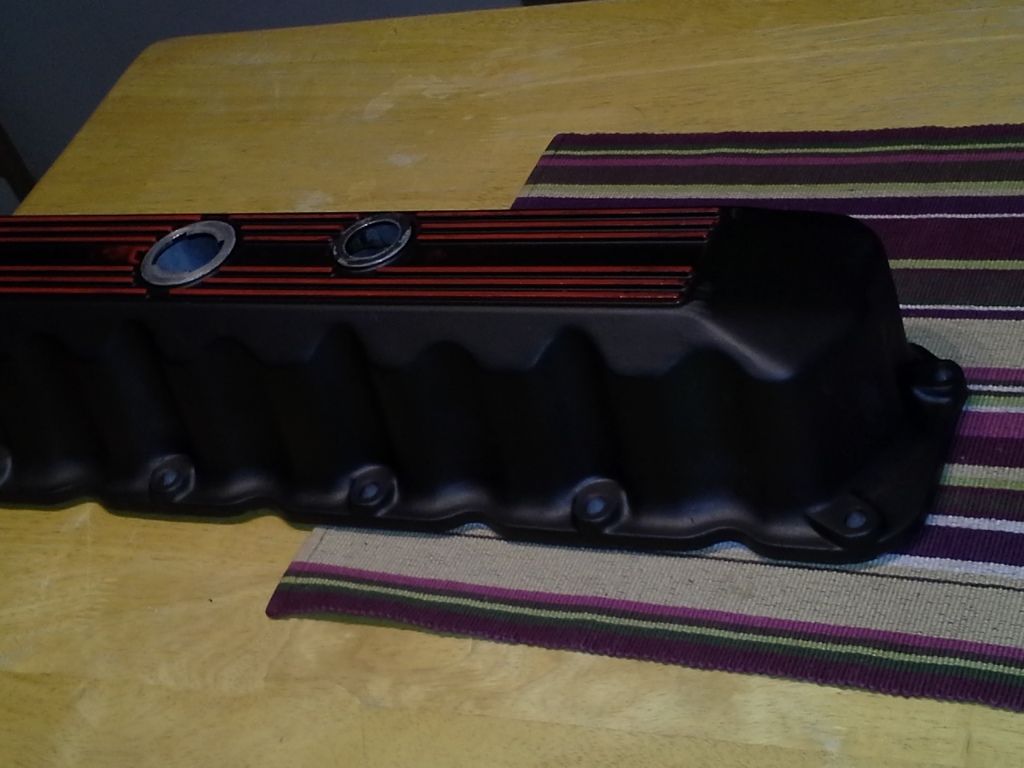
Fail, what happened?

20140216_184006.jpg


Did the red first, cooked it a little, then the black. Planning on taking the black powder off of the red strips with a damp finger, that part worked fine.

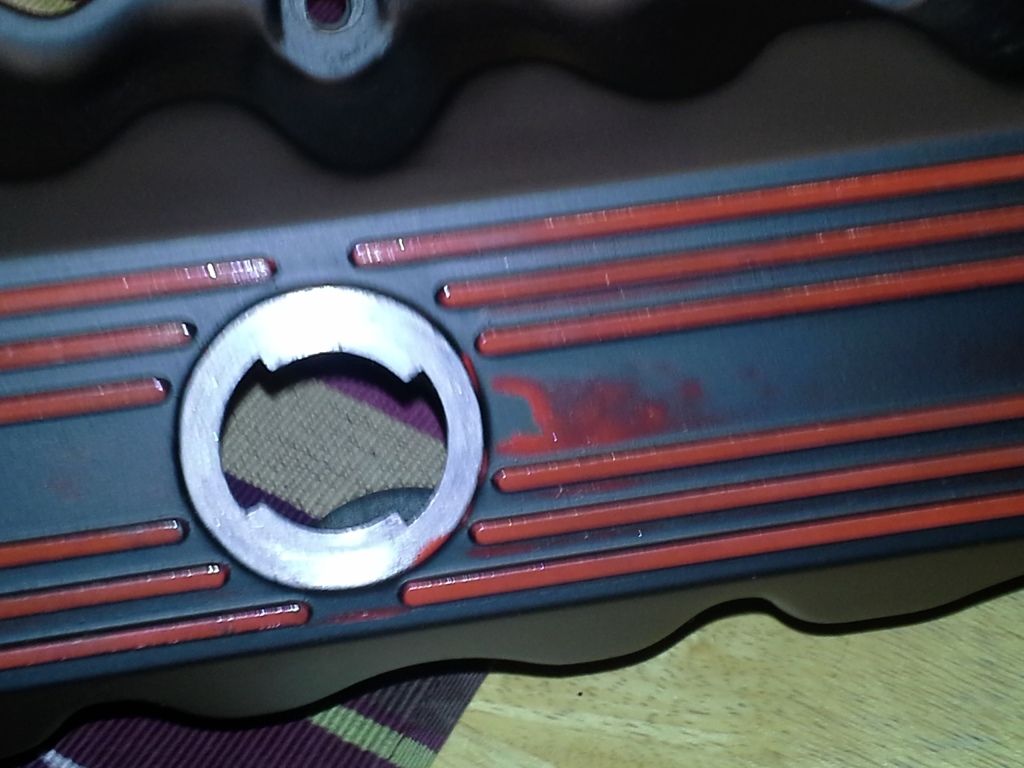
But the black wouldn't cover the red. Just in a couple places, it just wouldn't stick to the red. In the middle here:

20140216_184657.jpg


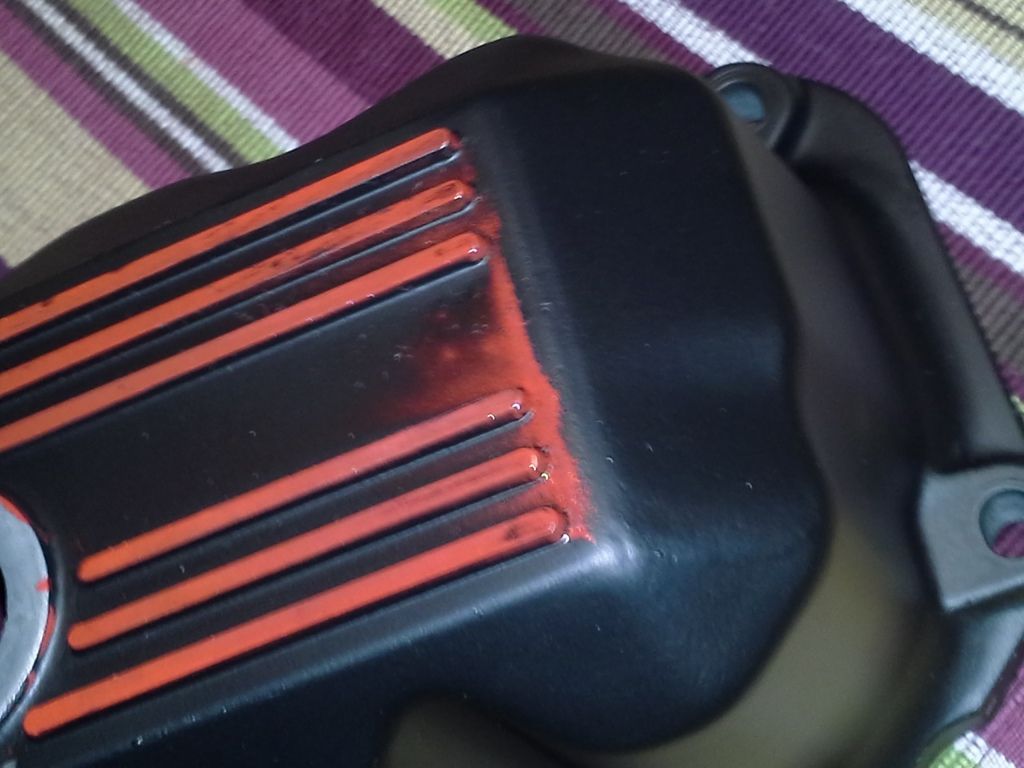
And here:

20140216_184642-1.jpg


Tried the higher Voltage setting, no good. The black just wouldn't be attracted to the red. Any ideas?
 
Hmmm, I read about people doing this two color thing, and also doing multiple coats of the same color. Never heard you can't do it.

Anybody know?
 
Yes you can.
Depending on what type of equipment you are using its really simple.
The first coat should only be flashed (once the first coat glosses only leave it in for half the cure cycle) a fully cured coat acts as a resister and can cause cratering or rejection of the second coat.
Also by the first coat not being fully cured it allows the two coats to bond during the second coat cure.
The trick is to lower the KV setting on the gun and not to get to close to the part. Also move or wiggle the gun back and fourth as you are coating the part(this helps to break the Faraday effect caused by first coat and any angles that are present.
And make sure your part is grounded well... It may take a couple of tries.
If it doesn't work simply blow off the powder of the second coat (make sure there is no residual on it) even can wipe (lightly) with a tac rag.
put it in a hot oven for just a few minutes...this releases the static electricity that has built up. let it cool and try it again.
They make two coat candy's that have a base coat/ tinted clear top coat that are outstanding.
It is all in technique and with a little practice I know you could do it!:D
 
Last edited:
Yes you can.
Depending on what type of equipment you are using its really simple.
The first coat should only be flashed (once the first coat glosses only leave it in for half the cure cycle) a fully cured coat acts as a resister and can cause cratering or rejection of the second coat.
Also by the first coat not being fully cured it allows the two coats to bond during the second coat cure.
The trick is to lower the KV setting on the gun and not to get to close to the part. Also move or wiggle the gun back and fourth as you are coating the part(this helps to break the Faraday effect caused by first coat and any angles that are present.
And make sure your part is grounded well... It may take a couple of tries.
If it doesn't work simply blow off the powder of the second coat (make sure there is no residual on it) even can wipe (lightly) with a tac rag.
put it in a hot oven for just a few minutes...this releases the static electricity that has built up. let it cool and try it again.
They make two coat candy's that have a base coat/ tinted clear top coat that are outstanding.
It is all in technique and with a little practice I know you could do it!:D

I may have cured the first coat too long. I waited for it to get shiny, then get dull again, but it's a shinier powder so it didn't get dull again like the matte black I have been using, maybe waited too long. Also I turned the oven off and opened the door but left it in the oven to cool. I think the end of the valve cover that was in the deep end of the oven might have stayed too hot too long. It worked fine on the other end. Also I was in a hurry, it was getting dark and windy, so didn't think of blowing it off and trying agin.

What would happen if I did the black again now after the full cure? Would curing it twice mess it up? I have heard overcuring is a bad thing?
 
Last edited:
Over curing can be a bad thing, but it mostly pertains to to high of a temp or leaving the part in way longer at temp than what is called for full cure.
What I use to do if I was on the fence about cure,
is to scuff the part that has been cured (green scuff pad works great) only do the black as much as you can.
Blow it off with air and do the whole in hot oven for few minutes thing (let cool)
Then you can shoot the black again.
 
I think, since this engine is going in an old Jeep, and the only person who will ever see it is me right before I spill oil on it, that good enough is good enough. It looks better than it did.

Thanks for the advice.
 
No problem...always willing to ramble on about something I actually know something about ;)
 
Thanks to this thread I'm looking hard at getting one of these PC guns.Tool place locally has then for less than I could bring it in from the US.Thanks tkent02
 
Anything gloss is harder than matte.Be a bit before I can get it but I'm sure it will be handy for all the black I have on the GPz.Tried the wrinkle finish?Some on the GPz I'd like to refinish.
 
No, I haven't tried it yet. I think that's next. Hopefully it works well on messed up surfaces. Seems like it would hide most anything.
 
Which color did you select in your kit

Which color did you select in your kit

Which color did you use? I noticed there were no less than 6 black options : vtwin, powder, wrinkle, mirror, satin, high gloss.
 
Back
Top