• Required reading for all forum users!!!

    Welcome!
    Register to access the full functionality of the GSResources forum. Until you register and activate your account you will not have full forum access, nor will you be able to post or reply to messages.

    A note to new registrants...
    All new forum registrations must be activated via email before you have full access to the forum.

    A Special Note about Email accounts!
    DO NOT SIGN UP USING hotmail, outlook, gmx, sbcglobal, att, bellsouth or email.com. They delete our forum signup emails.

    A note to old forum members...
    I receive numerous requests from people who can no longer log in because their accounts were deleted. As mentioned in the forum FAQ, user accounts are deleted if you haven't logged in for the past 6 months. If you can't log in, then create a new forum account. If you don't get an error message, then check your email account for an activation message. If you get a message stating that the email address is already in use, then your account still exists so follow the instructions in the forum FAQ for resetting your password.

    Have you forgotten your password or have a new email address? Then read the forum FAQ for details on how to reset it.

    Any email requests for "can't log in anymore" problems or "lost my password" problems will be deleted. Read the forum FAQ and follow the instructions there - that's what we have one for...

  • Returning Visitors

    If you are a returning visitor who never received your confirmation email, then odds are your email provider is blockinig emails from our server. The only thing that can be done to get around this is you will have to try creating another forum account using an email address from another domain.

    If you are a returning visitor to the forum and can't log in using your old forum name and password but used to be able to then chances are your account is deleted. Purges of the databases are done regularly. You will have to create a new forum account and you should be all set.

Top End Noob

  • Thread starter Thread starter MisterCinders
  • Start date Start date
With the Athena kits Ive used (and no long use) the biggest offender I found were the stud holes being cut just wrong. The base gasket/headgasket would want to buckle instead of sitting flat. The tear drop shaped Orings included for the oil passages around the studs I would also deem to be inferior as compared to OEM.

Having said that, I helped Steve rebuild his sons 850s top end with an Athena kit, and he just re-did his wifes 850s top end with an Athena kit.... No leaks that I am aware of...
 
With the Athena kits Ive used (and no long use) the biggest offender I found were the stud holes being cut just wrong. The base gasket/headgasket would want to buckle instead of sitting flat. The tear drop shaped Orings included for the oil passages around the studs I would also deem to be inferior as compared to OEM.

Having said that, I helped Steve rebuild his sons 850s top end with an Athena kit, and he just re-did his wifes 850s top end with an Athena kit.... No leaks that I am aware of...

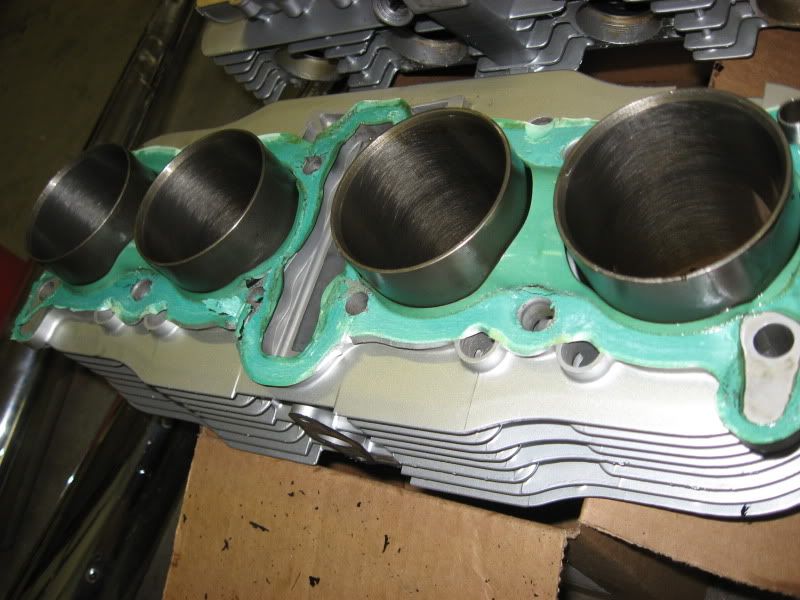
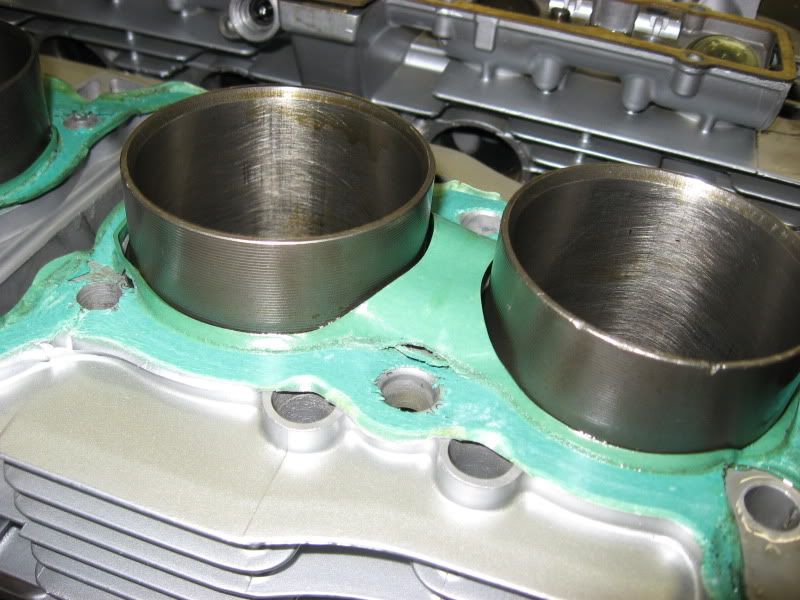
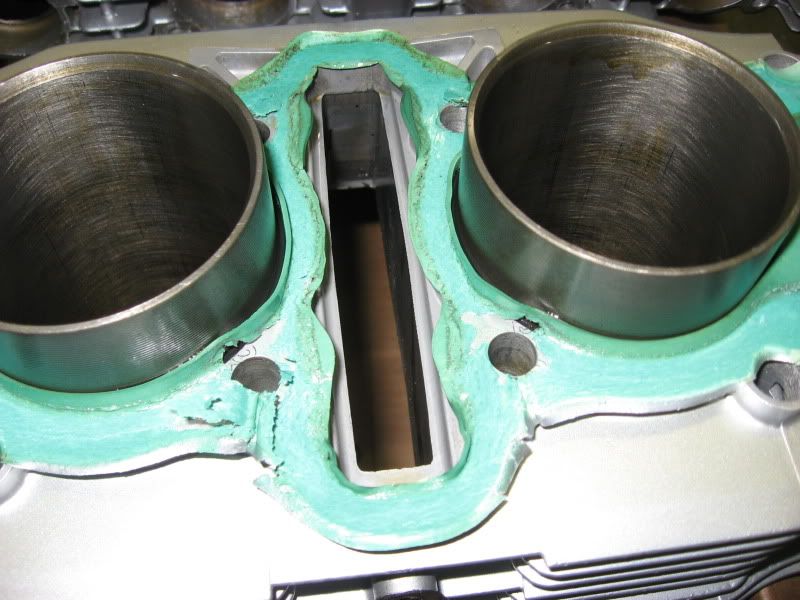
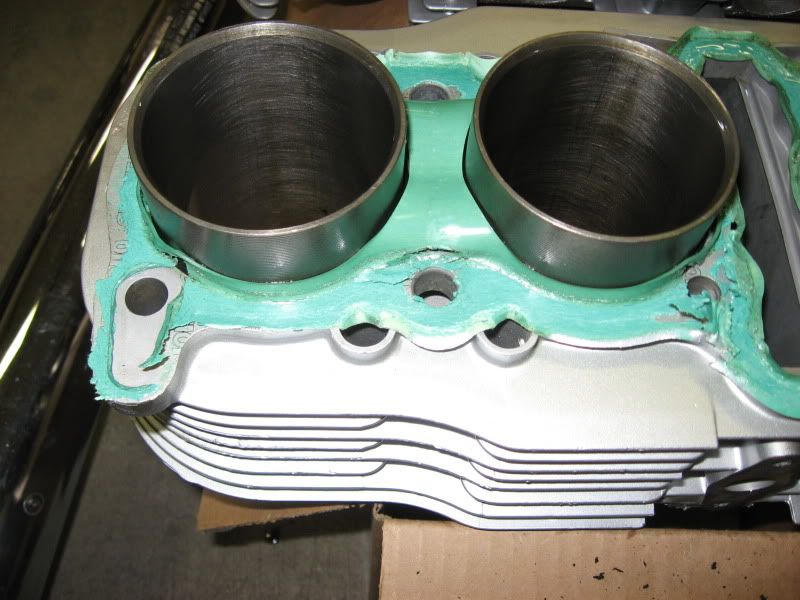
I'm surprised Steve would gamble on the Athena base gasket since surely he's seen these photos and read all the bad reviews on these gaskets. If I was forced to use the Athena gaskets (including the base gasket) again I'd torque the head nuts to 25 ft-lbs and then live with a little oil weepage. Better than total failure.


IMG_1931.jpg


IMG_1930.jpg


IMG_1929.jpg


IMG_1928.jpg
 
Yes it's good to use Threebond on that rectangular o-ring so it doesn't get out of place during the head installation (it's not really for "sealing" the o-ring per se). You want to let it set and get tacky. I've heard tales told too of people soaking them in hot water for a little while so they lose any natural curvature from the packaging.

Please do listen to Ed. Base gaskets are cheap. Perhaps my Athena head gasket would not have weeped oil if I'd used an OEM base gasket.


Which "Threebond" should I use. I have some 1194, but there is also a Threebond 1211. That matches the Clymer reference to "Suzuki Bond 1211." Should get a new tube of that stuff? Can I use what I have at hand?
 
Threebond 1194 should be fine. You're not really using it as a sealant, just as a glue to hold the o-ring in place so it doesn't slip out and get pinched during the head installation.
 
I am at a crossroads.

I pulled the head and installed the plug insert. The cylinder refuses to come off the engine. Tapping with a rubber mallet has no effect and there are no places to get a good purchase for prying the damn thing off. The gasket seal is so tight, that a razor won't get in there.

At first, I was tempted to reassemble and see how she runs, get some rides in, and otherwise postpone deeper exploration until later, perhaps through a shop.

A top-end rebuild, however, will cost about $400 - $500. So, my course of action is to return to the task of removing that cylinder, and possibly buying a replacement from eBay, should it not survive removal (there is already a small crack in one of the cooling fins).

Whether I replace the cylinder or not, I'll likely need to change piston rings and definitely need to hone the cylinders. I don't have the equipment for the hone job.

I also don't have the tools to remove the valves for inspection, though it looks like some home remedy tools might work from what I have seen on other threads. Even if I get the valves out, if they need any honing, I don't have the equipment.

I suppose that I could tear down the top end and get an estimate for the honing work from a shop. It should be much cheaper to get those discrete tasks done, without the added labor of tearing down and rebuilding the top end.

Does this make sense? Are there other approaches that I have overlooked?

TIA
 
Keep trying with the cylinder. I had the same problem getting it loose on one of my bikes but eventually it loosened after careful prying, and no fins were broken.

A bottle brush hone job shouldn't cost more than $30 or so, or buy your own hone from enginehones.com. The head shouldn't need any machine work unless it's warped or the gasket surface is corroded. Basscliff's web site has a valve removal tutorial if you need help.
 
The manual says to coat the cams in SUZUKI MOLY PASTE. Is that just anti-seize compound?
 
The manual says to coat the cams in SUZUKI MOLY PASTE. Is that just anti-seize compound?

No, anti-size is different stuff.

You can get engine assembly lube at auto parts stores but you don't need it. Plain engine oil is fine for an engine with used cams and followers. Put some oil on the cam journals (under the cam caps that bolt to the head) and then fill up the pockets on the head with oil and you will be fine.
 
OK - trying to remove this cylinder is kicking my ass. That bastard will not budge.

Tried tapping then whacking the damn thing with a rubber mallet. The rubber head split off the wooden handle (it was kind of old).

Cylinder - 1
Cinders - 0

Tried prying at different points, but there are not many spots that offer good purchase without risk of damage to a cooling fin. Where I could get a grip, screwdrivers and wrenches flexed without budging the beast.

Cylinder - 2
Cinders - 0

WTF is left? I'll pick up a new mallet and a prybar, but that approach seems hopeless. I have a heat gun, but that might cause uneven expansion of the metal, so I am loathe to try that.

I triple checked to make sure there is not some hidden fastener that I overlooked. Nothing.

Are there any solvents or other methods that will break the goddamn seal on this monster??
 
Is there a shelf just below or above the cam chain tensioner where you can get a little fin-risk-free leverage?
 
Ok, how 'bout this: lay a piece of angle iron across the top of the cylinders. Somehow figure a way to clamp the iron to the top of the cylinder. Cut a wood block to fit between the tops of 1 & 4 pistons and the bottom of the iron. Rotate the crankshaft using the 19mm bolt at the ignition end. Crank moves pistons up against the blocks / iron which 'lifts' the cylinders up...

I dunno, I'm just kickin' it around...

This is just a quick picture of my own GS700E at that stage...


Copyof004.jpg
 
Ok, how 'bout this: lay a piece of angle iron across the top of the cylinders. Somehow figure a way to clamp the iron to the top of the cylinder. Cut a wood block to fit between the tops of 1 & 4 pistons and the bottom of the iron. Rotate the crankshaft using the 19mm bolt at the ignition end. Crank moves pistons up against the blocks / iron which 'lifts' the cylinders up...

I dunno, I'm just kickin' it around...

This is just a quick picture of my own GS700E at that stage...

As much flex as I saw in my prying attempts, I suspect that approach would snap the timing chain.
 
No, not using the timing chain, but it might damage the pistons or the bolt on the end of the crank...

Maybe a blunt chisel, tapping (banging) upwards somewhere down at the bottom fin.

Or, aggressively hammering at the cylinder-to-block joint, and repair the damage later...

sigh.
 
Are you shooting anything (like PB Blaster or ATF/Acetone) down the inner 8 head studs? There are basically three things you're fighting - the base gasket seal, the piston ring drag, and all the gunk that's settled in between those studs and the cylinder.

A jack and a 2x2 under the front of the cam chain tunnel? Get a constant upward force then take your rubber/plastic mallet around the top and try to shake it loose. Give the studs a tap, too.
 
There's a tool made for this job. It's scissor looking contraption that wedges in between the block and head at the front of the engine. It has a nut that is adjusted to pop them apart. Now....where do get one ? I don't know, perhaps a local bike shop has one that you could leave your first-born with and borrow it.....Other than that, be careful not to break the fins and keep banging on it in strategic places. I suppose, if you're very careful, you could try tapping a thin blade of some sort in between to help begin to break it loose. Be very careful to to mar up the mating surfaces. :)
 
Are you shooting anything (like PB Blaster or ATF/Acetone) down the inner 8 head studs? There are basically three things you're fighting - the base gasket seal, the piston ring drag, and all the gunk that's settled in between those studs and the cylinder.

A jack and a 2x2 under the front of the cam chain tunnel? Get a constant upward force then take your rubber/plastic mallet around the top and try to shake it loose. Give the studs a tap, too.

I hadn't tried this. Will add it to the arsenal.
 
There's a tool made for this job. It's scissor looking contraption that wedges in between the block and head at the front of the engine. It has a nut that is adjusted to pop them apart. Now....where do get one ? I don't know, perhaps a local bike shop has one that you could leave your first-born with and borrow it.....Other than that, be careful not to break the fins and keep banging on it in strategic places. I suppose, if you're very careful, you could try tapping a thin blade of some sort in between to help begin to break it loose. Be very careful to to mar up the mating surfaces. :)

I tried to get a razor in there to break the seal. Not happening.
 
Question 1, where the cam chain gone?

You could try (dont all shout at me at once) holding the cam chain up and tight then turn the engine over slowly to see if the pistons lift the cylinder block. (Holding the chain tight be allowing it to move keeps the chain on the crankshaft sprocket.) The chain tensioner that sticking out will also hold the barrels up from coming fully off the studs too.

Its likely that the cylinder is stuck down with rust and years of crud in the stud holes. Its possible to remove the studs with a stud extractor but that's a final resort. (Restorer's cut the studs to get a head off on GT750's!)

Can you see damage in No3 bore hence the need for new rings? What's the condition of the other bore's, can you still see the honing marks?

Pictures please.
 
Last edited:
Hard to tell. I have been wrestling with it for so long, that the jugs picked up some light surface rust spots. :-( I can give them a good scrub and take some photos, check the honing, etc.

The piston tops show a healthy carbon build-up but nothing horrid AFAICT. Indeed, when I first opened it up, I was surprised to see that the No. 3 cylinder looked a bit cleaner than the others in terms of carbon build-up.
 
Back
Top