• Required reading for all forum users!!!

    Welcome!
    Register to access the full functionality of the GSResources forum. Until you register and activate your account you will not have full forum access, nor will you be able to post or reply to messages.

    A note to new registrants...
    All new forum registrations must be activated via email before you have full access to the forum.

    A Special Note about Email accounts!
    DO NOT SIGN UP USING hotmail, outlook, gmx, sbcglobal, att, bellsouth or email.com. They delete our forum signup emails.

    A note to old forum members...
    I receive numerous requests from people who can no longer log in because their accounts were deleted. As mentioned in the forum FAQ, user accounts are deleted if you haven't logged in for the past 6 months. If you can't log in, then create a new forum account. If you don't get an error message, then check your email account for an activation message. If you get a message stating that the email address is already in use, then your account still exists so follow the instructions in the forum FAQ for resetting your password.

    Have you forgotten your password or have a new email address? Then read the forum FAQ for details on how to reset it.

    Any email requests for "can't log in anymore" problems or "lost my password" problems will be deleted. Read the forum FAQ and follow the instructions there - that's what we have one for...

  • Returning Visitors

    If you are a returning visitor who never received your confirmation email, then odds are your email provider is blockinig emails from our server. The only thing that can be done to get around this is you will have to try creating another forum account using an email address from another domain.

    If you are a returning visitor to the forum and can't log in using your old forum name and password but used to be able to then chances are your account is deleted. Purges of the databases are done regularly. You will have to create a new forum account and you should be all set.

Why does intake leak cause hanging high idle ?

Redman

Forum Guru
Super Site Supporter
Past Site Supporter
I have expereinced it before, the hanging high idle, and have expereinced replacing the intake o-rings and/or intake boots and/or choke mechnism oring to cure it.

First time it happend to me, I could not tell that black hard flat thing in the intake boot, that easlily broke into pieces, was (or HAD been) a rubber o-ring.

If adjust the idle when engine is hot, then idle is too low when engine cold starts, If adjust idle when engine cool, then is way too high when engine warm - that is first clue. Then when engine hot and try to idle engine but the rpms take a while to idle down, or stay way high - that is definite clue.

Anyway, has been common knowlodge here on the forum that the hanging high idle, is caused by air leak in the carb intake boot o-ring or intake boot itself or carb itself.


But why does that air leak cause the high idle ?
Most people say "cuz is too lean", the air intake leak "causes a lean condition".

But, But I wondered, okay, why does too lean cause engine to idle higher RPM?
Seems like too lean fuel-air mixture would be less power and would run lower RPM. But, yet, I have epereinced it myself, air intake leak causes the high hanging idle.

After pondering for years.... one day it occured to me.... my therory....

Maybe when have air leak in intake, it is idleing higher, not because the fuel-to-air mixture in the combustion cyclinder is too lean, but maybe becase the engine is not having to suck all the air thru the carburator throat, is easier, reguires less force to suck the air thru the leaks than to suck the all the air thru the carb throat. That is my therory.

You can think of the engine as producing power out the crankshaft, but if also think of the engine as a vacuum pump producing vaccuum to suck air thru the carburators, if it is easier to suck air then it can runn faster.
 
Last edited:
Air leak = hanging idle due to a leaner mix.
Lean = more power until the overly lean mix produces too much heat and detonation which then leads to engine failure.
Engine failure is usually piston damage or seizure amongst others.
 
An air "leak" by definition means air is bypassing the throttle butterfly, thus you have no control over it, and more air will allow the engine to increase in speed.

I've also seen where lean running causes the idle speed to increase, but that is a little different situation. Both can lead to a high idle that hangs.
 
Extra air bleeding into the idle mix from a leak makes it lean and lean mixtures burn slower than a correct mixture. A rich also mixture burns slower too. This is why you can tune for highest idle on the mixture screw to set a correct idle mixture. With a rich mixture the extra fuel cools the combustion process as well as providing too many fuel molecules for the available oxygen molecules -so an incomplete burn. Which is why blipping the throttle on a rich idle mixture causes an under run or stall. Fuel being denser than air has more momentum and when you let the throttle snap shut, the air flow abruptly slows but the fuel flow doesn't slow as quickly and your rich mix gets momentarily richer.

In a lean mix there is a surplus of oxygen molecules, and these separate the fuel molecules from each other so that the flame propagation is slowed. Rather than a nice 'even-ish' chain reaction from one fuel molecule to the next, there are flame front dead-ends, and uneven transfer of flame through the charge. It is the slowness of this charge burn that causes overheating. The slower burn allows extended time for heat to be transferred to the piston and cylinder head rather than building a rapid pressure increase in the air contained in the cylinder and doing work at the crankshaft. A lean mixture can thus in extreme cases cause melted pistons and burnt exhaust valves, and often it causes detonation.

Lean mixture detonation is due to the combustion chamber end gases (the last of the mixture to be burnt) spontaneously igniting from the chamber pressure increase and the heat radiated from the slow flame front before it can ignite it controllably. This secondary uncontrolled ignition sends destructive shock-waves across the cylinder.

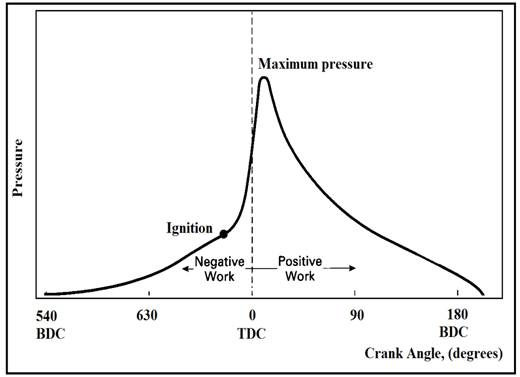
Theoretical-cylinder-pressure-curve-for-spark-ignition-SI-engines.png
wAAACH5BAEKAAAALAAAAAABAAEAAAICRAEAOw==


Maximum torque is exerted on the crankshaft when peak cylinder press occurs a few degrees ATDC. To achieve this spark has to fire some 10? - 40? BTDC depending on rpm and combustion chamber shape (swirl and especially squish speed up the burn), so some negative work is done compressing the burning charge so to achieve peak pressure at the crank position that delivers maximum torque. The slow burn causes peak pressure to be reached well after TDC with less negative work having to be done on the compression stroke. This causes the revs to hang as there is less resistance from the negative work to slow crank rotation. Less headwind, the slower you slow down.

A similar thing happens when you rotate a distributor to retard the spark on an idling engine (shifting the pressure curve to right in the diagram above). The idle revs pick up because you've moved peak pressure past ideal but reduced negative pumping work to overcome. Again less 'headwind', the faster you spin.
 
Last edited:
Lean means ALL the fuel is being burned, so you're extracting the maximum amount of energy from the incoming fuel. The additional air from the leak is increased mass.

More energy extracted from fuel + more mass flowing through the engine = more energy imparted to the engine = higher idle speed.
 
An air "leak" by definition means air is bypassing the throttle butterfly, thus you have no control over it, and more air will allow the engine to increase in speed.
....

That is consistent with my therory......
Idle RPM increases becaue with the intake air leak then requires less mechanical power during the intake stroke.
Is more about what heppens during the intake stroke than about what happens during combustion-power stroke.

Lot of things going on there, all at once.
 
The simplest way to think of it is that an air leak simulates opening the throttle just a bit. Or, the engine is seeing more flow and "thinks" the throttle is still open, but the carbs don't so they're not supplying any more fuel and you end up with a lean condition. The lean condition is a result, not a cause.
 
The simplest way to think of it is that an air leak simulates opening the throttle just a bit. Or, the engine is seeing more flow and "thinks" the throttle is still open, but the carbs don't so they're not supplying any more fuel and you end up with a lean condition. The lean condition is a result, not a cause.

Not labor the point, but this doesn't explain why leaning out a fuel screw on carbs without air leaks also causes a hanging idle... Your not adding any more air, your reducing the amount of fuel... which suggests its the leanness causing the hanging idle rather than extra air. Thoughts?
 
Not labor the point, but this doesn't explain why leaning out a fuel screw on carbs without air leaks also causes a hanging idle... Your not adding any more air, your reducing the amount of fuel... which suggests its the leanness causing the hanging idle rather than extra air. Thoughts?

Extra air or reduced fuel amount to the same thing.. A lean mix..
 
Back
Top