• Required reading for all forum users!!!

    Welcome!
    Register to access the full functionality of the GSResources forum. Until you register and activate your account you will not have full forum access, nor will you be able to post or reply to messages.

    A note to new registrants...
    All new forum registrations must be activated via email before you have full access to the forum.

    A Special Note about Email accounts!
    DO NOT SIGN UP USING hotmail, outlook, gmx, sbcglobal, att, bellsouth or email.com. They delete our forum signup emails.

    A note to old forum members...
    I receive numerous requests from people who can no longer log in because their accounts were deleted. As mentioned in the forum FAQ, user accounts are deleted if you haven't logged in for the past 6 months. If you can't log in, then create a new forum account. If you don't get an error message, then check your email account for an activation message. If you get a message stating that the email address is already in use, then your account still exists so follow the instructions in the forum FAQ for resetting your password.

    Have you forgotten your password or have a new email address? Then read the forum FAQ for details on how to reset it.

    Any email requests for "can't log in anymore" problems or "lost my password" problems will be deleted. Read the forum FAQ and follow the instructions there - that's what we have one for...

  • Returning Visitors

    If you are a returning visitor who never received your confirmation email, then odds are your email provider is blockinig emails from our server. The only thing that can be done to get around this is you will have to try creating another forum account using an email address from another domain.

    If you are a returning visitor to the forum and can't log in using your old forum name and password but used to be able to then chances are your account is deleted. Purges of the databases are done regularly. You will have to create a new forum account and you should be all set.

SH775 install frustrations

pdqford

Forum Mentor
Super Site Supporter
Past Site Supporter
I?m trying to figure out how I?m gonna find space to install the SH775, a new blade fuse box, and a relay to power the fuse box, AND still be able to cover it with the stock side cover on my 1980 GS750E.

I?ve started to mock it up but a few questions come to mind. Here?s a pic of what I?m working with.
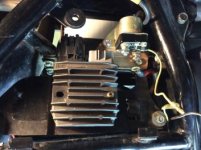
BF5268A0-E802-4CE6-AC38-6E8D3684A94E.jpg

Don?t know why the picture is upside down. Nor do I know how to make it right side up.

I?ve mocked up a cardboard bracket to move the starter relay down and slightly to the left to clear the SH775 connector. But the bolt hidden behind the SH775 that will hold the homemade bracket to the original plate interferes with the SH775.

So my question is, does the SH775 need to have its shinny backside in full contact with the plate it mounts to keep it cool?

Or can I try and mount the Sh775 with standoffs to hold it 1/4? to 3/8? away from the mounting plate so that it will clear the bolt head behind it and run some wires behind the SH775?

I don?t think I can lower the starter relay any more for fear it will contact the chain guard when the rear suspension is in compression, but one of the starter solenoid mounting bolts hits a bracket behind the mocked up plate. Maybe one bolt would be enough to hold the starter relay, but I hate to compromise.

This fabrication stuff is realy unnerving me!
 
Mine is on the opposite side of the bike under the cover on the right hand side mounted to the plate where the toolkit used to be, some people put it under the seat. Someone else might chime in with an opinion but I don't think it's necessary to mount it flush. As to wiring it in you're going to be better off going directly from the stator output wires to the regulator and bypassing the part that goes through the harness, make sure the ground goes directly to the battery and you're golden. On my bike, when I disconnected the stator wires from the harness and removed it I had plenty of wire to go to the right side of the bike, since to negative terminal of the battery was right there it made that connection much easier. Mounting it in a different spot with then leave you with plenty of room under the left side cover to mount that fuse block and relay, no need to relocate anything else.
 
Mounted tight? Not necessary. You can let it flop in the breeze, if you want, as long as the electrical connections are tight.

On the larger shafties, the stock location works well, but you might not have the room. Our stock location is under the battery box.

.
 
Mine sits in the stock location (attached to the battery box on the left side) while the fuse block and relay site on the right side of the airbox
 
This is how I mounted mine, on a 550 model that had the regulator and rectifier as separate Units. I simply re-used the regulator's mount:

 
Well, I am *finally* getting pack to my 1980 GS750E project that I started years ago.
I think I have figured out how to fit all the pieces I want to upgrade into the left side panel where the originals were located.

My plan was/is to convert to the SH775, switch from glass fuses to blade fuses, and install a relay to keep from dropping voltage up through the handle bar switches by having the relay feed the new blade fuses directly.

Here's what the mock up looks like. (I have verified that the side cover still fits but need to verify that the rear suspension travel clears the changes.)

IMG_0732 by pdq ford, on Flickr


And here's the questions I have.

Is it okay to install the starter solenoid upside down? (That way the battery cable and starter motor cable will side of still reach :-)
Does it matter which side of the starter solenoid the battery and starter motor cables are attached to?

With the fins of the SH775 vertical, will that effect the cooling of the R/R?

And finally, I had to lower the SH775 to where only one of the attachment holes has the metal plate behind it
ill one bolt be enough to hold the SH775 in place?

Appreciate any comments
 
Last edited:
Is it okay to install the starter solenoid upside down? (That way the battery cable and starter motor cable will side of still reach :-)
Does it matter which side of the starter solenoid the battery and starter motor cables are attached to?
shouldn’t matter

With the fins of the SH775 vertical, will that effect the cooling of the R/R?
Probably not enough to be a problem. Keep an eye on it.

And finally, I had to lower the SH775 to where only one of the attachment holes has the metal plate behind it
ill one bolt be enough to hold the SH775 in place?
use a split(lock) washer under the screw head, some blue loctite maybe as well. Belt and braces. If you’re concerned, run a zip tie through the open SH775 hole and a stationary frame member.

.,.,.,.,.,.,.,.,.,.
 
Last edited:
Thanks for your comments Rich.

I will (slowly) try and get this project moving (again).
My son will be visiting us this weekend and I’ll see if I can send that metal plate home with him.
He has a drill press to drill the new holes and a welder to tack weld some nuts to the back side of the newly drilled holes.
 
Seems like more work than necessary to me but I suppose if I had a welder, and was a competent welder (I don’t and I’m not), I may have done the same. My bike is different but this is how I mounted the RR. My bike has a plate that originally held the tool pouch. Said pouch and tools long gone, so I drilled some holes, and used bolts, washers, and split (lock) washers to secure the RR. This plate sits proud of the electrical panel that holds the fuse box and starter solenoid. Hasn’t come loose in 5 years.

nypKFs3h.jpg


lT86l87h.jpg
 
Rich, thanks for sharing.

What a difference between 1980 and 1982.
My tool kit on the 1980 GS750ET is back by the tail light.
There isn’t much depth to my electrical compartment.

Is your fuse block for glass or blade fuses?

Arn’t you now using Triumph connectors on the R/R ?
 
Oh, okay, I see now that you do have the Triumph connectors.
My Triumph connector is gray for the rectifier side and black for the regulator side.

One more question and then I will stop bugging you (for a while :-).
What size wires should I run from the stator up to the rectifier?
 
Sorry, not an expert there. Stator should have its own wires. They are smaller gauge than the ones in the triumph connector. Don’t go any smaller than the stator wires and you should be OK. — the opinions of a non electrical engineer.

But you really shouldn’t need more wire. You do have to cut off the ends of the Triumph connector and discard, unless you’re willing to hunt down the appropriate matching connector blocks and terminals to attach to your Stator wires.
onDllfcl.jpg


Just follow Nessism’s diagram for connecting everything back up.
uVSncv0h.jpg


For the physical reconnecting of the wiring, here’s what I did. Bought a good crimp tool and OEM quality bullet connectors from https://www.vintageconnections.com, practiced making good crimps, and go to work. If you want to avoid a fat bundle of connectors when you tape everything up, stagger the connections like this so they’re not all together.
KNHAyvxl.jpg
 
Last edited:
I put mine under the seat tool tray. It's opposite the battery, which makes the leads to the battery very short. It's also out of the way, and out of the elements. I never used that tool try, as my bike as a door on the tailpiece. I made a bracket out of a piece of flat stock from Home Depot, using a SImspon Tie down sheet. It rolled right over the frame with a few taps. :)
 
Okay guys, now for my next hurdle:

The wiring from the stator to my new SH775!

I suppose I could use the original 3 wires (Yellow, Blue/white, Green/white), ( by passing the headlight switch), and going directly to the SH775 but those wires look awful wimpy, and their connectors showed excess heat. Additionally, the Triump connector for the SH775 rectifier side looks like it expects a bigger gauge wire.

Or, I could do as Rich did and snip the stator wires near the stator, staggering the snips and splice in heavier wires and run direct to the SH775 rectifier side.
The Manual says that each stator wire can see up to 80 volts AC.
Anyone know how many amps the generator is rated for.?

The way I read the 1980 GS750ET wiring diagram in the Clymer Manual is that ALL current used by the electrical system flows through the main 15 amp fuse and I have never blown the main fuse so I’m guessing the generator is prolly 15-20 amps?

Maybe we have some “electrical Engineers” that could shed some light on these AC wires?

Thanks in advance ..............Jim
 
I never said snip the wires close to the stator. Don’t do that. You want as few connections as possible and you want them in an area you can access. Put new ends on the stator wires. Put corresponding new ends on the 3 wires coming from the left (the 3-wire) side of the 775 triumph connector. Make good crimps. Tape them up. You shouldn’t need any new wire.

I think you're confused about something else as well. You've referred to the rectifier side and regulator side of the SH775.

Left side of the RR (it is a regulator and rectifier in one) has 3 wires that connect to the 3 wires of the stator, in no particular order.

Right side of the RR has 2 wires, Black goes to a good ground, SPG (single point ground), or battery negative, your choice.
Red (triumph connector's wire is more of a brown)goes to exactly where the red wire from your old RR was disconnected from. This then splits to a in-line fuse connection to battery positive, and into the harness.
 
Last edited:
.....................................
I never said snip the wires close to the stator. Don’t do that. You want as few connections as possible and you want them in an area you can access. Put new ends on the stator wires. Put corresponding new ends on the 3 wires coming from the left (the 3-wire side) side or the 775 triumph connector. Make good crimps. Tape them up. You shouldn’t need any new wire.
Sorry about that Rich. You never did say to snip the stator wires close to the stator. I was wanting to run a heavier wire up to the SH775 in case they were too light and contributing to the overheated original connectors. If the original stator wires are adequate I may be able to run them straight into the Triumph connector after snipping the connectors off as I have the Triumph connectors to put on the ends of the stator wires. That will depend on IF the original stator wires are long enough to reach the location of the SH775.

I think you're confused about something else as well. You've referred to the rectifier side and regulator side of the SH775.


Left side of the RR (it is a regulator and rectifier in one) has 3 wires that connect to the 3 wires of the stator, in no particular order.
Sorry about that also. I use the rectifier side to indicate the 3-wire connector of the SH775 (where the three stator wires AC current gets rectified in to DC current) and the regulator side to indicate the 2-wire connector where the regulated voltage emerges from the SH775.

Right side of the RR has 2 wires, Black goes to a good ground, SPG (single point ground), or battery negative, your choice.
Red (triumph connector's wire is more of a brown)goes to exactly where the red wire from your old RR was disconnected from. This then splits to a in-line fuse connection to batter positive, and into the harness.
Correct. I don't have the full Triumph lead, just the Triumph connectors and Triumph ends. Ill have to improvise when (IF?) I get to that hurdle.
Thanks again for your help and guidance.
 
It will do no good to take a 16 gauge stator lead, and upsize it before attaching to the Triumph jumper. The default will be the smallest element, which is the original stator wires. Realize, of course, that these original wires are more than large enough to carry the current the stator can produce. For the attachment, I'd solder them. That's the lowest resistance attachment method.
 
And I usually defer to Ed on such matters. However, I’m not the best solderer, so I went with the best crimp connectors I could find.

You will want to trim those stator wires back past any verdigris (green) corrosion to fresh copper before either soldering or crimping on new connectors. Some do both.

Which leads me to. Have you tested your stator output? Do you know that your stator is still good? What usually happens is the connectors melt, corrode, causing resistance and takes out the stator. Some people will replace the stator at this point prophylactically, even if it tests as good. Just food for thought.
 
Last edited:
Back
Top