• Required reading for all forum users!!!

    Welcome!
    Register to access the full functionality of the GSResources forum. Until you register and activate your account you will not have full forum access, nor will you be able to post or reply to messages.

    A note to new registrants...
    All new forum registrations must be activated via email before you have full access to the forum.

    A Special Note about Email accounts!
    DO NOT SIGN UP USING hotmail, outlook, gmx, sbcglobal, att, bellsouth or email.com. They delete our forum signup emails.

    A note to old forum members...
    I receive numerous requests from people who can no longer log in because their accounts were deleted. As mentioned in the forum FAQ, user accounts are deleted if you haven't logged in for the past 6 months. If you can't log in, then create a new forum account. If you don't get an error message, then check your email account for an activation message. If you get a message stating that the email address is already in use, then your account still exists so follow the instructions in the forum FAQ for resetting your password.

    Have you forgotten your password or have a new email address? Then read the forum FAQ for details on how to reset it.

    Any email requests for "can't log in anymore" problems or "lost my password" problems will be deleted. Read the forum FAQ and follow the instructions there - that's what we have one for...

  • Returning Visitors

    If you are a returning visitor who never received your confirmation email, then odds are your email provider is blockinig emails from our server. The only thing that can be done to get around this is you will have to try creating another forum account using an email address from another domain.

    If you are a returning visitor to the forum and can't log in using your old forum name and password but used to be able to then chances are your account is deleted. Purges of the databases are done regularly. You will have to create a new forum account and you should be all set.

1977 GS750e project

  • Thread starter Thread starter jibledso
  • Start date Start date
I got the shifter worked out, the return spring was slightly bent so it shifts well now.

broke a clutch basket bolt, easy-out actually worked this time.

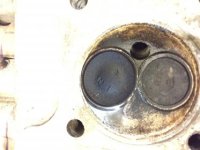
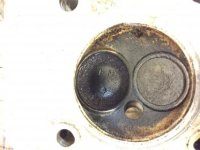
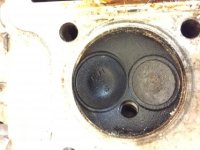
After all of that I decided to stop messing around about the oil coming out of the exhaust and took off the head last night. I got some valve seals and a head gasket lined up. The exhaust valves look super corroded, maybe I should replace them ? Not sure how to get that much corrosion/carbon off?

Whoever had the head off previously put sealant around the cam chain opening under the head gasket, and around the oil passages on the intake side of the jugs. I never heard of this being done before on a motor.
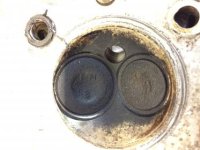
10357510-5FE3-4D29-B455-BD82E40CC46A.jpg
 
386E02B1-86A3-4140-81A7-D5088EDC03E1.jpg

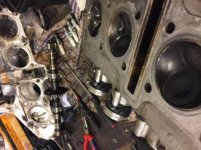
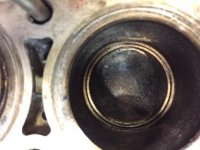
The pistons looked to be in good shape, just some surface blackness/carbon
 
That seems pretty normal.
DIY valve lapping to check valve seat wear while you have it apart. Look up the DIY method using a piece of rubber or clear fuel line pipe tubing, chucked up in a cordless drill.
I assume you must have a valve spring compressor tool, or a DIY method around it? Make sure to use a paint marker or something to label each valve as to which cylinder it came out of. 1 is left/stator side of bike, 4 is right/ignition side.

You can probably soak the valves Berryman's commercial carb dip or lacquer thinner, or other solvents to help get some of the baked on deposits off.
You will sometimes see some nasty deposits(barnacles) on the actual valve stems as well, be a lot more careful getting these off. I think I was told that these are mostly from using low quality gasoline.
 
Last edited:
0954BDF4-E846-4BC6-BD5E-CECD63569264.jpg

I cant wait till I get my tax return

btw earlier I did a compression test on the cylinders and they were all between 120-110 with oil, after that is what made me think it was the seals
 
That seems pretty normal.
DIY valve lapping to check valve seat wear while you have it apart. Look up the DIY method using a piece of rubber or clear fuel line pipe tubing, chucked up in a cordless drill.
I assume you must have a valve spring compressor tool, or a DIY method around it? Make sure to use a paint marker or something to label each valve as to which cylinder it came out of. 1 is left/stator side of bike, 4 is right/ignition side.

There?s another guy in our garage who has a valve decompressor. I?m not aware of the DIY method I?ll check it out thanks!
 
The DIY method is mostly just to remove them, and it is not so graceful!
Borrow the proper tool, and make sure to use a good bit of oil on the moving parts of the tool especially if it is the cheaper style, so that everything moves properly with no binding.

The DIY valve lapping method however is just fine to use, but if the seats are too worn, you cant cut new seats with this method, you'll just ruin the valves in the process by grinding too much off them, and also make detrimental changes to the airflow characteristics.
Valve lapping is just for a quick cleanup pass after good acceptable seats have already had the carbon cleaned up off of them as best as possible. Or it is to inspect the seats to see if they are still good...

Based on your wet compression test results still being low, your valves probably need a valve job. you can do a DIY valve lapping still to inspect the condition of the seats after cleaning all the carbon deposits off, but a valve lapping is not really going to fully restore power if they are really worn and/or burnt.
The valve stem seals just keep oil from migrating down from the valve spring shim bucket cavity down into the ports & into the combustion chamber.
Worn valve guides will cause sloppy valve stem fit & will also cause oil to get past the seals, and will require replacement, which always requires a fresh valve job afterwards to correct any alignment changes.

Generally low compression due to valve's not sealing is always going to likely require a valve job unless it was just from a lack of valve adjustment...
You can try just lapping the valves to get them to seal better for now, but a full-on valve job will give you much more power.

Maybe there is a good machine shop around your area that knows bikes well, or knows old Volkswagen air-cooled engines or even 1980s Volkswagen engines or Volkswagen diesels? Or even Honda Civic engines, it all crosses over to our GS heads as far as the familiarity of the labor to do a valve job on them. These are not rocker arm and hydraulic lifter, the old Volkswagen stuff also uses a shim and bucket set up, so that would be the most familiarity that would help.
 
Last edited:
***** check your valve guide clearances first per the Factory Service Manual, if those are worn beyond spec, there's no sense in even trying to do a valve lapping, you'll be best sending the head out for new valve guides, valve job, maybe even resurfacing...
If I have an engine apart that far, I'd be considering a set of Wiseco K844's... Vroom vroom!
 
I went back into my notes and found this

2CC69692-FD62-46DB-A664-328D19C35742.jpg

#2 doesn?t look unusual and is on the border of acceptable according to the PSI

I just got done talking with another guy in the garage and apparently we have a valve grinder in the garage. He said he has hhs cutters? for the seats and we can grind the valves. He promised to help once I got everything out of the head. John is an engineer on an oil rig up north and seems to take apart and put back together his 76? HD on a weekly basis, so I think he knows what he is doing, plus he?s a swell guy.

thanks for the additional info Chuck I?ll try soaking the valves once I get everything out.
 
***** check your valve guide clearances first per the Factory Service Manual, if those are worn beyond spec, there's no sense in even trying to do a valve lapping, you'll be best sending the head out for new valve guides, valve job, maybe even resurfacing...
If I have an engine apart that far, I'd be considering a set of Wiseco K844's... Vroom vroom!

yeah, I?d like to do that with the pistons but I?m already broke and really I don?t want to miss another summer of not riding. I do have a job lined up but doesn?t start till next month. I?ve been fortunate enough to have all these resources and parts to do this job, right now new pistons-rings-machining is out of the question until money starts flowing.
 
If you have to make deep cuts to clean up the valve seats, you also need to "tip the valves." That would be grinding (& perfectly perpendicular and flat) some material off of the top end of the valve stem to compensate for the valve sitting higher up in the head, otherwise you will run out of shim sizes to use, as the shim size needed will be incredibly thin. You just have to leave enough for the valve keepers/retainers so that the center machined protrusion on the underside of the shim bucket makes good contact with the top tip of the valve stem, but the valve retainer/keeper is not much higher than the top of the valve if any, otherwise it will hit the shim bucket, and this is NOT GOOD to be putting pressure on thxem at all! Time for new valves then if you tip them too far.

Also, you really need to be measuring the valve installed height off of the deck surface, and once you have done a minimum clean up cut pass on each valve seat, you really should be going back and cutting all (the other 3) of the valve seats nearly as deep as the deepest one (per side, intake or exhaust), so that they are all fairly uniform in combustion chamber volume, and hence compression.


also, it is very commonplace especially on the 77 - 78 GS cylinder heads and all Kawasaki heads of this era, to put a thin film of case sealer RTV such as Threebond 1211, on the big rectangular cam chain tunnel sealing o-ring. In 1979, they added a bolt at the front of the cam chain tunnel area to pull the head and the cylinder together, this eliminated the common oil seepage problem on the 77 - 78 GS up in the front area there. On the 77-78, just make sure you put some type of sealer on that rectangular o-ring, especially on the front portion of it.
The oil seepage or leaking that happens here is just oil drain back coming out of the head and running down the cam chain tunnel into the oil pan, it finds its way out through the front of the engine. It is not an oil pressure feed, just drain back making its way out through some very thin gaps, so it is not a serious leak area ever, but it is annoying and dirties up the front of the engine.

I have not heard of people doing this for the outside corner oil stud passages though. Those are under direct torque from the head studs, as they utilize the head stud passage as an oil passage as well. the only reason I would ever put sealer there is if I was too cheap to resurface the head or the cylinder, and it had some scratches or gouges in it. And I would not feel very good about doing it that way at that.

Make sure to cut the valve seats at the proper angle, all three angles and seat face widths are spelled out in the factory service manual very clearly.

And like I said, don't even bother doing a valve job if your valve guides are worn out, you will need to press or hammer those out. Some people just use heat, heat the head in an oven, and they glide right out. I think there is a special tool to drive them out, but I've never had to replace any on my own, so I'm not the one to ask on how to perform this. I bet Suzuki lists a special tool in the factory service manual for the job at hand.

ALSO... Once the valves are cleaned up really nicely, spin them in a set of v blocks and make sure that they are not bent! There are a lot of specialty tools needed for head service, that is why most people just send it out to a professional shop.
 
Last edited:
I?m going to consult with John and depending on what he says or has me believe, I may just send it to a machine shop.
 
Just see if he has the right cutting heads first if you're really trying to save $$$, it will be a good learning experience for you for sure, and you will appreciate quality machine shop services after seeing the amount of time an amateur job takes...
A machine shop is going to do a lot more precision job because they will be using at least a $30,000 machine (vs hand operated seat cutters) to do it on most likely, if not a fancy Serdi machine that has radiused transition cuts instead of just two flat angled cuts on either side of the valve seat aka 3 angle valve job. A Serdi machine valve job, you using a Dremel with sanding drums to match the intake ports to the intake boots, you removing any minor casting flash with a Dremel or a die grinder from inside the ports, and possibly resurfacing/milling the head slightly to raise compression a bit, all of this will give you better flow than the head ever had new, & will really rejuvenate the engine. just be very careful on camshaft timing when you reassemble, it's sometimes confusing having the front arrow on the cam sprocket pointing forward horizontally or parallel, ask for assistance and post photos if you have any questions, and make sure you very gently try to crank the engine over by hand several revolutions after you are done, making sure you don't have any piston to valve interference. If you encounter a lot of resistance, your timing is off in a valve is hitting a piston & will get bent...
Also when you are counting links on a cam chain, a careful attention, because the first pin that you start at on the cam chain, I believe you count as number one. You don't start at the first and move on to the second and then say "1..." When that would actually be the second link pin that you had counted.
if you don't already have the factory service manual, buy or download a copy. You can get a free pdf download of a 1976 original service manual off of BWringer or BassCliff's website.
I wouldn't rely on a clymer's manual alone, having both for the same procedure is nice.
 
I marked the cams with a felt pen but yeah, if the valves are cut that?s going to change everything.
 
Just had a consultation with John and it looks as though I?m to have to Mill the head because there is an imperfection on the bottom of the head, John spotted it, it?s like a scratch but not a crack. So, if I do that I?ll have to Mill the top of the jugs and at least hone the cylinders.

6EBEE5B7-CDB3-4A93-B223-4F94EA0EEC33.jpg
 
John also questioned the color of the top of the pistons and combustion chambers. To him they shouldn?t be as dark and more light.

he also thought the cross hatch was not prominent enough

8FD8C477-5167-4DF4-9179-CD1825520A4B.jpg
 
Just had a consultation with John and it looks as though I’m to have to Mill the head because there is an imperfection on the bottom of the head, John spotted it, it’s like a scratch but not a crack. So, if I do that I’ll have to Mill the top of the jugs and at least hone the cylinders.

View attachment 57512


you don't have to mill the top of the cylinder is just because you mill the head.
it is perfectly acceptable to do one and not the other, but if you do both, you know you will have a really good sealing surface. And higher compression ratio by a slight bit. That will more than make up for cutting the valves in deeper which would increase the combustion chamber volume slightly.

Also, where is this defect in the cylinder head? If it is not around the four outside corner cylinder studs, not around the cylinder bores outside of the combustion chamber where the sleeves seal to the head, and not around the cam chain tunnel, then there is no need to really worry about it at all. The only thing you need to worry about is warpage. You need a machinist straight edge and feeler gauges to check the warpage diagonally across the head.
 
Does anyone at your shared garage have a milling machine and a very large heavy fly cutter attachment? resurfacing the head and cylinders is not difficult at all with the right tools, but the difficult part is getting everything fixtured up in place and clamped down properly, and perfectly parallel to the work deck...that is all the labor there, and that takes quite a while.

John also questioned the color of the top of the pistons and combustion chambers. To him they shouldn?t be as dark and more light.

he also thought the cross hatch was not prominent enough

View attachment 57513

Did you tell him that you have low compression, and that you are burning oil, before he commented on the color of the carbon? Those two things alone would definitely make it black and sootey. so would neglected air filter maintenance or riding at higher altitudes than what the bike was jetted for.

Having a noticeable bit of cross-hatching would be nice. it helps to hold oil up on the cylinder wall, and is important to have a cross hatching done at opposing 45 degree angles. But if you do that, you will definitely want to put in some new piston rings.

At that, you might just start shopping on eBay for useable 850 cylinder block and pistons for cheap! You will have to grind a little on your crank case fit them, however. this can be done without tearing the bottom end down if you really don't want to, just turn the engine upside down and stuff the holes full of rags, not letting any metal shavings get into the crank bearings at all.
 
you don't have to mill the top of the cylinder is just because you mill the head.
it is perfectly acceptable to do one and not the other, but if you do both, you know you will have a really good sealing surface. And higher compression ratio by a slight bit. That will more than make up for cutting the valves in deeper which would increase the combustion chamber volume slightly.

Also, where is this defect in the cylinder head? If it is not around the four outside corner cylinder studs, not around the cylinder bores outside of the combustion chamber where the sleeves seal to the head, and not around the cam chain tunnel, then there is no need to really worry about it at all. The only thing you need to worry about is warpage. You need a machinist straight edge and feeler gauges to check the warpage diagonally across the head.

It’s in between #3 cylinder and a stud not seeable with my camera, John spotted it, he’s machined a lot of heads and was kind enough to show me how to recut the seats with his nice set but he didn’t have a rod small enough to fit into the valve hole to attach the cutter.

We were discussing machinist in the area and we narrowed down two who are quality. I’m going to call and discuss what could be done and how much. John thanks for my needs I could do it for 4000-5000 kroner, so the most would be $500 to Mill the head and jugs, cut the seats etc. if the cylinders meet the standard I’d probably try and get by with a hone and new rings.

One good thing, I’m standing in a lobby right now for an interview about a tire changing job, money flow looks emanate in the near future to get this bike I love back on the road.
 
Back
Top