• Required reading for all forum users!!!

    Welcome!
    Register to access the full functionality of the GSResources forum. Until you register and activate your account you will not have full forum access, nor will you be able to post or reply to messages.

    A note to new registrants...
    All new forum registrations must be activated via email before you have full access to the forum.

    A Special Note about Email accounts!
    DO NOT SIGN UP USING hotmail, outlook, gmx, sbcglobal, att, bellsouth or email.com. They delete our forum signup emails.

    A note to old forum members...
    I receive numerous requests from people who can no longer log in because their accounts were deleted. As mentioned in the forum FAQ, user accounts are deleted if you haven't logged in for the past 6 months. If you can't log in, then create a new forum account. If you don't get an error message, then check your email account for an activation message. If you get a message stating that the email address is already in use, then your account still exists so follow the instructions in the forum FAQ for resetting your password.

    Have you forgotten your password or have a new email address? Then read the forum FAQ for details on how to reset it.

    Any email requests for "can't log in anymore" problems or "lost my password" problems will be deleted. Read the forum FAQ and follow the instructions there - that's what we have one for...

  • Returning Visitors

    If you are a returning visitor who never received your confirmation email, then odds are your email provider is blockinig emails from our server. The only thing that can be done to get around this is you will have to try creating another forum account using an email address from another domain.

    If you are a returning visitor to the forum and can't log in using your old forum name and password but used to be able to then chances are your account is deleted. Purges of the databases are done regularly. You will have to create a new forum account and you should be all set.

1978 GS1000 Daily

  • Thread starter Thread starter Jacob4ta
  • Start date Start date
J

Jacob4ta

Guest
Hello folks thanks for stopping by. My wife inherited a 1978 GS1000 that has had all distinguishing body panels removed and discarded somewhere in a junkyard. My wife has modified the rear of the frame and made the bike a hardtail with a springer seat instead(not to my liking but its hers). I told her that I'd do the powertrain work for her so she could focus on making it cool/pretty/ratty or whatever she wants. Her end goal is to have a unique daily motorcycle that she can leave out in the heat of the day and not worry about the desert destroying her expensive Ducati that's garage kept.

On to my task, powertrain. Currently the bike has OEM sized jets(95 main 15 pilot) in the carbs, some mismatched set of needles and new K&N oval pod filters for fuel. Exhaust is OEM head pipes to two mufflers off some newer motorcycle; 2-1 style exhausts. As you all know this isn't enough fuel for the amount of air it pulling in so I'm patiently waiting for my DynoJet kit to arrive which includes their 138 and 142 mains(130-132.5 Mikuni equivalent) and four matching needles to replace my Frankenstein set. I have on hand new 17.5 and 20 sized pilots incase I need to upsize those for any reason.

On to the current running condition. The bike moves under its own power, reluctantly. It idles well now that I've ditched the small cheap pods and installed the K&N pods instead. As far as screw adjustment: fuel screw 6 turns out, air screw: seated. I hope I got you got somewhat of a laugh out of that because I thought I was dreaming when the bike actually drove itself on those settings but this tells me there is not enough fuel getting to the engine just yet. I tried 1 turn fuel, 2 turns air and I couldn't even roll on the throttle without it bogging and turning off.

While i'm waiting for jets in the mail, I'm going to check valve lash as that is where everyone seems to point first, then timing, then air leaks THEN jets/carb adjustment. I've already emailed Steve and asked for his valve adjustment guide and I'm shopping for a new valve cover gasket as I'm typing. Suggestions, comments and criticism are welcome.


Last edited:
...2-1 style exhausts...criticism...welcome.

You asked for it.

What (or where) are "2-1 style exhausts"?

Standing room only?

I remember when wives couldn't use welders or Sawzalls without adult supervision. :p :p

Welcome to the site.
 
You have to remember that the fuel and air screws are pilot screws, for the idle mixture only.

They have zero effect over 2500 rpm
 
You asked for it.

What (or where) are "2-1 style exhausts"?

Standing room only?

I remember when wives couldn't use welders

Cylinder 1 and 2 collect to one muffler and 3 and 4 collect to a separate muffler. Maybe I meant 4-2? I?m a newbie 🤣
 
You have to remember that the fuel and air screws are pilot screws, for the idle mixture only.

They have zero effect over 2500 rpm

Perhaps I do need to up the pilot jet then. I don?t have much top-end on the bike. It hits a wall pretty hard it seems fairly quickly somewhere just before half throttle. I?m fairly certain the tachometer doesn?t work well or at all but anything over 4K rpm seems to be very lack luster and once I roll off the throttle there is a considerable surge momentarily.
 
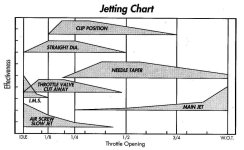
That range is the jet needle, not the pilot jet

Did you not understand that the idle (pilot) circuit only works idle-2500 rpm?jet-chart.jpg
 
That range is the jet needle, not the pilot jet

Did you not understand that the idle (pilot) circuit only works idle-2500 rpm?View attachment 60919

Oh yes I understand that part but I was referring to my hesitation from a stop as well as my current fuel and air screw settings. I don?t even have my air screws open currently, they are seated. My fuel screws are 6 turns out; much further out than they should be or a properly jetted carb. I have mismatched needles currently so that is also adding problems to the overall performance. That?s why I?m anxious to receive my Dynojet kit that has identical needles and larger main jets that would fit better for my current mods: Pod filters and a free flowing muffler.

Once I have parts that are identical between the 4 carburetors I?ll be ready to ACTUALLY diagnose and tune AFR properly. Right now I?m just wasting gas. That?s why I?m going to focus on checking valve lash, timing and syncing my carburetors.
 
Last edited:
Skip the carb sync until you've finished with all the other carb stuff

Fuel screw at 1 turn, Air screws at 2 turns to start should remove that hesitation.
 
Skip the carb sync until you've finished with all the other carb stuff

Fuel screw at 1 turn, Air screws at 2 turns to start should remove that hesitation.

I tried 1 turn fuel, 2 turns air and I couldn't even roll on the throttle without it bogging and turning off.

Tried that in an act of desperation and it made everything worse. I’m sure needles are in the incorrect spot and that would be causing me issues. I don’t want to adjust these needles because they don’t match so there isn’t much of a point to keep tinkering with the carb set until I receive my new needles, jets and fuel screws.
 
I?m right at sea level and only use the 138?s with K&N and Marving 4:1 (third exhaust I?ve run, the pipe has never changed the settings needed although it did run richer with the V&H pipe than the Marving or Yoshi).

Don?t believe I changed pilots. Maybe... I think I followed DJ suggestion for the needle and it was fine.

welcome by the way... I?m the guy on Facebook that sent you here :)
 
Thank you so much for helping me out and pointing me in the direction of this forum. Volumes of information available from real people who?ve all dealt with the exact same issues and worse haha. As I?ve said over and over again, I?m anxious to get my new parts in and actually begin to tune the motorcycle. 👍🏻
 
I ordered an O-ring set and O-rings for the intake flanges(the 32mm ones) from Cycleorings.com last night to make sure I?m not getting any unmetered air into the engine by accident. I?m going to pull the valve cover this morning and start measuring gaps and see where I?m at. Correct me if I?m wrong but I?ve read to try and be on the higher side of the 0.08MM tolerance than closer to the 0.03MM tolerance. Fingers crossed everything is where it needs to be and no work is necessary.
 
Yep, looser is better
The clearances tighten up over time
 
Ok so I've just completed checking valve clearances this morning. My feeler gauge only goes as small as 0.04MM which I assume is more than satisfactory especially if the tightest measurement within tolerance is 0.03MM.

All the measurements that I listed below are the LARGEST gauge I could fit between the bucket and cam lobe. I checked each valve position in the A and the B position that are referenced in the service manual.

Cylinder 1 Intake: 0.04MM Exhaust: 0.10MM
Cylinder 2 Intake: Too tight Exhaust: 0.04MM
Cylinder 3 Intake: 0.04MM Exhaust: 0.05MM
Cylinder 4 Intake: 0.04MM Exhaust: 0.05MM

Looks like I could use some work on all 8 positions if I am to be closer to the 0.08MM range. I've already contacted Steve via email and I'm patiently waiting for his guide to get to me. The felt valve cover gasket did tear on a couple locations, is it worth it to replace, or just line up the tears and move on with installing the cover?
 
So if each new shim is 0.05MM thicker or thinner, how would I go about replacing them? Is it acceptable to go beyond the 0.08MM tolerance? I?m referencing the service manual which shows everything from 2.15MM to 3.10MM in increments of 0.05MM each step.
 
I'm working on timing now and I'm referencing the service manual but I'm drawing a bit of a blank. I've tried to follow it step by step and done my best to reference the images some of the procedure calls out but it doesn't make much sense to me. This is my first time ever timing a points vehicle so that definitely isn't help my frustration either.

1) Put a 0.35MM gap between the point and the breaker for cylinder 1&4; excellent that was easy enough.
2) Connect timing tester...I don't have that. I have a timing gun if that is what that step is asking for?
3) Rotate crank until index mark 2 comes into register with timing mark 4. What is index mark 2 referring to? Is timing mark 4 just the hole in the plate?
4) Loosen the 3 screws holding plate until the points begin to separate. Which points? Didn't I already put a 0.35MM gap between 1&4?
5) Rotate crank, if breaker begins to open its contact when timing mark 2 comes into register with mark 4 then the adjustment is correct for 1&4. What is mark 2?? What is mark 4??
6) Bring mark F into register with the timing mark. The hole in the plate? 4? Is this mark 4?
7) Loosen screws and rotate plate counterclockwise to determine its position for the beginning of the opening action. When I loosen the screws and adjust the plate there is no gap created between the point no matter which direction I rotate. The point connected to the condenser is screwed to the plate I've just loosened so it can't create a gap.

SOS, send help.
 
Last edited:
Looking at your mixture settings makes me cringe a bit. Yes, those setting might be what is working, but they are SO far out of 'normal', it makes me wonder if your jets are actually proper.

Some well-meaning (and CHEAP) owners will drill out jets to make them larger. You look at it and say "hey, that's a #15 pilot jet", when it's been drilled out to ... who know what. You already have your jets on order, so wait until they get there, that way you KNOW they will all be the same.

In a stock configuration, having the fuel screw (the one on the bottom) out 1 turn is pretty close for pods and exhaust work. The general ratio for fuel screw/air screw is close to 1:2, but I like to start rich, then tune towards lean, so I start with the air screws about 1 1/2 out. Be careful turning those screws, especially the fuel screw, they are VERY fragile and removing a broken screw tip is not fun.

There should be no need to increase the size of your pilot jets. Needles should be raised a notch or two and mains definitely increased, but I have never understood why the pilot jets needed to be increased. When you remove the airbox, you remove a lot of restriction when the carbs are wide open, so yes, you need more fuel for the mixture. Increase the mains. However, at IDLE, the throttle slides are your restriction, and they are in the same positions as when the airbox was installed. There is no increase in airflow at idle, so why would you need larger jets?

.
 
So if each new shim is 0.05MM thicker or thinner, how would I go about replacing them? Is it acceptable to go beyond the 0.08MM tolerance? I’m referencing the service manual which shows everything from 2.15MM to 3.10MM in increments of 0.05MM each step.

Are you referring to the factory service manual?
That shows the tool needed for shim removal. Some use the alternative zip tie method. Both are shown on the BassCliff site.

Looser is better, .1 is acceptable. You can get thinner shims from the Shim Club, found in the Services forum
 
I'm working on timing now and I'm referencing the service manual but I'm drawing a bit of a blank. I've tried to follow it step by step and done my best to reference the images some of the procedure calls out but it doesn't make much sense to me. This is my first time ever timing a points vehicle so that definitely isn't help my frustration either.

1) Put a 0.35MM gap between the point and the breaker for cylinder 1&4; excellent that was easy enough.
2) Connect timing tester...I don't have that. I have a timing gun if that is what that step is asking for?
3) Rotate crank until index mark 2 comes into register with timing mark 4. What is index mark 2 referring to? Is timing mark 4 just the hole in the plate?
4) Loosen the 3 screws holding plate until the points begin to separate. Which points? Didn't I already put a 0.35MM gap between 1&4?
5) Rotate crank, if breaker begins to open its contact when timing mark 2 comes into register with mark 4 then the adjustment is correct for 1&4. What is mark 2?? What is mark 4??
6) Bring mark F into register with the timing mark. The hole in the plate? 4? Is this mark 4?
7) Loosen screws and rotate plate counterclockwise to determine its position for the beginning of the opening action. When I loosen the screws and adjust the plate there is no gap created between the point no matter which direction I rotate. The point connected to the condenser is screwed to the plate I've just loosened so it can't create a gap.

SOS, send help.
1 ok

2. It's a powered test light. You can turn on the ignition and use a test light
3 look in the hole for the index mark. Rotate the crank until the1-4 F mark aligns with it
4. Rotate the entire plate until the test light goes off (on?)
5. Tighten the plate
6. Switch the test light to the 2-3 points. Rotate the crank to align the 2-3 F mark aligns with the index mark.
7. Adjust the small plate on the right until the light changes.

Takeoff the test light and attach your timing light to#4
Fire up the bike and adjust 1-4 onto F1-4. Apply throttle and confirm it advances to the advance mark

Connect timing light to #3 spark wire and confirming F2-3 to index mark. Confirm advance

Sorry I can't remember whether the test light goes on or off, but I haven't usedpoints since 1983, and it's bedtime
 
I'm working on timing now and I'm referencing the service manual but I'm drawing a bit of a blank. I've tried to follow it step by step and done my best to reference the images some of the procedure calls out but it doesn't make much sense to me. This is my first time ever timing a points vehicle so that definitely isn't help my frustration either.

1) Put a 0.35MM gap between the point and the breaker for cylinder 1&4; excellent that was easy enough.
2) Connect timing tester...I don't have that. I have a timing gun if that is what that step is asking for?
3) Rotate crank until index mark 2 comes into register with timing mark 4. What is index mark 2 referring to? Is timing mark 4 just the hole in the plate?
4) Loosen the 3 screws holding plate until the points begin to separate. Which points? Didn't I already put a 0.35MM gap between 1&4?
5) Rotate crank, if breaker begins to open its contact when timing mark 2 comes into register with mark 4 then the adjustment is correct for 1&4. What is mark 2?? What is mark 4??
6) Bring mark F into register with the timing mark. The hole in the plate? 4? Is this mark 4?
7) Loosen screws and rotate plate counterclockwise to determine its position for the beginning of the opening action. When I loosen the screws and adjust the plate there is no gap created between the point no matter which direction I rotate. The point connected to the condenser is screwed to the plate I've just loosened so it can't create a gap.

SOS, send help.
1 ok

2. It's a powered test light. You can turn on the ignition and use a test light
3 look in the hole for the index mark. Rotate the crank until the1-4 F mark aligns with it
4. Rotate the entire plate until the test light goes off (on?)
5. Tighten the plate
6. Switch the test light to the 2-3 points. Rotate the crank to align the 2-3 F mark aligns with the index mark.
7. Adjust the small plate on the right until the light changes.

Takeoff the test light and attach your timing light to#4
Fire up the bike and adjust 1-4 onto F1-4. Apply throttle and confirm it advances to the advance mark

Connect timing light to #3 spark wire and confirming F2-3 to index mark. Confirm advance

Sorry I can't remember whether the test light goes on or off, but I haven't usedpoints since 1983, and it's bedtime
 
Back
Top