• Required reading for all forum users!!!

    Welcome!
    Register to access the full functionality of the GSResources forum. Until you register and activate your account you will not have full forum access, nor will you be able to post or reply to messages.

    A note to new registrants...
    All new forum registrations must be activated via email before you have full access to the forum.

    A Special Note about Email accounts!
    DO NOT SIGN UP USING hotmail, outlook, gmx, sbcglobal, att, bellsouth or email.com. They delete our forum signup emails.

    A note to old forum members...
    I receive numerous requests from people who can no longer log in because their accounts were deleted. As mentioned in the forum FAQ, user accounts are deleted if you haven't logged in for the past 6 months. If you can't log in, then create a new forum account. If you don't get an error message, then check your email account for an activation message. If you get a message stating that the email address is already in use, then your account still exists so follow the instructions in the forum FAQ for resetting your password.

    Have you forgotten your password or have a new email address? Then read the forum FAQ for details on how to reset it.

    Any email requests for "can't log in anymore" problems or "lost my password" problems will be deleted. Read the forum FAQ and follow the instructions there - that's what we have one for...

  • Returning Visitors

    If you are a returning visitor who never received your confirmation email, then odds are your email provider is blockinig emails from our server. The only thing that can be done to get around this is you will have to try creating another forum account using an email address from another domain.

    If you are a returning visitor to the forum and can't log in using your old forum name and password but used to be able to then chances are your account is deleted. Purges of the databases are done regularly. You will have to create a new forum account and you should be all set.

1980 GS850GLT - Getting her back up to riding condition

  • Thread starter Thread starter redfenix
  • Start date Start date
R

redfenix

Guest
Back in 2012 I got my first motorcycle, a 1980 GS850 GLT that didn't look much like a GLT anymore. I went through basscliff's instructions and replaced the regulator, coils, went through the carbs, and bought an original exhaust set. Eventually, I got her running pretty well (and up over 110MPH on the highway once, even.)

IMG_0454.jpg

A few years ago, she started leaking oil significantly through the seals and leaving puddles wherever I parked her. I stopped riding her because I didn't want to be "that guy" wherever I parked. With a vow to rebuild her eventually, life happened and some years passed. And now I've finally gotten back to do the job. Figured I'd post my updates here for everyones amusement and maybe some knowledge (hopefully not of what not to do!)

Here's what I plan to do, roughly in order:

- Disassemble bike enough to get the engine out
- Replace exterior seals/gaskets on the engine (including head gasket, etc.) I bought an aftermarket seal kit and will use most of it and some additional OEM seals/gaskets
- Check tappet valve clearance again, make sure it's still good and adjust shims if necessary (I already did this in 2012)
- Replace valve seals, lap valves
- Replace piston rings, hone cylinders
- Dip, clean, rebuild carburetors (again, I already did this in 2012)
- Inspect air box, seal up all leaks, replace with new K&N filter
- Put engine back in, put bike back together
- Replace choke cable (original one is completely stuck)
- Drain/refill final drive oil
- Inspect electrical system for any major issues, replace connectors, etc. as needed
- Inspect front forks, ensure they're filled with enough air
- Tune, test, balance carbs to ensure engine is running well, mixture is good, etc.
- Replace tires with new ones
- Inspect brakes, replace brake fluid
- Rebuild front forks probably with seals, new progressive springs? Replace fork oil

And that's about it, will add more as needed if inspections show stuff that needs it. If you have anything you feel I should add to my list, I'd like to hear it!
 
Last edited:
Getting the engine out.

Getting the engine out.

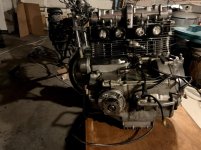
First point of order is getting the bike disassembled enough to get the engine out so I can work on it.
I started Saturday evening, on the 8th. By Sunday the 9th, I had the engine out and on a desk.

IMG_1099.jpg

A couple of points of interest:

1. I discovered only 3 of the 4 bolts were in place between the secondary drive and the final shaft. :eek: The 4th was loose in the rubber boot and had been banging around against the other surfaces in there, and the 3 that remained were fairly loose too! I'm guessing the PO put them back without any threadlocker?
2. I used a car engine crane for getting the engine out. I wrapped a lashing strap around the block twice and lifted it up. Yes, it was overkill, but I already had the crane and it made the removal sooo much easier and precise!

3. Man, there's a lot of oil on the bottom side of this engine. Using an array of engine degreasers, scotch brite pads, paper towels, and my trusty old toothbrush and plenty of elbow grease. Gloves definitely recommended for this work.
 
Last edited:
Oil Pan

Oil Pan

Yesterday (Monday the 10th), I didn't have much time, but figured I'd start on some of the seals while I'm waiting for some parts to get here (OEM piston rings, etc. ordered and on the way).
I started with the oil pan, to get a good idea of what I'm getting into.
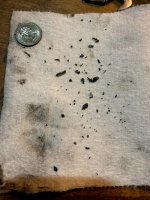
The inside doesn't look too bad, however, I did find more metal filings in the pan than I wanted to:

IMG_1103.jpg

Gotta be honest, if I found chunks like that in my car's oil pan, I'd be really concerned, but given that this is from both the engine and the transmission, should I be worried? That one long piece almost looks like the tip of a spur gear. If someone has some advice on whether I should be worried about this or not, it's much appreciated. Regardless, I scraped the gasket surfaces carefully with a razor blade, pre-oiled the new gasket with Rotella T4 oil, put it on and torqued the bolts to around 60 inch/lbs. (as recommended by the service manual).

Another question: how does everyone prefer to prepare and install gaskets? How do you clean off the surfaces of gasket material and debris? Do you pre-oil the gaskets and with what?
 
Last edited:
The gear tip might be the result of a clumsy gearchange by a PO. If it is, and during the time you were running it you didn't hear anything amiss (knocks, clunks, grinding, crunching) it'll probably be fine.
For gaskets, surgically clean casting faces and some oil them on the engine side so that the gasket will remove in one piece with the sump or side cover. It works for some people, but there's no guarantee.
OEM gaskets where you can. The side cover gaskets aren't quite so important as they're easy to replace, but OEM only for the barrel base gasket and OEM for the head gasket if you can find one. They are getting harder to find at a reasonable price as New Old Stock dries up. Partzilla has one for $114 though. A bit ouchy steep, but it's a one-time only expense.
https://www.partzilla.com/catalog/suzuki/motorcycle/1980/gs850gl/cylinder-head
 
Thanks for the reply, Grimly. I don't recall hearing or feeling anything like that in particular, so I'll call it good and not take apart the bottom end for now.
I've been scraping the gasket faces with razor blades, taking great care to avoid gouging the soft aluminum. I've been able to get all of the gasket material and debris off except for the remaining discoloration here and there.
I did purchase an aftermarket gasket kit, but I also got an OEM base gasket and o-rings. I also have silicone "real gaskets" for the valve cover and breather that I'll be reusing. I'm a little on the fence about the $110 head gasket though.
Thanks again!
 
Clutch cover

Clutch cover

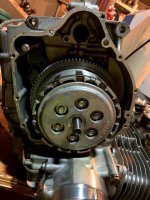
Yesterday I started by pulling off the clutch cover to have a look and replace the gasket.

IMG_1113.jpg

Looked pretty good in there to me, nothing further needed here, I think. So I cleaned off the gasket surfaces carefully with a couple of razor blades cleaned up the oil sediment that had settled on the bottom, and gave the rest of the area a good cleaning before I oiled the gasket and put it back together.
 
Stator cover

Stator cover

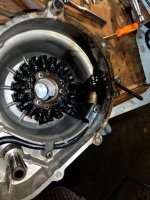
Last night after I finished up the clutch cover, I figured I'd at least get the stator cover off to see how it's doing.

IMG_1114.jpg

Looks ok. For a moment I forgot that there's supposed to be some oil in here and got a little concerned. The stator looks a little dark, but I guess that's to be expected. I'll see how it looks after I clean it up a bit.
To be clear, I've never actually had a problem with the stator on this bike. After reading the stator papers, I replaced the regulator before I had any problems.
 
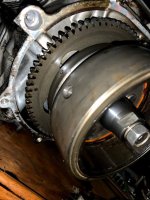
Under the stator cover

Under the stator cover

Figured I'd share a pic of the flywheel too. All looks fine here I think.

IMG_1115.jpg
 
Yesterday I started by pulling off the clutch cover to have a look and replace the gasket.

View attachment 61519

Looked pretty good in there to me, nothing further needed here, I think. So I cleaned off the gasket surfaces carefully with a couple of razor blades cleaned up the oil sediment that had settled on the bottom, and gave the rest of the area a good cleaning before I oiled the gasket and put it back together.

I'd check the clutch for a fairly common issue .. the central clutch hub nut.
On these GSes they tend to come loose.
Lasts a long time when re-torqued but APE sells a stronger nut that will not loosen.

 
Yesterday (Monday the 10th), I didn't have much time, but figured I'd start on some of the seals while I'm waiting for some parts to get here (OEM piston rings, etc. ordered and on the way).
I started with the oil pan, to get a good idea of what I'm getting into.
The inside doesn't look too bad, however, I did find more metal filings in the pan than I wanted to:

View attachment 61513

Gotta be honest, if I found chunks like that in my car's oil pan, I'd be really concerned, but given that this is from both the engine and the transmission, should I be worried? That one long piece almost looks like the tip of a spur gear. If someone has some advice on whether I should be worried about this or not, it's much appreciated. Regardless, I scraped the gasket surfaces carefully with a razor blade, pre-oiled the new gasket with Rotella T4 oil, put it on and torqued the bolts to around 60 inch/lbs. (as recommended by the service manual).

Another question: how does everyone prefer to prepare and install gaskets? How do you clean off the surfaces of gasket material and debris? Do you pre-oil the gaskets and with what?

Personally, I'd be more concerned how that quarter got in there.
 
:lol: mine runs on plastic... swiped at any number of corner locations en route! :)

Welcome back to the forum. Looks like you're getting stuck in! I just finished up an 1100G. Just finished running it in :)
 
Speaking from experience with that particular model, I would recommend an item for your to-do list. Verify correct function of the petcock valve.

In the prime position, you should be able to suck on the vacuum port and feel the valve actuate and stay actuated with no more air flowing through the vacuum line. In the run position, you will need to keep sucking, but not a lot.

The problem is, the plastic part of the valve shrinks over the decades creating a vacuum leak, so the petcock won't stay open correctly. This manifests as fuel starvation at highway speeds, and feels exactly like running out of gas when the tank is not yet empty.

Most people also recommend checking that the gas cap vents correctly when the fuel starvation question comes up. Probably should verify both before it has a chance to be a problem.
 
Finished lower-end covers and took apart carbs

Finished lower-end covers and took apart carbs

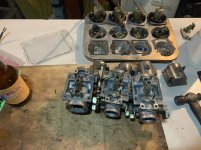
I was out late last week, traveling to visit family until I got back this Monday. I had yesterday off and finished up the lower-end covers. Then, since I took Grimly's advice and I ordered a new head gasket, I decided to wait to open that up for a little bit. So instead, I started on the carbs.

IMG_1163.jpg

Here's what I got done:

1. Removed stator from cover and cleaned off, reinstalled.
2. Cleaned gasket face and looked over starter gears/flywheel.
3. Reinstalled stator cover with new gasket.
4. Took clutch cover off again, took off clutch pressure plate, springs, plates.
5. Measured clutch plates as per service manual (all well within spec)
6. Measured clutch springs (low end of spec, will need to replace at some point)
7. Checked center clutch hub nut, and it was extremely tight with no visible wear on folded part of washer. I tried to loosen it but it did not budge easily, so I did not go any further. (Thanks Rijko for the tip!)
8. Put clutch back together, torqued, replaced cover using existing (new) gasket.
9. Un-ganged and disassembled carbs (lots of green, sticky fuel in them)
10. Started putting carbs in dip

And that's where I'm at now. Since the fuel was so sticky, I'm figuring on needing to let the carb bodies and parts sit in the dip a bit longer. Good thing I bought a new bucket of dip for this.
I'll get back to the top-end of the engine after the rest of the parts come in and I'm done with the carbs.
 
Last edited:
Speaking from experience with that particular model, I would recommend an item for your to-do list. Verify correct function of the petcock valve.

Thanks for the heads-up. I already replaced the vacuum petcock with a standard pingel one a long time ago, so no worries there. I just don't trust the vacuum ones and I'd rather eliminate that variable from my system. :)
 
Progress on carbs and started top-end

Progress on carbs and started top-end

Last evening Carb #1 was finished with the dip, so I got it cleaned out and reassembled with new o-rings. The rest of the carbs are cycling through the dip. Since there was so much green, sticky fuel in them I'm leaving the carb bodies in for 6-8 hours each and the bowls/jets for 4 hours.

- Dipped #1 carb body overnight
- Dipped #1 bowl and jets 4 hours
- Checked passages, reassembled #1 carb with new o-rings
- Measured float height (no adjustment needed)

I bought new OEM carb bowl gaskets, but decided to use the existing ones since they're in good shape. I'll just hang on to the new ones.

Since now I'm waiting on the dip process, I started taking apart the top-end.

- Took the intake boots off, cleaned, replaced o-rings, coated in red rubber grease and put them in a ziploc for later
- Took the valve cover off, saved the gasket (I have a "Real Gasket"), cleaned off, put bolts/brackets in ziploc
- Took the crank cover off the side, so I can turn the engine

Next up:
- Continue cleaning and reassembling carbs
- Check tappet shim clearances before tear-down
- Remove camshafts, buckets, head, clean it all up
- Start on the valves
 
You say you bought a new can of carb dip. Is it Berryman's? If so, I also just purchased a new one and found the strength of the dip to be less than one I bought several years ago. Yeah, I now can dip two carb bodies at a time. Speeds up the process by two days.

Also, most of us leave our parts in the dip for at least 24 hours for complete cleaning.
 
You say you bought a new can of carb dip. Is it Berryman's? If so, I also just purchased a new one and found the strength of the dip to be less than one I bought several years ago. Yeah, I now can dip two carb bodies at a time. Speeds up the process by two days.

Also, most of us leave our parts in the dip for at least 24 hours for complete cleaning.

Yeah, it's Berryman's. It's been working pretty well for me so far. I did have to clean out one bowl passage with some small music wire, but that's been it so far.
I've been dipping the carb bodies overnight for about 12 hours each, and then 4 hours for the bowls and jets. Then I check the passages with carb cleaner, and use some very fine music wire to clear out the holes in the jets, being very careful not to force or enlarge the holes. So far so good, I guess I won't know for sure until I get it all done and back together, which will probably be at least a week for the top-end rebuild (still waiting on an OEM head gasket to arrive to the local shop).

Thanks for the reply!
 
Carbs 2 & 3 and removing the head

Carbs 2 & 3 and removing the head

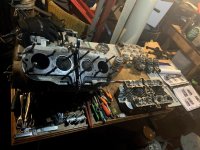
Last evening I continued on the carbs, and then went back to the top-end after that:

Carburetors:
- Carb #2 and #3 finished dip
- Cleaned off #2 and #3 with carb cleaner, sprayed thru passages
- Had to clear out #3's bowl passage with some music wire to get it spraying thru correctly
- Put on new o-rings, used silicone lubricant spray on them and the bowl gasket
- Reassembled carbs #2 and #3
- Put #4 carb body in dip for overnight

Top-End:
- Checked tappet clearances, all exhaust were .005-.006 (all good!), most intake were .004, but #4 intake was .003 (getting a bit too tight) I will check the shims I have in there and swap them out if I have them or order thinner ones
- Locked cam chain tensioner and removed it
- Removed both camshafts (I used the large vice-grip method to hold them as I loosened the blocks)
- Removed all head stud nuts (some were pretty tough to loosen, definitely no top-end work since factory)
- Cleaned up all parts removed
- Removed head and placed aside, head gasket was definitely leaking, top of pistons have a lot of carbon buildup

IMG_1184.jpg


Next up:
- Finish up carb #4
- Re-gang carbs and set aside
- Remove and mark tappet shims, valve buckets
- Measure/find marking on tappet shims to see if I have spares that can be used for the intakes that are getting too tight, or order them
- Clean up head
- Turn head upside down and fill with fuel to see if I had any leaks
- Remove valves
- Lap valves
- Reassemble valves in head
 
Back
Top