• Required reading for all forum users!!!

    Welcome!
    Register to access the full functionality of the GSResources forum. Until you register and activate your account you will not have full forum access, nor will you be able to post or reply to messages.

    A note to new registrants...
    All new forum registrations must be activated via email before you have full access to the forum.

    A Special Note about Email accounts!
    DO NOT SIGN UP USING hotmail, outlook, gmx, sbcglobal, att, bellsouth or email.com. They delete our forum signup emails.

    A note to old forum members...
    I receive numerous requests from people who can no longer log in because their accounts were deleted. As mentioned in the forum FAQ, user accounts are deleted if you haven't logged in for the past 6 months. If you can't log in, then create a new forum account. If you don't get an error message, then check your email account for an activation message. If you get a message stating that the email address is already in use, then your account still exists so follow the instructions in the forum FAQ for resetting your password.

    Have you forgotten your password or have a new email address? Then read the forum FAQ for details on how to reset it.

    Any email requests for "can't log in anymore" problems or "lost my password" problems will be deleted. Read the forum FAQ and follow the instructions there - that's what we have one for...

  • Returning Visitors

    If you are a returning visitor who never received your confirmation email, then odds are your email provider is blockinig emails from our server. The only thing that can be done to get around this is you will have to try creating another forum account using an email address from another domain.

    If you are a returning visitor to the forum and can't log in using your old forum name and password but used to be able to then chances are your account is deleted. Purges of the databases are done regularly. You will have to create a new forum account and you should be all set.

'79 GS1000S - 1085 Wiseco Kit - overheats at low speeds

  • Thread starter Thread starter IanR
  • Start date Start date
I

IanR

Guest
The bike
1979 GS1000S, with Standard pipes (yes proper originals), and standard airbox and filter with lid on, Dynateck Electronic ignition (I've put a strobe light on the timing and it appears fine going fully advance at around 3500rpm).

The change
I've recently added a Wiseco 1085 piston kit. The bike runs like a train - lots of power, no flat spots, no hesitations up to redline, idles well.

The problem
If I ride for about 20-30 minutes at 60-80km/h 35-50mph on a COOL day with no stop-start traffic the oil temp gradually keeps rising (this model is the one with the oil temp guage) until it reaches almost 170C (around 330 deg F) before I stop and let it cool down. If I take it onto the freeway or non-urban roads and ride at around 100Km/h (60mph) or above the temp drops to around 100 deg C (212 deg F) or less.

The cause?
I've read on this forum that big bore kits make these bikes run lean. It seems to me that this is what must be happening - the plugs look very clean, but not burnt when I do a chop test.

Three Questions for the experts:

1. Why is it that the bigger capacity causes it to run lean with standard jetting?
2. I've booked the bike into a motorcycle workshop that has experience with these older bikes. What could I reasonably expect them to investigate/do to rectify the overheating problem?
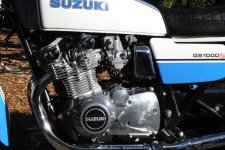
3. It seems that many forum members who add a big bore kit also add an oil cooler. Should I be considering this as an option? I'd perfer not to as I like my bike looking stock (see below) and with the adaptor plate I would not be able to use the oil temp sensor.

Thanks for your time,

Ian

.
attachment.php
 

Attachments

  • DSCF3647.jpg
    DSCF3647.jpg
    96.1 KB · Views: 0
Big bores don't make bikes run lean; not rejetting for a BB causes the bike to run lean. You have to step up the jetting.
 
Big bores don't make bikes run lean; not rejetting for a BB causes the bike to run lean. You have to step up the jetting.

Thanks for replying. My question was really seeking an explanation for the need to "step up the jetting": what happens to change the air/fuel ratio on the inducation stroke after the installation of the big-bore kit?
 
I can't tell you the precise technical reason but on my 1166 with cv carbs I needed about 4 steps on the mains.
bigger cams need bigger mains but a flowed head may need less. So a simple answer to your question might be hard to obtain. Most of my experience is using an afr o2
data logger.

i would not be riding the bike without increasing the jetting.

one other thing on temp, this will probsbly draw some fire from some 8v guys but the bb 16v guys know you can drop temperature by using a series r/r.
 
Last edited:
Adding an 1150 oil cooler (and filter cover) to my stock 1075, dropped temps so much I usually ride with the cooler covered up with cardboard. It still runs much cooler than it did before.

If your jetting is correct, sounds like you need an oil cooler. Doesn't a big-bore make more heat?
 
Last edited:
An interesting result. My bone stock 1000S oil temp will get up over 300F when on the road at 75+ mph on a hot day, but it cools off when you slow down. Pretty much opposite of what's going on with this bike.

BTW, a big bore kit won't make the engine run hot all by itself. It's just bigger pistons. The larger engine has the potential to make more power, but when cruising the amount of power output won't be different than a stock engine, so it shouldn't run hotter unless the jetting is jacked up. You might want to try bumping the mains one step and lifting the needles. At cruise the engine won't be running off the main jets anyway but it won't hurt to hedge your bet.
 
I can't tell you the precise technical reason
I believe Bernoulli's Principle comes into play. Ironically you'll find that in most cases you actually need to reduce the size of the main when going bigger bore. With everything remaining equal, larger displacement means more air volume means larger signal to the carb = more fuel drawn from a given sized jet. Pilot circuit usually need to go up though. At least that's what I've found on carburetored automotive engines. Maybe one of the tuning gurus will chime in.
 
Aftermarket pistons usually have more COMPRESSION than stock pistons, causing more heat. Go 2-3 sizes bigger on the main jet, re-adjust the mixture/air screws, to the "fastest idle" method & you should see a good improvement. I am a fan of oil coolers on bigger air cooled engines but to each their own.
Ray.
 
I believe Bernoulli's Principle comes into play. Ironically you'll find that in most cases you actually need to reduce the size of the main when going bigger bore. With everything remaining equal, larger displacement means more air volume means larger signal to the carb = more fuel drawn from a given sized jet. Pilot circuit usually need to go up though. At least that's what I've found on carburetored automotive engines. Maybe one of the tuning gurus will chime in.


wow, I haven't seen Bernoulli's Principle since I got my Enlisted Aviation Warfare Specialist. but it does make sense in this case
 
wow, I haven't seen Bernoulli's Principle since I got my Enlisted Aviation Warfare Specialist. but it does make sense in this case

Well I'm sure Bernoulli will pop up his head somewhere trying to riddle the jetting question, but JTGS850GL has really offered no explanation that follows the facts. His automotive experience is exact opposite to these motorcycles, so I think we will need to wait a little longer for a "simple" explanation for the jetting behavior.
 
Well I'm sure Bernoulli will pop up his head somewhere trying to riddle the jetting question, but JTGS850GL has really offered no explanation that follows the facts. His automotive experience is exact opposite to these motorcycles, so I think we will need to wait a little longer for a "simple" explanation for the jetting behavior.

Automotive emulsion tube carbs are operating on the same physics as everything else but utilizing quite different principles.

My guess is that the reason for bigger jets as the wide open flow rate increases is that the increased pressure drop that results from more air going through isn't capable of delivering equivalently more fuel velocity due to the fact that the fuel is liquid and massively more viscous than air. IOW, the two curves don't overlap. If the air velocity/fuel flow relationship was a linear one, oh how simple carbs could be. In fact, they can be; my lawnmower is a one jet wonder, but it only runs one speed.

The oil overheat question is pretty strange; my only guess is that maybe the engine speed is too low [downshift?] to circulate the oil fast enough. There's also the possibility that the air passageways between the cylinders are plugged with dead bugs and leaves. In theory, the engine should run its coolest at about 50 mph.
 
Automotive emulsion tube carbs are operating on the same physics as everything else but utilizing quite different principles.

My guess is that the reason for bigger jets as the wide open flow rate increases is that the increased pressure drop that results from more air going through isn't capable of delivering equivalently more fuel velocity due to the fact that the fuel is liquid and massively more viscous than air. IOW, the two curves don't overlap. If the air velocity/fuel flow relationship was a linear one, oh how simple carbs could be. In fact, they can be; my lawnmower is a one jet wonder, but it only runs one speed.

.

OK that is a good explanation (even using Bernoulli) but how does it predict a better flowing head needs smaller main jets? Do we need a composite theory?
 
An interesting result. My bone stock 1000S oil temp will get up over 300F when on the road at 75+ mph on a hot day, but it cools off when you slow down. Pretty much opposite of what's going on with this bike.
Ed since his bike is building heat at moderate riding speeds and RPM, it would be a pleasant surprise if his operating temperatures did in fact drop with the SERIES R/R as the 1100E's do (I know you don't believe it). :)
 
Larger displacement, as in boring the stock barrels, will equate to the engine running hotter. It really does not "make more heat" it just has reduced material to absorb the heat and dissipate it, therefore it will run hotter.

Like I teach my students "less meat equals more heat". One of the main reasons we do not bore out aircraft cylinders, which are 2 valve and air cooled. Quite similar to the GS1000 2 valve engine.

Do your engine/stock over bored cylinder barrels a favor, run an oil cooler. My 1085 has an oil cooler, the highest temp I have seen is 111 Celsius after the oil cooler, before the oil cooler was installed I could see as high as 150 Celsius, way to hot. But 111 is perfect, water boils at 100 C !
 
Last edited:
Larger displacement, as in boring the stock barrels, will equate to the engine running hotter. It really does not "make more heat" it just has reduced material to absorb the heat and dissipate it, therefore it will run hotter.

I have argued that the convective heat dissipation capacity of an particular engine is fixed with smaller displacement engines being generally of the same surface area and therefore same heat dissipative capacity. The smaller engine runs cooler because it has a high dissipative capacity in relation to it's generated hp. When you bore (increasing cc s) the engine, you are certainly not improving it's ability to dissipate heat, as there is nothing changing on the outside. Since it has a fixed thermal resistance between the the air and the heat generation source, more heat requires a higher internal operating temperature.

The alternate argument is even the High hp engine only needs to put out the same hp as the smaller engine to go the same speed so all else being the same why does it still run hotter? I suspect it is the high ratio of losses to crank or RW hp, but it may be where this simple explanation (from an external view) breaks down.
 
Theoretically the cooling capacity of the engine design, as in the cooling fins, has not changed and therefore should be able to keep the engine cool. However, as I said, the reduced barrel thickness has a reduced convective capacity. This is where the oil comes in, as in gets hotter. Because the cylinder barrel has lost some of its heat transferring ability the heat has to go somewhere. This is where the oil gets hotter, other than lubricating, one of oils most important roles is cooling.

The engine from Suzuki is designed to keep within an acceptable operating temperature. We change the thermal capacity by overboring, hence the reason an oil cooler is required on air cooled engines, IMOP whether stock or modified. Every other air cooled engine I have ever worked on are were
equipped with an oil cooler.

The early Suzuki engines ran hot when pushed hard, I think the bean counters were the reason why they were not equipped with an oil cooler.
 
Last edited:
Theoretically the cooling capacity of the engine design, as in the cooling fins, has not changed and therefore should be able to keep the engine cool. However, as I said, the reduced barrel thickness has a reduced convective capacity. This is where the oil comes in, as in gets hotter. Because the cylinder barrel has lost some of its heat transferring ability the heat has to go somewhere. This is where the oil comes in, other than lubricating, one of oils most important roles is cooling.

I agree the cooling effectiveness or Thermal resistance of the convective cooling capacity has not changed but that does nothing to insure it will remain cool. In fact that is exactly my point, more internal heat from higher Hp would necessitate higher operating temp since the convective thermal resistance is unchanged. It just occured to me that the larger cylinder walls and piston skirts will generate more heat just due to friction at the same nominal speed even if the RWHP is the same. While there may be hot spots related to thinner linings, it is the unchanged overall thermal impedance that necessitates a higher operating temp with higher Hp.
 
I agree the cooling effectiveness or Thermal resistance of the convective cooling capacity has not changed but that does nothing to insure it will remain cool. In fact that is exactly my point, more internal heat from higher Hp would necessitate higher operating temp since the convective thermal resistance is unchanged. It just occured to me that the larger cylinder walls and piston skirts will generate more heat just due to friction at the same nominal speed even if the RWHP is the same. While there may be hot spots related to thinner linings, it is the unchanged overall thermal impedance that necessitates a higher operating temp with higher Hp.

GOOD point about the larger pistons increasing friction/ temperature! The higher HP, compression ratio, increased friction from larger pistons all equate to higher temps.

I would love to be able to get/afford larger sleeves and install in the 1085 to see if it would lower temps? Not really necessary as my oil cooler takes care of it, but just to quantify what I have been told by the Lycoming and Continental engineers about reduced cooling capacity.
 
GOOD point about the larger pistons increasing friction/ temperature! The higher HP, compression ratio, increased friction from larger pistons all equate to higher temps.

I would love to be able to get/afford larger sleeves and install in the 1085 to see if it would lower temps? Not really necessary as my oil cooler takes care of it, but just to quantify what I have been told by the Lycoming and Continental engineers about reduced cooling capacity.

I dont know if you are aware, but there are several documented cases of a SERIES R/R reducing oil temperature and presumably engine temperature. Not everybody believes this but in the link you will see those that have seen it by doing it ( I have seen it and Chef as well no I have no doubts). Now Ed tried it on his 8V 1000 and got no improvement.

http://www.thegsresources.com/_forum/showthread.php?161397-Compu-Fire-SERIES-R-R-Install

The only explanation I can come up with is the same one why as to why some people burn up stators and some don't; it has to do with how much heat the bike is generating and how well it can convect the heat away. Similar sized engines will be able to convey heat away similarly, but the smaller engines will run cooler as they have more excess capacity effectively. They don't burn stators as readily.

A 1100E with an 1166 kit definitely runs warmer and it definitely cools off substantially (20-40 degF )running the SERIES R/R. So this all implies that there is in fact a delicate balance of thermal efficiency v.s. heat production and it doesn't take much to tilt it the wrong way.

One other indicator of the same, is that East coast 1100E seem to run cooler that hey do out west. Not sure why except for humidity. I had an office mate with a Phd in thermal/heat flow Mechanical Engineering and he could not endorse such a theory but I don't know what else it could be.
 
I run a RR off a Goldwing, sh775, it also sits out in the air just above the swingarm on my 1085. It definitely helped with the temps, as you stated.


attachment.php
 

Attachments

  • image.jpg
    image.jpg
    99.8 KB · Views: 0
Last edited:
Back
Top