• Required reading for all forum users!!!

    Welcome!
    Register to access the full functionality of the GSResources forum. Until you register and activate your account you will not have full forum access, nor will you be able to post or reply to messages.

    A note to new registrants...
    All new forum registrations must be activated via email before you have full access to the forum.

    A Special Note about Email accounts!
    DO NOT SIGN UP USING hotmail, outlook, gmx, sbcglobal, att, bellsouth or email.com. They delete our forum signup emails.

    A note to old forum members...
    I receive numerous requests from people who can no longer log in because their accounts were deleted. As mentioned in the forum FAQ, user accounts are deleted if you haven't logged in for the past 6 months. If you can't log in, then create a new forum account. If you don't get an error message, then check your email account for an activation message. If you get a message stating that the email address is already in use, then your account still exists so follow the instructions in the forum FAQ for resetting your password.

    Have you forgotten your password or have a new email address? Then read the forum FAQ for details on how to reset it.

    Any email requests for "can't log in anymore" problems or "lost my password" problems will be deleted. Read the forum FAQ and follow the instructions there - that's what we have one for...

  • Returning Visitors

    If you are a returning visitor who never received your confirmation email, then odds are your email provider is blockinig emails from our server. The only thing that can be done to get around this is you will have to try creating another forum account using an email address from another domain.

    If you are a returning visitor to the forum and can't log in using your old forum name and password but used to be able to then chances are your account is deleted. Purges of the databases are done regularly. You will have to create a new forum account and you should be all set.

Bike dying when using turn signals

  • Thread starter Thread starter mcquillr
  • Start date Start date
Me too, in addition to the fusebox I would as a matter of course open and clean the ignition and kill switch contacts.
Measure the coil supply voltage before and after with the coil connected.
Half a volt below battery is tolerable. You might get a pleasant surprise at the combined effect of fusebox, switch and plug cleaning.
I'm sure nobody at Suzuki in the 70s saw these machines still running around half a century later.
 
Okay so I took a cursory look at the electrical system this morning (the only place I can currently work on it is out front my city row home). I cleaned off the ground where the battery is connected to (there was some grease and stuff on connections that went around the screw). I checked each turn signal bulb as well as their connectors in the accessible part of the harness: the two rear bulbs look fine but the two front bulbs look a little suspicious so I will replace those. The turn signal flasher relay also looks pretty beat (I think I changed this like 5 years ago) so I'll order another one of those. The turn signal switch removal will require a little more space so I'll have to hold off on that for now until I can find an area to work.
 
All of the switches have plugs so can be removed from the bike where you can work on them at your desk. This includes the ignition switch and the kill switch. They are usually combined functions so you can kill more than one bird with one stone. The worst you may have to fool with outside would be removing the gas tank and probably the headlight from it's housing. Not hard jobs but it will be an education on how the bike is put together and wire routing. Take pictures in case you forget. All of this will be part of becoming your own mechanic. There is nothing worse than breaking down in a secluded place without a clue as how to get going again.
 
All of the switches have plugs so can be removed from the bike where you can work on them at your desk. This includes the ignition switch and the kill switch. They are usually combined functions so you can kill more than one bird with one stone. The worst you may have to fool with outside would be removing the gas tank and probably the headlight from it's housing. Not hard jobs but it will be an education on how the bike is put together and wire routing. Take pictures in case you forget. All of this will be part of becoming your own mechanic. There is nothing worse than breaking down in a secluded place without a clue as how to get going again.

Yes I will definitely do this. I am pretty familiar with how to remove the gas tank and headlight assembly (you're right this is pretty easy to do). I did this Sunday when I was checking connections and such. After taking the bike out for a test ride again yesterday I found that it was behaving the same as before.

A cool thing is that there is a community garage near me where there is space people can rent to work on their motorcycles with someone there to teach you how to do things that you'd like to learn how to do. I brought my bike over there yesterday the guy there showed me how to re-set and adjust my air/fuel screws on my carbs (not the idle set screw). Doing this immediately allowed the bike to idle better and stronger.

However when I repeated the quick test that was previously posted, I found that the battery was constantly getting 14.0+ voltage even when the bike was idling. I guess this means the R/R is on it's way out or already gone. I also checked the resistances on the stator and found some of them to be a little higher than 2Ohms. I guess this means the stator might be on it's way out too.

I am thinking that replacing the stator and R/R is probably a good idea in the long run? Is there any modifications that need to be made to the wiring to switch from a Shunt R/R to a Series R/R?
 
Last edited:
Besides removing the headlight loop and making accommodations for direct stator connections there are no other changes except creating a single point grounding system. There is tons of information on that on this site you will find in discussions about changing over to a Series R/R. A Series R/R will not be fooled by a lack of load so the headlight loop is no longer necessary if the headlight is off or blown out, where the old Shunt system would tend to overcharge in those situations.
 
Besides removing the headlight loop and making accommodations for direct stator connections there are no other changes except creating a single point grounding system. There is tons of information on that on this site you will find in discussions about changing over to a Series R/R. A Series R/R will not be fooled by a lack of load so the headlight loop is no longer necessary if the headlight is off or blown out, where the old Shunt system would tend to overcharge in those situations.

Okay great, I will check out these threads!
 
Also, it looks like the SH775's are kind of hard to track down? I'm seeing that the knock-offs on eBay are no good. There are no used ones on eBay at this time so I guess my only option is http://roadstercycle.com/index.htm for $118?
 
B0D9B4BC-BE54-4B1E-8742-83E2FAEB98BF.jpg

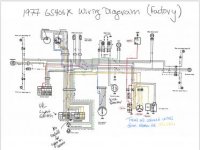
As a semi-side note, I am trying to understand my bike’s wiring diagram. I have begun to annotate the factory diagram in color, but I’m not understanding how the regulator is functioning in this circuit. It doesn’t appear to be in-line with the battery. I must be missing something here unless the regulator is drawing current away from the stator circuit to regulate he voltage?

Image Link: http://m.imgur.com/a/I38PayM
 
Last edited:
View attachment 56196

As a semi-side note, I am trying to understand my bike’s wiring diagram. I have begun to annotate the factory diagram in color, but I’m not understanding how the regulator is functioning in this circuit. It doesn’t appear to be in-line with the battery. I must be missing something here unless the regulator is drawing current away from the stator circuit to regulate he voltage?

Image Link: http://m.imgur.com/a/I38PayM

Power is generated at the stator.. 3 phase (the three wires from the stator) feed the rectifier/regulator converting the AC voltage to DC power.. from there to the fuse box and to the battery to charge.
 
Yes but in the wiring diagram it looks like the regulator is connected directly to one of the phases instead of being inline with the rectifier and then the battery.
 
Last edited:
Actually, I think I was thinking about this wrong. The voltage off the stator is somewhere around 75V and once it leaves the rectifier circuit it should be around the proper range (13-14V) to charge the battery. If the battery is full, the regulator begins to draw power from the rectifier circuit straight to ground. If the rectifier can't dissipate the heat fast enough then that heat is passed off back to the stator (this is what can cause it to blow up).

Did I get it right this time?
 
View attachment 56196

As a semi-side note, I am trying to understand my bike?s wiring diagram. I have begun to annotate the factory diagram in color, but I?m not understanding how the regulator is functioning in this circuit. It doesn?t appear to be in-line with the battery. I must be missing something here unless the regulator is drawing current away from the stator circuit to regulate he voltage?

Image Link: http://m.imgur.com/a/I38PayM

Hard to read the diagram but....
The output of the regulator is what runs the bike, not the battery. The positive r/r output is teed into the main power line and the negative receives the returning currents as directly as possible or should do. That leads on to the idea of single point grounding, SPG.
The battery is there to crank the starter and provide a little help at low rpm and high electrical load.
It's correct position in the circuit is in parallel with the other loads. In this position the regulator has the best view of the state of charge and has a better chance of keeping it topped up provided the earth returns are not creating a difference in voltage between the battery negative and the regulator ground.
 
I see, because in my wiring diagram (in 1978 and earlier the regulator and rectifier were separate units) the regulator is connected directly to the third phase of the stator and has a ground but that's it. There aren't any other connections to the regulator. That third phase of the stator splits via a connector: one yellow wire to the regulator and one yellow wire as an input into the rectifier. This is where I am confused.
 
Actually, I think I was thinking about this wrong. The voltage off the stator is somewhere around 75V and once it leaves the rectifier circuit it should be around the proper range (13-14V) to charge the battery. If the battery is full, the regulator begins to draw power from the rectifier circuit straight to ground. If the rectifier can't dissipate the heat fast enough then that heat is passed off back to the stator (this is what can cause it to blow up).

Did I get it right this time?
looks right to me.. I can't see your diagram well enough to see how close it is to my 850g... but I'm sure some others will be able to tell you.
 
Back
Top