• Required reading for all forum users!!!

    Welcome!
    Register to access the full functionality of the GSResources forum. Until you register and activate your account you will not have full forum access, nor will you be able to post or reply to messages.

    A note to new registrants...
    All new forum registrations must be activated via email before you have full access to the forum.

    A Special Note about Email accounts!
    DO NOT SIGN UP USING hotmail, outlook, gmx, sbcglobal, att, bellsouth or email.com. They delete our forum signup emails.

    A note to old forum members...
    I receive numerous requests from people who can no longer log in because their accounts were deleted. As mentioned in the forum FAQ, user accounts are deleted if you haven't logged in for the past 6 months. If you can't log in, then create a new forum account. If you don't get an error message, then check your email account for an activation message. If you get a message stating that the email address is already in use, then your account still exists so follow the instructions in the forum FAQ for resetting your password.

    Have you forgotten your password or have a new email address? Then read the forum FAQ for details on how to reset it.

    Any email requests for "can't log in anymore" problems or "lost my password" problems will be deleted. Read the forum FAQ and follow the instructions there - that's what we have one for...

  • Returning Visitors

    If you are a returning visitor who never received your confirmation email, then odds are your email provider is blockinig emails from our server. The only thing that can be done to get around this is you will have to try creating another forum account using an email address from another domain.

    If you are a returning visitor to the forum and can't log in using your old forum name and password but used to be able to then chances are your account is deleted. Purges of the databases are done regularly. You will have to create a new forum account and you should be all set.

Carb Sync Adaptors

Mr.humbucker

Forum Mentor
Past Site Supporter
Today I attemped to sync my carbs on my GS550T using the Motion Pro Carburetor Syncpro Tuner. Step one requires you to bring the engine up to operating temperature and then sync the tuner which I did successfully. Yeah me!

Next the instructions require you to remove the manifold balance point screws (Steve I hope I got the name of these correct) and insert the brass adaptors so you can hook the sync tool up. Now, whoever wrote this didn't seem to mind the fact that the engine is hot (understatement) and getting in there to remove the hex head screws on the middle cylinders is awkward nevermind threading in the adaptors without buring the $&@! out of the back of your hand. I eventually figured out how to use a cloth to insulate my hand as gloves didn't give me the dexterity I needed to get those threads to catch. Next time I will make a set of fingerless $3 (with a coupon) Harbor Freight Hardy Hobo gloves to insulate my hand and reveal my finger tips to give me the dexterity I needed ... I digress ...

So thinking there must be a better way I found these permanent adaptors and I am curious as to whether any of you fine forum folks have these installed and what the pros and cons are to them. A good deal of all this is new to me and so, like many others here, learn as I go. Seems these adaptors would be easier to remove the cap from and pop the sync hose line on to then working with threads on the hex screws and adaptors.
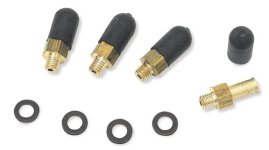
IMG_0817.JPG
And by the way, I was able to sync the carbs after all the "screwing" around.
 
If your bike runs absatively, posilutely perfectly and never, EVER backfires, those will be great. :encouragement:

However (you just knew there was a downside), if your bike EVER hiccups or backfires, those rubber caps will be spit off and you have a MAJOR air leak. You want to bother to ask me how I know? Never mind, I'll tell you. I had the same idea and put them on my bike. I got mine from Z1, not sure where the source was you had pictured. My bike would hiccup a time or two while warming up, it was just "normal", I never thought much about it. About an hour into the ride, I stopped for a short break. I happened to notice one rubber cap was missing. I had some electrical tape with me, used that to cover the port until I could get to an auto parts store. Got an assortment of rubber caps, installed the tightest one that would fit. When I got back to where I started, I replaced the other three caps with tighter-fitting caps. About a week later, I noticed one of them was missing, too, so I went back to the stock plugs/screws.

What I have found is best (for me) is to install the adapters BEFORE warming up the engine. It doesn't take long for the engine to run decently off-"choke". I have a tool that I use at work that helps this job. It is basically a screwdriver-type handle with assorted bits that can be inserted. I have gotten a couple of extra items that I dedicate to synching carbs and keep them in the carb sync tool kit. The items are the driver hande, a 4" extension and the 4mm ball-end bit that will remove the screws. I thread the metal adapters into place (mine are aluminum, from a previous sync tool) and use a short section of rubber hose as a grippy handle. I remove the short hose and put on the hose to the gauge set, then continue with the other hoses. After the sync (and the mixture adjustment) is done, I remove the gauge hoses and use the short hose to grip the adapters and unscrew them.

For thermal protection, I just fold a shop rag in half and lay it over the engine. It also helps catch parts that might fall in the next step. The ball-end hex bit will not hold the screws well enough to start them on cylinders 2 and three, and a straight-end bit holds them at the wrong angle. I use a pencil magnet to hold the screw and put it up to the hole where it needs to go. There is just enough grip with the magnet to twist in in about a turn. Remove the magnet, use your hex wrench to finish.

Just did this again this evening, finishing up my bike, getting ready for our "little ride". :encouragement:

.
 
Once again - great advice Steve. I knew you'd pick up on what I was putting down here. All your tips make sense. I had a bad feeling on those adaptors, having said that I can only remember one of my bikes backfiring in recent years. Regardless, I'll install the adaptors prior to the sync. Curious on what you're referring to when you say the mixture adjustment.

What I found tonight that did work was using my 3/8 drive hex head socket to place and set the hex screw back in place. I simply used my fingertips to twist it into place thereby holding it at a bit of a distance from heat and an easier radius to turn than the hex head itself. Between this and my soon to be patented Hobo Gloves I think I'll have a smoother go of it.

All the best on your Grand Tour!
 
Glad to see I'm not the only one suffering through that.

On my friend's Kawa, similar adaptors are/were permanently installed (factory even, I think), and so far they held on. I've considered something similar; #2 above the starter house will still require something to insulate one's hand. This, my recently acquired lathe, and Steve's comment however make me revisit an old idea I had; fabricating a small bracket on the side of the engine with four sync ports connected via tubes to the intake boots. Not too sure however if and how that small added volume changes (fluid) dynamics inside the boots though.
 
Curious on what you're referring to when you say the mixture adjustment.
"Mixture adjustment" is simply adjusting the pilot mixture using the mixture screws. I tend to do that while the sync gauges are still connected. The principle: when adjusting the sync, you can see the vacuum levels change, but mostly in ONE cylinder. Adjusting the pilot mixture will affect engine speed without changing the throttle setting(s), so the vacuum level will change in ALL cylinders, and by the same amount. For those who can't quite hear the slight difference in engine speed when adjusting the mixtures, the visual aid of seeing the vacuum level change is a great help.

On my friend's Kawa, similar adaptors are/were permanently installed (factory even, I think), and so far they held on.
I had similar adapters on my KZ1300. Only on cylinders 3 and 4, as they were opposite each other in the firing order, so would provide even pulses to the emission-control system. I got four more to install on the rest of the ports and had no problems. I think I looked into getting those, but the price was rather prohibitive, so I settled for the ones from Z1.


... four sync ports connected via tubes to the intake boots. Not too sure however if and how that small added volume changes (fluid) dynamics inside the boots though.
I think there is something going on the Yamaha forums about removing the emission-control system and linking the hoses in a similar manner, so there is a possibility that there are no ill effects. I have no idea how that system works or exactly where those ports are, so I don't even know if the comparison is a valid one.

.
 
One other item to note on those little permanent adapters: even if they stay on the rubber caps deteriorate, harden, and crack with exposure to heat and gasoline fumes.

Not a bad idea, but poor execution. Maybe if you could find Viton caps. Or one thing I've seen is to install tubing (you can get Viton tubing from McMaster-Carr) and run the lines out to one side. On my V-Strom, the sync ports in the throttle bodies are so incredibly difficult to access, running tubing out to the side is pretty standard.

On a GS it's not all that difficult. So since you don't really have to sync all that often, I just go with the method Steve outlined above for removing the sync port screws and installing the adapters temporarily.

One additional wrinkle is that I have a set of Bondhus metric "Prohold" ball end drivers that have a little plastic nubbin inside that retains the screw on the tip. Very very VERY handy.
https://www.amazon.com/Bondhus-7469...pID=41Npb70EMdL&preST=_SX300_QL70_&dpSrc=srch

These drivers can't really withstand a lot of torque, so I have extra-long ball-end t-handles I use to break them free and to tighten. These are available individually or in sets.
https://www.amazon.com/Bondhus-4-0m...D=21%2Bn196zlkL&preST=_SY300_QL70_&dpSrc=srch


< tangent >
With hex tools, it's really important to stick with a proven brand, like Bondhus, Eklind, Wiha, etc. I have a set of Craftsman t-handles that have been fantastic for years of hard use, but I'm not sure who made them or whether the current supplier is the same. Lots of Craftsman stuff has moved to China in recent years and quality is awful.
https://www.sears.com/craftsman-7-p...SellerId=Sears&prdNo=6&blockNo=6&blockType=G6

I have tons of Harbor Freight tools -- their "Pro" stuff made in Taiwan is fantastic -- but their t-handle and L-wrench hex stuff is very sub-par. Hex stuff is one area where you do need to spend a little more on a proven brand.
< /tangent >
 
Last edited:
I have those adapters on my '78 GS1000E. They get too hot to properly sync the carburetors even with my monster fan in front of the motor. The little caps would never stay on. I zip tied high heat silicon thick wall vacuum line to the nipples and ran the vacuum line from 1-4 and 2-3 cylinder. It helps with low end power and idle. I cut the Vacuum lines in the middle and barbed them together. To sync the carburetors I separate the lines I cut and use the barbs, two on the vacuum lines and two on my Carbtune Pro. Works like a champ. When the pretty blue vacuum line turns brown I replace them (about every year and a half).
 
Last edited:
I attached the beautifully made brass barbs that came with my Carbtune Pro....cylinders 2 and 3. Doorman vacuum caps.....24 months or so ago....less than 8,000 miles ;-( but.....no issues. No fiddling and dropping ...sheesh.....the copper crush washer ….always recovered them.....but extra minutes of frustration sometimes meant...no ride today.....
 
"Mixture adjustment" is simply adjusting the pilot mixture using the mixture screws. I tend to do that while the sync gauges are still connected. The principle: when adjusting the sync, you can see the vacuum levels change, but mostly in ONE cylinder. Adjusting the pilot mixture will affect engine speed without changing the throttle setting(s), so the vacuum level will change in ALL cylinders, and by the same amount. For those who can't quite hear the slight difference in engine speed when adjusting the mixtures, the visual aid of seeing the vacuum level change is a great help.

That's a great tip!
 
Back
Top