• Required reading for all forum users!!!

    Welcome!
    Register to access the full functionality of the GSResources forum. Until you register and activate your account you will not have full forum access, nor will you be able to post or reply to messages.

    A note to new registrants...
    All new forum registrations must be activated via email before you have full access to the forum.

    A Special Note about Email accounts!
    DO NOT SIGN UP USING hotmail, outlook, gmx, sbcglobal, att, bellsouth or email.com. They delete our forum signup emails.

    A note to old forum members...
    I receive numerous requests from people who can no longer log in because their accounts were deleted. As mentioned in the forum FAQ, user accounts are deleted if you haven't logged in for the past 6 months. If you can't log in, then create a new forum account. If you don't get an error message, then check your email account for an activation message. If you get a message stating that the email address is already in use, then your account still exists so follow the instructions in the forum FAQ for resetting your password.

    Have you forgotten your password or have a new email address? Then read the forum FAQ for details on how to reset it.

    Any email requests for "can't log in anymore" problems or "lost my password" problems will be deleted. Read the forum FAQ and follow the instructions there - that's what we have one for...

  • Returning Visitors

    If you are a returning visitor who never received your confirmation email, then odds are your email provider is blockinig emails from our server. The only thing that can be done to get around this is you will have to try creating another forum account using an email address from another domain.

    If you are a returning visitor to the forum and can't log in using your old forum name and password but used to be able to then chances are your account is deleted. Purges of the databases are done regularly. You will have to create a new forum account and you should be all set.

Confused about valve adjustment procedures

  • Thread starter Thread starter lettuceman44
  • Start date Start date
L

lettuceman44

Guest
Hello everyone,

Feels a bit weird to make another thread already, but I need some more help :P

So, I'm trying to do the valve adjustment, but I keep getting conflicting info.

1. Clymer manual says to turn the engine until one of the cam lobes is perpendicular, and then measure.
It is a bit vague though, do I measure each clearance with the cam lobe perpendicular, or is only one cam lobe perpendicular and I measure all of them?

2. https://www.youtube.com/watch?v=Qgm4dwy0TJ4
This video has it so the cam lobes are 180 to the shims

3. https://www.youtube.com/watch?v=jIL0eMzRPF8
This video has the cam shaft notches facing towards each other to measure the intakes and the right hand exhaust, and then the notches facing away from eachother to measure the left hand exhaust.

I don't know what I'm supposed to do now. I just want to make sure I'm doing this right so I get proper measurements.

My guess is that all these methods are right, but I just want to double check, because I can't fit a 0.025mm gauge in any of them.
 
Last edited:
The method in the Clymer manual is wrong. Use the Suzuki Service Manual method.
 
As I recall you have a 450 so just point the cam lobe away from the valve.

As I recall again, you can't get the feeler gauge in there so try to spin the bucket with your finger. Hopefully it will spin and if so, that means you may get away with only moving the shims one size. You are going to have to remove them to take an inventory. And never turn over the engine without all the shims installed. Remove, measure, reinstall, then go to the next valve. The valves tighten with mileage so when ordering shims you may as well plan ahead and get some spares in the smaller sizes. You will need them eventually.
 
Alright thank you everyone. Good thing I decided to ask :P

I can't get the buckets to spin, so I'm gonna try going 2 sizes down. The sizes installed ranged from 2.65 to 2.80. Seems a bit large. I ordered one 2.4 to see if I can get any clearance measurements.
 
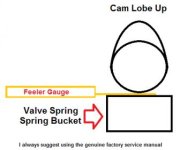
Here's how I've always done it

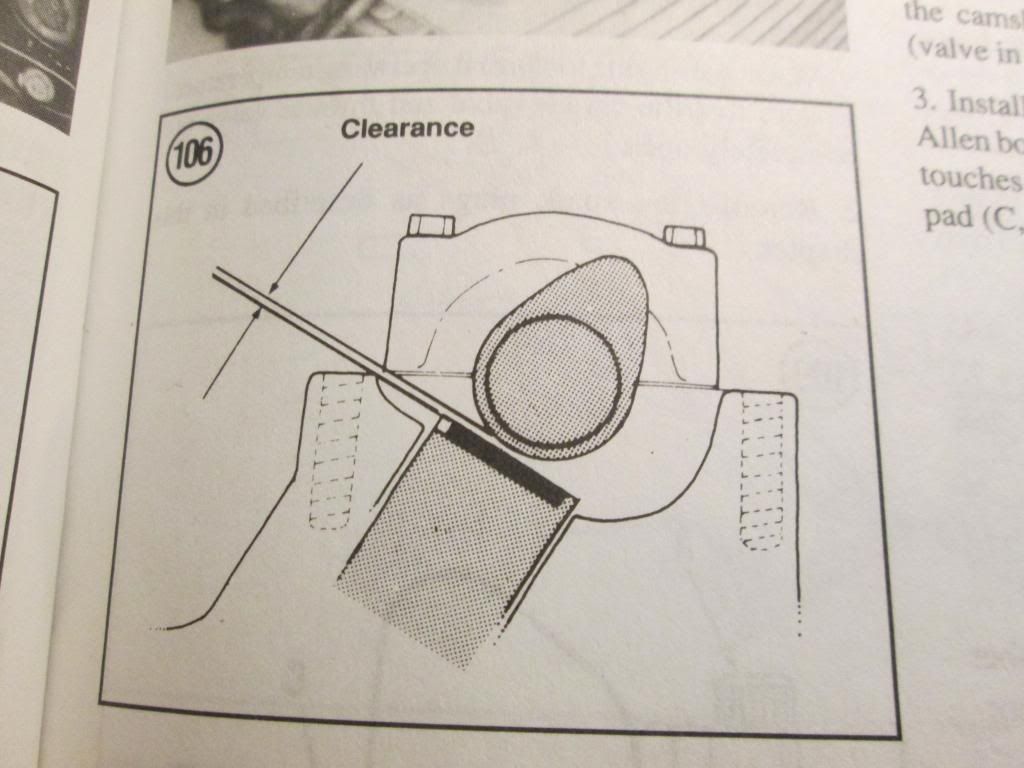
View attachment 46543


What some don't realize is that there are quieting ramps on the cams that take up some of the clearance before the lobe proper comes into play. You can see when the lobe is at the follower, but the ramp before that is invisible and however long the manufacturer decided it to be. ??

Methods that avoid tuning the crank for each valve check may save time, but I like to know for sure. The lobe 180 degrees opposite is never wrong.
 
What some don't realize is that there are quieting ramps on the cams that take up some of the clearance before the lobe proper comes into play. You can see when the lobe is at the follower, but the ramp before that is invisible and however long the manufacturer decided it to be. ??

Methods that avoid tuning the crank for each valve check may save time, but I like to know for sure. The lobe 180 degrees opposite is never wrong.

In your diagram, it says "I always suggest using the genuine factory service manual". However, your method is not what the genuine factory service manual says to do.
 
Here's how I've always done it

View attachment 46543

This method is fine for a twin bike like the 450. It's not the best method to use for the 4 cylinder bikes though because we need to pay attention to what the adjacent valve is doing. Following the factory Suzuki method is best because it positions two adjacent valves on the base circle at the same time.
 
This method is fine for a twin bike like the 450. It's not the best method to use for the 4 cylinder bikes though because we need to pay attention to what the adjacent valve is doing. Following the factory Suzuki method is best because it positions two adjacent valves on the base circle at the same time.


I may have to do mine again?
I got different readings when the lobes were opposed and when they were pointing at each other and when they were 180 from the valve.
I decided to do them as that diagram on compression stroke. The difference was a couple of thousandths between positions.
Is that what you're saying when you say base circle?
 
This method is fine for a twin bike like the 450. It's not the best method to use for the 4 cylinder bikes though because we need to pay attention to what the adjacent valve is doing. Following the factory Suzuki method is best because it positions two adjacent valves on the base circle at the same time.

I've been working on motorcycles since the 1970's and managed a few service departments.

What you are saying makes absolutely no sense unless you lack the common sense to know you have to rotate the camshaft for each valve.

Then again, there are always those old screw and lock nut set up's, I can remember fearing shims, now, I prefer them....

I love my FJ1200, it's a cake walk!

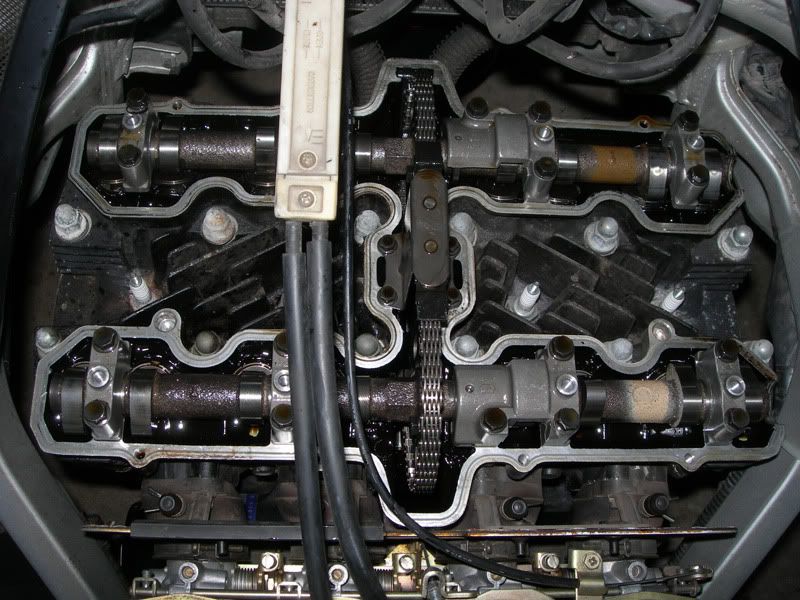
TopOpenHead.jpg


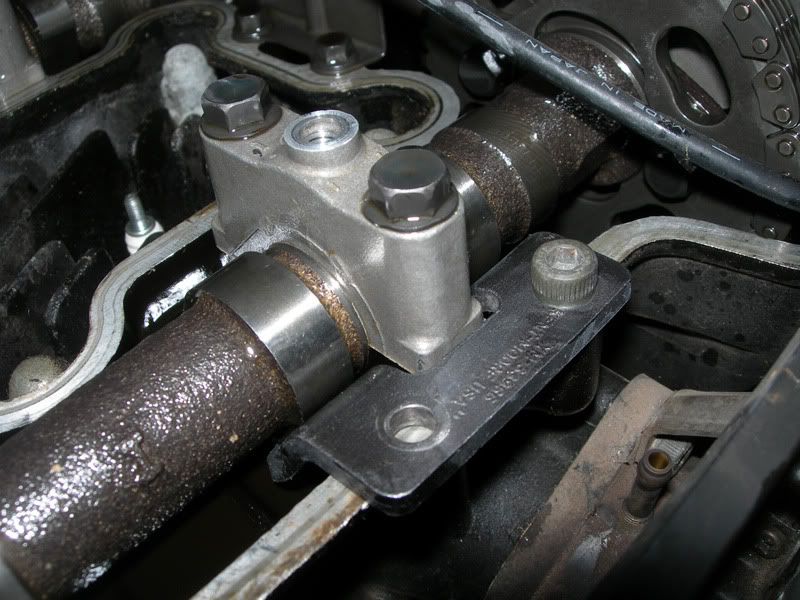
ShimTool.jpg


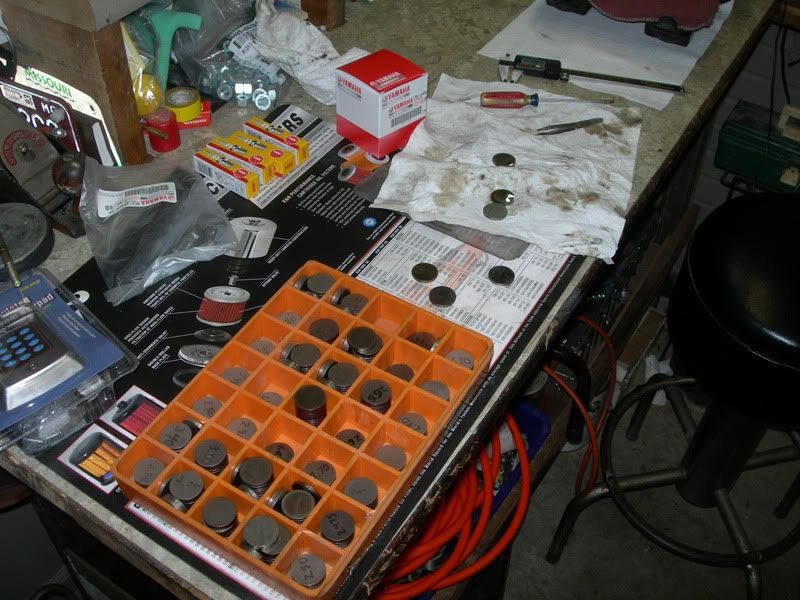
Shims.jpg


IMG_0156_zpse1d51b70.jpg


BUT - As mentioned, some brands call for different positions, it's always best to verify with the factory (Not aftermarket!) manual.

I have a dislike of those bikes you have to pull the cams on. I bought a Honda 919 new and luckily, like most Honda's, the valves never needed adjustment.

I'll give Honda credit where credit it due. I sure diss them enough.....
 

Attachments

  • 2009-11-14_230142_Valve_checking_GSX.jpg
    2009-11-14_230142_Valve_checking_GSX.jpg
    69.3 KB · Views: 0
Last edited:
In your diagram, it says "I always suggest using the genuine factory service manual". However, your method is not what the genuine factory service manual says to do.

It is exactly what many factory manuals tell you to do.

There are variables.

and disclaimers, such as I used :tongue-new:
 
I've been working on motorcycles since the 1970's and managed a few service departments.

What you are saying makes absolutely no sense unless you lack the common sense to know you have to rotate the camshaft for each valve.

I'm not going to argue with you since you seem to know it all already. Except, you don't know that the Suzuki method of positioning the cams for the 4 cylinder shim motors requires you to put TWO adjacent valves on the base circle at the same time. Failing to do this, such as using your method to position the cams, results in the adjacent valve pushing up on the cam and skewing it in the camshaft journal clearance. Depending on how worn the journals are the valve lash measurement will be about .0015-.002" GREATER than if you use the proper method to position the cams. The GS shim engines use a very tight valve lash range of .03-.08mm (.0012-.0031"), so you can't afford this level of inaccuracy if you want the valves to be properly cared for.
 
Last edited:
I'm not going to argue with you since you seem to know it all already. Except, you don't know that the Suzuki method of positioning the cams for the 4 cylinder shim motors requires you to put TWO adjacent valves on the base circle at the same time. Failing to do this, such as using your method to position the cams, results in the adjacent valve pushing up on the cam and skewing it in the camshaft journal clearance. Depending on how worn the journals are the valve lash measurement will be about .0015-.002" GREATER than if you use the proper method to position the cams. The GS shim engines use a very tight valve lash range of .03-.08mm (.0012-.0031"), so you can't afford this level of inaccuracy if you want the valves to be properly cared for.

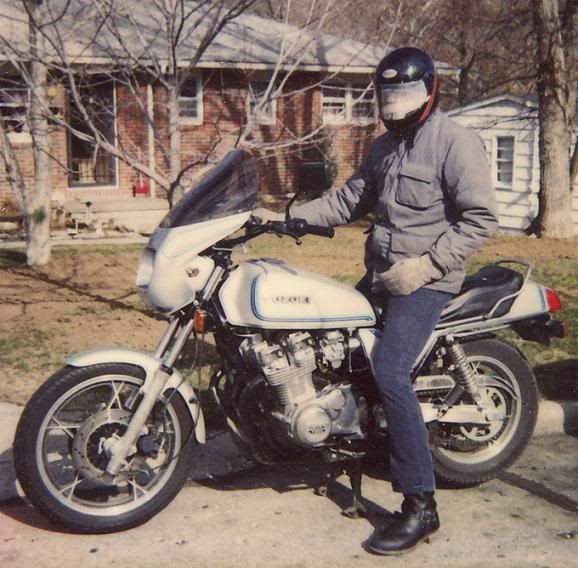
I had a GS1100E way back in the stoned ages - but that's a different story -

1980gs1100e.jpg


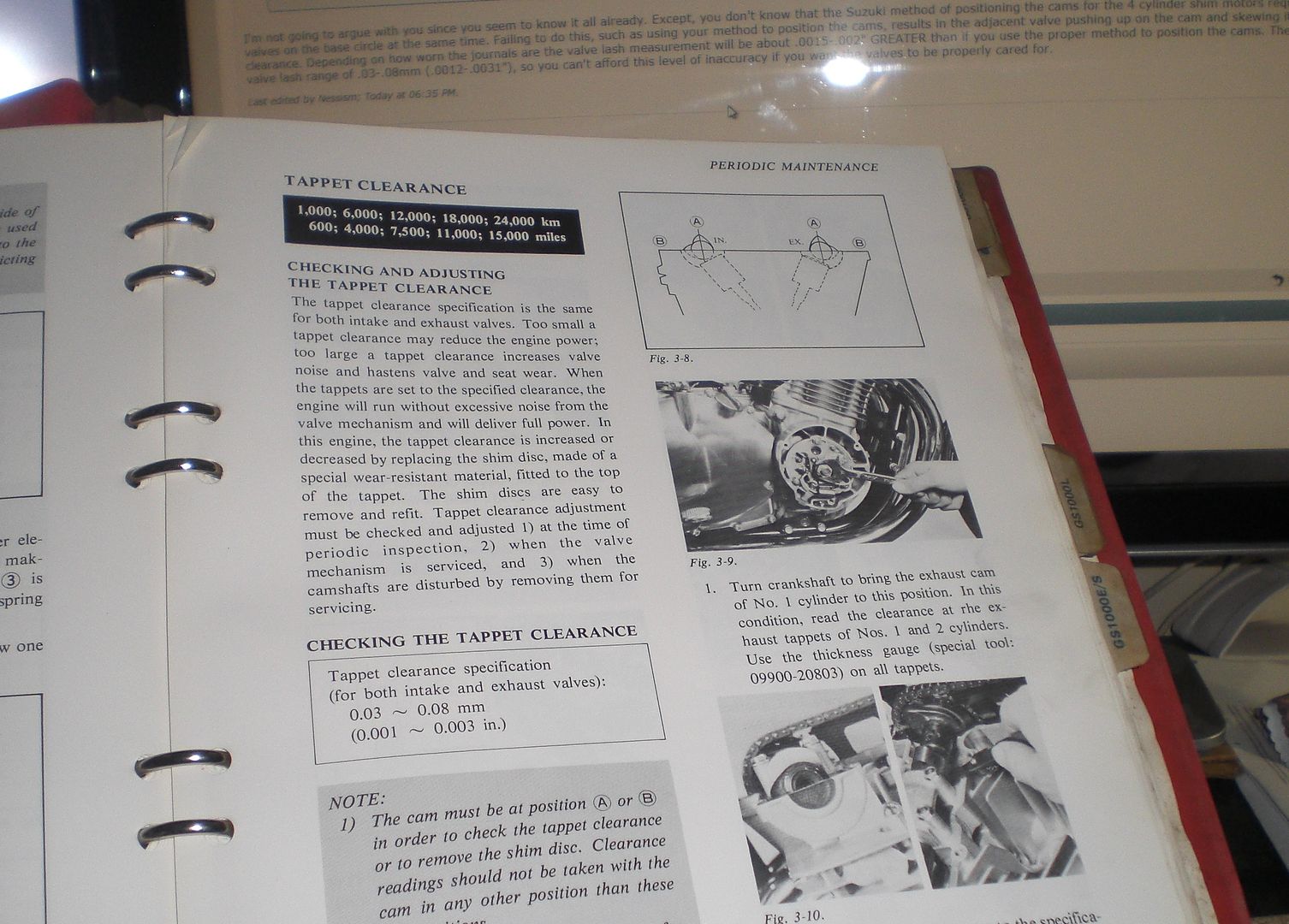
And I have the GS1000 factory service manual binder right here in my hand and you and I both know that is exactly true.

Page 3.5 to be exact -

CIMG9278_zpsxlbj2nnn.jpg


I applaud you for your ability to be as anal as I am when it comes to certain aspects of repairs.

When I do my valves, I don't make sure they are within spec - I make sure they are all the same, exactly (intakes match/exhausts match).

You sound like you might be that guy as well.

We may need help.....
 
That GS1100E is a 16-valve engine that uses a different procedure for checking clearances.

I will repeat what others are saying, which is what the Suzuki manual is saying, but will use some slightly different words.

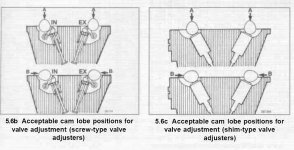
The manual tells you to position the lobes in a certain way, but the picture they give you is not very clear. For the exhaust (I usually start with 1 and 2), E1 lobe will point FORWARD, E2 lobe will point UP. While those two lobes are in that position, neither one is pushing on its valve and are still both on the base circle, so they are not skewing that side of the cam in its bearing. While those lobes are in that position, measure BOTH, E1 and E2.

Now rotate the crank 180 degrees (1/2 turn), you will find that Intake 1 is pointing UP and Intake 2 is pointing BACKWARD. Measure BOTH, I1 and I2.

Rotate the crank another 180 degrees, you will see that E4 is FORWARD, E3 is UP. Measure BOTH, E3 and E4.

Rotate the crank a final 180 degrees, you will see that I4 is UP and I3 is BACKWARD. Measure BOTH, I3 and I4.

The concept is not hard, once you grasp the idea that both cam lobes are pointing away from their valves at about 45 degrees, so are not pushing on them at all. I believe the factory manual is the only one that uses the words "measure both valves", neither Clymer or Haynes mentions that, they only show an end view of a cam with two lobes and say something to the effect of "use this position", but doesn't say for which valves.

And, BoCoMoMann, if you insist on using your way to adjust the valves, I will respectfully avoid your shop. :oops:

EDIT: I just took another look at the picture you posted of the manual. Look in the right-side column, item number 1.
Turn crankshaft to bring the exhaust cam of No.1 cylinder to this position.
In this condition, read the clearance at the exhaust tappets of Nos. 1 and 2 cylinders.
I added the bold for emphasis, but there it is, in your own factory manual. :-\\\

.
 
Last edited:
We got into this long discussion over at KZ Rider about the best way to position the cams, and needless to say there wasn't a consensus.

I checked the valves on my KZ three different ways and took the measurements. Bottom line, the Suzuki method results in the tightest measurements, which is perfectly appropriate on GS's because the lash spec is tight. The 180* positioning method resulted in the greatest clearances, and that frankly is good enough for KZ bikes because the lash spec is quite a bit wider than GS's. I'd say that the 180* method could be used for GS's as well, but I'd bump the spec range up from .03-.08mm to .06-.11mm. Kawasaki's spec is .05-.15mm.
 
That GS1100E is a 16-valve engine that uses a different procedure for checking clearances.

I will repeat what others are saying, which is what the Suzuki manual is saying, but will use some slightly different words.

The manual tells you to position the lobes in a certain way, but the picture they give you is not very clear. For the exhaust (I usually start with 1 and 2), E1 lobe will point FORWARD, E2 lobe will point UP. While those two lobes are in that position, neither one is pushing on its valve and are still both on the base circle, so they are not skewing that side of the cam in its bearing. While those lobes are in that position, measure BOTH, E1 and E2.

Now rotate the crank 180 degrees (1/2 turn), you will find that Intake 1 is pointing UP and Intake 2 is pointing BACKWARD. Measure BOTH, I1 and I2.

Rotate the crank another 180 degrees, you will see that E4 is FORWARD, E3 is UP. Measure BOTH, E3 and E4.

Rotate the crank a final 180 degrees, you will see that I4 is UP and I3 is BACKWARD. Measure BOTH, I3 and I4.

The concept is not hard, once you grasp the idea that both cam lobes are pointing away from their valves at about 45 degrees, so are not pushing on them at all. I believe the factory manual is the only one that uses the words "measure both valves", neither Clymer or Haynes mentions that, they only show an end view of a cam with two lobes and say something to the effect of "use this position", but doesn't say for which valves.

And, BoCoMoMann, if you insist on using your way to adjust the valves, I will respectfully avoid your shop. :oops:

EDIT: I just took another look at the picture you posted of the manual. Look in the right-side column, item number 1.

I added the bold for emphasis, but there it is, in your own factory manual. :-\\\

.

Uh, yes, I posted the manual page with the hope that you might understand I know what you are talking about.

It's only applicable to a few bikes -

It's not a big deal and blinders I wear not.

How again is all that applicable to the GS450 series?

And I quit working at powersports dealerships, mainly because certain people took all the fun out of it.

I'll never do that again, but I'll wrench on my own stuff all day long.

Thanks for the comments
 
Last edited:
We got into this long discussion over at KZ Rider about the best way to position the cams, and needless to say there wasn't a consensus.

To me it is quite simple - and this is the only way I ever do it.

Refer to the FACTORY shop manual.

Follow THEIR instructions

Works every time

There are too many variables for any one generic method to work

Still, a far better discussion that which oil to use or if K&N filters really suck or not.
 
To me it is quite simple - and this is the only way I ever do it.

Refer to the FACTORY shop manual.

Follow THEIR instructions

Works every time

There are too many variables for any one generic method to work

Still, a far better discussion that which oil to use or if K&N filters really suck or not.

The Kawasaki KZ factory method of positioning the cams results in inconsistent measurement results. By that I mean that on some of the valves the adjacent cam lobe is pushing up on the cam and for other valves it isn't. I prefer the Suzuki method since the adjacent valve is always on the base circle. At the end of the day it doesn't matter that much since as mentioned, the KZ bikes use a lot of valve lash. Can't say I'm inspired to follow their method though.
 
The Kawasaki KZ factory method of positioning the cams results in inconsistent measurement results. By that I mean that on some of the valves the adjacent cam lobe is pushing up on the cam and for other valves it isn't. I prefer the Suzuki method since the adjacent valve is always on the base circle. At the end of the day it doesn't matter that much since as mentioned, the KZ bikes use a lot of valve lash. Can't say I'm inspired to follow their method though.

Kawasaki builds them to be fast - not to last.

At least that is what it always seems like.....

The first street bike I ever had - H1B

Fast (for the time), did not last.
 
Back
Top