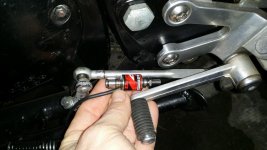
Last night I started looking at the linkage and where the "pull" sensor is going to go. I was looking forward to a nice little project that would keep me busy for a couple hours.
Unfortunately it only took me about 20 min. I was gifted this little mini lathe about 10 years ago in exchange for making a guy some supermoto wheel spacers, and I can't tell you how useful this thing is.
I use it probably 1x per month in my garage for all sorts of random projects. Tractor parts, motorcycle parts, kitchen sink parts, one off parts for work, etc. Amazing little tool. I can't imagine buying random lengths of shift linkage parts and trying to make something work just bolting stuff together.
This is where the sensor will go.
First cut to size.
Here's the cutting tools I need: Centering bit, 15/32 drill bit, and 6M x 1 tap.
First center the hole.
Drill it out.
I tapped it with the tap in the chock, then turned the lathe by hand. I only use the lathe to make sure the tap starts nice and straight.
Here it is in place and ready for wiring.
Another view:
This is an 1150 motor and ZX12 rearsets that I made to work. Lighter, cooler, sweeter.
I do run GP shift, or "Reverse" shifting, so you have to remember that this configuration "pulls" on the shift linkage when I upshift. The linkage part attached to the shift shaft (on the motor) is flipped upside down. I became accustomed to this type of shifting when I was roadracing, and even in my old age, I was able to re-learn how to shift in less than one day. It actually becomes pretty natural after a while, and makes me wonder why all bikes don't come this way from the factory.
Once I hook up the brains and give the bike a test run, I'll report back with how it works.
This new model 4-126 has the ability to adjust the pressure required to activate the switch, and also the duration of the "kill" for different RPMs. The default setting is 66ms for all RPM. Hopefully that works just fine, and I won't really have to make any fine tuning adjustments.
If you're wondering how this thing works: the Sensor (pictured) connects to the Brain box, a little cracker sized box with a bunch of wires coming off it. The other wires coming off the box connect to the signal wires on the coils and interrupt the signal for 66ms when the sensor is triggered. You hold the throttle wide open, in my case push the shifter down, the motor kills for 66ms, the bike shifts, and full power is resumed.
Let's say it takes me 200ms to shift manually. (2/10 or .200 sec.) and this makes it 66ms. (.66/10ths or .066 sec). I'm trying to get this 11.1 second bike below 10.9, and this is just part of the effort. It sounds so stupid now that I'm writing it out, but these are the things that a couple trips to the drag strip drive you to do. Plus I find the tinkering just as fun as the drag racing.
-Kevin