I -- uhh. please don't be insulted but I am not understanding the final goal of what you want to achieve. I love trying new things - reinventing the wheel, wasting time building a better mouse trap. I have some custom bikes - I simply have an opinion and I hope you and the "GS guys/gals" don't overreact.
Not insulted - considering that my undergraduate degree is in philosophy, I enjoy the opportunity to engage in a lively debate. For the purposes of this conversation, I want to examine your suggestions based on their merit with respect to my understanding of basic engineering principles and the "scope" of my GS restoration/rebuild.
This is what I see, you took a heavy frame and made it heavier with out really making it better. drag racing ? or road racing?
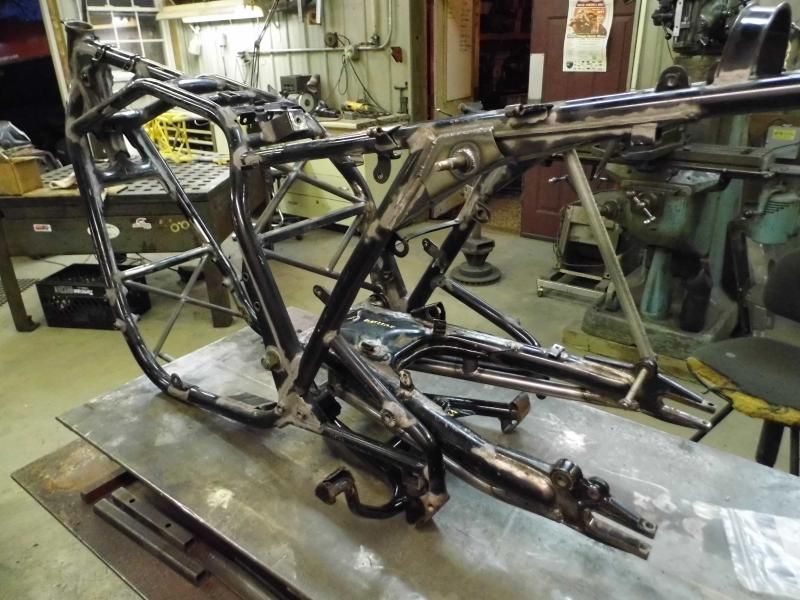
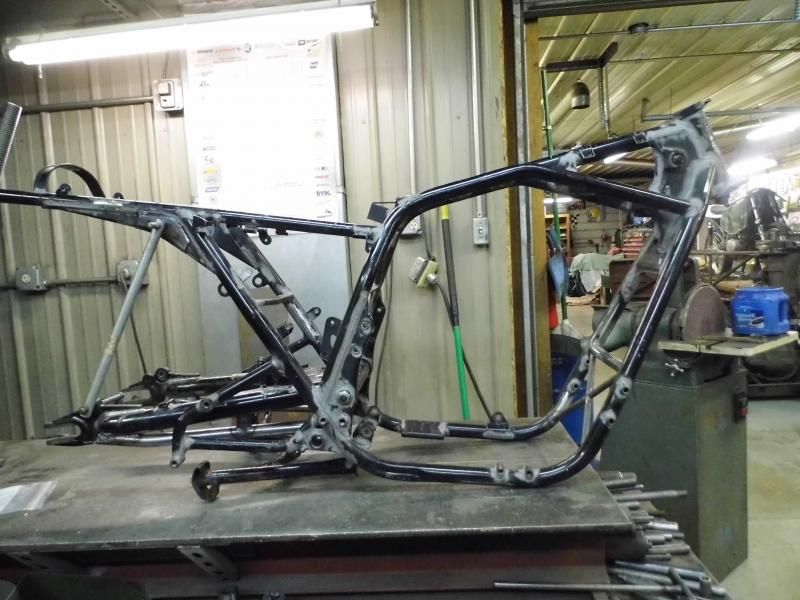
First, the goal of this build was to take a stock 1978 GS1000 and to perform a "period correct" performance build. Thus, I built the motor to be more powerful (120 to 130hp), the suspension and brakes are being improved, and my desire for the frame was to add some bracing that would "clean up" the handling for occasional aggressive road riding. According to every engineer and frame builder with which I have spoken, the biggest areas of concern on a GS frame (when more power is added) are swingarm flex and "trapezoiding" of the frame. If my expectation was to build a bike that was as fast and would handle as well as my 2007 FZ6, that would be a fruitless endeavor - starting with a GS platform in hopes of copycatting the manners of a sportbike is like comparing a 60's era muscle car to a modern supercar. I took a heavy frame, braced a few areas based on importance and budgetary constraints, a subtracted weight in other areas (lighter exhaust, etc).
the mods you have chosen don't make sense to me -other than to put the flex somewhere else in your chassis,-
Where did the flex go - to lunch, dinner, the movies? Whenever we brace a frame, flex points can migrate to other areas. The goal in any bracing project is to mitigate the types of flex that will affect handling the most. In my opinion, that is what I did. Once again, the modifications that I made will not make my frame equivalent with that of a modern sportbike. I understand this...
but really, I am not banging your project for fun - it's just like the emperor's new suit - I am not impressed and I can't lie -
Ok... Arguing aesthetics and "what is pleasing" is pointless, as it is the equivalent to arguing over what color is better over another. However, like I mentioned before, all we can truly argue about the efficacy of the modifications that were performed to my frame.
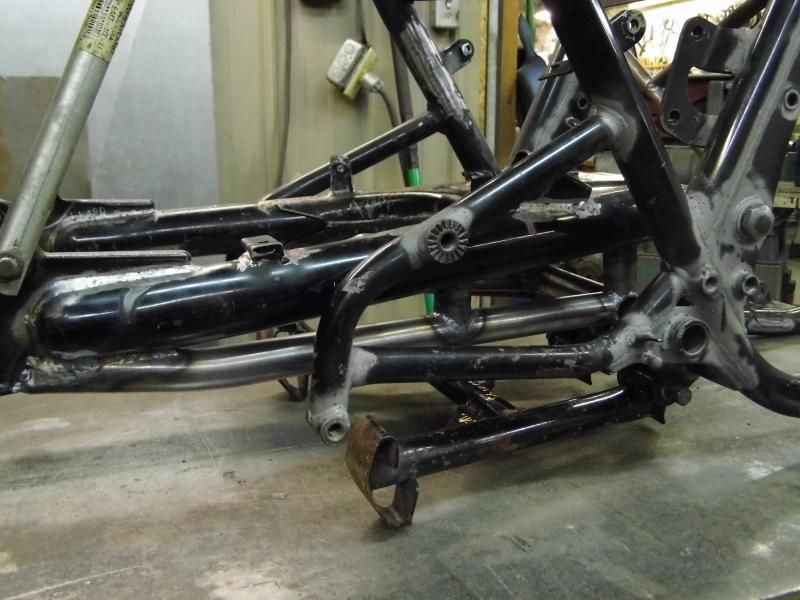
bracing the stock swing arm ( which is a hideous weld) and not increasing the diameter of the pivot bolt ? or relocating it upwards? or using a lighter material?
Because I am retaining the stock dual-shock setup and not converting to a monoshock, increasing the size of the pivot bolt or relocating are modifcations that would be of great expense and little benefit. The area of the swingarm that typically flexes are the parts that hold the rear axle - analogous to bending the tines of a fork in opposite directions. As for rebuilding the swingarm with a lighter material - completely rebuilding or reengineering the frame is beyond the scope of this project. If money was limitless, I would have a custom frame built from the ground up. Better yet, I could simply not bother with reinventing the wheel and start with a modern bike as a platform. However, I love the vintage look of the GS1000, and thus, there are compromises.
lowering the seat rails is a good idea - putting a triangular at a horizontal plane at the lowered seat rail.
Once again, reengineering the frame of my bike is not in my budget or within the scope of this project.
put a bar straight through/between the rear shock mounts- plus a larger diameter . adding a better rear top engine mount does a lot
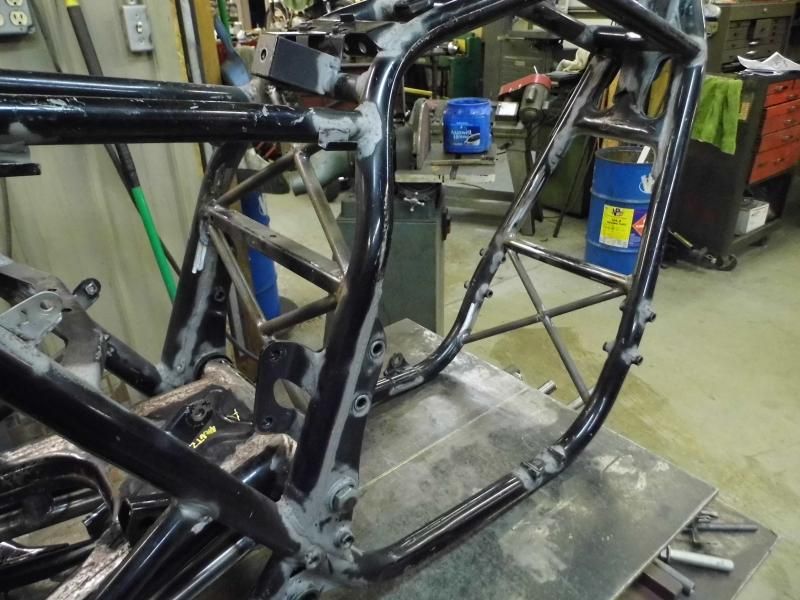
The shock mounts were straightened and reinforced - adding a straight bar between them would prevent fitment of the OE rear fender liner and possibly cause issues with rear tire clearance. I AGREE that larger diameter shock mounts might help, however, it was more cost effective to straighten and reinforce the ones I had - the shock mounting studs didn't bend, it was the mounting point to which they were welded that bent and cracked. As for the engine mount, modern bikes use the engine as a component that is integral to the frame, i.e. the engine performs a critical role in stiffening the frame. On the GS, it is possible that reinforced engine mounts might help, however you are still limited to the bolt sizes and mounting locations on the engine itself. This is another cost/benefit situation...
is the oil filter cap a tight fit to remove? or is it just the angle of the photo. - lose the front X and cut the original cross brace out and replace it with a wider with rectangular tube thin wall chromoly instead of regular mild steel.
Oil filler cap access is fine - must be the angle of the photo. From a pure engineering standpoint, I can't fathom how a piece of rectangle tube, regardless if it's chromoly or mild steel, would provide more rigidity than a properly designed and welded "x brace." Completely re-engineering the entire frame is an expensive an questionable endeavor.
sleepers are faster than original -- in order to make a GS "fast" you have to lose weight and gain geometric advantage.
I did not begin this project with the intention of making my GS to be as fast and nimble as a modern sportbike - through what I believed to be sound research, I made incremental improvements the allowed the greatest "bang for the buck" factor. My primary goal is to have a vintage bike that handles better than stock with more oomph - I'm throwing in some fantastic upholstery and paintwork to make it look drop dead gorgeous, too 




 but I can get into the groove of your project because I love modified power bikes.


