• Required reading for all forum users!!!

    Welcome!
    Register to access the full functionality of the GSResources forum. Until you register and activate your account you will not have full forum access, nor will you be able to post or reply to messages.

    A note to new registrants...
    All new forum registrations must be activated via email before you have full access to the forum.

    A Special Note about Email accounts!
    DO NOT SIGN UP USING hotmail, outlook, gmx, sbcglobal, att, bellsouth or email.com. They delete our forum signup emails.

    A note to old forum members...
    I receive numerous requests from people who can no longer log in because their accounts were deleted. As mentioned in the forum FAQ, user accounts are deleted if you haven't logged in for the past 6 months. If you can't log in, then create a new forum account. If you don't get an error message, then check your email account for an activation message. If you get a message stating that the email address is already in use, then your account still exists so follow the instructions in the forum FAQ for resetting your password.

    Have you forgotten your password or have a new email address? Then read the forum FAQ for details on how to reset it.

    Any email requests for "can't log in anymore" problems or "lost my password" problems will be deleted. Read the forum FAQ and follow the instructions there - that's what we have one for...

  • Returning Visitors

    If you are a returning visitor who never received your confirmation email, then odds are your email provider is blockinig emails from our server. The only thing that can be done to get around this is you will have to try creating another forum account using an email address from another domain.

    If you are a returning visitor to the forum and can't log in using your old forum name and password but used to be able to then chances are your account is deleted. Purges of the databases are done regularly. You will have to create a new forum account and you should be all set.

GS Stator

It's stories like yours or maybe yours that convinced me to follow posplayer and convert to a Series R/R. Electrosport sells Shunt R/R's and that or any other Shunt R/R and electrical system condition is the culprit, not the stator in the majority of cases. In this you do not know what you are talking about. Electrosport actually makes good stators along with Ricks and many of our members have had real good luck with Ebay stators. I have only heard of a couple of cases on an 1150 I believe where an Electrosport stator failed that had been fitted with a Series R/R and that was a fit problem with the stator where some wires were out of place and got pinched in installation. You are complaining about the result of having used Shunt R/R's not crappy stators. It's not your fault because that is the majority of R/R's on the market and you wouldn't have known, but now you are in a place that knows better and you can correct that problem and incorrect statements with the information posplayr has brought to everyone's attention. I'm talking about bikes with three phase AC generators like the GS so anything with another system I can not answer for and is not within my experience. Posplayer's picture below of a failing Electrosport stator is exactly the results of using shunt R/R's no matter what the quality of the unit and not the stator at all.

Electrosport's stators make more power than a stock Suzuki stator, and as such there is more power shunted back into itself. I suspect that leads to increased failure of these units. Yes, a series R/R solves that problem but I think their basic approach to maximize output is not the best for general users.

Basscliff was using RM Stator a while back and he suffered a number of failures in a short time. Can't remember what he did to solve that issue just remember he had lots of troubles with the cheap Chinese stators.
 
You would be correct but paired with the series R/R the extra output is not a problem as you pointed out. It just compounds the problem paired with the shunt R/R's. My parts bike had something like 4,600 miles on it when I bought it and had burned stator connectors already. It was a story about three Electrasport stator failures in a row (and it was determined that it was the new Electrasport shunt R/R's that caused them) that caused me to adopt the Series regulator. That the industry is not responding and hanging on to the old technology because it is cheap is beyond me. I'm guessing stator replacement has become a profitable industry in itself.
 
Last edited:
Electrosport's stators make more power than a stock Suzuki stator, and as such there is more power shunted back into itself. I suspect that leads to increased failure of these units. Yes, a series R/R solves that problem but I think their basic approach to maximize output is not the best for general users.

Basscliff was using RM Stator a while back and he suffered a number of failures in a short time. Can't remember what he did to solve that issue just remember he had lots of troubles with the cheap Chinese stators.

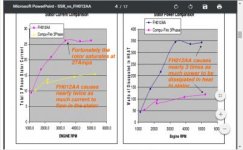
I'll try and put some detail to your point that invalidates your conclusion. Yes the Electrosport claims to increase power but as I have described this is only in an low RPM range where a different stator wind would produce lower voltage. Basically at idle the Electrosport will give a higher voltage. Once you get to 2500 RPM that benefit is largely gone as you are starting to saturate the magnetics and approach maximum current capability of the rotor. At 3500 RPM and above there is going to be no difference in power produced.

As far as how to get the highest idle voltage and the best stator longevity I recommend the Compufire R/R with the Electrosport stator.

The Compufire uses MOSFETs whereas the SH-775 uses SCRs so all else being equal you will see a higher output voltage at idle (say 1000 RPM).

With the Electrosport stator wind it will produce a higher output voltage at this same RPM. I have never done a stator swap out to confirm their claims , but assuming it is valid it would be highest at low idle. 20% power increase would correspond to approximately 10% (sqrt(1+.2)-1)=9.5%) voltage increase or if we were idling at 1000 RPM and were at 12.8V with a more traditional stator, the electrosport would produce 12.8*1.095=14.0V. This is probably the maximum extent of what the electrosport benefit because as soon as it gets to 14.25-14.5V it will be regulated. And yes this mid range RPM is where more power will be generated.

So while the statement that the Electrosport produces more power is true, it is only in a low voltage situation from 1000-2000 RPM where it will be noticeable and beyond that there is no difference.

beyond this, you can also be confident that the Electrosport rotors were designed by someone that understand electromotive forces on the stator winding. See the heavy epoxy. That will ensure years of longevity and protection against vibration and EMF.

On A GS at least, it is far worse to use a MOSFET SHUNT regulator like the FH008, FH0012, FH0020.!! That is because these MOSFETS are very efficient shorts and they will run cooler than your average SHUNT R/R that traditionally uses SCRs. What You say my MOSFET R/R running cooler is bad? Yes because any heat the SHUNT R/R does not dissipate is being dissipated in the stator making it run hotter.

Yes I will admit the worst combination is a Electrosport (higher low RPM output)with SHUNTING MOSFET R/R, but the MOSFET R/R is the worst part delivering between 10-20 more watts back to the stator than a old style SCR SHUNT R/R.

See my picture above about where the power is dissipated to understand this. If the total power is not dissipated in the load or the R/R then it is dissipated in the stator. So when running down the road with your engine at 4-5K RPM and the charging system is at maximum due to rotor limitations, loads are the same, if the R/R is running cooler then the stator is hotter.
 
Last edited:
Jim, you continue to baffle me at times but I sure am glad you are here to guide us through.:biggrin:
 
Of course anybody looking to just solve the problems and move on would simply just install a SERIES R/R and all these revelations, and workarounds would become mute.
but when "anybody" is on the road (too far from Amazon's drone service) with a non-regulating charging system,"anybody" might find unplugging a stator leg worth a try.

From looking at the image and the reticle centered on the stator (as well as the high resolution of the image) I think it is safe to say that the Messpunkt, is an average in the near region of the center retical. This does not imply that the engine oil will be 34.7 degrees cooler using the Compufire, but that the stator is running substantially hotter with the shunt R/R.

We will disagree as to what is "safe to say". "The colours are an important part of the presentation . Also, just in passing, per the "reticule centered on the stator" the centre of the stator is hollow . The coils would seem more pertinent.
 
Stator_Power_Rolloff.jpg
Jim, you continue to baffle me at times but I sure am glad you are here to guide us through.:biggrin:


I know what I'm talking about may sound mysterious, but just ask yourself what is the conversion efficiency of the GS Charging system?

Basically there is a certain amount of power available from the engine for a given RPM. If the conversion efficiency of the charging system remained constant or in other words linear, then you can expect both the current and voltage to rise in proportion to RPM (this is a consequence of what is known as Lentz's law)

https://en.wikipedia.org/wiki/Lenz's_law

Lenz's law states that the current induced in a circuit due to a change or a motion in a magnetic field is so directed as to oppose the change in flux and to exert a mechanical force opposing the motion.

Basically force on a wire and the current through it is a reversible process (conservation of energy)which is why a motor is a motor when you drive it with current or a generator if you drive it mechanically. But I digress :).

What this means is that in an ideal world the electrical power out (P=I^2R=V^2/R) of the GS Charging system should increase to the square of RPM. And in fact in the low RPM range 500-1500 RPM it does. But around 1500-2000 RPM this squared law rise (double the input quadruples the output) is not realized! The output of the stator starts to roll off. Why? It is magnetic saturation ; Real materials like iron, steel and magnets have pronounced saturation effects.

You can visualize this as the materials having a lot of randomly aligned electrons when not in a magnetic field, but as the magnetic field becomes more pronounced the electrons align themselves with the magnetic field. But they can only align themselves and the more in alignment they are the less additional magnetic flux you get.

I'm no motor designer, but anybody who has studied the performance of basic DC motors will know these things are true. This is a very real effect and is well known , documented and obvious when you start taking measurements. So you can not take a stator that is in a charging system producing 150 watts and rewind it to produce 300 watts. It is impossible because it is the rotor and its magnets as well as the iron flux paths around the stator that dictate how much flux can be supported no matter if you run the engine up to 10K RPM or 15K RPM the charging system saturated and conversion efficiency drops correspondingly.

So Lentz's Law applies to ideal materials or materials that are not saturated. Most motors and charging systems run well into saturation because it is cheaper to run something to the max and get the design power levels than to design something that does not saturate but is capable of generating 10 times what you are using it for.


https://en.wikipedia.org/wiki/Saturation_(magnetic)

This is the main explanation of why the much heralded 20% power increase of the Electrosport stator can only be at low RPM as I described above and calculated as nominally a 1V increase at slow idle.

The fast rise in current and even faster rise in power that suddenly flatlines is due to "magnetic saturation effects"
 
Last edited:
We will disagree as to what is "safe to say". "The colours are an important part of the presentation . Also, just in passing, per the "reticule centered on the stator" the centre of the stator is hollow . The coils would seem more pertinent.


You see what you want to see in the information.

If you understood the physical process of IR sensing you would realize that you can not see the hole anymore than you can see the coil. IR does not make the aluminum cover invisible or transparent for that matter. It can only read the surface temperature of the cover.

If you consider for the briefest moment the principles of heat flow especially in a material as thermally conductive as aluminum you would realize that the even relatively small temperature gradients across the cover are due to very large temperature differentials behind the cover (the IR can't see behind the cover). To overstate the obvious, that is because heat flows so well in aluminum that it takes a whole lot of heat flow to generate a temperature differential.
Anybody familiar with welding aluminum can readily attest to this.


The point is that you are only looking at a small part of the real thermal differences behind the cover. The SHUNT controlled stator has to be much much hotter to support such high thermal gradients across the aluminum cover.


If a 34.7 degF differences on the surface of the cover is not enough to convince you that the SHUNT stator is going to be remarkably hotter than SERIES controlled then I have no words for you that I wish to post.
 
Last edited:
Would it be correct to say that the rate of change of flux in the stator poles is what induces the emf in the windings. If you could somehow support all the windings in the rotor without a core the emf would be much less and that the stator poles saturate at some point making increases of speed and or number of windings irrelevant.
 
Without a controlled experiment on a bench setup running at set speeds with a fixed load and a thermometer measuring precisely, we only have a guess as to what's going on.
 
Where I work we use a fair number of motors and differences in how the stator is wound and wire size have an effect on current consumption and performance in general. I don't know at what rpm the magnetic field is saturated on a GS charging system using various stators but I do know my bike sees a fair bit of time in the lower rpm regions, and if stators are burning up because of too much power being shunted back in themselves then what's the point in maximizing current output at a lower rpm when the system doesn't need it?

Everyone is free to do what they want but I don't see the point in high output stators unless you are driving electrical loads beyond the bike as stock. Every GS I've ever bought or owned had a stock stator and the charging system functioned okay after fixing R/R grounds in the system. Clearly though, a lot of stock stators burn out so there is value in fixing the wiring system and installing a series
R/R. My unofficial survey of stator failures has the chinese made aftermarket units (Electrosport and RM Stator) failing at a higher rate than stock or Rick's. That's why I spent the extra money on a Rick's recently. They make no claim about being high output and the quality seems good.
 
Last edited:
I would expect thermal imaging systems to auto range for maximum contrast. The human eye frequency range is fixed and it will show white whether the top temperature in the view is an exhaust or a poorly insulated door on a house. Colours for effect and to show where to point the crosshairs for the messpunkt.
The casings and oil are taking away heat fairly fast so the true stator temperature could well be multiples of the indicated difference in the pictures.
BTW anyone notice that the sun was shining in one pic so the difference is more than you think :)
Then we already know that shunt types have higher average current in the stator and that integrated over a period should be enough to know considerably more energy is being dissipated in the windings and that for me is a more accurate measure than external imaging. In fact given the pathways for the heat to escape the stator, that there is any detectable difference at all on the outside is a strong indicator that there is a big temperature difference.
 
Would it be correct to say that the rate of change of flux in the stator poles is what induces the emf in the windings. If you could somehow support all the windings in the rotor without a core the emf would be much less and that the stator poles saturate at some point making increases of speed and or number of windings irrelevant.

The simple way I like to think of it is that "current is produced in a wire when you move a wire through a magnetic field"(generator effect). Correspondingly "when you put current through a wire that is in a magnetic field a force is applied to the wire"(motor effect). The faster the velocity the more current/force, the higher the magnetic field the higher the current/force.

Generally speaking motors and generator designs try to minimize air gap because a much larger flux density (i.e. magnetic field) can be supported in the iron than in air. So a set of windings supported in air would be a very poor motor/generator. The rotor is so close to the stator to minimize air gaps and keep the magnetic field in the gap higher because there is less air. You can probably find a reference on line that will show the paths of flux for this type of generator.

If you want to talk about cutting lines of flux(wire moving through the magnetic field) or rate of change of flux (not sure what you are referencing here unless it is an AC machine), you are starting to get more into motor design principles that are probably beyond most folks here.


EDIT:
I found this link, apparently changing magnetic field also causes the voltage change. This is implicit in my statement that higher magnetic field produces higher current/force. The link talks about Maxwell, Faraday and Lentz all in the same context with not nary an integral so I think this is a good place to start for good understanding.

http://hyperphysics.phy-astr.gsu.edu/hbase/electric/farlaw.html

In an undergraduate (1st year Junior level) you take Electromagnetics I and that is where you have to cut your theeth on Maxwell's Equations including the integral and differential forms shown here.

https://en.wikipedia.org/wiki/Maxwell's_equations
 
Last edited:
I prefer Electrosport and with a Series R/R they are no problems. The GS1100E stators have been high quality like this one. Heavy epoxy to immobilize the winding. Most people probably do not realize that the are Electromotive forces on the winding which will cause flexure if not supported. A thermal epoxy as you see here is what is used. It is not just for insulation, it is to keep the winding from flexing under the EMF forces. If you see winding that do not appear to have anything but a thin insulation cover, they are going to be less tolerant to usage.


I don't know that all of Electrosport product coating are this heavy but there are superior to most I have seen from any other vendor. If you are still using Shunt R/Rs and burning stators well there is not much anybody can say to help...............

This picture was to document heat damage from a MOSFET Shunt R/R after a 250 mile ride on a brand new ES stator. It was getting hot.

attachment.php

I'm assuming that the brass fitting is an oil spray device. Is it a coincidence that the 'saut?ed' section is directly in its path, or are we making an assumption that oil is cooling the stators? I've seen stators fried in a sectional area, but usually as a result of shorting directly to the core.

The stator shouldn't really see all that much oil, being inside a centrifuge. Hot oil as a cooling mechanism presupposes that the stator is hotter than the oil. The case is well drained and the only feed is from the main bearing spin off. I'd expect the flywheel to be above the oil level so all that normally gets to the stator is some transient splash which would be flung off pretty fast.

Or? it just got hot there because it did. And/or, the fitting is something else. ??
 
Without a controlled experiment on a bench setup running at set speeds with a fixed load and a thermometer measuring precisely, we only have a guess as to what's going on.

There is far more already known than would be answered by the measurements you suggest and those measurements would likely do nothing to answer the naysayers on oil temperature drop using Series R/Rs.
 
I'm assuming that the brass fitting is an oil spray device. Is it a coincidence that the 'saut?ed' section is directly in its path, or are we making an assumption that oil is cooling the stators? I've seen stators fried in a sectional area, but usually as a result of shorting directly to the core.

The stator shouldn't really see all that much oil, being inside a centrifuge. Hot oil as a cooling mechanism presupposes that the stator is hotter than the oil. The case is well drained and the only feed is from the main bearing spin off. I'd expect the flywheel to be above the oil level so all that normally gets to the stator is some transient splash which would be flung off pretty fast.

Or… it just got hot there because it did. And/or, the fitting is something else. ??


Good eye on spotting the sprayer. I purposely avoided mentioning it as it would require going into more discussion really not relevant to the specific discussion of series R/R but more into the thermal properties of stators and how they cool themselves. The sprayer was added after the first 250 mile ride (on a new stator install) that burned the stator as shown, but before I found a Compufire Series R/R. I have since swapped out the stator using the Compufire and without the sprayer (I plug the line) and the stator is still baby blue. Overheating has been stopped

The sprayer was positioned to the 'saut?ed' section" to keep it cool and after adding it seemed to lower the operating temperature of the oil and stop/reduce the burning. It aimed to spray into the air gap to get at the shrouded stator coils and not onto the rotor.

From the heating pattern it is clear (to me at least) that the lowest coils stay cooler due to oil picked up from the bottom of the cover. The coils at the top remain relatively dry or at least without much oil circulation.

Also when these little baby blue coils turn brown, my assumption it is because the thermal epoxy is getting over 400 degF which is a damn site hotter than the oil. My temps before the sprayer would run normally at about 270 degF as measured by teh OEM oil temp gauge. After fitting with the Compufire (and I have to admit teh sprayer in various forms). I'm hard pressed to get the engine to 230 degF with it remaining closer to 220 degF most of the time.
 
Where I work we use a fair number of motors and differences in how the stator is wound and wire size have an effect on current consumption and performance in general. I don't know at what rpm the magnetic field is saturated on a GS charging system using various stators but I do know my bike sees a fair bit of time in the lower rpm regions, and if stators are burning up because of too much power being shunted back in themselves then what's the point in maximizing current output at a lower rpm when the system doesn't need it?

Everyone is free to do what they want but I don't see the point in high output stators unless you are driving electrical loads beyond the bike as stock. Every GS I've ever bought or owned had a stock stator and the charging system functioned okay after fixing R/R grounds in the system. Clearly though, a lot of stock stators burn out so there is value in fixing the wiring system and installing a series
R/R. My unofficial survey of stator failures has the chinese made aftermarket units (Electrosport and RM Stator) failing at a higher rate than stock or Rick's. That's why I spent the extra money on a Rick's recently. They make no claim about being high output and the quality seems good.

Ed if you are burning stator it is because of the R/R not the stators themselves. At best you can say one stator is more tolerant to the abuse of a SHUNT R/R than another. That doesn't necessarily mean the others are poor quality. However, I will propose that your best stator is based on the type of R/R you run. If it is SHUNT then teh electrosport is not the best choice. If you go series I think it is the best for reasons I already mentioned above.
 
Also when these little baby blue coils turn brown, my assumption it is because the thermal epoxy is getting over 400 degF which is a damn site hotter than the oil. My temps before the sprayer would run normally at about 270 degF as measured by teh OEM oil temp gauge. After fitting with the Compufire (and I have to admit teh sprayer in various forms). I'm hard pressed to get the engine to 230 degF with it remaining closer to 220 degF most of the time.

Here we go again...

Figured this discussion would come around to this huge oil temperature reduction claim sooner or later. I'm not going to get into it again but have gone on the record having proven, with back to back testing, using both a shunt and series R/R on my bike, and it made no difference in oil temp.
 
Last edited:
Here we go again...

Figured this discussion would come around to this huge oil temperature reduction claim sooner or later. I'm not going to get into it again but have gone on the record having proven, with back to back testing, using both a shunt and series R/R on my bike, and it made no difference in oil temp.

For your bike and your bike alone. Making categorical statements in the face of overwhelming evidence of multiple owners is something all together.

Anybody else following this, just go to the top of this link for other people (beside me)who have reported temperature drops. The bigger the engine the more drop is likely. It seems to be primarily liter bikes with BB kits (higher compression).

http://www.thegsresources.com/_forum/showthread.php?161397-Compu-Fire-SERIES-R-R-Install


Ed it must be a conspiracy...................... and your bike is in on it :(
 
Last edited:
Jim, you must be an electrical guy because you don't know very much about heat transfer.

In order for the engine oil to heat up from 220 to 270F because of the stator then the stator must be significantly hotter than that. There is almost NO oil flow over the stator (oil jet nonsense notwithstanding) so the stator would have to be heated to something like 350+F to heat up a gallon of oil in the sump to 270F. You would need considerably more power than the extra stator power shunted back into itself to increase the stator temp that much.

I'm not getting into it any further since this is just more nonsense rehash. Go do a proper test like I did and report back with photo evidence like I did. Same bike, same day, 30 miles testing with each R/R back to back. Remove that oil spray nozzle first of course. I double dog dare you to do this test and report back. I did this exact test and it showed NO difference in oil temp.
 
Last edited:
Jim, you must be an electrical guy because you don't know very much about heat transfer.

In order for the engine oil to heat up from 220 to 270F because of the stator then the stator must be significantly hotter than that. There is almost NO oil flow over the stator (oil jet nonsense notwithstanding) so the stator would have to be heated to something like 350+F to heat up a gallon of oil in the sump to 270F. You would need considerably more power than the extra stator power shunted back into itself to increase the stator temp that much.

I'm not getting into it any further since this is just more nonsense rehash. Go do a proper test like I did and report back with photo evidence like I did. Same bike, same day, 30 miles testing with each R/R back to back. Remove that oil spray nozzle first of course. I double dog dare you to do this test and report back.

Sorry Ed, there is really nothing worth sacrificing another set of WebCams to the stator gods for. The facts that exist tell the important story, I have too many other things to worry about that trying to put a finer point on what I already know today.

I will however update the power calculation that I published. Used a quality Fluke current probe (the raw data is published in the Compufire v.s. FH012A comparison back 2010)I measured the stator current in one of the legs and converted that to a three phase power equivalent of 26 amp RMS (all three phases).

In order to calculate the power, I used : P=I^2*R where R is assumed to be 1/2 an ohm(what you would measure at room temperature with an ohm meter). note 26^2/2=338 watts. If we scale the likely resistance based on a stator temperature of 400 degF which is what it takes to blacken the epoxy then R goes from about 0.5 ohms to 0.86 ohms which would now be 581 watts.

http://hyperphysics.phy-astr.gsu.edu/hbase/electric/restmp.html#c3

The question is what temp is your stator running at? It would also explain why my engine cooled from just spraying the stator with the MOSFET R/R.

The interesting conclusion which is supported by the theory is that the PM alternator is not a power limited device, it is a current limited device. If the output is regulated to 14.5V then there is no effective difference at the DC output. But when shunting the stator windings, you can not infer anything about stator power using Factory quoted power capability. Two completely different things.

Given a high enough RPM, the PM generator will push it's maximum current limited only by the magnetic saturation effects. If that current is going through a room temperature stator at 0.5 ohms (only at startup) it will dissipate less power. If the stator is at 400degF and has a resistance of 0.86 ohms expect 70% more power being dissipated.
 
Last edited:
Back
Top