• Required reading for all forum users!!!

    Welcome!
    Register to access the full functionality of the GSResources forum. Until you register and activate your account you will not have full forum access, nor will you be able to post or reply to messages.

    A note to new registrants...
    All new forum registrations must be activated via email before you have full access to the forum.

    A Special Note about Email accounts!
    DO NOT SIGN UP USING hotmail, outlook, gmx, sbcglobal, att, bellsouth or email.com. They delete our forum signup emails.

    A note to old forum members...
    I receive numerous requests from people who can no longer log in because their accounts were deleted. As mentioned in the forum FAQ, user accounts are deleted if you haven't logged in for the past 6 months. If you can't log in, then create a new forum account. If you don't get an error message, then check your email account for an activation message. If you get a message stating that the email address is already in use, then your account still exists so follow the instructions in the forum FAQ for resetting your password.

    Have you forgotten your password or have a new email address? Then read the forum FAQ for details on how to reset it.

    Any email requests for "can't log in anymore" problems or "lost my password" problems will be deleted. Read the forum FAQ and follow the instructions there - that's what we have one for...

  • Returning Visitors

    If you are a returning visitor who never received your confirmation email, then odds are your email provider is blockinig emails from our server. The only thing that can be done to get around this is you will have to try creating another forum account using an email address from another domain.

    If you are a returning visitor to the forum and can't log in using your old forum name and password but used to be able to then chances are your account is deleted. Purges of the databases are done regularly. You will have to create a new forum account and you should be all set.

GS1000G mods- big bore and fuel injection

  • Thread starter Thread starter GS1000G Shopper
  • Start date Start date
Converting the GS1000 Ignitor Box

Converting the GS1000 Ignitor Box

This post will show how to use the GS1000 ignitor box as a (in this case) coil driver. This came about due to running out of room for extra components. The box could be used for any other purpose so long as the components will fit in. It's about 3" x 2" x 1", so it offers some room for many projects. For the coil driver, most of the stock wiring could have been retained, but it's pointless to be at this stage and not use good quality wire vs 30+ year old wire. This modification will work with the relay mod that is described in another section of the GSR forum. You'll need a pair of Bosch BIP373 coil drivers, and they are only available at one place for about $9. You'll also need perfboard (Radio Shack # 276-1396, about $4) and a pair of 220 ohm resistors (Radio Shack, #271-1313, about $2).

The box is stamped steel and is basically held together by the 6mm mounting bolts. To take it apart, wedge a small flat tip screw driver between the gold & black parts and the black part will lift off.


You'll see a circuit board with wires going out. The board is held in place by 4 Phillips screws. Unscrew them and the board can be removed. There is sleeving and a rubber grommet on the wiring harness we can reuse, but you'll have to cut off the connectors to use them.


Here's the other side of the board once it is removed:


You can now trace the dimensions onto some nd match/drill the holes so it will mount up in the original location using the original screws. Once installed, it will look like this:


Here's the wiring diagram:
Coil_drivers_BIP373_zpseddff878.png
 
Last edited:
Sensor data for Tuner Studio software:

Bias resistor value for temp sensors= 2,490
Cylinder head temp (temperature in Celsius & ohms) for
Spectrum Sensors PN GC4914A-3-100:
0- 162,210
150- 892.8
300- 64.87

Intake air temp (temperature in Celsius & ohms) for
Vishay PN NTCLE400E3222H:
0- 7,162
40- 1,173
85- 235.5

MAP (kPa) for
GM 1 bar sensor:
0V= 10
5V= 105

TPS sensor (count) for
GSXR600 OEM sensor:
(The TPS settings will vary by bike)


O2 wideband sensor (volts & AFR) for
Bosch LSU 4.2/17014 sensor and Spartan2 controller:
Set as “Custom linear WB”
The Spartan 2 controller was designed for a Mega/Microsquirt, and has a process to correct the output. It is located here, but I'll copy & paste the text and hopefully the photos:
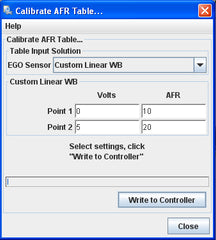
In Tuner Studio, tools->Calibrate AFR Table->EGO Sensor select "Custom Linear WB", enter the values shown in the picture below (edit: Point 1, 0 volts/AFR 10; Point 2 5 volts/AFR 20) and write changes to MegaSquirt.
Untitled-1_medium.jpg
Later on we will change the Custom Linear WB settings to account for offset and linear errors.​
During powerup Spartan 2's Output Sequencer will be triggered, the Output Sequencer will output 2 distinct calibration voltages on the Linear Output, 1.666 volts for the first 5 seconds then 3.333 volts the next 5 seconds, after 10 seconds has passed; the Linear Output will function normally. When a wideband controller is first powered up, it will take about 30 seconds to 1 minute for the Wideband Oxygen Sensor to heat up, while the sensor is heating up the Wideband Sensor is unable to read the AFR of the exhaust gas composition, only when the sensor is heated up will the AFR of the exhaust gas composition be correct. Spartan 2's Output sequencer takes advantage of this heatup time when the AFR data is not correct to output calibration voltages that we will use to generate new Tuner Studio settings to compensate for offset and linear errors.​
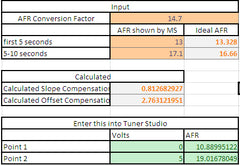
While Tuner Studio connected to MS and is actively displaying AFR data, cycle power to Spartan 2 and write down the 2 AFRs shown by tuner studio during the first 5 seconds and then during the next 5-10 seconds. For this example lets use 13 AFR and 17.1 AFR. Now if there were no offset or linear errors present; the first 5 seconds AFR should be 13.328 AFR and the 5-10 seconds AFR should be 16.666 AFR.​
Now download and open this Microsoft excel worksheet here
Untitled-2_medium.jpg
Assuming that the first 5 seconds AFR shown by Tuner Studio is 13 AFR and the 5-10 seconds AFR shown by tuner studio is 17.1 AFR, you would enter 13 and 17.1 into the excel worksheet like the above picture, of course instead of 13 AFR and 17.1 AFR you would enter the AFR shown by your Tuner studio. Once those two AFRs are entered, the settings in the green box will be calculated to compensate for offset and linear errors, this calculated setting you will enter into Tuner Studio and your MegaSquirt will be able to read AFRs from Spartan 2 with an accuracy of 1/10th of an AFR.​
In Tuner Studio, tools->Calibrate AFR Table->EGO Sensor select "Custom Linear WB", enter the values shown in green excel worksheet and write changes to MegaSquirt. In my example where the first 5 seconds AFR is 13 AFR and the 5-10 AFR is 17.1 AFR, my calculated new tuner studio settings is 10.89 AFR @ 0 volts and 19.02 AFR @ 5 volts.​
Untitled-3_medium.jpg
Now if everything was done correctly then now your Megasquirt will be able to read AFR with 1/10th AFR accuracy. Cycle power to Spartan 2 again and now the first 5 seconds AFR should be 13.3 +/- 0.1 AFR and the 5-10 seconds AFR should be 16.7 AFR +/- 0.1 AFR. Because Megasquirt uses only upto the first decimal place to represent AFR, the best you can do is +/- 0.1 AFR accuracy.

 
Last edited:
(Edited for brevity)


PVC wire is generally not as high quality, so be sure not to use it where it will see a lot of heat or friction.
http://www.thegsresources.com/_forum/showpost.php?p=1849672&postcount=208

A side note - PVC wire jacket cold flows, so using any pvc jacketed wire on a weathertite connector system, your wire jacket will deform away from the pressure of the seal, and you will get corrosion at the seal location.

Crosslinked polyethylene wire insulation was developed to address this issue (GXL, TXL, etc)

-- Mark (sometimes wiring harness engineer, in the olden days)
 
Thanks for the note. Unfortunately I have not found small quantity automotive grade striped wire that is affordable. If you know of a source, I'll be glad to link it.
 
Project is on parts hold again until the PWM controller and parts for the coil drivers get here. Should be by next week.
 
Wiring info due to first post being too long:

Wiring
Most of my wiring on this project used GM style Weatherpack connectors. I used smaller Mertipack ones on the main connector for the fuel injection harness. The trick setup (discovered after I made my harness) as recommended by another forum member is a place called Corsa Technic. They sell nearly every connector used on Japanese bikes, they are dirt cheap, the connectors include terminals and seals, and they don't charge an arm & a leg to ship. My kind of place. I've bought connectors to make a semi-standalone harness for my GSX-G project.

Here's a listing I copied from my GSX-G project document. All part numbers are from either Mouser.com (Microsquirt connector) or Corsa Technic (everything else).
A. Microsquirt side (only needed if you want to make a complete standalone harness; this connector will plug into the Microsquirt)

Terminals and seals separate
1.Microsquirt connector, 35-way: Mouser part #571-776164-1, TE #776164-1. $10.70

2. Female terminal (35). Mouser part #571-7708541, TE #770854-1. $.18 each (35)

There are 8 wires that go from the Microsquirt to the GSXR600 harness:
Injector bank 1
Injector Bank 2
Sensor ground
MAP
Cylinder Head Temperature (coolant)
Intake Air Temperature
Throttle Position Sensor
5V reference


B. Suzuki side
All of these come with terminals and seals
1. Main connector, 16-way: Corsa Technic part #HM-16S. $8.16
This site has a great selection of oddball connectors at reasonable prices.
Mating half of connector: HM-16P
From HM Sealed Series
Bottom of connector features a bracket mount
Typical Application:
- Suzuki GSXR injector sub-harness

This part will interface with the Suzuki harness. If building a standalone injector harness, also use HM-16P. You can then plug in all 4 injectors and the TPS. You'll need to adapt the MAP and IAT with their own connector. In the alternative, you can test the Suzuki MAP sensor with a vacuum gauge and multimeter and use it as a “custom” MAP in Tuner Studio.

Here is the shop manual calibration data for the Suzuki MAP sensor:
Altitude: kPa: Volts
0-2,000: 100-94: 3.6-3.1
2,001-5,000: 94-85: 3.4-2.8
5,001-8,000: 85-76: 3.1-2.6
8,001-10,000: 76-70: 2.9-2.4

In Tuner Studio, the custom MAP needs two values, the kPa at 0.0 volts and the kPa at 5.0 volts. While the manual does not give us this information, it can be obtained as noted above via a vacuum gauge and multimeter or extrapolated using the Suzuki data and a spreadsheet.

I'll use an example of a sea-level installation. Since we know 100 kPa= 3.1 volts and 94 kPa=3.6 volts, then the difference of 6 kPa over these 5 points means 6/5 or 1.2 kPa for each .1 volt. A spreadsheet can be used to auto calculate all points from 0.0 to 5.0. In this case, 0.0 volts= 56.8 kPa, and 5.0 volts= 116.8 kPa.

Other altitudes can be used by simply switching the data input as above.
Here is the shop manual calibration data for the Suzuki IAT sensor:
Temp (Celsius): Approximate Ohms (original spec was K Ohms, straight ohms used here)
20: 2,450 (range in manual is 2,200 to 2,700)
50: 808
80: 322
110: 148

There are 2 empty sockets for the secondary throttle valves, they will not be used. In their place you can use two wires for coolant (head) temperature sensor, and if you want to use the three remaining wires you could use them for a baro sensor.

2. a. MAP connector, Suzuki 3 pin. Corsa Technic part #SSC-3S-A $2.41
Mating half of connector
Tyco/AMP p/n: 184032-1 from Sealed Sensor Connector Series

2. b. MAP connector, GM pin. Corsa Technic part #MP150-3S-2 $2.05
Delphi p/n: 12129946 from Metri-Pack 150 Sealed series

3. TPS connector, 3 pin. Corsa Technic part #MT-3S. $2.03 (not needed if using a factory harness)
Mating half of connector: MT-3P
Sumitomo p/n: 6180-3241 from MT Sealed Series

4. CHT connector, 2 pin. Corsa Technic part #HX090-2S-1. $3.77
Mating half not available; OEM Suzuki sensor 13650-10G00, about $58

Alternative: MP150.2-2S-2, $2.67
Header to mount thermistor:
MP150.2-2P-2, $3.38
Use thermistor mounted to head, block of aluminum between fins with threaded hole to mount thermistor.

5. Injector connector, 2 pin. Corsa Technic part #HX090-2S-2. $3.87 (4)
Mating half of connector: HX090-2P-2
From HX 090 Sealed Series

6. IAT sensor, 2 pin. Uses 2 pin secondary throttle valve connector.
Item: MT-2S-1 , $2.36
Mating half of connector MT-2P-1

Mount IAT Thermistor to:
Item: MT2-P-1, $3.16


Use quality automotive grade wire. This is called SXL (thick), GXL (regular), or TXL (thin) wire. Here are a couple of inexpensive sources.
Motorsports wiring Good prices on SXL/GXL/TXL

Performance Connector Systems- Good source for Weatherpack and Mertipack parts

British Wiring- PVC wires page, includes striped wire at a good price. Contrary to the name, this is a US company.

PVC wire is generally not as high quality, so be sure not to use it where it will see a lot of heat or friction.

EDIT
I found an informative post on a low-cost method of making your own striped wire using colored Sharpie markers. I tried it on one TXL wire and it seemed to work well enough. First page has been updated with this info.
 
Last edited:
Just in case anyone wants to use the Bosch ignition module mentioned a few posts back rather than making their own, see the cross ref list below. Please bear in mind the info came from Google so I cannot guarantee it is 100% but I haven't found any errors yet.

Beru* 0040401026* 040401026* 40401026* ZM026

Bosch 0277 100 200

Bosch 0277 100 201

Bosch 0277 100 202

Bosch 0277 100 204

Bosch 0277 100 213

Bosch 0277 100 215

BMW 12141461441

Bremi 14022

Alfa 60558153 605581530

Citroen 5945.54* 96073612* 9607361280

Fiat 605581530* 60809477* 7648798* 76487980

Fister* HW670

GM 90444650* 90449574

Hella 5DA006623601

Huco 138401

Lucas DAB419 or 21411924

Man 51259190017

Marelli 940038514* 940038514010

Opel 1208074

Peugeot 5945.54* 96073612

PSA 5945.54* 96073612* 9607361280

Valeo 245525

Quinton Hazel XEI57
 
Coil driver box is complete and wired in, the PWM controller is now the holdup. Hoping it will ship soon.

I'm thinking there is a better way to DIY this that does not use the Arudino. I see a bunch of PWM controllers on eBay for around $10. They use a potentiometer to control the output. If I were more up to speed on electronics, there must be a way to adapt the 0-5V output of the pressure sensor to replace the potentiometer. Any input from electronics gurus is welcome. :)

EDIT
While shopping on eBay, I saw one titled "DC 6V- 90V 15A 12V 24V Max 1000W DC Motor Speed Control PWM Controller". It has a potentiometer that plugs in- most are soldered to the board.

I'll attach a photo that shows the potentiometer input. It's labeled ground, 0-5V, and 5V. It seems like this could possibly be wired directly to the pressure sensor, since it uses 0-5V. I need to figure out the corelation between input voltage and PWM output. Does 0V= 0 output or 100% output, and ditto for 5V? As I understand potentiometers, they are variable resistors.

If at full resistance the output is 0V, it seems like this would be 0 motor output, which is opposite of what I need it to do. I know I had to invert the input on the Arudino when I wrote the code for it.

At < $10 shipped (from China) it would be worthwhile to experiment with it.
 
Last edited:
The $50 aftermarket fuel pump controller arrived this week, and I'm disappointed. There were NO instructions or a wiring diagram. The online page is ambiguous at best- there are way more wires than needed. The board should have 3x wires from the sensor, this one has 5, apparently 3 are ground, with one data and one 5V power. That's the easy part.

The power wiring should consist of 12V & ground in and out to the pump, 4 wires. This one has 8, two pairs of red & black and two pairs of red & green.

Additionally, it is just a bare board and unrestrained wires. I'll have to find a small enclosure and rig up a strain relief for the wiring. I have an email in to the supplier to see if he can explain the various wires. I also sent a wiring diagram based on my best guess and his online instructions. I'll post it here once I sort it out.

He has the market cornered on this for now, the least expensive alternative is a lot more expensive. Some are over $300.

Here's a pic of the unit as received:


UPDATE
Here is the correct wiring diagram, with my notes at the bottom.


Here is the small Radio Shack enclosure #270-1801, it's the smallest one they sell, 3" x 2" x 1", about $3.50. I used a couple of 3/8 x 1/4 rubber grommets to run the wires through. I had to smooth the inside of the enclosure since it has ribs for board mounting. The board press-fits in the standoffs, and I used a small amount of adhesive to hold it in place. I used two small zip ties for strain relief. I topped it off with a label for future reference. Upon use, my pressure gauge showed it was set to about 48 PSI, so I bumped it down a little via the "down" button.


Last edited:
there are 10 wires defined for three different pumps. Do you have more wires than that? :confused:

You can probably visually inspect or buzz the board but I bet every one of the Red's is +12V either to the pump or power. Same of the Black all grounds.
 
Last edited:
After doing some reading on the subject, I think the reason why my Arudino didn't work was because I used the aluminum case as a heatsink for the output transistor. This effectively grounded the output pin, which then fed power to the pump regardless of the input.

Still no word from the guy that made the aftermarket controller. I'll likely go with a best guess scenario on wiring it.

EDIT
I heard from him a couple of days later. Post above updated with photos & diagram.
 
Last edited:
The thread is fairly well organized now (see first post for table of contents), and I tired to start the bike today w/o success. It is sputtering but won't run. I checked for spark on plugs 1 and 3 and saw I was getting a spark, fuel pressure is good. I'm sure this is a setting somewhere on the Tuner Studio setup. I've asked the gurus on the MS forum for some help with my settings.
 
The thread is fairly well organized now (see first post for table of contents), and I tired to start the bike today w/o success. It is sputtering but won't run. I checked for spark on plugs 1 and 3 and saw I was getting a spark, fuel pressure is good. I'm sure this is a setting somewhere on the Tuner Studio setup. I've asked the gurus on the MS forum for some help with my settings.

Very nice way to "get organized". It is often hard to find all the details for peopled projects and hopefully others will follow your example and improve the website by making the details more accessible.

Some of my threads have run on in the past, but at least I try to put a summary at the first thread with forward links as required. Your seems more diligent than the efforts I made. :confused:
 
After several days and several firmware and tuning changes, I still can't get the bike to start. I'm currently back to firmware 3.83, and have figured out the settings needed to get it to register RPM with my dual trigger setup. This basically alienated me on the MS Extra forum, so now I'm a noob and worthless (all posts are moderated) on the Microsquirt forum, which I had to find and create an "approved" email address just to join. This also rendered my cylinder head temp thermister invalid, as it reports temps of -32 F even after calibration (it worked fine w/ other versions). It may be the MS can't handle settings up to 300F, so I'll try a lower top point and see what happens.

It occurs to me it's amazing Suzuki was able to make these bikes run 30+ years ago with then-existing technology.

I cannot recommend this as a viable option for anyone wanting to convert to fuel injection. I can see why so many projects were abandoned.
 
Hey I am sorry to read you are having problems. I think I read somewhere the dual trigger set up was unproven with msextra but is supported by the ms firmware. The manual has info on the settings but I must admit I didn't understand it too much. That's why most people (me included) tend to go for something more conventional like the 36-1 tooth trigger.
I have seen something about the problems you are experiencing with the thermistor. I believe that it can be fixed but I have no idea where I read it. I think it involves writing something different in the firmware. Well beyond me.
I hope you won't give up on your project as the microsquirt is sold as experimental so I guess there will be a few problems along the way. Certainly your choice of trigger has probably made things a little difficult but it will be interesting to see how it works.
Good luck
Nick
 
LOL, the dual pickup looked to be the "reliable" setup as opposed to taping into one of the coil wires. It seems like if this can be used to power an ignitor in 1981, it should be far easier to do so in 2013.

I'm not giving up, I love this bike and want it to run. I don't want to try and fit a 36-1 wheel in if I can avoid it.

I have spark on plugs 3 and 4 (did not pull the wires on 1 and 2 since they are on the same coils), my fuel pressure is dropping while cranking, so I have fuel and spark, just not at the right time.

There are many more questions I can and will ask on this, it is just everything involved with this is a hassle, e.g. batteries run down (bike & laptop), hoops to jump through just to post on a forum, etc.

I found a site called msruns.com and looked for anything similar (UJM type of 4 cylinder bike). One post had several responses, and I noted every one of them was the member's only post on that forum. The fellow I referenced here with the GPZ a few posts back was on the Microsquirt forum and I've followed up on one of his posts (he had 3 in total) from January 2012.
 
Still working on how to lock out the advance. It goes from 17 BTDC under 1500 RPM to 37 BTDC above 2350.

The CHT thermistor I'm using worked fine in Microsquirt B&G firmware v. 3.77 and also MS Extra 3.24, so I don't know what changed in B&G v. 3.83. What the 914 people were talking about (defaulting to 180 degrees) does not happen on my GS, I just get a bogus reading (like -32 F) from start up.

I did look through the 3.83 ini file, and neither set EXPANDED_CLT_TEMP nor #unset EXPANDED_CLT_TEMP were there. Every instance of EXPANDED_CLT_TEMP was preceded by "if".

I found a mainController.ini file in the 3.83 folder and it was the same way.

I did find the line #unset EXPANDED_CLT_TEMP in a file called settings.ini in the MS (not the 3.83) folder. It says this:
; This setting allows for expanded coolant temperature ranges for gauges
; and inputs - for example -40F to 600F instead of -40F to 200F. This is
; useful for air-cooled vehicles. This setting only adjusts the temperature
; displays and input limits used by MegaTune. You will still need to
; upload the appropriate coolant lookup table that is specific to your
; coolant sensor if it is different from the stock GM sensor. Works with
; MegaSquirt-II only

#unset EXPANDED_CLT_TEMP "Expanded Coolant Temperature Range"

I'll change it and see what happens.

EDIT
I gave this some thought and since when you load an updated firmware, you also use the corresponding ini file (not settings.ini), I added the line # set EXPANDED_CLT_TEMP after # set AUTO_TRIG near the beginning of the 3.83 ini file and renamed it so I know to use this file. I'll reload the FW and see if this makes a difference.

UPDATE

This didn't work, so I reloaded v. 3.78 again and the CLT reading is now normal.
 
Last edited:
Back
Top