• Required reading for all forum users!!!

    Welcome!
    Register to access the full functionality of the GSResources forum. Until you register and activate your account you will not have full forum access, nor will you be able to post or reply to messages.

    A note to new registrants...
    All new forum registrations must be activated via email before you have full access to the forum.

    A Special Note about Email accounts!
    DO NOT SIGN UP USING hotmail, outlook, gmx, sbcglobal, att, bellsouth or email.com. They delete our forum signup emails.

    A note to old forum members...
    I receive numerous requests from people who can no longer log in because their accounts were deleted. As mentioned in the forum FAQ, user accounts are deleted if you haven't logged in for the past 6 months. If you can't log in, then create a new forum account. If you don't get an error message, then check your email account for an activation message. If you get a message stating that the email address is already in use, then your account still exists so follow the instructions in the forum FAQ for resetting your password.

    Have you forgotten your password or have a new email address? Then read the forum FAQ for details on how to reset it.

    Any email requests for "can't log in anymore" problems or "lost my password" problems will be deleted. Read the forum FAQ and follow the instructions there - that's what we have one for...

  • Returning Visitors

    If you are a returning visitor who never received your confirmation email, then odds are your email provider is blockinig emails from our server. The only thing that can be done to get around this is you will have to try creating another forum account using an email address from another domain.

    If you are a returning visitor to the forum and can't log in using your old forum name and password but used to be able to then chances are your account is deleted. Purges of the databases are done regularly. You will have to create a new forum account and you should be all set.

how much temperature range are the CV carbs good for ?

  • Thread starter Thread starter tirebiter
  • Start date Start date
T

tirebiter

Guest
Ok, maybe I'm overdoing it a little, riding in this weather but when it's dry, I go. Sometimes it's very, very cold out. Sometimes it's even colder.

When it's even colder outside, lately I am noticing a slight miss sometimes which I am sure is a lean condition. I usually start her up and drive right off so there are a few miles of cold running before the engine reaches operating temperature. I shut the choke off about as soon as I'm underway. Everything seems fine above 35 degrees, especially at any throttle opening above a steady cruise.

I last made the mixture adjustment when it was about 40 or 45 outside. It still gets that warm some days so I hessitate to go richer with the mixture screws, if I don't have to.

My question is how many degrees F is a mixture adjustment good for ? If I adjust to perfection at say, 40 degrees, will the carbs still work normally at say 20 degrees or 10 degrees ?

I'm talking some real numbers but I have not see anything less than 22 ... yet ... at a standstill. Windchill ? Welllll that's another story altogether.

At this point "little Suzy" runs great when warmed up except for after a bit of relaxed highway miles at 60-65 when it's below 30 degrees out. I can feel a slight almost non-existant weakening of the power. A slight miss that isn't really a miss at all. Almost like she's not getting quite enough fuel to the carbs. I have left the fuel shutoff "off" enough times to know exactly what that feels like. If I roll in just a tiny extra amount of throttle she smooths out and feels ok.

I'd like to be able to ride all Winter when it's dry outside regardless of the temperature. I don't want to have to tweak the mixture screws every other week. Is going to these extremes impossible due to carbs that cannot handle much temperature fluctuation without needing to ? HELP !
 
Last edited:
All of these GS models were set lean from the factory and can be improved by upping the main jets one size. Especially at/near Sea level.
As you are now running in colder/denser air the problem is intensified. Z1 Enterprises is located close to you so why not just buy a set of 117.5 or 120 jets? Start with the 117.5's.
 
Mine work fine from less than 5 degrees to 110+ Fahrenheit with no changes.

Any air leaks? Are your airbox and filter properly sealed and intakes o-ringed and booted? Are the airbox-to-carb boots and carb-to-head boots reasonably new?

As above, if you're on the borderline of lean a bit cold can make it worse. If you're set up properly, temperature makes little to no difference to the carburetion.


The suspension is a different matter... fork oil gets pretty thick in the cold. And ice in the brake calipers will certainly wake you up.
 
Been riding my 850 in temps close to 32F with no noticeable changes. I do have them tuned richer then stock though.
 
I've done some jet changes back a couple of months ago and settled on 120 mains and 45 pilot jets. No air leaks that I am aware of. Pliable rubber boots on both sides of the carbs. Mixture screws are at about 1.5 - 2 turns out with a half turn variation between the four.

Before that I did the valve adjustment and had the carbs all apart. It's basically a stock foam air cleaner element inside the airbox and has a 4-into- exhaust. Checked float level by eye and maybe one carb has a slightly lower fuel level than the others which is why it's only a slight miss.

I bought some air corrector jets mostly smaller but at least one set a size bigger. Have not done any changes with those as yet. She was running pretty good until it got really cold at night. Might be time to give them a shot.

Hearing the temperature range you guys say you are operating in with no need to adjust the mixture svrews gives me hope. If it makes a difference this only seems to happen at very small throttle openings. It also happens a little in all the lower gears before the engine warms up and I've already shut off the choke. I typically shift at VERY low RPM and that is part of why it's noticeable, because I barely crack open the throttle to accelerate up to 2000-2500 before shifting.

What prompts me to want to do something about it is that it now that it's getting colder, the slight misfire happens sometimes on the highway in 5th gear. I mean, maybe the throttle is not opening enough to pick up the air piston. I have not looked at the needle postiion in the air piston. I have also not done anything yet to make sure the coils have a good electrical source, i.e. relay mod or anything. Good/new battery and already repaired bad connections in the wring from the stator.

Averaging about 40 MPG. Was hoping for more and delibearately have everything set as lean as possible.
 
I've done some jet changes back a couple of months ago and settled on 120 mains and 45 pilot jets. Mixture screws are at about 1.5 - 2 turns out ... It's basically a stock foam air cleaner element inside the airbox and has a 4-into- exhaust. ... and delibearately have everything set as lean as possible.
I will agree that the 120 mains with the 4-1 pipe might be on the lean side, but your pilot jets are two sizes larger than stock. Even in a bored-out, over-cammed engine, you rarely have to increase the pilots, and then, just one size.


I bought some air corrector jets mostly smaller but at least one set a size bigger. Have not done any changes with those as yet. She was running pretty good until it got really cold at night. Might be time to give them a shot.
If those are the pilot air jets that go into the carb throats at the 8 o'clock position, they only change the mixture ratio for the pilot mixture. Given your pilot fuel jet size, you are already too rich, installing smaller air jets will just richen it even more, possibly too much. No, make that WAY too much.


Hearing the temperature range you guys say you are operating in with no need to adjust the mixture svrews gives me hope.
Yeah, but did you notice that we are doing it with pretty much STOCK jetting?


If it makes a difference this only seems to happen at very small throttle openings. It also happens a little in all the lower gears before the engine warms up and I've already shut off the choke. I typically shift at VERY low RPM and that is part of why it's noticeable, because I barely crack open the throttle to accelerate up to 2000-2500 before shifting.
This just might be your whole problem. You are not letting the engine do its job.

You should be DOWNSHIFTING if the speed drops below 2500, not upshifting to keep it below that.

I am one that shifts rather conservatively, and I usually shift around 4000, depending on the speed of traffic. If getting on the freeway, 5-6000 is a more-normal shift speed, but keeping it under 2500 is simply ludicrous.


I mean, maybe the throttle is not opening enough to pick up the air piston.
I have never heard it called an "air piston", but that's probably as accurate as any other. :-k

The throttle does not "pick up the air piston". What picks it up is air flow through the venturi under it. Yes, opening the throttle will increase air flow, which, in turn, will pick up the piston, but it's not a direct connection.


I have not looked at the needle postiion in the air piston.
Assuming you have stock needles, there is only one position.


Averaging about 40 MPG. Was hoping for more and delibearately have everything set as lean as possible.
Well, you don't have everything "as lean as possible", and there is such a thing as "too lean", which will not help your mileage, either.

Given your riding style (shifting at ridiculously low RPM), 40 is about all you are going to get. Go back to stock pilot jets, turn the mixture screws out a bit to compensate (about 2.5 turns, usually), start doubling your shift speed, you will let the engine breathe better and do better work for you.

.
 
In your first post in this thread you neglected to mention that you had already screwed up your carbs with jetting guesses.
Reinstall the stock pilot jets and buy some 122.5 and 125 main jets and see which works best for you on that 850. Don't forget to readjust the fuel mixture screws also.
 
Putting aside the mechanical differences of the PO's bike/carb/riding style, the question still remains: What is the effect of atmospheric temperature on a Mikuni carb?

This is not an easy question to figure out at 1am on the back of an envelope. Even though every cell in my body wants to get into the physics behind this, for the sake of everyone else I am hoping there is a quick and agreed upon answer (then I can go in a corner and figure out why :tongue-new:). But it seems to me that the Mikuni carb could be self regulating, at least during the operating ranges driven by jet needle position, and because the stock fuel valve (which the OP does not have BTW) is also engine pressure actuated.
Based on the input from the guys above with the experience, this is seeming plausible since they can run at a wide range of atmospheric conditions without having to make mixture adjustments. (I thought about my model airplane engine experience, and first remembered that many of us had to adjust our needles when it was cold or hot, but then I remembered running regulated engines which have diaphragms regulating fuel flow, and those were all 'set and forget'.)

If this is the case, I would suggest to the OP to get a stock petcock :) There is no 'off' on a stock valve because the 'on' position is regulated by a diaphragm and won't pass fuel unless being asked for by the engine, or unless it is broken. The other positions are Prime and Reserve.
 
Last edited:
Hearing the temperature range you guys say you are operating in with no need to adjust the mixture svrews gives me hope. If it makes a difference this only seems to happen at very small throttle openings. It also happens a little in all the lower gears before the engine warms up and I've already shut off the choke. I typically shift at VERY low RPM and that is part of why it's noticeable, because I barely crack open the throttle to accelerate up to 2000-2500 before shifting.


Averaging about 40 MPG. Was hoping for more and delibearately have everything set as lean as possible.

Why are you shifting at such a low rpm? All you are doing is lugging the bike. 5000, 6000, 7000+ rpms would be better depending on the gear. Your bike doesn't even get on the cam until around 4,200-4500 rpms. 40mpg isn't anything to worry about, that is pretty normal for your bike. Lean as possible? Yeah no, running lean makes heat, heat can do bad things to a bike engine. I rather be a wee bit on the rich side. And as far as operating temps for CV carbs, it's a pretty much a non issue. I've run in temps in the low teens to 118 degrees no problems. Something not to lose sleep over.
 
Last edited:
Joe Garfield thank you very much for your recounting of my original question.

To everybody else, I'll try to explain. I'm not good with remembering numbers. I think that's why man invented writing. Just to help people like me. If needed, I can pour over the notes I have taken (I am good with writing) and report all the numbers/jet sizes. If you want you can recount the entire tale as already posted in another thread on another part of this website here :

http://www.thegsresources.com/_forum/showthread.php?225303-Just-bought-non-running-GS850

but here's a quick recap of my messing up the jetting without some of the numbers :

I started with the stock jets that were in place when I got the bike. Stock sizes as specified in the Factory Sercvice Manual. There was no air filter element inside the air filter housing. The cage was missing also so I made a cage to support the filter element and put in a stock aftermarket air filter foam element. The bike came with an unknown brand of 4-into-1 exhaust/megaphone, heavily baffled.

The engine would start easily and did not run too badly from idle on up except it would not go past 6000 RPM. Add more throttle and it would just bog. Try to use full throttle at any RPM and it would just bog. Pull out the choke at full throttle and no bog, regardless of RPM.

Went up one size on the main jets, Mixture screws needed to be out about 3.5 turns to get a good idle. Better but still not there. Went up another size on the mainjets. Yes I bough several sets of MIKUNI brand mainjets at the outset. Redjust mixture screws for highest idle, Still 3-3.5 turns out. No more problem with full throttle. Went to redline - 9500 ? Like I say. Not good with remembering numbers.

Tried one more size up on mainjets. Seemed about the same except the exhaust pipe was sooty. Went back to the previous size.

Tried one size larger pilot jets. Mixture screws still around 3 turns for best idle. Meanwhile spark plugs typically very white. Went up one more size on pilot jets. Mixture screws and 1.5 - 2. Seems to run well under all conditions. Spark plugs darkened a little.

When sitting for a few hours or overnight the engine will start immediately when using the choke. Has trouble starting or won't start at all without the choke especially when it's cold outside. Warm start no choke, no problem, good idle.

I belive I am somewhat close to the correct air/fuel ratio for the air temperature I was experiencing during these jet messing withs. Now that it has gotten about 60 dgrees cooler outside, I am wondering if it's prudent to run a set of Winter jets.

Thus my question regarding the range these carbs are known to be good to go without any adjutment needed.

Yes, I could go richer accross the board and the engine would run richer when it's warm out and leaner when it's cold out and I would have a decent running machine. I'm trying to maximize fuel economy so I'm insterested in how much fiddling does it take to keep the mixture - air/fuel ratio - as close to the perfect number as possible with mechanical and vacuum operated carburetion.

In addition, I have advanced the ignition timing - I know I should have checked it before all the jetting errors I've made - and it's now at the factory spefified 37 above 3500 RPM. A short while prior to that I adjusted the valve clearnaces to proper spec also. That one thing made the idle MUCH more stable and now I keep it around 1000 RPM.

I tried using a 6000 RPM shift point and a 4000 RPM shift point and discoverd it actually gets better fuel economy at the smaller throttle openings that I use when going to 2500-3000 RPM shift points. I do not accelerate very fast normally.

I notice lower MPG when driving it using larger throttle openings regardless the shift point such as when I am in big hurry to get somehwere. Yes, I absolutely use higher shift points when I'm trying to accelerate faster. Even full throttle at times but never when the engine is below 4500-6000 RPM. I understand the relationship between RPM and power/torque and horsepower curves yet I have not been able to view either of those curves/graphs for a stock GS850L.

I can say one thing about my particular style of jetting methods. The engine screams up to 9000 RPM in 4th. Just a tad less amazing in 5th but still gets there. It's almost like hitting a Nitrous injection button at 6000 RPM and feels like it would go right to 12 if I ever wanted it too. I'd probably be even more impressed with a 1000 but this 850 is good enough for what I need.

So back to my original question with a modification. What temperature range do these carbs wrok well in without any adjustments made t othe mixture screws ? Same answers ?

Back to Joe Garfield : Does the stock vacuum operated fuel petcock actually alter the air/fuel mixture by changing the fuel level in the float bowls, while the engine is running ? I thought is was basically just a fuel shutoff that you did not have to remember to close, when you park the bike.
 
In addition, I have advanced the ignition timing - I know I should have checked it before all the jetting errors I've made - and it's now at the factory spefified 37 above 3500 RPM. A short while prior to that I adjusted the valve clearnaces to proper spec also. That one thing made the idle MUCH more stable and now I keep it around 1000 RPM.

I tried using a 6000 RPM shift point and a 4000 RPM shift point and discoverd it actually gets better fuel economy at the smaller throttle openings that I use when going to 2500-3000 RPM shift points. I do not accelerate very fast normally.

I notice lower MPG when driving it using larger throttle openings regardless the shift point such as when I am in big hurry to get somehwere. Yes, I absolutely use higher shift points when I'm trying to accelerate faster. Even full throttle at times but never when the engine is below 4500-6000 RPM. I understand the relationship between RPM and power/torque and horsepower curves yet I have not been able to view either of those curves/graphs for a stock GS850L.

I can say one thing about my particular style of jetting methods. The engine screams up to 9000 RPM in 4th. Just a tad less amazing in 5th but still gets there. It's almost like hitting a Nitrous injection button at 6000 RPM and feels like it would go right to 12 if I ever wanted it too. I'd probably be even more impressed with a 1000 but this 850 is good enough for what I need.

So back to my original question with a modification. What temperature range do these carbs wrok well in without any adjustments made t othe mixture screws ? Same answers ?

Back to Joe Garfield : Does the stock vacuum operated fuel petcock actually alter the air/fuel mixture by changing the fuel level in the float bowls, while the engine is running ? I thought is was basically just a fuel shutoff that you did not have to remember to close, when you park the bike.

Read back through the replys you got, the answers you seek are all there. 5th gear is somewhat like an overdrive or open highway gear, it won't pull as hard as the other gears. There is no such thing as winter jets. These engines like rpms. shifting at low rpms isn't doing you any good and the affect on gas mileage is minimal. Temps for CVs is not an issue. And fuel flowing into the bowls doesn't change the mixture unless your floats are set wrong and you are either starving or dumping too much fuel into the carb throats. I think you are over thinking the process way too much.
 
Last edited:
(I just want to mention that my motorcycle experience is pretty limited compared to many/most people in this forum. However this topic is particularly interesting to me. I have a decent amount of experience with 2- and 4- stroke model engines, and I design fuel injectors and combustion systems at work. So please take my thoughts for what they are worth and pay attention to the guys who have been riding these bikes for many years :) Experience often trumps knowledge.)

What I know is the stock petcock operates on a diaphragm and only sends fuel to the engine when 'asked for' via pressure pulses. There is a shut-off in the float as well. If the shutoff in the float is not working properly and you leave the bike in Prime, you can get excess fuel in the carbs. I imagine the Prime setting is similar to that of a generic fuel valve with in 'On' position. The petcock itself would not affect the fuel/air ratio, however it could impact the level of fluid in the float bowl especially if the float was not shutting off flow. Even if the shutoff works, I don't know how well the system works if the float is always completely full. If your float height is not properly set then it's a no brainer :) Anyway there is a certain amount of 'suction' needed to operate the diaphragm, and certain amount needed to draw fuel from the float bowl. When the system was designed, both of those things were taken into account and a properly maintained system works very well. By altering the shutoff valve, you alter the operating pressures of the system. At the moment, I have no idea if that change is an appreciable amount or not. What I design for work has some distinct similarities and also some drastic differences. The effective flow areas of the circuits is probably in the same ballpark, and small changes (carbon deposits, manufacturing defects, dirt, etc) can have significant impacts on operation and total fuel flow.

There is a lot to these carbs and I am just learning about them, and as interesting as it is it's hard to spend a lot of time thinking about it because it's basically what I do 9-10hrs/day.
 
This information is largely anecdotal and may (or not) give a clue as to what is happening.
I read about this one day and it clicked as I read your original post.
From memory-
Cold air causes a strange effect on our CV carbs. The fuel that is vaporized as it is drawn into the jets hits the cold carb body parts and condenses back to raw fuel. This is causing the bike to not run well as it gets spurts of raw fuel and water vapor from the condensation process. The mixture is changing and cycling as the carb body stays cool - once the carb is physically warmed up this dissipates - and the thought that it runs better at above freezing tempratures seems to support this hypothesis.

If this all makes sense ... great ...or I could be way wrong too...:indecisiveness:
 
I was thinking carb icing but the symptom I'm experiencing is far more subtle than the icing/stumbling/coughing/stalling/total lack of power which I have dealt with in other vehicles that sometimes suffer from jet or carb bore icing conditions. One thing I can say for certain is that the slight miss ONLY happens under the right conditions and ONLY after enough time at a set speed. It can also happen when the engine is cold even in lower gears if I hold a low enough RPM cruise speed at an extremly small throttle opening with no choke.

I just opened all 4 mixtures screws 1/4 turn (out) and had a look-see at the plugs. Bright white again. Hmmm. I'm thinking the timing adjustment I made a month ago is showing up as the ambient temperature goes down and it's been running too lean all this time. Oops !

I'll be on the road before sunnup tomorrow morning. It's already 33 out and falling. Low 20s predicted for the overnight. Should be a good test to see if the mixture was too lean.

One thing I can't get my head around is why are there adustable screws on these CV carbs. Put there to alter the mixture at idle and partial throttle openings. Why should there be if it's "a set it and forget it" type of thing ?

I have never heard of a non-computer controlled carb that does not require a periodic idle mixture adjustment to compensate for seasonal air temperature fluctuations.
 
One thing I can't get my head around is why are there adustable screws on these CV carbs. Put there to alter the mixture at idle and partial throttle openings. Why should there be if it's "a set it and forget it" type of thing ?

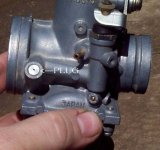
Isn't that the screw that comes covered up from the factory?

carbs_plug1.jpg
 
Just got back. She ran ok this morning at 26F outside. I was not taking my time and did not notice if the symptoms were there. In other words there was no steady speed cruising for long enough. Less then a minute or two of light throttle steady speed cruise, if that, early this morning.

On the way home just now, I took a look to see just how much rotation I'm operating with on the twist grip. It is 5 degrees or less as an estimate. The edge of the rubber throttle grip moves an eighth inch or less when I back off, from 60 MPH on level ground.

I was paying very close attention on the way home and noticed the symptom several other times. As if it was a slight missing from one cylinder or just a general almsot imperceptable loss of power. Turns out I feel the same thing at other times besides after the typical extended cruise at low RPMs. It happens every time I pass someone on the highway or if I am being passed. Just as I get the blast of wind that tends to slow me down a little.

I'm over thinking this as usual but it seems the air piston, slide, whatever you want to call it, receives a slightly different signal from the vacuum of the partially open throttle, every time the engine gets a heavier load such as a blast of wind pushing back on me from an adjacent car/truck on the highway. It may not be enough of a vacuum signal change to alter the position of the air piston. Maybe it's not enough of a vacuum change and a slightly higher enedle postion would help.

I notice the same effect/symptom when I'm climbing a bridge that spans a large river at highway speeds and the wind happens to blow at the same time. It seems to affect the engine somehow. Still it is only there when I am keeping the throttle steady and holding a steady speed. Maybe it is where the transition occurs between the idle circuit and the main circuit. Richening up the mixture screws did seem to fix things in the lower gears but it didn't seem to help at all to eliminate the symptom in 5th.

I'm still thinking about trying the smaller air jets to see if it makes a drastic change or if it even helps at all.

First half tank was before I turned the mixture screws out. 2nd half tank was after. 42 MPG. The best yet ! Obviously the richening did not ruin my MPG. I'll try to go slightly richer with the screws and see if that eliminates the symptom or makes any difference in 5th or not.

Joe Garfiled. I see your point and forgot these carbs had plugged/tamper-proof mixture screws. That would explain a carb that is supposed to run all year long in all temperatures. The plugs on mine had been removed before I got the bike. The ones I have are aimed upwards though. I use a long thin screwdriver to go straight down, next too and between the frame members to adjust, after dismounting the gas tank. I assume your photo is for illustration purpose or I have the wrong carbs entirely.

Another thought is that I might do well to install some type of warm air intake to keep the carbs from getting so cold. I know it makes a big difference regarding winter dirveability on some engines in cars and trucks. Maybe just a couple of flat shroud pieces one ach side from the head to the airbox. See if reataining some of the warmed air and keeping the carbs warmer will make any difference.
 
tirebiter, how do you have the two breather hoses running off the carbs routed? They need to be in dead air space, like under the seat.
 
Good thought mrbill5491 ... I'm Hopeful, this remark makes the most sense to me.

I have the 2 vent lines going up over the air cleaner housing on each side then down behind it ending about half way down. Wasn't sure where they are supposed to go. The right side triangular frame cover is missing. Blew off one day I guess and did not notice. The end of the vent hose is exposed on that side. I'll try rerouting both of them up to the top of the battery.

I can see how the float bowl could be subject to negative or positve pressure if the vent hose gets wind blowing across it. That could certainly make a profound difference in fuel mixture.


tirebiter, how do you have the two breather hoses running off the carbs routed? They need to be in dead air space, like under the seat.
 
I have never heard of a non-computer controlled carb that does not require a periodic idle mixture adjustment to compensate for seasonal air temperature fluctuations.

Other way around; I've never come across a carb that needs summer/winter jetting.
What used to be common was an air intake that pointed towards the front of the car in summer and to the exhaust manifold in winter, in an attempt to even out some the air intake temperatures and avoid carb icing. About 30 years ago, various makers started doing this automatically, with bimetallic sensors and mover, so the driver was unaware of any need to change anything.
It's remarkable that the bike installations never needed any special treatment of this sort.
 
I get your point Grimly. Seems like I'm barking up another wrong tree with my thinking that I need to allow specail pre-heated air to the carbs. My bit of two-wheel experience is that people just don't normally use motorcycles on the highway in these temperatures but again, seems like I'm wrong there, also.

I'm guessing the forum members who replied saying they ride in 20 Fahrenheit degree air with the same settings year 'round - no special mixture screw adjustment for cold weather/temperatures - are also travelling far enough at 60-75 MPH to chill everything, at least the same amount as I am. Wind chill is different at different speeds isn't it ?

Wingsconson's remark regarding the fuel mist condensing on the side wall of the carb bores seems plausible but apparently nobody on this forum has experienced any problem first hand.

I looked at the vent hose on the right side where the triangular frame cover/side cover is missing. The vent hose goes through a metal tab that looks stock and is held close to the back of the air cleaner housing. The vent hose ends down low behind the gearbox actually. About 10 inches off the ground.

It's cold AND wet out today so no testing until the surface of the streets are not dangerous for motorcycles. I do not do snow, ice or mixed rain/sleet on two street tires.

As soon as it's safe to ride again, I'll try rerouting that one vent hose up under the seat. See if it makes any difference when I get hit by a sudden blast of wind from passing vehicles.
 
Back
Top