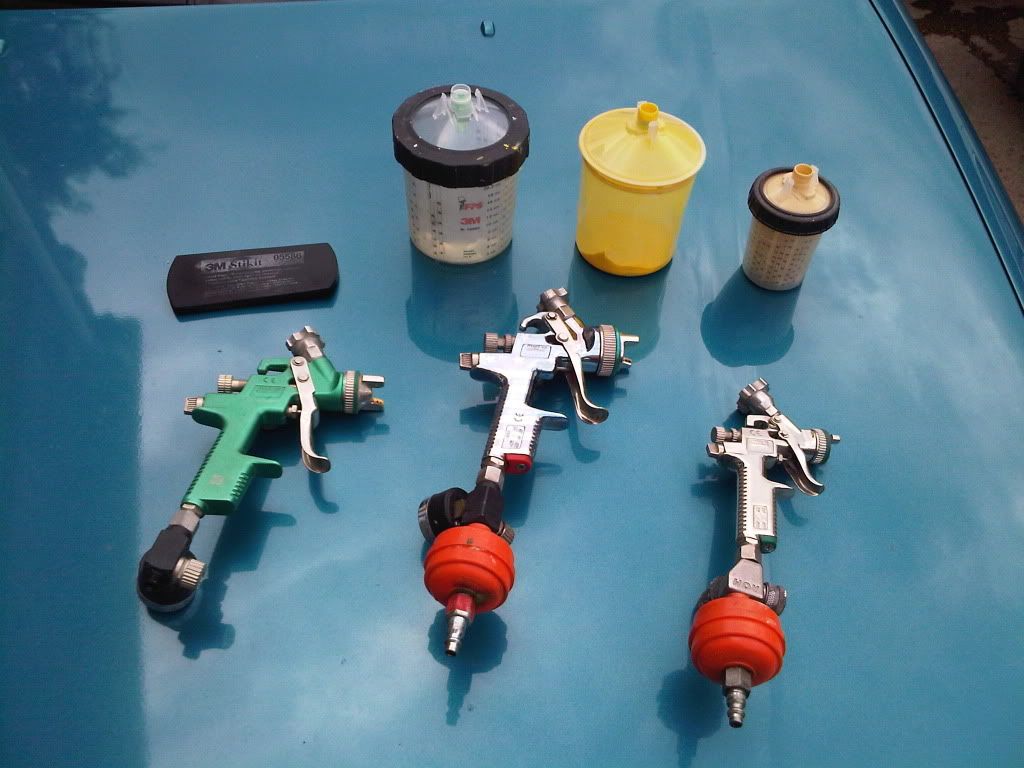
CAUTION! long reply
CAUTION! long reply
I have seen a pressure gauge attached to the handle of the gun, do I need one of those? I have a gauge on my compressor.
A gauge would be very helpful in getting a nice paint job out of the HVLP gun, they are available at most auto parts stores, same place you can buy your paint. Check your manual that came with the gun for correct "at gun" pressure to make sure the paint will atomize properly when it exits the paint gun.
Once you have found the pressure setting in your manual, put a small amount of thinner or reducer in the gun and test the spray pattern by spraying a quick 1 second burst onto some paper, it should be a nice thick line from top to bottom like this ||, it may be a bit more like this (), ovaled in the center. Adjust as necessary as per the manual.
Keep this pattern in mind when spraying. Try to visualize the paint going on in your head before you paint the part. Look at the shape of the part, all of it's edges and curves, and picture how the paint will build up on the part when spraying, and how you need to move the gun to avoid the paint going on too heavy in the curvy area.
I recommend practicing on a couple things first, before painting your bike parts. I had a co-op student at the shop who wanted to learn to spray, so I filled the paint cup with water and told him to go "paint" his car so that there isn't enough water per coat to make it run down the panel. I was just looking to teach him how to move the gun to develop consistant speed of movement.
It's kind of fun to do too! Just make sure you dry out your gun before putting it away for the night.
I have a water drain plug on my compressor, do I need something in the compressor hose line to trap water, moisture from getting to the gun and spoiling the finished job (it will probably get spoilt anyway, seeing as it's my first time).
You can buy small disposable in-line water filters at the auto parts/paint store. They look like a small barrel with an inner tube around the center, and have threaded end on top and bottom. Usually around 5-6 bucks IIRC.
Later on, once you have painted a few bikes/cars/whatever, and you feel like you need a better moisture trap, you can get an in-line dessicant dryer which pulls the moisture out of the air as it travels through it. Just like the little disposable ones, just better.
Is there anything else that I need before I can start?
Prepare for all stages of the paint job before you start, including prep and clean-up, so you will need:
-sand paper appropriate to the work done
+filler putty/fiberglass = 80-180 grit to start, up to 1000 grit depending how picky you are
+primer = 320 to 1000 G
+basecoat = 600 to 1000 G
+clearcoat = not needed unless you plan to buff it, whole other subject
-Reducer, used with the paint to thin it, and for clean-up of equipment after painting (Never let paint dry in the gun! Give it a good clean as per the manual.)
-Wipes, preferably lint free
-Tack-rags to remove any dust before priming and painting
-A proper NIOSH filtered mask rated for fumes, not particulates, they do nothing against fumes
On a slightly different issue concerning the paint. Which paint is best to use? and do I just purchase it from the local guy that supplies the body shops around here?
Most paints are similar in form and function, so if you aren't picky, you can use any brand and quality level you like, but... if you are looking to do more painting in the future, check around and see what the prevalent brand in your area is, and make sure to ask if it is low V.O.C. compliant. The rules are changing this year on what paint can be sold in North America, and you need to make sure if you want to keep using the same stuff for other jobs, that you aren't buying materials which won't be able to be used with anything else later on.
What I'm getting at in my wordy way is, if you just want to worry about this job, buy small quantities and save a bit of money. If you are painting basecoat/clearcoat, 1 quart will be oodles of paint, same for the clearcoat, but you may be stuck buying clearcoat in a 1 gallon can, depending on what your local guys stock/order in. The clearcoat needs a hardener additive too, so a small amount of that depending on your mix ratio.
If you are planning on painting in single-stage paint which does not need clearcoat on top, it's cheaper since you don't need anything else, just the paint. You can also get a hardener for single-stage paint as well, I recommend it. It will make the paint much more resistant to wear, and chemicals.
Single-stage usually isn't able to provide the same quality as basecoat/clearcoat for shine, unless you buff it. Even then it likely won't give the same feeling of "depth" in the paint job, but it is easier and cheaper to work with. 1 quart should be enough, but won't leave much for repair/touch-ups/accidents.
Does he give instructions on how to mix the different portions in the correct ratios, etc.
They can give you TDS and MSDS sheets on the product which will include all of the mixing ratios, compatible products, and the most important, the health and safety information for the chemicals in the paint.
I hope this has helped, and feel free to ask more questions, I am sure the others here can help fill in the gaps.