• Required reading for all forum users!!!

    Welcome!
    Register to access the full functionality of the GSResources forum. Until you register and activate your account you will not have full forum access, nor will you be able to post or reply to messages.

    A note to new registrants...
    All new forum registrations must be activated via email before you have full access to the forum.

    A Special Note about Email accounts!
    DO NOT SIGN UP USING hotmail, outlook, gmx, sbcglobal, att, bellsouth or email.com. They delete our forum signup emails.

    A note to old forum members...
    I receive numerous requests from people who can no longer log in because their accounts were deleted. As mentioned in the forum FAQ, user accounts are deleted if you haven't logged in for the past 6 months. If you can't log in, then create a new forum account. If you don't get an error message, then check your email account for an activation message. If you get a message stating that the email address is already in use, then your account still exists so follow the instructions in the forum FAQ for resetting your password.

    Have you forgotten your password or have a new email address? Then read the forum FAQ for details on how to reset it.

    Any email requests for "can't log in anymore" problems or "lost my password" problems will be deleted. Read the forum FAQ and follow the instructions there - that's what we have one for...

  • Returning Visitors

    If you are a returning visitor who never received your confirmation email, then odds are your email provider is blockinig emails from our server. The only thing that can be done to get around this is you will have to try creating another forum account using an email address from another domain.

    If you are a returning visitor to the forum and can't log in using your old forum name and password but used to be able to then chances are your account is deleted. Purges of the databases are done regularly. You will have to create a new forum account and you should be all set.

Jdub goes there 1981 650e rebuild

I did go ahead and purchase a used head with cams and caps as I anticipate removing the required amount of material from cam journals and caps is going to be a crapshoot. The mechanic I spoke to said it would likely require a flapper sanding disk to remove the required amount of material.
Now I get to go back to my machinist and see if he will prep the replacement head for free after trashing the original.

FYI, while searching for the replacement head, I came across an NOS GS850 Cylinder and head for $380 OBO + tax and $60 shipping.
 
Have been cleaning up the new head and taking a shot at grinding down the original. It has been a very slow process with several rounds of lapping compound to remove the absolute minimum amount of material, but I now have the cams spinning freely.
I have been tempted to just start re-shimming every valve and button things up and get this thing started and tuned up.
However, Im concerned that there is a level of precision that i first need to figure out. I have polished up the journals, bearings and caps to a fairly smooth finish (up to 3000 grit sand paper soaked in wd40), but as you might imagine, the journal widths are not perfectly uniform - lower in areas where they contact the bearings. I don't really know what kind of measurements I need to be taking to ensure proper operation. Do I need to account for expansion when the engine gets hot, how to prevent knocking, etc.

The used head that I purchased has good valves that fit nice and tight. However, the lower surface looks almost like it was decked at an angle with the mating surface a bit higher on one side.
 
I only have the manual for the 850, but from it you can see (using Plastigage) there's not much clearance allowed - 0.15mm or 0.0059".
I have no reason to think the 650 engine will be any different, but I could be mistaken.

image upload
 
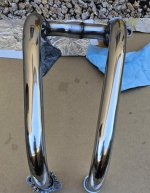
After searching far and wide on how to restore chrome, especially dull and hazy chrome, I realized that re-chroming is really the only answer if you want anything close to the original finish.
Since I wasn't going there, I instead went with the multiple rounds of sanding with WD-40. From 320 up to 5000 grit. Then buffing and polishing. Finally, I used a worn down, clean, dry piece of 3000 grit paper and went to town in a small area. I noticed shallow scratches disappearing and shine reappearing. So I repeated this on the rest of the pipes, then a final buff with lambs wool disc. Certainly no where near showroom quality, but I'm satisfied with the outcome.
Click image for larger version  Name:	20241208_110157.jpg Views:	0 Size:	69.3 KB ID:	1760600
 
Last edited:
I have decided to give the original head a try for a couple of reasons. I was able to get the cams to move freely after grinding the journals, bearings and caps down with valve grinding compound. I was quite surprised that the measurements between bearing and journal diameters were so consistent.
The head I purchased clearly had a sloped mating surface. I took it to my machinist to blast, cut valves and seats and resurface. He was apologetic about the mistakes he made decking the top surface of my original head and only charged $50 for this work. Unfortunately, it looks like he had to take too much material off the head to flatten it. It may still work, but since my original head surface is in great shape, Im more confident with it.
We'll see.
 
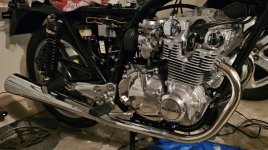
When waiting for parts or other engine building delays, I'm trying to keep busy polishing parts, touching up emblems, etc.
Not sure I like the chromish appearance of the case covers. Any tips for making them look more stock in appearance?

You probably figured out how to make the highly polished aluminum look more stock, but I hit the faces with horizontal 1,500 grit wet, then sides with vertical sanding.
 
Thanks for the tip Dom.
I was amazed at what a fine wire wheel and some polish and buffing could do a dull piece of dull aluminum.
Ill give it a shot.
 
Some good things have come from my head dilemma.
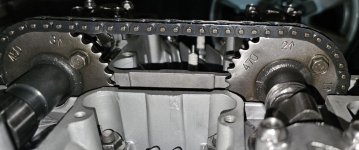
First I realized that the manual was correct as far as the cam chain links. It actually is 19 link spacing even though the intake cam sprocket arrow does not point straight up. Every bike I researched from the era, including the 650g and gl that share the same head, but different number of sprocket teeth, had 20 link spacing.
Found this confirmed in a thread from 15 years ago from a member in NZ who did a 550 to 650 engine conversion.

I also learned a trick (common knowledge to a mechanic or vet) on how to get the exhaust cam #1 sprocket arrow lined up flush to the gasket surface at TDC. Just start with the sprocket one link turn down and when the cam caps are torqued down, the arrow ends up perfectly flush. It may also be due to my camshaft journals not resting flush on the bearings in that position, which may also may be a result of my shims being too large.

Speaking of shims, I ordered a dozen from Z1 to cover the size range and quantity that I expect to be needed. At $5.25/shim it was economical to get the job done in one session and end up with several spare shims.

20241223_070735.jpg
 
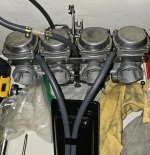
I'm getting close to firing this thing up for the first time in over a year. Made the bonehead mistake of installing the carbs and airbox without installing the fuel and vent lines first This was one of the most difficult jobs that I previously did due to the tight spacing. However, using a little silicone lube and a heat gun, it was surprisingly not too difficult. Then I noticed that the fuel line that I had purchased was the reinforced braided type and rather stiff making it really difficult to bend and add a filter. I got some more flexible hose and now I'm trying to figure out if the lines should be routed inside or outside of the carb rail before reinstalling the carbs.
Went to Bikecliff's "Where do these hoses go" article, but the pics are not available. Other searches showed several variations.
In the end, it probably doesn't matter, but what is the proper or best way to route these lines? This is what I've pieced together.
20241223_074742.jpg
 
I moved the gas and vent hoses on the other side of the rail. Not that it matters, but because two sets of photos in the sevice manual show it that way.

After four rounds, including thread repair, I finished shimming the valves. Results as follows:
#1 exhaust: 2.50 - 0.05
#2 exhaust: 2.45 - 0.07
#3 exhaust: 2.40 - 0.09
#4 exhaust: 2.45 - 0.07
#1 intake: 2.35 - 0.09
#2 intake: 2.50 - 0.07
#3 intake: 2.55 - 0.07
#4 intake: 2.45 - 0.09

Understand that .09 is technically out of spec., but saw in several places that this OK and even preferred. I don't actually have a .07 or .09 feeler blade, but the .06 and .08 blades slid in easily and the next blades up (.08 and .10 respectively) did not clear.

Back to installing the carbs and air cleaner, followed by exhaust and valve cover. Getting close to seeing what I have.
 
Was hoping to attempt a start today, but did a last few checks. Found 35 kohm resistance between #1&#4 spark plug caps which is in spec. Then found an open circuit between #2&#3. Pulled off the caps and found one to be bad. Then measured across the two wires and got about 14 kohm coil resistance. Since the resistance of the caps is 5 kohm nominal, that would give a total of 24 kohm from cap to cap which is below spec. Concerned that #2 & #3 coil is on the way out.
I know I can still get OEM caps, but can anyone recommend a coil replacement? I've seen a bunch of them online, but many comments about them not fitting.
How about non-OEM plugs that I can get fast for a test?

The last time I had this running, it did not act like a cylinder was dead, but just had a surging RPM after it warmed up. Did have gas in the airbox though.
 
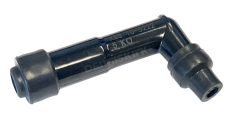
Put new OEM plug caps on order. Apparently NGK has discontinued these over a year ago and they will be very hard to find in the near future, especially the 120? long type.

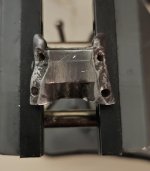
All that remains before attempting to start is repair of a broken exhaust clamp that Ive put off since the beginning of this rebuild. So I drilled four holes on one broken piece, inserted toothpicks, cut off flush and put drops of paint on each. Then carefully pressed the pieces together to transfer drill locations and drilled four more holes on the mating piece. Drill holes heeded to be 90? to the surfaces in order to press fit metal dowels for reinforcement.

20241230_045828.jpg ex
 
Hi jdub,

You did a right fine job there! Puff out your chest, take a bow, and be proud!

I hope it runs as good as it looks.
 
Looking fantastic! The GS650E is one of those sleeper UJMs that got overlooked, and it's a shame.

Almost as fast as the KZ/XJ/GS/CB 750s, but much smaller and more nimble.

My '82 is one of my favorites. It's been in sleep mode for about four years. Maybe this is the year I break it out as one of my riders for the year.
 
Put new OEM plug caps on order. Apparently NGK has discontinued these over a year ago and they will be very hard to find in the near future, especially the 120? long type...

Just an FYI for future reference, K&S is now offering NGK-style resistor caps.

When there is a demand, the market will respond.
image.png - Click image for larger version  Name:	image.png Views:	0 Size:	24.6 KB ID:	1761806
 
Last edited:
Good to know, I knew NGK had quit them. I've used a lot of K&S turn signals and stalks and always been very impressed with their quality.
 
I have a set on my Yamaha 750 Seca. They work fine. Inexpensive, too. About $6-$7 each.
 
I attempted to start the bike last night. Got the oil circulating, checked compression (150,150,140,145), checked spark and then hooked up the tank. Nothing happened. Tried for about an hour. Found one of the not replaced spark caps fell apart when I pulled the plug out. Replaced it with another of the cheapo Amazon caps while waiting seven days for the OEMs that were shipped UPS second day air. Still no luck.
This morning I started grasping at a few straws. Noticed that one of the coil mounts was not grounded due to chassis due to powder coat. Filed part of the tabs to bare metal. OK, dont know what that will do other than maybe reduce EMI. Readjusted carb mixture screws to two turns out. Stuffed a rag at the air intake.
Tried again and heard my first pop of combustion.
A few cranks later, it started and the revs went towards infinity. Scared the crap out of me. Shut it down as fast as I could. Checked the Idle screw and somehow, it was substantially open. Cranked it back down until it barely moved the fuel rail.
Started back up with half choke and it roared to life. It was smooth except for a pronounced clacking rattle sound coming from below the valve cover. Shut it down. Started back up, let run for about ten seconds. Again fairly smooth, but the noise prompted me to shut it down. All four exhaust pipes were warm. Not the normal GS sound.
 
One step forward, and one step sidewise. Sounds normal to me...

Check your cam chain tensioner. They like to jamb. When rebuilding an old GS, it's time well spent to break it down, and make sure the plunger is moving freely. Not sure this is the issue at hand, but hopefully something simple.
 
Back
Top