• Required reading for all forum users!!!

    Welcome!
    Register to access the full functionality of the GSResources forum. Until you register and activate your account you will not have full forum access, nor will you be able to post or reply to messages.

    A note to new registrants...
    All new forum registrations must be activated via email before you have full access to the forum.

    A Special Note about Email accounts!
    DO NOT SIGN UP USING hotmail, outlook, gmx, sbcglobal, att, bellsouth or email.com. They delete our forum signup emails.

    A note to old forum members...
    I receive numerous requests from people who can no longer log in because their accounts were deleted. As mentioned in the forum FAQ, user accounts are deleted if you haven't logged in for the past 6 months. If you can't log in, then create a new forum account. If you don't get an error message, then check your email account for an activation message. If you get a message stating that the email address is already in use, then your account still exists so follow the instructions in the forum FAQ for resetting your password.

    Have you forgotten your password or have a new email address? Then read the forum FAQ for details on how to reset it.

    Any email requests for "can't log in anymore" problems or "lost my password" problems will be deleted. Read the forum FAQ and follow the instructions there - that's what we have one for...

  • Returning Visitors

    If you are a returning visitor who never received your confirmation email, then odds are your email provider is blockinig emails from our server. The only thing that can be done to get around this is you will have to try creating another forum account using an email address from another domain.

    If you are a returning visitor to the forum and can't log in using your old forum name and password but used to be able to then chances are your account is deleted. Purges of the databases are done regularly. You will have to create a new forum account and you should be all set.

Power Draw through coils

salty_monk

Forum Guru
Super Site Supporter
Past Site Supporter
TGSR Superstar
How many amps does the ignition circuit draw on a running bike?

using ohms law I guess each coil draws 3 Amps so 6 Amps.

If I run an added 20watts (approx 1.6amps) on the same circuit will a 10amp fuse be fine or should I go up to a 15Amp?

i have a coil relay mod that I also want to use to power some grip heaters.

:)
 
I'd use a seperate fuse-3amp- for the heater....no fun having the ignition conk out while you're riding
 
I could put one inline I guess so that blows first but that doesn't tell me anything about the overall load... I don't want to install a 2nd relay. :)
 
Last time I put an ammeter inline to check running current draw it showed 1.6 amps draw for a Dyna S.

My reason for doing it was to establish battery size needed for a days racing....

If anyone wants to try it on a street bike, I'd strongly recommend push starting the beast. An ammeter inline won't take the starter current draw.
 
Last time I put an ammeter inline to check running current draw it showed 1.6 amps draw for a Dyna S.

My reason for doing it was to establish battery size needed for a days racing....

If anyone wants to try it on a street bike, I'd strongly recommend push starting the beast. An ammeter inline won't take the starter current draw.
Edit - on a racebike it wa easiest to take it at the battery. You could of course simply take it at the coils which sidesteps the high starter draw...
 
I have a clamp meter that will measure that draw, but MY version of Ohm's law says that 14 volts, feeding 3Ω coils will be 4.667 amps per coil, or about 1 1/2 times what you figured. That is a total of 9.333 amps for both.

OK, the current gets interrupted every once in a while, so the AVERAGE current will be a bit lower. I should be able to verify that with my meter by comparing current draw with engine OFF and engine ON. I'll get some measurements and post the results.

If you are going to tap any circuit, I would tap in to the SIGNALS fuse. As tom203 mentioned, it's no fun to lose spark while riding. And I imagine it could be downright EXCITING if you were to lose your lights in a curve at night. The SIGNALS fuse powers your brake light, turn signals, horn and gear indicator, all of which you can do without and make it home.

.
 
Gs1100e stock igniter 2.5amps total measured with Ths730 on O.W circuit.
edit: accel 3 ohm coils
 
Last edited:
Thanks Jim. I figured there would be plenty of space left on that circuit.

I didn't want to add a second relay but I guess I could. The original ignition circuit fuse is now the switched live for the relay... The relay takes it's power from the stock 10amp accessory fused circuit.

Steve - I used 4ohms for the coils & a lower voltage figure :)
 
Well, I was a bit surprised. With the key ON and the engine not running, my meter showed 2.6 amps on the orange/white wire just after the fuse box. That would include both coils and the miniscule amount that the ignitor requires to switch its transistors. With the engine running, that number dropped to right around 2 amps.

I had trouble believing that, so I grabbed my second clamp meter and got the same numbers.
dunno.gif


.
 
Steve,
With KOEO (Key on, engine off), how many volts were available on that circuit?

Has anyone been able to verify if both coils are ever energized at the same time?
Or when one coil goes open, the other one energizes?
 
I'd expect the coils will only show a direct consumption of V/R=Amps when they are NOT "pulsing"...that is, when you hook them up directly to the battery like a light bulb.

add:I'll suppose that means without the black box TCI ignitor or whatever else...points should be ok though measuring direct throughput.

otherwise, the amperage on a running bike will be less due to the dwell, the engine speed and the collapsing fields resisting recharge too..But as the coil warms up I guess its resistance will increase a bit too.
 
Last edited:

For someone who is electrically challenged (like me) this conversation is incredibly interesting -

--interesting - yet being spoken in a language I do not know -

Learning is constant ;)
 
In the days of points it was fairly normal for an auto coil to draw 5 to 6A on idle and that would drop to 1.5 - 2A above 3K rpm.
From direct observation, I found this to be the same with those electronic ignitions I had bothered to test, although I can't say whether that applies to every installation or design - but given that the circumstances of operation are broadly the same, I'd not be surprised if they're all in the same ballpark.
 
I have a clamp meter that will measure that draw, but MY version of Ohm's law says that 14 volts, feeding 3Ω coils will be 4.667 amps per coil, or about 1 1/2 times what you figured. That is a total of 9.333 amps for both.

OK, the current gets interrupted every once in a while, so the AVERAGE current will be a bit lower. I should be able to verify that with my meter by comparing current draw with engine OFF and engine ON. I'll get some measurements and post the results.

If you are going to tap any circuit, I would tap in to the SIGNALS fuse. As tom203 mentioned, it's no fun to lose spark while riding. And I imagine it could be downright EXCITING if you were to lose your lights in a curve at night. The SIGNALS fuse powers your brake light, turn signals, horn and gear indicator, all of which you can do without and make it home.

.

Do you think there's enough available overhead to tap into on the SIGNALS circuit to run a 3 amp draw for a wideband oxygen sensor and not pop the fuse?
 
Do you think there's enough available overhead to tap into on the SIGNALS circuit to run a 3 amp draw for a wideband oxygen sensor and not pop the fuse?

Yep should just about be... If you think about the total load of what's on that circuit.... Maybe 85w (20w x 4 bulbs incl the brake light plus 5w for the gear change) if lamps if all are on (if you don't have 4 way flashers as that could add another 40w).

(I don't know what your KOSO draws for gear change & dash flasher indicator but I suspect it's very small so I didn't include anything for the dash light).

P=IV so your 3amp x 14v = 42w.

Say 127w / 14 = 9.1 amps. Of course that figure could rise if the voltages are off (i.e. lower voltage = more amps). It would only be intermittent but you always brake with a turn signal going at some point!

You could consider making more room on the circuit with low power LED bulbs, you should be able to free up 40w easily that way I would think.

Failing that... an inline fuse or accessory fuse block would work fine. Use the signal circuit to switch a relay. :)
 
Last edited:
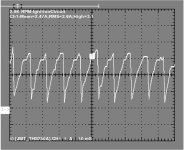
This is a figure for my GS1100ED with Accel coils (3 ohms) and a stock ignitor.
The legend says 2.47 A average with 2.6 amp RMS and a 3.1 A high.
The scale is 1A per division but the base is at about 1.9 divisions.


2019-10-11_18-18-52_OW_Ignition_2p5RPM.jpg
 
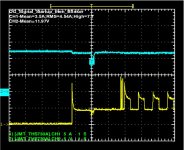
This shows the OG 1.) key On, 2.) Crank engine 3.) apply blinkers.
The scale is changed to 5 amps per division.

Channel 1 is Current, Channel 2 is Voltage (scales are shown at the bottom)

After seeing these plots you can certainly understand why going LED for signal lights would help the whole electrical situation.

LED signal is typically about 1/6 current draw of incandescent bulbs.
LED headlamp is closer to 1/3.


2019-10-11_18-27-10_OG_Signal_Statup_thenBlinker.jpg
 
Last edited:
Dan,
You can see in the plots above how much the OG varies. Just turning ON the ignition on gives a 5 Amp load on OG (60 watts). With blinker it jumps between 5-10 amps.
If I was going to put the WBO2 on OG I would certainly switch to LED signal bulbs. Even though you don't see that much variation on the battery voltage, the large current excursion could have a significant effect on the voltage going to the WBO2. Depending on that device, it may or many not have an effect on O2 readout accuracy. No reason to tempt fate.

If it is a temporary setup i would go direct to the battery with a fuse.
 
Well, I was a bit surprised.

I wouldn't be.. Jim (Posplayr) is a very skilled Electrical Engineer. If he says it's so it usually is! :D
For the record, I was not surprised at his results. I was more surprised that the reality shown on the meters (his and mine) were not what I expected, based on simple calculations.

Jim and I have gone round and round on a few items. Yes, he is very skilled, but not (yet) perfect. I believe there was a point or two that I made that might have adjusted his viewpoint a bit, but he is usually correct AND well-spoken. :encouragement:

The scope graphs are interesting, as well. They definitely confirm the lower readings on the meter, which are average readings that are incapable of showing the sharp peaks and valleys in the trace.

I was going through some stuff in storage a few days ago and saw my old dwell meter. I'll have to hook it up to see what the dwell angle is. I have a feeling that it's going to be smaller than I am currently envisioning. :-k
(Feel free to interpret that as another "surprise".)

.
 
Back
Top