• Required reading for all forum users!!!

    Welcome!
    Register to access the full functionality of the GSResources forum. Until you register and activate your account you will not have full forum access, nor will you be able to post or reply to messages.

    A note to new registrants...
    All new forum registrations must be activated via email before you have full access to the forum.

    A Special Note about Email accounts!
    DO NOT SIGN UP USING hotmail, outlook, gmx, sbcglobal, att, bellsouth or email.com. They delete our forum signup emails.

    A note to old forum members...
    I receive numerous requests from people who can no longer log in because their accounts were deleted. As mentioned in the forum FAQ, user accounts are deleted if you haven't logged in for the past 6 months. If you can't log in, then create a new forum account. If you don't get an error message, then check your email account for an activation message. If you get a message stating that the email address is already in use, then your account still exists so follow the instructions in the forum FAQ for resetting your password.

    Have you forgotten your password or have a new email address? Then read the forum FAQ for details on how to reset it.

    Any email requests for "can't log in anymore" problems or "lost my password" problems will be deleted. Read the forum FAQ and follow the instructions there - that's what we have one for...

  • Returning Visitors

    If you are a returning visitor who never received your confirmation email, then odds are your email provider is blockinig emails from our server. The only thing that can be done to get around this is you will have to try creating another forum account using an email address from another domain.

    If you are a returning visitor to the forum and can't log in using your old forum name and password but used to be able to then chances are your account is deleted. Purges of the databases are done regularly. You will have to create a new forum account and you should be all set.

Reg/Rec ground question

  • Thread starter Thread starter GSAddikt
  • Start date Start date
G

GSAddikt

Guest
Ok y'all, I know I read something on running a ground from the reg/rec to a CGP rather than the battery box (or something like that) but I can't remember what exactly what I read or where and I cannot find it again, I have read the stator papers and maybe I missed it?? Long story short, just installed a new Caltric stator and I am switching to the SH775AA reg/rec, I am also waiting on the Triumph harness to get here.

My question, is the ground that will run from the harness to the battery sufficient for a ground or do I need to run a separate ground as well? Is there anything else I need to know?? I apologize as I know this has been covered but I cannot find the specific info in the search function, please go easy on me... Thanks...
 
  • There is not universal agreement, but few if any of those people have an EE degree.

The recommendations below are to provide the best charging voltages after your wiring has been subjected to certain levels of corrosion.

Depending upon you environment (humidity levels), you should periodically treat the connectors and connections between you R/R and the battery. Ig you use dielectric grease then less often is required.

The thing to remember is that when running down the road, your stator is supply the power to the bike. The current coming out of the R/R(+) must return to the R/R(-)!!!! This current does not return to the battery.

That firmly in mind make sure that there are current return paths to the R/R(-) for:

  • B/W harness
  • Frame
  • battery(-)

That is what is shown in the figure below as a Single Point Ground (SPG) all those currents are collected so they can go back to the R/R(-).

Now you can hook the R/R right across the battery as I'm sure Ed will be along quickly to recommends, however after a few years of corrosion that will be a much worse situation and you will have lower charging voltages as a result.

If you have a 6 wire the same applies, you are just going to have to find a low impedance switched power source. You can do a search, but a coil mod relay provides about the best option. Otherwise hook it right to the battery and make sure to not let the GS set for long periods of days
Here is a simplified diagram showing the connections for a 6 wire R/R. Just omit the Brown wire for a 5 wire R/R. The R/R has doubled up wires for both (+) and (-) so it is actually an 8 wire as shown.
NOTE IN LEGEND BELOW ASSUME THE MAIN FUSE 30 A IS ONLY 15 Amps as per stock GS. SORRY WAS OVERSIGHT AS NOT MY ARTWORK
picture.php

STEP #2.) GOOD R/R GROUNDS Make sure that the R/R(-) is properly grounded to: harness,battery,frame.
I have described a single point grounding approach that minimizes the amount of current that flows between the battery (-) and the R/R (-) connections. By doing that there is less susceptibility to resistance due to bad connections and corrosion and the R/R should charge the battery more accurately.

While there a different ways to implement the R/R grounding scheme, the way Suzuki originally implemented the GS electrical charging systems is confused, inconsistent and not ideal in any sense of the word. I provided the theory of why the one below is best, I will not rehash that here. Just follow the directions below:


Quick Discussion of Single Point Grounds:
http://www.thegsresources.com/_foru...revent-grounding-issues&p=2154549#post2154549


https://www.thegsresources.com/_forum/showthread.php?152769-GS-Charging-System-Health&p=1138531#post1138531
 
Yep, posplayr is our go-to guy for charging issues. :encouragement:

It might help a bit to look at the entire system. The heart of it all is the stator and R/R. Together, they supply all the electrical needs. They supply power to the lights, igntion, signals, battery, etc. Yep, while going down the road, the battery is just another one of the loads that essentially gets connected, just like anything else.

.
 
When talking about the graound wire (black/white) from the harness that the r/r is connected to dont forget that wire gounds the battery box and is needed for the starter soleneoid also. So If you do add a ground wire of your own, dont ignore the solenoid.

Say, In your two years of being on the forumn, anybody suggest you add your bikes model and year in the signature line........?
Then we will all know what bike you are talking about.
 
What they're trying to say is that (electrical) current always takes the path of least resistance. That path may change over time; since every connection experiences varying degrees of corrosion. Less connections; less variation overall in the system.

Also, current sink/source do change with RPM (mainly around idle, mind you), and following that so does the current flow/paths.

A star-like wiring, or SPG, or CGP, or whatever you wanna call it, reduces or nearly eliminates much of the worries connected (hah) to these circumstances.

Personally, I don't give much of a f$!k, and keep charging the batteries from time to time. Of course, I'm only human, and sometimes even fail at that; make sure you do it in a more regular fashion than me.

(Ed's and posplayr's recommendations are not at odds, btw.)
 
What they're trying to say is that (electrical) current always takes the path of least resistance. That path may change over time; since every connection experiences varying degrees of corrosion. Less connections; less variation overall in the system.

Also, current sink/source do change with RPM (mainly around idle, mind you), and following that so does the current flow/paths.

A star-like wiring, or SPG, or CGP, or whatever you wanna call it, reduces or nearly eliminates much of the worries connected (hah) to these circumstances.

Personally, I don't give much of a f$!k, and keep charging the batteries from time to time. Of course, I'm only human, and sometimes even fail at that; make sure you do it in a more regular fashion than me.

(Ed's and posplayr's recommendations are not at odds, btw.)

I have no idea what that last comment means. Perhaps it means "either will work"?

Lets make this somewhat quantitative. For purposes of discussion, most bikes with a stock complement of lighting require the charging system to produce about 15 amps from R/R(+). This current is split at the "T" with nominally 11 amps goes ignitions switch and all other loads while 4 amps goes to charge the battery(15=11+4 total amps).

In Ed's picture he is not showing how all that current is getting back from the loads to the R/R(-), however we know it is 15 amps going from the battery to the R/R(-) becuase it is the only path he is providing. In order to drop 1 volt (a huge amount for the grounds), all we need is 1/15=.0667 ohms of resistance in the wire or conenctions. Also battery connections are notorious for getting corroded, so even fi you use a 10 AWG wire, you still have issues with the lugs and the battery side connectors. Now in a perfect world maybe you can keep the resistance in the wire and at the connectors below that level (if you just got finished cleaning it). But how bout in 6 months of humid weather?

To keep that drop below the conservative 0.25V drop we need to keep the resistance at 0.0667/4=0.01667 ohms (i.e. 1/4 the voltage)! Most people's ohm meters will not even read below 0.1 ohms, and most meter leads are not this good.

So what you say? Well if there is a 1V drop, then the charging voltage at the battery will not be 14.5 volts as controlled by the R/R, but rather it will 1 volt less or 13.5V=14.5-1.0V. If your charging system only delivers 13.5V then you can pretty much be assured you are going to be running around on a low battery all the time. I would guess 50% state of charge depending upon how much cranking and idling you do. I have posted state of charge graphs for lead acid battereis in the past, I won't do it anymore. 13.5 volts is much closer to a float voltage than any bulk charging voltage.


In contrast the SPG configuration is designed to divert as much current away from the wire that runs between the battery (-) and the R/R(-)battery. In fact it reduces the current from from the battery to the minimum which is just the battery charging current. In our example that is 4 amps compared to the 15 amps total. That relates directly to a reduction in the voltage drops we would see across the battery. In this case instead of a 1V drop using Ed's configuration, the drop would be 4/15V = 0.26V (1/4 of the voltage drop in Ed's configuration).

In reality the SPG is much better, because when the battery gets more charged, the charging current drops off. So let's just say for a fully charged battery the charging current drops from 4 amps to 2 amps.

Now instead of 15 total amps demand, the total is 11+2 = 13 amps.

In the case of Ed's configuration the voltage drop is now 13 amps*0.0667 ohms= 0.867 Volts ; still pretty crappy!
In contrast the SPG has now dropped the 4 amps returning charging current in 1/2 and the actual voltage drop is 2 amps*0.0667=0.13334V; this is crappy but well within the maximum recommended of 0.25V.

In this simple example that most people shoudl be able to understand (I would hope) there is a 6.5:1 ratio between the voltage drops on the groudn side of your R/R connections.

Ed's connection is always 6.5 times worse on the grounds!!!
 
When talking about the graound wire (black/white) from the harness that the r/r is connected to dont forget that wire gounds the battery box and is needed for the starter soleneoid also. So If you do add a ground wire of your own, dont ignore the solenoid.

Say, In your two years of being on the forumn, anybody suggest you add your bikes model and year in the signature line........?
Then we will all know what bike you are talking about.

I updated my signature but I don't see it anywhere on my reply's, with that being said, my bike is an '85 GS700 ES.... Disregard that, I see it now..
 
Good ol' Jim overthinking things again.:p

(as I've mentioned before) Kawasaki KZ bikes have no where near the number of charging system failures as GS bikes and many of them run the R/R + output direct to the battery, via the starter solenoid, with no fuse in the line. The negative runs a more indirect path; going into the harness where it's split before coming back to the battery. KZ guys scoff at SH775's because those bikes don't burn stators (nor harnesses like GS's do due to the stator loop.) My point being: keep it simple. I'm sure single point ground is great in theory but the guys I've seen trying to execute it have all these lugs attached at one point which isn't any better than what I'm suggesting in terms of building up resistance.

My schematic is simple to follow and foolproof. Put some grease on your battery posts if you are the type of person that doesn't do maintenance by cleaning them regularly. Done.
 
Good ol' Jim overthinking things again.:p

(as I've mentioned before) Kawasaki KZ bikes have no where near the number of charging system failures as GS bikes and many of them run the R/R + output direct to the battery, via the starter solenoid, with no fuse in the line. The negative runs a more indirect path; going into the harness where it's split before coming back to the battery. KZ guys scoff at SH775's because those bikes don't burn stators (nor harnesses like GS's do due to the stator loop.) My point being: keep it simple. I'm sure single point ground is great in theory but the guys I've seen trying to execute it have all these lugs attached at one point which isn't any better than what I'm suggesting in terms of building up resistance.

My schematic is simple to follow and foolproof. Put some grease on your battery posts if you are the type of person that doesn't do maintenance by cleaning them regularly. Done.


Ed and here you go extrapolating empirical data far beyond any realm of validity and purposefully ignoring all the GS failures which you should know by now actually exist. And as far as scoffing at SH-775's is that why you keep selling them? Sure if yoiu cant follow a simple schematic then do what you can do. That doesn't make it right.

As far as complexity, you do realize that the SPG only adds one additional wire ground to frame? The B/W harmness ring lug is already on every GS bike (the one you forgot in your schematic) and the R/R(-) to battery is the same although i suspect you are arguing for 10-12 awg wire there.

So for the SPG configuration, the only additional wire is an R/R(-) to somewhere on the frame. If this overcomplicates everything such that the walls come caving in, then I guess i will have to give in.
 
Tell you what Jim, why don't you create a really simple diagram (like I did) showing people how to hook up their SH775 the "proper" way if you don't like my schematic. Do that and then maybe I'll stop posting mine. Talk of SPG is just talk for most (if they are paying attention at all.) Teach don't preach.
 
Let's see your SPGs...
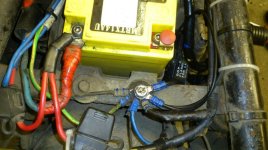
View attachment 60191


I am honestly not trying to be a wiseguy- but is that pic a joke? Per my recent thread, I am working through my own spaghetti level wiring work- steep learning curve.
In doing so, I am trying to absorb the well intended advice of other folks here.

Is the back of the battery a good spot to locate an SPG? Is there a more desirable one since I have things apart? I might try the more simple/temporary approach (non spg) first, just to see if I have the stator connected OK and the previously botched wires connected correctly. Then maybe I will move to an SPG once I am more confident and make permanent connections from there.

Thanks
 
Grimley must have several “add on” accessories and took the SPG to heart and ran all the accessory returns to SPG rather than bat(-).

if you do Ed’s method correctly and compare it to the SPG, there is only one additional frame ground wire.
 
In my bike there are many accessories, and lo I didst taketh the SPG very seriously indeed.
Each one lovingly crafted with the finest of crimps, all coming together in the SPG to beat all.
 
My "spg" is the frame...so any bolt attached to the frame is a place to connect a ground....but, if people want to stack ring-lugs in awkward star shapes, sure, but it must be a bit of a nuisance disconnecting just one thing, let alone running extra wire to the "special golden bolt" and accounting for the rotation each lug needs to sit flat too....
 
My "spg" is the frame...so any bolt attached to the frame is a place to connect a ground....but, if people want to stack ring-lugs in awkward star shapes, sure, but it must be a bit of a nuisance disconnecting just one thing, let alone running extra wire to the "special golden bolt" and accounting for the rotation each lug needs to sit flat too....

The primary idea of the SPG for the GS is to steal current away from the direct battery(-) to R/R(-) connection ( a standard upgrade recommendation) . That means providing lower impedance path than say the dirty starter ground strap.
The frame is not a SPG other than at one point.

For example If you have a Dyn-S, it returns current through the engine case. So how does this engine case current get back to the R/R(-)? The most obvious way is that the current flows from the engine case to the 6 AWG started ground cable then to the battery(-) and then on to your R/R(-). This is exactly what (if possible) you want to minimize. It may not be possible, but oif your 6 AWG groudn streap gets dirty enough, you can provide a frame ground pickup to (where engine case current grounds through the multiple mounting bolts) and you can divert that current from going past the battery.

In the case of having a large accessory (like heated vest/gloves), if you run this right back to the battery then that current travels between battery(-) and R/R(-) increasing the drop. On the other hand if you "ground" the negative side of the acc to teh SPGF then the current will bypass the battery and go direct from SPG to R/R(-).

Additionally I don't know what you mean if the entire frame is SPG with respect to the harness B/W wire? How doe the harness get to the R/R(-)?
 
The primary idea of the SPG for the GS is to steal current away from the direct battery(-) to R/R(-) connection ( a standard upgrade recommendation) . That means providing lower impedance path than say the dirty starter ground strap.
For example If you have a Dyn-S, it returns current through the engine case. So how does this engine case current get back to the R/R(-)? The most obvious way is that the current flows from the engine case to the 6 AWG started ground cable then to the battery(-) and then on to your R/R(-). This is exactly what (if possible) you want to minimize.
see, that's the kind of stuff I don't get. Any suspect path can be tested as a voltage drop...firstly, if the assumption is that the device will work noticeably better "correcting" a tiny voltage drop and that secondly, running a parallel path is the solution, go at it. Myself, I'm not convinced that these extras improve function. I'm comforted that manufacturers agree with me:I don't see ground wires running very far in any car or bike I've seen.

If someone wants an electric vest or gloves plugged into the dash, sure-run an extra ground wire to the frame(not merely to the existing B/W) I'd agree that suzuki's B/W wires were a little light.

but What "dirty ...ground strap"? I say, Clean it up! What impedance? ...it's amply sized to weld...and even if a dyna-S grounded to engine "wants" to get to the R/R (-), (assuming its got the higher potential), it can go there direct via the multiple engine mounting bolts to the frame, thence to the R/R (-) also attached to the frame. The frame may not be copper but its mass determines that it's resistance is effectvely 0. Likewise multiple steel bolts*

But,
*threadlock or antiseize notwithstanding...graphite or copper-based antiseize is going to be pretty low on the worry list especially as the threads themselves are not the only contact point.
 
Last edited:
Back
Top