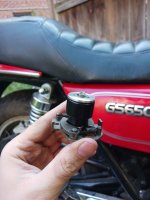
Measurements on the power side look similar to last time. On the ground side, the black/yellow ground-side was dropping about 1.78V, but I found that the white (1-4) cable was dropping 11+ volts.
I pushed the white cable onto the ignition coil a little more and found that the white side cable was now dropping about 1.5V, but the black/yellow side was now dropping 11+V.
I took the white cable off the coil post and saw arcing between the spade connector and the coil post in the process. Putting back on moved the bad drop back to the white side. I tested a few more configurations and the 'bad' side moved back and forth. I didn't see any additional arcing.
Good work!
I can kinda explain what you are seeing here.
Mind you, I have never scoped an IB and can only guess exactly what goes on inside there.
When you see the ground side of the coil voltage drop jump up to 11+ volts, that indicates the IB has released the ground for that coil (you know, to make it throw a spark), and has not reconnected the ground to recharge up the coil primary again.
So now there is no current flowing through that coils circuit and therefore there is no voltage to drop.
What you are seeing is what is called open circuit voltage, aka battery voltage!
(Think of it this way: you have 12 psi of water pressure entering the hose (circuit), you loose 1.5 psi of pressure through the hose (circuit), you loose another 1.5 psi of pressure to get out of the discharge hose, and therefore you only have 9 psi available to power up the gadget (the coil primary) to do its work.
Now put your thumb over the discharge hose (unground the circuit) and stop all water flow (current). Now the pressure anyplace in that circuit will equalize and will be 12 psi (battery voltage) any place you check it.)
So when you are reading 11+ volts you are seeing battery voltage and there is no voltage drop because there is no current flow.
Folks on this form have reported that when testing for spark they get one more spark when they shut the key off. So if you are turning the key off after each measurement, I don't know exactly what is going on in that IB, but that maybe causing the IB to ground the opposite coil to charge up its primary circuit. And when you turn the key back on to measure the opposite coils voltage drop, the 11+ volts you are reading switches sides?
Note that I'm only guessing, and hopefully one of the experts on here can chime in here on what the IB strategy is.
I've always avoided leaving the key in the on position for an extended period of time as one or both coils will be sucking current from the battery and could kill a marginal battery. Not an issue for an engine that uses a crank sensor as it is smart enough to not turn the coil on if it doesn't detect crankshaft rotation.
Well, I gotta back out of here as I'm rambling again. I would suspect your coil primaries are working fine.
So I would do as the salty one above said. check out the secondary for high tension leaks.
Like in a completely dark area with the engine at idle, sprits some water on the high tension wires and see if you can cause a spark show.