• Required reading for all forum users!!!

    Welcome!
    Register to access the full functionality of the GSResources forum. Until you register and activate your account you will not have full forum access, nor will you be able to post or reply to messages.

    A note to new registrants...
    All new forum registrations must be activated via email before you have full access to the forum.

    A Special Note about Email accounts!
    DO NOT SIGN UP USING hotmail, outlook, gmx, sbcglobal, att, bellsouth or email.com. They delete our forum signup emails.

    A note to old forum members...
    I receive numerous requests from people who can no longer log in because their accounts were deleted. As mentioned in the forum FAQ, user accounts are deleted if you haven't logged in for the past 6 months. If you can't log in, then create a new forum account. If you don't get an error message, then check your email account for an activation message. If you get a message stating that the email address is already in use, then your account still exists so follow the instructions in the forum FAQ for resetting your password.

    Have you forgotten your password or have a new email address? Then read the forum FAQ for details on how to reset it.

    Any email requests for "can't log in anymore" problems or "lost my password" problems will be deleted. Read the forum FAQ and follow the instructions there - that's what we have one for...

  • Returning Visitors

    If you are a returning visitor who never received your confirmation email, then odds are your email provider is blockinig emails from our server. The only thing that can be done to get around this is you will have to try creating another forum account using an email address from another domain.

    If you are a returning visitor to the forum and can't log in using your old forum name and password but used to be able to then chances are your account is deleted. Purges of the databases are done regularly. You will have to create a new forum account and you should be all set.

Reg/Rec

  • Thread starter Thread starter GSXXZRX
  • Start date Start date
G

GSXXZRX

Guest
Here's a novel idea. I came across this trying to find if anyone has relocated
the r/r on the Blackbird. I recently had to replace mine and after a short ride
of 3 miles I felt the r/r and it was hot. I mean HOT. Being I have nothing to
compare it to, I did some research and found that this is pretty much normal.
I've since grounded the r/r to the battery and put a copper plate under it to
help dissipate heat. But it still gets pretty hot.
I was going to compare it to the ZRX, but being I never had a problem with
the electrics I don't even know where its located on the bike.:-k But I will this
weekend.
Anyway, I can't do this mod on the Blackbird because of where the r/r is
located, (on the side of the sub frame under your right thigh, where no fresh air
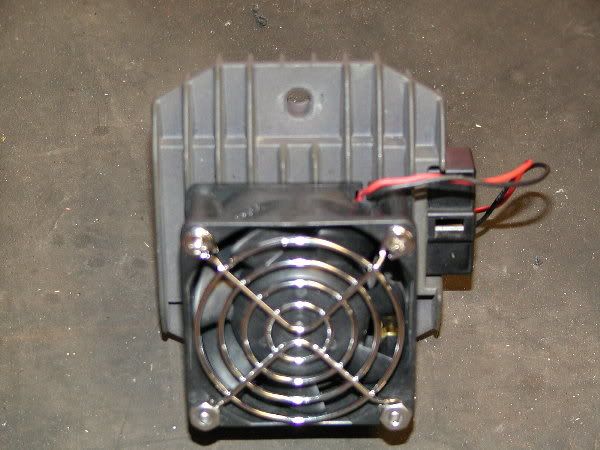
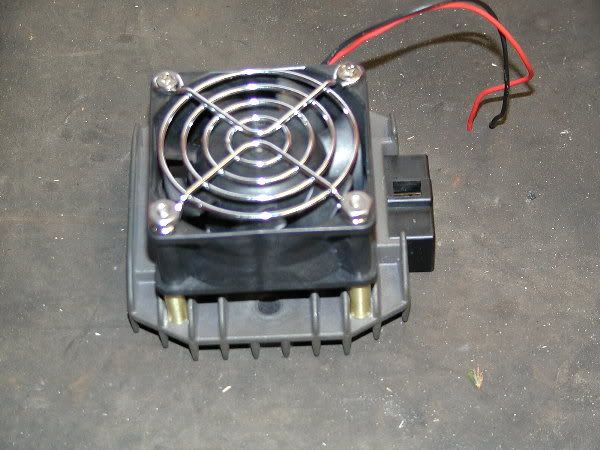
gets to it) but may be something to think about on the GS's. Here's a link.
http://borg20014.tripod.com/service_sectionm.htm
">
reg4.jpg
 
Last edited:
Your R/R will get very hot immediately if it is not properly connected across the battery. The R/R should not be hot to the touch at idle, but with poor connections it easily rise above 120 degF.

Verifying the connection voltage drops is the best thing you can do for R/R longevity.
 
posplayr
I realize the importance of a good ground. Like you, (I can tell by the bikes
in your sig) I am very particular. And I'm cheap. The electrical system is
working perfectly. 12.9 across batt. 12.2 with ignition on, 14.2 with engine running.
The way I understand it, The r/r dumps unused voltage to ground usually by
way of the frame, which causes resistance, which causes heat. Grounding
to the battery gives less resistance therefore less heat. As the power connection to the r/r should be spotless and greased also.
But these things still get pretty hot depending where they are located on
the bike. A lot of cruisers have them right between the front frame down
tubes.
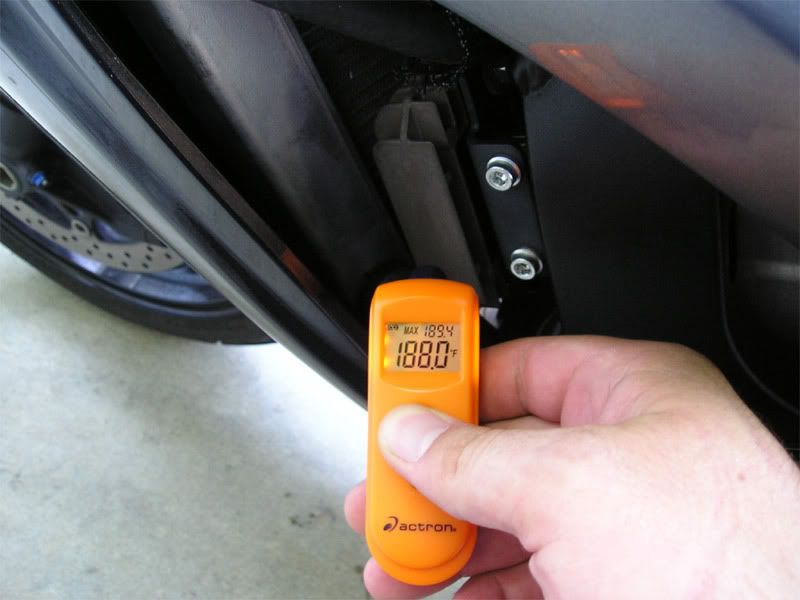
This pic was taken right after a ride by a fellow on the Gixxer board .

">
 
posplayr
I realize the importance of a good ground. Like you, (I can tell by the bikes
in your sig) I am very particular. And I'm cheap. The electrical system is
working perfectly. 12.9 across batt. 12.2 with ignition on, 14.2 with engine running.
The way I understand it, The r/r dumps unused voltage to ground usually by
way of the frame, which causes resistance, which causes heat. Grounding
to the battery gives less resistance therefore less heat. As the power connection to the r/r should be spotless and greased also.
But these things still get pretty hot depending where they are located on
the bike. A lot of cruisers have them right between the front frame down
tubes.
This pic was taken right after a ride by a fellow on the Gixxer board .

">

I don't know if that guage is right or not but 190 degF is 88 DegC and is beyond the 85 degC upper range of extended temperature range parts. If the outside case is that hot then the junction temperatures are going to be much higher. If you touch that R/R you will burn your skin. That is simply too hot unless you just got off of a 130 mph run that lasted 20-30 minutes.

As an example I mounted my R/R on the GS750 on a copper heat sink which you apparently did somthing similar and I never saw more than a 20-25 degC drop between my R/R temperature (measured with a dual input temperature probes) and frame. So if my frame were running under hot conditions at about 40 degC, then the R/R would be at about 60-65 which is with the +85 degreeC range.

From your description of VERY HOT R/R and that temperature reading Sounds like you have something wrong. :(

How does your charging voltage at 5000 RPM compare to idle; U did not mention that and that is the key measurement.

Not to picky but, your description of R/R operation is not really correct and you could get the wrong idea from it. All current returns to the R/R (-) to complete the circuit in the stator windings. The currents return from the frame to the R/R (-) and the harness ring lugs (grounds) as well. In fact charging current from the R/R (+) to the battery plus, completes a circuit by returning to the R/R (-) otherwise it will not charge the battery.
 
Last edited:
posplayr
Believe me, I'm not trying to beat you up on this. I'm just trying to learn.
I've been reading a lot and have been finding a lot of contradictions. Some things are a little confusing. I don't understand how current can go from the
frame back to the r/r. I thought the purpose of a diode was to allow electrical current to flow in only one direction. And the r/r was to convert AC current to DC current. So if DC current is coming from the r/r, why would it
need to return to the r/r.

BTW: 14.2 @ 5000rpm , a little less at idle.
 
Nothing is "coming back" to the r/r. :-k

In very basic terms, three wires feed alternating current from the stator to the inputs of the r/r. The alternating current is rectified into an approximate direct current. There is quite a bit of "ripple", but all the voltage is on the same side of ZERO, making it 'direct current' or DC. This DC is now fed to the regulator, which is just a high-speed switch with a reference voltage. When the output voltage is lower than the reference, ALL the output goes to the positive wire and on to the bike. What the bike does not use, will end up stored in the battery. When the voltage is higher than the reference voltage, ALL the output gets switched and goes straight to the ground connection. When the voltage is lower than the reference (and this happens rather quickly with a direct short), ALL the current is switched back to the positive wire. This process happens about 2,000 times per second, so you can see why you need a very good ground connection and also why your r/r might get a bit warm. :o

.
 
Thanks guys. Maybe I should take a little harder look at this situation with
the hot r/r. It seems the charging is doing what its supposed to, except
for the excessive heat from the r/r. If I don't attend to it, It'll smoke another
r/r. This thing won't last long at these temps. And I don't want to take something
else out with it.
I'll let you know if I remedy this. If I don't, I'll be back to bother you some more.

Thanks
Jim
 
Last edited:
Nothing is "coming back" to the r/r. :-k

:o

.

Steve, your statement above this is a VERY common misconception.
If you look at this link I have referenced the GS1100E factory manual for additional corroborating evidence that statement above is false. All current that the stator generates has to complete a circuit. That circuit is completed when all return currents flow back to the R/R (-) and complete the circuit as shown in the full wave rectifier diagram.

I was under the same misconception until was investigating the charging system operation and had one of the engineers at work explain it to me the full wave rectifier (I probably understood it 30 years ago but forgot :o). Later I even found the manual reference saying the same thing.

This should not be controversial; it is simply a matter of understanding the current flows and polarities of a 3 phase full wave rectified bridge.


RR_Rectifying.jpg


http://www.thegsresources.com/_forum/showpost.php?p=978254&postcount=1
 
Last edited:
Your R/R temperature is dependant on the power it dissipates and it's ability to dissipate power as heat. That power is the difference between what is generated by the stator and the load the bike requires. Did you permanently connect the third stator coil? Try turning on more loads - mainly your headlight.

Your R/R should not get that hot.
 
posplayr
Believe me, I'm not trying to beat you up on this. I'm just trying to learn.
I've been reading a lot and have been finding a lot of contradictions. Some things are a little confusing. I don't understand how current can go from the
frame back to the r/r. I thought the purpose of a diode was to allow electrical current to flow in only one direction. And the r/r was to convert AC current to DC current. So if DC current is coming from the r/r, why would it
need to return to the r/r.

BTW: 14.2 @ 5000rpm , a little less at idle.

It sounds like the R/R is working properly but it is still too hot. Given your voltages and the look of that regulator it appears to be an FET type FH0012A. Those are rated at 50 watts at about 20 degC ambient. There is a power derating if operated at higher ambient temp.

If I did not know anything else I woudl say that it is operating normally and still getting hot then you have a high demand load on the bike. However I took another look at the pictrue of your bike to see how you have it mounted. I cant really tell but it appears as if you have it mounted behind a radiator :confused:.

If that is the case then you are trying to cool the R/R with convective flow from the radiator that is at 200 degF :eek:. If this is the case then the radiator is increasing the temperature of the R/R and you are exceeding the R/R ambient temperature rating.
 
Sorry for the confusion.
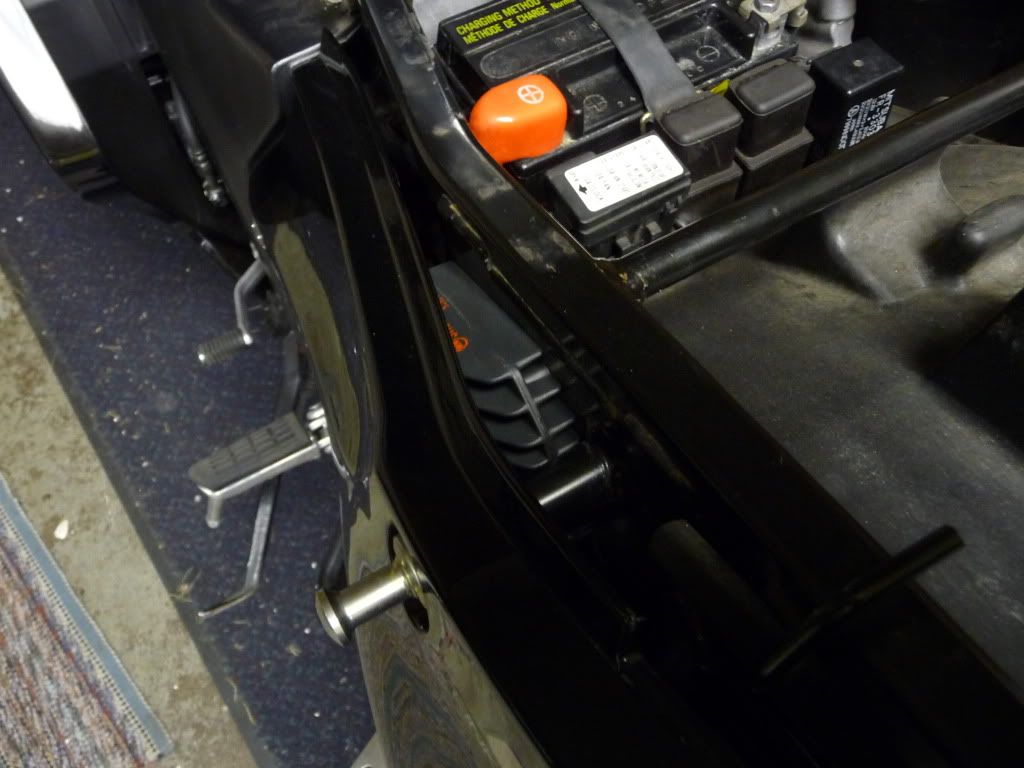
That pic was taken right after a ride by a fellow on the Gixxer board . It is behind the rad, and is also the factory location.:eek:
The r/r on my Blackbird is bolted to the outside of the sub frame. Sitting
on the bike, its right under my left thigh, between the sub frame and the
tail piece. The only air it gets is from the engine.
">
 
Last edited:
Steve, your statement above this is a VERY common misconception.
Pos, once again, you are quite correct. :oops:

I mis-read his statement to say that some current went to charge the battery, then, when any excess was being 'regulated' (shunted) it would get sent back to the r/r. After going back and re-reading it, I see that I mis-interpreted what he wrote.

Back to the original poster ... GSXXZRX, yes, current does go back to the r/r, but it goes in the back door, like posplayr says. It goes out via the positive wire and comes back in via the negative wire, which also happens to be the chassis ground. It has to complete the circuit. Any excess that is being shunted (the process of regulating the voltage) will go straight to ground (yes, that's a momentary direct short, that's why your regulator is getting warm), the rest of the time it's going to either the electric stuff on the bike or the battery.

.
 
The Honda R/R I've installed on my bikes barely feel warm to the touch.

If yours is getting that hot (and it's not from sitting right behind a radiator) something is Bad Wrong.
 
I've used a case fan for about 10 years and have posted about it in the past.
 
Measure all 6 of the diodes in the RR, you MAY have one that is shorted. It only takes one shorted diode to heat the RR up that much while it still provides regulated output. Since there are 3 phases and 5 other diodes you have enough there to provide for the bike, but the RR will heat up. If you do have a bad shorted diode it is only a matter of time before one leg of the stator goes out. Then you will start to have problems getting above 13 volts. eventually the other two legs of the stator will feel the strain and one will go out as well. Then you have 12.2 volts all the time and you get to push start it everywhere.

Of course this could all be wrong. I'm not there to check the diodes so I can only speculate as to why your RR is as hot as the cylinder head.

To check the diodes use a voltmeter and set it to measure diodes.. You can use a meter without a diode check feature, just set it to read 0 - 1000 ohms or so.

Connect the red to the ground lead and the black to the RR stator input lines, one at a time. There are three so you connect it to each one individually. You should measure about 500 - 600 ohms and they should be the same for all three.

Now connect the Black meter lead to the + output of the RR and probe the stator input connections with the Red lead. You should see the same 500 - 600 ohms for those three diodes as well.

Do all this with the RR unplugged from the bike and have a pin out diagram for the RR handy. You are measuring things in reverse since diodes block flow in one direction and flow in the other. This is called forward biasing and in effect the diode turns on allowing voltage to pass. A little is lost due to resistance but it's negligible. In Reverse bias mode the diode should be a brick wall and not allow any current flow. Most diodes appear as a open circuit in reverse bias.

If it checks out OK pull the headlight fuse and test again. Maybe something electrical on the machine is drawing way more current than it should. But this is not healthy for the stator nor the RR.
 
Back
Top