• Required reading for all forum users!!!

    Welcome!
    Register to access the full functionality of the GSResources forum. Until you register and activate your account you will not have full forum access, nor will you be able to post or reply to messages.

    A note to new registrants...
    All new forum registrations must be activated via email before you have full access to the forum.

    A Special Note about Email accounts!
    DO NOT SIGN UP USING hotmail, outlook, gmx, sbcglobal, att, bellsouth or email.com. They delete our forum signup emails.

    A note to old forum members...
    I receive numerous requests from people who can no longer log in because their accounts were deleted. As mentioned in the forum FAQ, user accounts are deleted if you haven't logged in for the past 6 months. If you can't log in, then create a new forum account. If you don't get an error message, then check your email account for an activation message. If you get a message stating that the email address is already in use, then your account still exists so follow the instructions in the forum FAQ for resetting your password.

    Have you forgotten your password or have a new email address? Then read the forum FAQ for details on how to reset it.

    Any email requests for "can't log in anymore" problems or "lost my password" problems will be deleted. Read the forum FAQ and follow the instructions there - that's what we have one for...

  • Returning Visitors

    If you are a returning visitor who never received your confirmation email, then odds are your email provider is blockinig emails from our server. The only thing that can be done to get around this is you will have to try creating another forum account using an email address from another domain.

    If you are a returning visitor to the forum and can't log in using your old forum name and password but used to be able to then chances are your account is deleted. Purges of the databases are done regularly. You will have to create a new forum account and you should be all set.

Reservoir holes (front brake)

  • Thread starter Thread starter MikeS
  • Start date Start date
M

MikeS

Guest
My front brakes have been dragging occasionally over the last two or three months. It got to the point that the front wheel was so locked that I had to open the bleed bolts to release pressure just to get home.

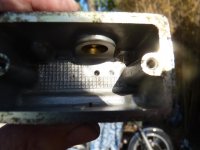
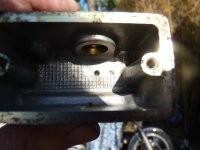
So . . . yesterday and today I have taken the front calipers off, pulled the pistons, cleaned everything, lubed the pistons, and the brakes are still dragging. So . . . reading on these forums someone suggested to someone else that their problem was their master cylinder having a clogged "suction" hole. I don't know which one is the suction hole but it must be the one towards the front or, looking at the pictures, to the right. It doesn't seem clogged so much as it looks like it has a piece of machined aluminum in it and there no way to get to it that I can figure out. Somehow their must be a way to remove the master cylinder piston but it doesn't seem obvious and my Clymer or whatever it is book doesn't break things down that far.

I've used wire to dig at it and air pressure into the outlet to try and blow the obstruction out. It looks like it's aluminum just like the reservoir itself so I'm thinking I simply just don't know what I'm doing.

Here's some pictures of what I've got. Can anyone identify or explain why that first hole looks like it has a piece of machined aluminum in it? It looks like it's part of the reservoir case instead of some crud that got caught in my return (suction) line.

I'm at the point of thinking I need to pull the master cylinder if only because if I drill this hole out, there's going to be a burr on the bottom of the hole that needs to be removed so one way or another the piston & spring needs to come out. Right?

Help please. This is a 1982 GS850G.

MikeRes2.jpg
Okay. In my shop manual which covers all of the GS850's from 1982, it says there is a circlip holding the master cylinder piston in. It ways it requires a special tool to take if off and not to use the old one when putting it back together.

That return (suction) hole is the problem the piston isn't sucking fluid back into the reservoir thus causing pressure to build in the lines and calipers which causes the dragging and the locking. So I'll drill that damn hole out if it comes to it - wire and everything else I've tried isn't working . . . but I'm sure a drill will work. I don't think the piston actually extends all the way to that return hole so maybe the drilling burr won't interfere - at least until it breaks off and lodges down in the caliper pistons.

Does anyone agree with me that I need to drill out this strange piece of aluminum that appears to have been cast into the reservoir when it was built - obviously not since the brakes have been working fine.

I noticed in taking calipers off that pads on the left side still look brand new while the ones on the right are well worn. For some reason, my brakes have just been working on the right side all this time. I never noticed. I've changed out my rear pads a couple times over the years but this is my first exposure to the front brake system.

Please see the post below this one for a second picture of the reservoir holes.
 
Last edited:
"The post below" will only happen IMMEDIATELY after you posted this one, and then, only if you do it in the middle of the night, when NOBODY else is posting. :-k

You will be better off copying your second thread, posting it here, then deleting that one, to avoid confusion.

Now, to your problem:
You do NOT have an aluminum restriction in that hole. That is the aluminum body of the reservoir. It is machined down a bit and has a VERY small hole at the bottom. If your brakes are dragging after riding a few miles, THAT is the hole that needs to be cleaned. Do whatever it takes to clean it, do not drill it out, unless you have VERY small drill bits. Typically, the smallest drill bit in a set is 1/16", that is much larger than the hole. What I usually use is a single strand of copper from a 14- or 16-gauge wire. Some brands have different numbers of different-size strands to make up their wire, so you might have to search a bit to find one that works.

There is nothing in the bore inside that hole, so feel free to poke away to get in there.

.
 
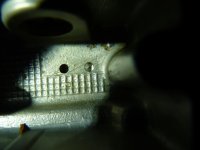
This is a clearer and closer picture. Thanks for the info regarding the nature of this hole. I can see the tiny hole you are talking about so need to find something small enough to get into it. I've got some valve adjustment clearance wires around somewhere which, if I can find it, should have something small and strong enough to poke around. I'll try air again, now that I can see there's a hole there. Funny . . . it wasn't visible yesterday when I was fooling with this. I guess I wasn't looking for something that small.
 

Attachments

  • Res2.jpg
    Res2.jpg
    81.4 KB · Views: 0
Last edited:
"Clearer and closer" is always nice, but you still need to clean that little hole.
dunno.gif


.
 
This is a clearer and closer picture. So far no luck puncturing what appears to be solid metal.Res1.jpg
 
Assuming I eventully get tht hole unplugged - just a matter of time - I've got pads on the left caliper tht look brand new after something like 40K miles. The ones on the right, one is worn normally and the other is badly worn, but still showing a gap in the center line. I don't remember changing out these pads, but could have. Need to look in my maintenance log.

Question: What is responsible for determining fluid quantity to the two reservoirs? Should I take my lines off and blean them, along with the manifold fittings? Seems like the mors I get into this the more thorough an overhaul I need to do. Something is directing more pressure into my right caliper than my left one.

Rear brake has been a real trooper. Occasionally new pads but I don,t recall even changing fluid in the last five yers. I'll surely get around to flushing my rear brake system after dealing with these front brakes.

Mike
GS850G - 1982 & 1979 before that (still sitting in the back yard - blown head gasket)
 
Believe it or not, Suzuki recommended changing brake hoses every two years. I am willing to bet that very few bikes have had that done. Yes, I am guilty of that, too. :oops: An internally-plugged line will keep fluid from flowing.

Rather than discover what else you might have to do, why not just start from scratch? Rebuild the master cylinder, rebuild both calipers, replace the hoses, DONE.

.
 
Steve, I know the factory stock brake lines should be replaced every two years. My question is, how often should the "new" braided type brake lines be replaced? I would think they'd last much longer. I never made my own lines, what type of hose do they use?
 
The brake line to my left front caliper isn't blocked. With both bleed valves open, squeezing the lever squirts fluid equally out of both holes. Taking the piston out and cleaning as I did yesterday may fix that problem. It wasn't pitted or rusted on the outside but it wasn't perfectly smooth and clean either (but now it is), so we'll see.

Today, putting air through the fluid outlet on the reservoir, I feel air coming out of the "tiny hole", so it's not blocked. It might have been blocked before, or not . . . I never even noticed the tiny little hole until I blew up that picture I posted.

Onward. I saw somebody say mixing oil and brake fluid is likely to cause some kind of disaster . . . actually some people recommend using mineral oil instead of brake fluid, so I don't immediately see how getting the two in contact with each other could be all that serious. Looking at my can of brake cleaner, it does say not to use kerosene or oil or gas to clean brake parts, so somebody is correct.

My shop manual does say in big bold letters to change out the brake lines every two years. Seems excessive. I got by for many years with just a coaster brake on the rear wheel, so I'm not so sure a front brake is all that necessary anyway.

It could be that the lines need to be strictly rigid and not subject to swelling for the fluid return function of the master cylinder to work properly. I'll find out shortly.
 
Seems excessive. I got by for many years with just a coaster brake on the rear wheel, so I'm not so sure a front brake is all that necessary anyway

Wow. Far be it from me to tell anyone else how to do anything on a motorcycle. I just don't Understand that statement at all. I rode my dirt bike in the soft stuff that way when I was a kid but on a street bike It is generally accepted that approximately 70% of a motorcycle's total braking power comes from the front brake and only 30% from the rear brake.
 
I got by for many years with just a coaster brake on the rear wheel, so I'm not so sure a front brake is all that necessary anyway.
On a 30-pound Schwinn, yeah, no problem. On a 600-pound Suzuki, ...

Well, let's just say that I'm glad I won't be in YOUR neck of the woods any time soon. :oops:

.
 
Replace the brake lines and rebuild the calipers. The seals ate 37 years old

And, thoroughly clean off any oil on every brake part

Clean the slides so the pads can move
 
given proper maintenance, that is....i know you know this, steve, and MAYBE it goes without saying but....
It is my understanding that the stainless lines last forever. :encouragement:

.
 
Wow. Far be it from me to tell anyone else how to do anything on a motorcycle. I just don't Understand that statement at all. I rode my dirt bike in the soft stuff that way when I was a kid but on a street bike It is generally accepted that approximately 70% of a motorcycle's total braking power comes from the front brake and only 30% from the rear brake.

I read somewhere that that figure can actually be low... on many late model sport bikes the are capable of "stoppies" (braking so well that the rear tire comes off the ground) in that instance the front brakes are 100% of the vehicle's stopping power. Just food for thought. Regardless, front brake are darn important!
 
> "Clean the slides so the pads can move."

Would you please clarify what you mean by "slides"?

******************

Front brakes are back together with fresh fluid and lever is not locking up (as it was) because my "tiny hole" was plugged.

It's too soon to say really that it's completely back to normal . . . that'll take a few days of riding . . . but reading the forum helped tremendously in understanding the function and the importance of the "tiny hole."

I had trouble twice in this process of getting pressure back into the lines. I read the post regarding the person who had the same problem and read the responses. In both instances I got it fixed . . . the first time on my own, just accidently, and the second time by tie-wrapping the lever to the handgrip and just letting it set with a full reservoir of fluid for half an hour or so, letting gravity drain fresh fluid through the lines to dribble out the bleed nuts. I think I did something similar the first time it happened. I let the fluid run out the bleed valves and after a while just closed the bleed valves and pumped the lever a few times and it's now back to normal. I think.

Another thing I did, both times, was stick a rubber hose over the bleed valve and pump the Harbor Freight vaccuum pump a few times, on each side, to pull the fluid down from the reservoir. I've had that thing for about ten years and this is the first time I've ever used it for something. The little rubber adapters it comes with were rotten it's so old, but the main hose line still was okay. If bought on sale I think it's a handy little thing to have for pressurizing a line or for as in this case, creating a vaccuum in the line. They call it a "brake fluid pump kit" or something similar. It was cheap and I was surprised to find the diaphragm was still good.

I've never noticed any lack of braking power even though it appears one of my calipers (left side) hasn't been doing it's job. I'm hoping cleaning up the calipers & flushing everything with WD-40 (oops . . . meant to say "brake fluid" heh, heh . .) has loosened it up. The piston was a little dirty, but not bad. Maybe that's all it takes is a little crud to keep it from working properly.

As Steve said, I really should put new lines on to do the job right. I could tell in working with it over a couple days that a residual amount of old dirty brake fluid stays in the lines.

Somehow I got some brake fluid on the gas tank so now have an ugly discoloration there. That must be why it always says on the bottle of brake fluid to not get it on painted surfaces.

Mike


It's really great to have this forum as a resource. Thank you webmaster and contributors for keeping it going.

Mike
 
Clean the slides so the pads can move

Hey Big T . . . would you please expand on that? What "slides" are you referring to.

Some brakes I know have one or two tracking or alignment bars (don't know just what to call them) that keep the caliper in alignment so that when pressure is applied to the pads, the rest of the caliper housing moves in unison or at least doesn't suffer any warping force.

These "alignment bars" (if that's what they might be called) are not presnt on my calipers, so clearly you are referring to something else and I can't figure it out. One of my old pads had some kind of thin metal contraption attached to it which I'm thinking "might" be what you're talking about. I can't find that piece. Brakes are back together and working but not as smooth as they once were . . . so maybe I need to order some "slides"? . I imagine they fit behind the pad? Obviously not on the face of the pad, so perhaps they go behind the pad and allow the pad to "move" as you state. I didn't know they needed to move within their brackets . . . but clearly there's a lot I don't know about lots of things. Please let me know what you mean by slides on these calipers. Again, it's a 1982 GS850G. I've got a '79 under a tarp in the back yard with a blown head gasket - so those little metal pieces that may go behind the pads are probably on the old bike. If they're important I'll take them off the old bike. Are they necessary?
 
Last edited:
Nope.I was referring to the "pad Guide" #7 on the front brake fiche.

This is the L shaped pieces that clip on the caliper holder, that the ears of the brake pad ride on.

Very necessary

And spend $13 and get new seals for your brake pistons. Yours are old and hard and are keeping your brakes from working properly.

I can't believe you are riding around with malfunctioning brakes
 
Last edited:
Steve, I know the factory stock brake lines should be replaced every two years. My question is, how often should the "new" braided type brake lines be replaced? I would think they'd last much longer. I never made my own lines, what type of hose do they use?

Norm, I believe the type of hose used is teflon with the steel braided outer line.

Seems excessive. I got by for many years with just a coaster brake on the rear wheel, so I'm not so sure a front brake is all that necessary anyway.
/QUOTE]

Are you serious????? That sounds like the kind of mentality a Harley rider uses. You need to practice, practice, and practice some more on the art of stopping with the front brakes. My ratio is probably 90% front brake to 10% rear brake.
 
Nope.I was referring to the "pad Guide" #7 on the front brake fiche.

This is the L shaped pieces that clip on the caliper holder, that the ears of the brake pad ride on.

Very necessary

And spend $13 and get new seals for your brake pistons. Yours are old and hard and are keeping your brakes from working properly.

I can't believe you are riding around with malfunctioning brakes

Thanks for responding. I'll take a look at a blow-up of the caliper and see what you are talking about.

Re "malfunctioning brakes", there's different levels of malfunctioning. Obviously if the wheel won't turn freely something needs to be done. When sitting in the sun, pressure would build up in the system so badly that the front wheel was locked and lever wouldn't move. Releasing pressure through the bleed screws (8mm) was the way to fix that, temporarily. I figured it was water in my brake fluid, which was very old.

Bleeding thoroughly didn't fix it!

That's when I learned about the "tiny hole". If whatever is blocking it is close to the same color as the aluminum of the reservoir, it literally takes a magnifying glass to find it. Fortunately, I didn't need to buy a guitar string or use one of my wire spark plug gappers to clean it out. I used my Harbor Freight vaccuum brake bleeder thing to suck whatever it was out of the hole.

If I can't get my left caliper to start working, I'll take your advice on putting new seals. Thanks!
 
Back
Top