• Required reading for all forum users!!!

    Welcome!
    Register to access the full functionality of the GSResources forum. Until you register and activate your account you will not have full forum access, nor will you be able to post or reply to messages.

    A note to new registrants...
    All new forum registrations must be activated via email before you have full access to the forum.

    A Special Note about Email accounts!
    DO NOT SIGN UP USING hotmail, outlook, gmx, sbcglobal, att, bellsouth or email.com. They delete our forum signup emails.

    A note to old forum members...
    I receive numerous requests from people who can no longer log in because their accounts were deleted. As mentioned in the forum FAQ, user accounts are deleted if you haven't logged in for the past 6 months. If you can't log in, then create a new forum account. If you don't get an error message, then check your email account for an activation message. If you get a message stating that the email address is already in use, then your account still exists so follow the instructions in the forum FAQ for resetting your password.

    Have you forgotten your password or have a new email address? Then read the forum FAQ for details on how to reset it.

    Any email requests for "can't log in anymore" problems or "lost my password" problems will be deleted. Read the forum FAQ and follow the instructions there - that's what we have one for...

  • Returning Visitors

    If you are a returning visitor who never received your confirmation email, then odds are your email provider is blockinig emails from our server. The only thing that can be done to get around this is you will have to try creating another forum account using an email address from another domain.

    If you are a returning visitor to the forum and can't log in using your old forum name and password but used to be able to then chances are your account is deleted. Purges of the databases are done regularly. You will have to create a new forum account and you should be all set.

The finer points of tuning GS450S carbs.

  • Thread starter Thread starter IanF
  • Start date Start date
I

IanF

Guest
Greetings all:

Been so long since I've posted here that my account was purged and I had to create a new one. Some of you might remember me as IanFrancisco from bygone days. Photos of my 1980 GS450ST are still in the gallery:

http://thegsresources.com/_scripts/gallerydispwnd.php?RegID=599

My GS has been spending most of its time in the garage since I bought a VX800 in '06, then a KLR650 in '07. Well, the VX has 70k miles on it and the KLR has 40K and just broke down. Needs a shift linkage spring on the pawl. So I decided to start riding the GS450 again more regularly. It doesn't really like to sit around that much and I had to clean the carbs again and solve some gas leaking into the oil in recent weeks to get it back on the road. Needed a new o-ring on the petcock diaphragm and the float levels were about .75mm higher than the spec, which is 23.4mm if I recall correctly. They are now set exactly to spec per my new vernier caliper.

The 1980 GS450 carbs were set up lean from the manufacturer as many know, and the previous owner had gotten rid of the spacers forcing the needles down into ridiculously lean territory. These are the BS34SS Mikunis and the stock needles don't have clips so fine tuning these is challenging.

The bike now idles perfectly after about 30 seconds of warm-up and starts well in mild SoCal weather without the enrichener. It also runs wide open real well. That tells me that carbs are not too far off of being dialed in. I have the stock airbox and filter, stock jetting and needles (minus spacers) in the carbs and stock exhaust. The plugs are new. The old ones were a medium brown color. The pipes are slighty goldish rather than bluish, so I don't think I'm running too lean or too rich, maybe a little on the fat side if anything. Hard to tell without an exhaust gas analyzer. I could try some plug chop tests, but I don't really trust the results and juggling hot sparkplugs at the side of the road is not my idea of fun. Maybe a colortune plug might be a good thing to try.

What the bike does not do well is run at 5500 to 6k rpm at small throttle openings which is exactly what is needed to cruise at 65 to 70mph on the freeway in 6th gear. One cylinder acts like it is cutting out and there is surging, similar to a gas starvation issue. Roll the throttle open and the problem disappears. Drop a gear or ride at speeds faster or slower to get away from the 5.5k to 6k rpm range and the problem disappears.

I have had people tell me that carbs running wrong at certain throttle openings is not related to rpm but to jetting, pilot screw settings etc. but I am here to say that my problem IS only happening between 5k and 6.5k rpm. Seems to be something with the airflow or vacuum created at that rpm range. I can ride the bike slowly, short-shifting at 4500-5k rpm and never get a stumble at any throttle opening. That level of performance doesn't beat traffic away from the lights though. I can ride the bike with a heavy throttle hand and rev up to 7k before shifting and I don't have a problem, but that seems to go against the easy going nature of this little twin.

I admit that since riding the VX800 and KLR650 I am accustomed to getting a stronger launch off the line and having some power on tap so I'm asking the GS450 to give me a little more of its 40bhp than before, and am wanting to keep it up in its power band now. In a perfect world I would ride this bike around town keeping the revs up over 4.5k rpm so that there's some torque available, but right now if I gently roll the throttle open at 5k rpm to say, halfway to 3/4 open, I don't get smooth power, I get hesitation and stumbling. If I whack the throttle wide open I get some action, but I shouldn't have to do that. Frustrating! It's a 450, not a Ninja 250.

I noticed that the airbox doesn't seal around the carbs very well. I have new clamps and airbox parts on order so that will be rectified soon. I replaced the intake boot o-rings once a couple of years ago and the boots and clamps are in good shape so I am reasonably confident there are no leaks on that side. Would a small leak on the airbox side affect the mixture that much? Hard to believe if so. It's not like I put pod filters on.

Any ideas? I'm looking for some experienced GS450 tuners here. I'm reasonably sure the carbs are clean enough. The jets and emulsion tubes are spotless. I did not tear them completely down and dunk them this time. I figure if the bikes idle well the pilot circuits are functional and if it runs wide open well the main circuits are also functional. I use Stabil or Seafoam in the tank regularly. This is a midrange problem. I am resistant to the idea of spending $90 for a Dyno jet kit just for their trick needles. If someone knows where to get the needles separately for cheaper I might be interested in that. But since the bike has all stock parts in the intake, carbs and exhaust, I don't see the need to rejet. I want my MPG! And, I want a tractable engine that will run in the midrange (4k to 7k rpm) with proper fueling/air mixture at all throttle openings. Is that asking too much?

Thanks for reading my rant,

ian
 
Hiya Ian and welcome back.

First off, I'm not going to pretend to be a tuning guru and in fact I haven't even started on tuning my carbs although I will be doing so once I get my engine running, the K&N pods on, and an exhaust made. But that's a different story...

What I can tell you is that with my carbs totally stock and the stock airbox and air filter in, I had no issues at all in the 5500 - 6000 RPM range when mine was running. It's an '82 450E so the carb spec's should be identical to yours.

So, while I haven't done much yet, I have been doing a lot of reading and research on the forum here and other places in preparation for my rejetting and tuning work.

From memory, those rev's at that speed on my 450 would've been more towards the middle of the throttle opening rather than the low end, but it's been some years since I last rode it.

You may need to look at putting some shims on your needles to richen the mixture up a little, but I think you really are going to need to do plug chops to confirm if it's lean or rich or if it's right.

I know this reply isn't going to help you a great deal, but hopefully just a second head on the problem may help.

The other thought I had was if it's surging, maybe the float height isn't right or if it's been sitting for a while, maybe it really does need another carb tear down and clean?
 
When facing problems like this a good starting point to make sure the bike is dead stock and properly serviced. Those new airbox boots are a good start, and you also might want to check the carb sync. How many turns open are the pilot screws? Three turns open is a good starting point for GS CV carbs. One other thing to check is the air filter. The stock 450 filter is just a flat sheet of filter foam so you can cut one yourself if yours is old. Uni sells filter foam sheets - get the fine mesh, not the coarse since that will flow too much air. One other possible problem might be that someone put some aftermarket "carb kits" in the carbs and the pilot jets are not a proper match to the Suzuki/Mikuni specification. Dennis Kirk sells real Mikuni jets so you might want to bite the bullet and just get some new ones straight away. And regarding your needles, removing the plastic spacers is sort of drastic...but shouldn't cause the problem you note. Regardless, I'd try using two thin metal washers on top of the needle since that's less drastic of a change. You can always play further but I think you want to keep the bike as stock as possible and then go from there.

Good luck and hope this helps.
 
And regarding your needles, removing the plastic spacers is sort of drastic...but shouldn't cause the problem you note. Regardless, I'd try using two thin metal washers on top of the needle since that's less drastic of a change.

Can someone please explain this to me? I've yet to get an answer. I don't see anywhere in the 450 carb where there are any washers on the needles to change, and I didn't see anything in the writeup on Cliff's site about 450 carbs that even mentions it.
 
I agree with Ed, it sounds like the needles need to be raised a little. Also double check your float measurement, according to BassCliff's site your float is either 22.4 or 23.0 mm +/- 1.0 mm depending on which model, I don't see your S listed. His site also has a cleaning and reassembly tutorial for gs450 carbs.

I am not familiar enough with 450 carbs to know the exact layout. According to this thread, they are different from most CV carbs.

http://www.thegsresources.com/_forum/showthread.php?t=162213&highlight=450+carbs

You may want to just do a plug chop when it stumbles, should give you an idea what you are up against. It may stumble in lower gears at same speed but only shows itself in high gear under load.

I wonder if it might be an electrical problem with coils or igniter. All Black Magic to me.:o
 
Can someone please explain this to me? I've yet to get an answer. I don't see anywhere in the 450 carb where there are any washers on the needles to change, and I didn't see anything in the writeup on Cliff's site about 450 carbs that even mentions it.

Pull out slide from carb. Carefully remove needle valve from slide. Usually this involves removing circlip with long handled pair of pliers. Note order of washers and placement on needles. In most CV carbs it will be in order of reassembly, spring, needle, small plastic washer, large plastic needle holder and then circlip.

What you want to do is replace the small plastic washer with a thinner washer of same diameter. This will allow needle to sit higher as being held up by spring and thus allow more fuel to flow into carb throat and make mixture richer.
 
I agree with Ed, it sounds like the needles need to be raised a little.

Actually, the needles have already been raised because the plastic spacer on top of the clip has been removed...problem is the needle may have been raised too much.

The needle has a spring under the clip so the needle height is controlled by the spacer stack on top of the clip; thinner spacer means the needle is raised more than a thick spacer.
 
Pull out slide from carb. Carefully remove needle valve from slide. Usually this involves removing circlip with long handled pair of pliers. Note order of washers and placement on needles. In most CV carbs it will be in order of reassembly, spring, needle, small plastic washer, large plastic needle holder and then circlip.

What you want to do is replace the small plastic washer with a thinner washer of same diameter. This will allow needle to sit higher as being held up by spring and thus allow more fuel to flow into carb throat and make mixture richer.

I think I get it now. So the needle is on the slide itself? Maybe that's why I never dealt with it, the guide doesn't say anything about messing with the slide at all.

I guess I'll just have to get mine apart to see it before it'll make sense, unless I figure out this stupid bogging some other way.

Thanks!
 
Actually, the needles have already been raised because the plastic spacer on top of the clip has been removed...problem is the needle may have been raised too much.

The needle has a spring under the clip so the needle height is controlled by the spacer stack on top of the clip; thinner spacer means the needle is raised more than a thick spacer.

Good catch, I was reading his post and didn't realize what he had written. He thought it was too lean since they removed washer, you are correct with stating that it would be richer.

He may want to try and place a washer or two in there to see if it helps. Do you know how thick the standard plastic washer is? I am guessing around 0.100 inch? I know when I did my 550, I ended up with two washers in mine.
 
Along with the others, I'm not going to pretend to be a 450 tuner, either. In fact, I saw the "tuning 450 carbs" in the title and kept passing over it, but I think I have read all the other posts, so I am finally looking here. :D

Let's see if we can address these one at a time:
Been so long since I've posted here that my account was purged and I had to create a new one.
Welcome back.
welcome1.gif


Needed a new o-ring on the petcock diaphragm and the float levels were about .75mm higher than the spec, which is 23.4mm if I recall correctly. They are now set exactly to spec per my new vernier caliper.
If you set them to 23.4 mm, you are at the very leanest end of the range. The '80-'82 450s called for a 22.4 +/- 1.0 mm float level. Starting with the '83 models they changed that to 23.0 +/- 1.0 mm. Remember that a higher number (23.4 vs 22.4) will have the floats a bit lower once the carb is turned back right-side up, so all circuits will be running a bit leaner than they should.

Even though setting the float height is important, is is more accurate to view the actual fuel level, using a clear tube attached to the drain plug, to make sure the floats are doing their job properly.

I forget who it was, but someone posted that all four of his floats were set perfectly, but the actual levels were several millimeters different across the rack of carbs.


The 1980 GS450 carbs were set up lean from the manufacturer as many know, and the previous owner had gotten rid of the spacers forcing the needles down into ridiculously lean territory. These are the BS34SS Mikunis and the stock needles don't have clips so fine tuning these is challenging.
A couple of questions, here. There should be a clip near the top of the needle. That's what hold it in place. Yeah, there's only one groove for it to sit in, unlike earlier years, where they had several grooves to play with, but there has to be a clip on the needle. In stock configuration, there should be a thicker (3-4mm) nylon spacer above the clip and a thinner metal washer below the clip, between it and the spring. If you don't have any washers or spacers there, the spring will push the needle UP, making the mid-range richer, not leaner. If you have not done any other mods related to intake and exhaust (and you indicate that you haven't), maybe richening a bit from stock by substituting a couple of thin washers for the thick nylon spacer would fix the stock lean mixture, but having no spacer above the clip would be too rich for a stock setup.


What the bike does not do well is run at 5500 to 6k rpm at small throttle openings which is exactly what is needed to cruise at 65 to 70mph on the freeway in 6th gear. One cylinder acts like it is cutting out and there is surging, similar to a gas starvation issue. Roll the throttle open and the problem disappears. Drop a gear or ride at speeds faster or slower to get away from the 5.5k to 6k rpm range and the problem disappears.
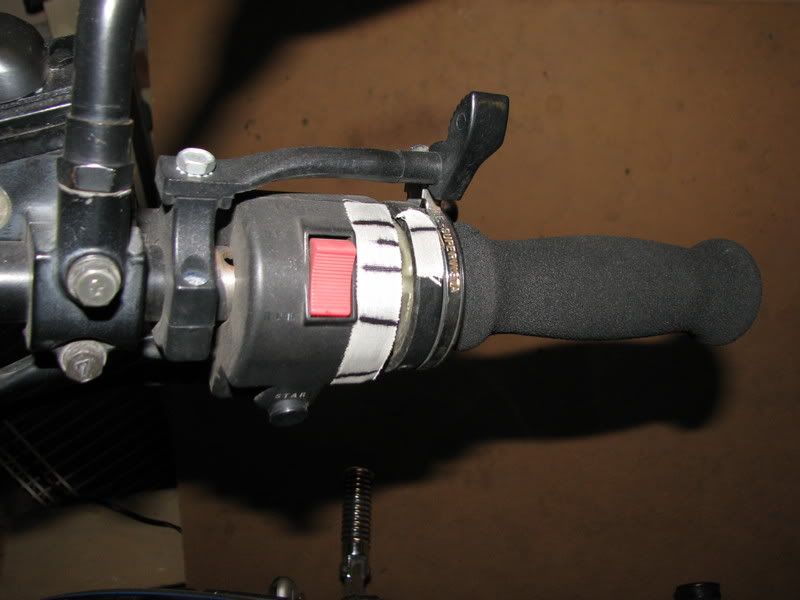
You might be surprised to learn how far you really have the throttle open. Try marking it like this, so you don't have to guess:
IMG_3646.jpg


Put a single mark on the throttle grip. With it at idle, put a corresponding mark on the tape on the housing. Hold the throttle completely open, put another mark to show FULL. Measure the space between the two marks, make additional marks for 1/2, 1/4 and 1/8. Now it is very easy to see just how far you have it open.

Regardless, your operating circumstances are showing a possible lean condition. In spited of your needles being lifted, due to no spacer, your fuel level being too low will cause that.


I could try some plug chop tests, but I don't really trust the results and juggling hot sparkplugs at the side of the road is not my idea of fun. Maybe a colortune plug might be a good thing to try.
With your twin, there shouldn't be any "juggling" necessary. Just pull the lead, use your socket to take out the plug, hold it up and read it. When you are done, use the socket to put it back. You never have to actually touch the plug and burn your fingers. It's much more fun getting #2 and #3 plugs in on a four cylinder bike. :p
My (limited) experience with a Colortun on CV carbs is mixed. I didn't really see any advantage, so borrow one before you buy one, if possible.


What the bike does not do well is run at 5500 to 6k rpm at small throttle openings which is exactly what is needed to cruise at 65 to 70mph on the freeway in 6th gear. One cylinder acts like it is cutting out and there is surging, similar to a gas starvation issue. Roll the throttle open and the problem disappears. Drop a gear or ride at speeds faster or slower to get away from the 5.5k to 6k rpm range and the problem disappears.
Again, it sounds lean. Re-check the fuel level. Might even be an issue with the diaphragm not lifting the needle enough. :-k


I have had people tell me that carbs running wrong at certain throttle openings is not related to rpm but to jetting, pilot screw settings etc. but I am here to say that my problem IS only happening between 5k and 6.5k rpm. Seems to be something with the airflow or vacuum created at that rpm range. I can ride the bike slowly, short-shifting at 4500-5k rpm and never get a stumble at any throttle opening. That level of performance doesn't beat traffic away from the lights though. I can ride the bike with a heavy throttle hand and rev up to 7k before shifting and I don't have a problem, but that seems to go against the easy going nature of this little twin.
You have to admit, though, that it takes a LOT more throttle to hold 5,000 rpm going up Cajon Pass than it does to hold 5,000 rpm sitting on the centerstand.
Same RPM, different carb circuits involved, that's why throttle opening is so important.


Would a small leak on the airbox side affect the mixture that much? Hard to believe if so. It's not like I put pod filters on.
That would depend on just where the leak is and how big it is. If it's the seal from the boots to the carbs, it's more of a disturbing turbulence to the incoming airstream, and that is what can affect the way the air is able to pick up fuel as it goes by the jets. Your new boots should fix that.


I am resistant to the idea of spending $90 for a Dyno jet kit just for their trick needles.
I would be, too, for a stock bike. You should be able to get by with shimming the needle and proper setting of the mixture screw.

By the way, what is the setting on your mixture screws? Stock was probably about 1 1/4 to 1 1/2, it will work much better somewhere between 2 and 3 turns out.


Hope some of this helps.
shrug2.gif


.
 
Just to add a bit more info regarding the mixture screw...

When I did my balancing by ear many years ago (highest RPM method I think it's called), I ended up with one carb 2 turns out and the other 2 1/4 turns out, so that gels well with your numbers Steve.
 
If the airbox fix doesn't fix the midrange than I'd either shim the needle (remove plastic spacer and then add a lesser heigth of washers). Rapidray also sells needles that are adjustable.
Midrange is basically the needle circuit. If it idles well and goes to redline fine than your pilot circuit (pilot jet and idle mixture screw adjustment) is fine as is your main jet.
Concentrate on the airbox and the needle circuit.
 
Along with the others, I'm not going to pretend to be a 450 tuner, either. In fact, I saw the "tuning 450 carbs" in the title and kept passing over it, but I think I have read all the other posts, so I am finally looking here..

Well you might have read it but you didn't weigh in on my thread, Steve :D. Sorry, didn't mean to thread-jack. As you were.
 
If the airbox fix doesn't fix the midrange than I'd either shim the needle (remove plastic spacer and then add a lesser heigth of washers). Rapidray also sells needles that are adjustable.
Midrange is basically the needle circuit. If it idles well and goes to redline fine than your pilot circuit (pilot jet and idle mixture screw adjustment) is fine as is your main jet.
Concentrate on the airbox and the needle circuit.

Sorry, slight distraction... I didn't know Ray sold adjustable needles so I will have to enquire for mine :D
 
Wow

Wow

Thanks for all the responses guys :) Didn't expect this much response to a GS450 question since most of you ride four-bangers. Yes, the needles do have one slot and clip, making them non-adjustable without adding washers/spacers equal to some fraction of the OE nylon spacer, which would lower the needle, leaning it out and bringing it back toward stock. I have nothing in there right now, wanting the bike to be a little on the fat side at closed to 1/2 throttle openings. My frustration was at very small throttle openings where the pilot circuit and main circuit are both working and in transition from one to the other. Trying to open and close the throttle at 5k to 6k rpm was giving me lots of stumbling and surging.

I am pretty embarrassed. I completely forgot to check the pilot screws, thinking they were still where I left them, at approx. 1.5 to 2 turns out. They were not. The left was at 2.5 and the right at 1 - Doh! No clue how they got that far off. After setting them both back to 1.5 the symptoms are not completely eliminated but the engine is much more responsive to small throttle openings and seems to be its normal self again, although not perfect.

I remember someone saying it took him a lot of fiddling to get his 450 running the way he liked it with decent fueling at all throttle openings and throughout the rev range. I was never after that much perfection so lived with it the way it is now. It's certainly ridable as is especially for a newb.

Thanks again for all the suggestions. Still going to work on the airbox and get it sealed and experiment with different pilot screw settings and some thin washers. On my VX800 the rear carb has the same nylon spacer leaning out the carb and I ended up taking a dremel to the spacer and grinding it down to about 60% of its original thickness which richened it up enough to change the pipe from blueish to goldish. No sense in running too fat.
 
correction

correction

Correction - I went with the float height specified in my factory service manual which was 22.4mm but I just remembered the number incorrectly. Thanks again guys :)
 
Thanks for all the responses guys :) Didn't expect this much response to a GS450 question since most of you ride four-bangers. Yes, the needles do have one slot and clip, making them non-adjustable without adding washers/spacers equal to some fraction of the OE nylon spacer, which would lower the needle, leaning it out and bringing it back toward stock. I have nothing in there right now, wanting the bike to be a little on the fat side at closed to 1/2 throttle openings. My frustration was at very small throttle openings where the pilot circuit and main circuit are both working and in transition from one to the other. Trying to open and close the throttle at 5k to 6k rpm was giving me lots of stumbling and surging.

I am pretty embarrassed. I completely forgot to check the pilot screws, thinking they were still where I left them, at approx. 1.5 to 2 turns out. They were not. The left was at 2.5 and the right at 1 - Doh! No clue how they got that far off. After setting them both back to 1.5 the symptoms are not completely eliminated but the engine is much more responsive to small throttle openings and seems to be its normal self again, although not perfect.

1.5 turns open is too lean for the pilot screws in my experience - that's why I recommended 3 turns in my other response. More open means more fuel so if the bike is lean, you need to open them more. Also, what about the carb sync? You can't fine tune the carbs until the basic maintenance is complete.
 
Last edited:
Hi,

After Ian gets his airbox boots and other bits needed to tighten up the intake system, I'll have him over and connect up my Carbtune. We'll tweak those carbs to life. ;)


Thank you for your indulgence,

BassCliff
 
Back
Top