• Required reading for all forum users!!!

    Welcome!
    Register to access the full functionality of the GSResources forum. Until you register and activate your account you will not have full forum access, nor will you be able to post or reply to messages.

    A note to new registrants...
    All new forum registrations must be activated via email before you have full access to the forum.

    A Special Note about Email accounts!
    DO NOT SIGN UP USING hotmail, outlook, gmx, sbcglobal, att, bellsouth or email.com. They delete our forum signup emails.

    A note to old forum members...
    I receive numerous requests from people who can no longer log in because their accounts were deleted. As mentioned in the forum FAQ, user accounts are deleted if you haven't logged in for the past 6 months. If you can't log in, then create a new forum account. If you don't get an error message, then check your email account for an activation message. If you get a message stating that the email address is already in use, then your account still exists so follow the instructions in the forum FAQ for resetting your password.

    Have you forgotten your password or have a new email address? Then read the forum FAQ for details on how to reset it.

    Any email requests for "can't log in anymore" problems or "lost my password" problems will be deleted. Read the forum FAQ and follow the instructions there - that's what we have one for...

  • Returning Visitors

    If you are a returning visitor who never received your confirmation email, then odds are your email provider is blockinig emails from our server. The only thing that can be done to get around this is you will have to try creating another forum account using an email address from another domain.

    If you are a returning visitor to the forum and can't log in using your old forum name and password but used to be able to then chances are your account is deleted. Purges of the databases are done regularly. You will have to create a new forum account and you should be all set.

  • For Your Information

    Go to http://www.thegsresources.com/yellowfrank.php for the latest project updates, pictures and info.

1981 GS850glx (BS32SS) Air screw/tuning help needed!

aflythe

Forum Newbie
Hello! I am new to the GSResources so I am very sorry if this question has been asked, I tried to look for info but I didn't find much. I have a 1981 GS850GL that has come a long way since I first got it last year to fix up. I've learned a lot on this bike, like re-wiring it with a moto gadget M-unit since the wiring was totally trashed. Now, I am in need of some help with tuning the bike, as you know I have the BS32SS carbs on this bike, but I did some modifications that would affect the tuning. I've over bored the engine 0.5mm using genuine Suzuki parts, I got lucky finding those, and I have a delkevic 4-1 exhaust now. My issue is that on deceleration, the bike crackles and pops, seems to have good power, and the pops don't bother me, but my worry was that I had it lean with the modifications I did. I do have the stock airbox. I have the air screws 3 turns out on each and it seemed to idle highest there, my question is, is that too far out and I need to go up a jet size or is that ok? Will the popping every go away? If it doesn't hurt the engine, then I'm happy with it. Yes, the carburetors are vacuum synced, and the valves should be in spec. Also, I know the idle jet on these carbs get their fuel through the main jet, so should I go up a main too? I haven't noticed any hesitation in any range of rpm, in fact, on a hard pull it will pick the front end up. I have a Gunson ColorTune and it seems to be good, but I can't see what it looks like under load going down the road. Any help would be much appreciated!
Thank you,
Andrew F!​
 
You can try one size larger on the mains, and lifting the needle a small amount. Don't mess with the pilot jets. Trialing different positions for the pilot screws is unlikely to have much effect, but you will know for sure if you try. 3.5 turns open is max rich, going down to about 2 turns open. Experiment, but one thing at a time.

BTW, check the carb rebuild tutorial in my signature to see how to lift the needle (hint: it doesn't include washers under the clip)
 
OK! Thank you! I will order some main jets, I suppose one size bigger so 117.5? also, where do you buy mikuni jets? I've seen some but not sure if they were quality. Also, I used your rebuild tutorial when doing mine so thanks! For lifting the needle or sanding down the spacer, how much should i take off at a time? .1mm you think?
 
Last edited:
When you installed the Delkevic system did you use the red high-temp goo? If not, or not enough, the Delko system will crackle and pop like a bowl of Rice Krispies.
If you need more red high-temp goo, some stove high-temp red silicone will do the job.

Personally, I like the popping.
 
No, I did not, I had never even heard of that. Do you mean to seal the exhaust port? they gave me copper crush washer; I figured that was good enough. If the popping is just the exhasut then I am perfectly fine with that. Using the ColorTune it seemed to be tuned pretty well.
 
No, I did not, I had never even heard of that. Do you mean to seal the exhaust port? they gave me copper crush washer; I figured that was good enough. If the popping is just the exhasut then I am perfectly fine with that. Using the ColorTune it seemed to be tuned pretty well.

The high-temp goo goes into the downpipes / collector / muffter joints. if theyr'e unsealed, air gets in and causes partial combustion of unwholly burned exhaust gases.
 
The high-temp goo goes into the downpipes / collector / muffter joints. if theyr'e unsealed, air gets in and causes partial combustion of unwholly burned exhaust gases.

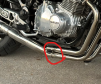
You mean here?
image.png

Mine pops like crazy as well. And I did not add any red goop. That wasn't included in the instructions. :/​
 
FWIW, mine has larger mains, and it still pops like crazy. Could be related to the issue listed above that I never knew about.

For a while I was trying to tune it out using the pilot jets. The only way I could get it to stop was to turn them WAY out. But then it would run so rich it would foul the plugs out super quick. Once I dialed the pilots back to a reasonable setting, the decel pop came back, but the plugs are always perfect now. I'm def going to try the red goop!
 
Hm ok, i have the screws all at 3 turns out from lightly seated, the plugs are white on top but black everywhere else. so its running rich and lean? I've already ordered 1 size up for both the idle and mains, ill try mains first and see what happens. The gunson colortune still makes it look like it runs fine, weird. I will put in bigger mains and see what happens with the plugs. Im gonna feel like an idiot, but screwing the screws OUT (counter-clockwise) means MORE fuel right? Cause now that i think about it, the screw being on the top and engine side of the carbs means its an air screw doesn't it. I've done this wrong the whole time if that's the case. :(
https://youtube.com/shorts/F1OQOD3qR1Y?feature=share hopefully that link works, I uploaded a video of what the colortune looks like on my bike.
 
Last edited:
Hi There, I've used the colortune, and had good results (setting up air screws on VMs)... and not so good results... I think the colour variation is too blunt a tool for fine tuning BS fuel screws.

The most accurate way is to fit an AFR (lambda) sensor and an ARF gauge... Or go old fashioned.

I have got my BS34 (Katana 750) running sweet on a engine running a 4 into one, a large foam pod in place of the rear airbox, squish clearance closed up to 0.75mm (0.030") port/inlet bowl/short side radius clean-up and slightly higher compression ratio, multi-angle valve seat recut. I did this the old school way and here's what I've learned.

If you need to re-jet it's because whatever you have changed has caused more (or less) air to flow through your engine compared to stock at particular throttle opening/rpm. Re-jetting is adding more (or less) fuel to that changed air volume to obtain the correct AFR. I know that seems self-evident, but it's surprising how many folks think 'more gas = more power', when it's actually 'more air = more power (when the AFR is correct)'.

Tune the carbs on your particular bike from the evidence you see/feel. Especially if you have made any changes. If someone gives you advice like 'go up 2 jet sizes and 3 turns out' and doesn't know your bike, take it with a grain of salt.

Most common mods have minimal effect on the idle/slow circuit. Pods and pipes can effect mid-throttle jetting and pod-induced leanness is best corrected using an air correction kit. Trying to compensate for pods with bigger pilots sacrifices idle and off-idle performance and is a poor way of getting acceptable mid throttle performance and makes mid-corner roll on from a closed throttle shitty experience.


Best way I have found to set the fuel mixture is to set all screws at the same number of turns out (whatever the manual says for your bike). If there isn't a spec, start at 1? turns out. With the engine fully warmed up 'flick/blip' the throttle grip letting the throttle slam shut under it's return springs. Do it so it revs pick to about 3000 rpm. If the revs hang or drop slowly after you've released the throttle grip, the fuel screws are lean. Turn all the screws out ⅛ turn and repeat the blip test and turn out until the revs drop quickly back to idle. If you blip and revs drop quickly but drop below the initial idle rpm before coming back to the set idle (undershoots) or stalls you're rich and the screws need to be turned in. Again ⅛ turn and repeat until the revs pick up and drop swiftly to a steady idle.

Main jet tuning by road testing can be difficult, because you need to be WFO, close to redline and under load for long enough to do plug chops. License threatening stuff. Also having plugs fresh enough to give accurate readings is necessary.

Forget the old plug reading photo montages from the 1970s, a lot of them were for two-strokes and modern unleaded fuels don't leave the same deposits. The correct main jet mixture will give a white insulator with a carbon ring close to where the porcelain joins the metal body of the plug, which requires either cutting away the metal or an appropriate magnifier to observe.

Another thing that I learned during the tuning process was 'roll off tuning' for the main jet. I got plug chop color which looked good for the main jet selection and was happy enough with the performance on the odd occasion I gave it full throttle at speed. But what I did notice was a momentary but very noticable surge of power when I rolled off the throttle from WFO. The bike went faster for a second (like a turbo kicked in) when the throttle was being closed. A little research and the explanation was that the main jet was too lean.

When you roll off the throttle from WFO, the volume of air passing through the carb is reduced immediately, but the flow of fuel which is denser and has momentum due to its speed though the main jet reacts slower to the change than the air. This causes a momentary enrichment of the mixture. Which if the main jet is too small results in a mixture closer to correct with a resulting increase in torque. I went up 1 size and then another in response to the feedback from the engine in this situation.

With the changes I made to my engine, the nett result was bigger main jets which made sense as all the mods made were made to improve high rpm air flow. Apart from the squish and compression which is about increasing combustion turbulence and speeding up the burn.
 
Last edited:
Hm ok, i have the screws all at 3 turns out from lightly seated, the plugs are white on top but black everywhere else. so its running rich and lean? I've already ordered 1 size up for both the idle and mains, ill try mains first and see what happens. The gunson colortune still makes it look like it runs fine, weird. I will put in bigger mains and see what happens with the plugs. Im gonna feel like an idiot, but screwing the screws OUT (counter-clockwise) means MORE fuel right? Cause now that i think about it, the screw being on the top and engine side of the carbs means its an air screw doesn't it. I've done this wrong the whole time if that's the case. :(
https://youtube.com/shorts/F1OQOD3qR1Y?feature=share hopefully that link works, I uploaded a video of what the colortune looks like on my bike.

When the carbs are on the bike, clockwise is less fuel, counterclockwise is more fuel. Black around with white in the center on the plugs is ok. Depends on how white. If they're kind of grey or brown that's perfect. You just dont want them to be all black, or have a stark white electrode. Reading plugs is not an exact science. If I have some time later, I can send you a pic of what mine look like currently.

I had mixed results with the color tune. As someone mentioned below, it just doesn't have enough detail to really dial the carbs in the way you need to. 1/2 - 1/4 turn can make a big performance difference but no visible difference on the colortune.

Per Delkevik, the delkevic 4 into 1 is not supposed to require any carb re-jetting. If you do add one size up on the mains and pilots, like I have, you'll probably just settle on slightly fewer turns on the pilot screw. I'm at 2 turns out now. The stock configuration is 2.5 turns out. I found the "highest lean idle method" worked best for me to find the right mixture.

Lastly, from everything I read, decel pop is normal and doesn't hurt anything. It's just a matter of preference. Some love it, some dont. The engine is likely not running lean based on what you're describing. If it's popping at times other than decel then I'd say there's a tuning issue.

I just learned to live with it since the bike runs great. But I will def try the red goop trick and see if that gets rid of it.
 
I had mixed results with the color tune.

The Colortune was designed for stock carbs with stock jetting, so that when you set the idle mix, it's assumed the jetting further up will be correct.
That all goes out of the window when anything is changed, of course.
It's an imprecise method, but good enough for cooking engines in wheezy old cars of the 60s and 70s, which weren't putting out 100bhp per litre or anything like it.
However, once a jetting setting is settled upon, the Colortune can come back into play, if nothing is fundamentally altered after the main jetting process.
 
The timing of this post is uncanny. I said my delkevik exhaust pops allot. I don't remember if it's always been like that or for how long exactly. But this morning, I noticed a rattle when I started it up. I didn't think much of it as the bike makes occasional weird sounds. By the time I got where I was going it was gone. About 2 hrs later, I started it up and the rattle was louder this time. After some hunting, turns out my #3 exhaust flange was loose. Who knows how long it's been loose. I guess it finally got loose enough for me to hear it rattle.

I got home, re-tightend the bolts, with a little loc-tite added for good measure, and took it out for a test ride. Wouldn't you know ALL OF THE POPPING WAS GONE! The only thing it does now is make pleasant gurgling sounds on decel. Coincidentally over the last few days, I noticed the popping was getting more pronounced, then it started popping in between gears, which I thought was weird. Then I happened to comment on this post and learned about how the header connections can suck air and cause popping.

Apparently, not only can it suck air from the header to muffler connection, but also from the exhaust flanges. Check your exhaust flanges!
 
The timing of this post is uncanny. I said my delkevik exhaust pops allot. I don't remember if it's always been like that or for how long exactly. But this morning, I noticed a rattle when I started it up. I didn't think much of it as the bike makes occasional weird sounds. By the time I got where I was going it was gone. About 2 hrs later, I started it up and the rattle was louder this time. After some hunting, turns out my #3 exhaust flange was loose. Who knows how long it's been loose. I guess it finally got loose enough for me to hear it rattle.

I got home, re-tightend the bolts, with a little loc-tite added for good measure, and took it out for a test ride. Wouldn't you know ALL OF THE POPPING WAS GONE! The only thing it does now is make pleasant gurgling sounds on decel. Coincidentally over the last few days, I noticed the popping was getting more pronounced, then it started popping in between gears, which I thought was weird. Then I happened to comment on this post and learned about how the header connections can suck air and cause popping.

Apparently, not only can it suck air from the header to muffler connection, but also from the exhaust flanges. Check your exhaust flanges!

Yep, that too.
An exhaust leak at the flange can sound like mechanical mayhem is about to explode in the engine, too. Caused quite a few head-scratchings over the years.
 
Hi There, I've used the colortune, and had good results (setting up air screws on VMs)... and not so good results... I think the colour variation is too blunt a tool for fine tuning BS fuel screws.

The most accurate way is to fit an AFR (lambda) sensor and an ARF gauge... Or go old fashioned.

I have got my BS34 (Katana 750) running sweet on a engine running a 4 into one, a large foam pod in place of the rear airbox, squish clearance closed up to 0.75mm (0.030") port/inlet bowl/short side radius clean-up and slightly higher compression ratio, multi-angle valve seat recut. I did this the old school way and here's what I've learned.

If you need to re-jet it's because whatever you have changed has caused more (or less) air to flow through your engine compared to stock at particular throttle opening/rpm. Re-jetting is adding more (or less) fuel to that changed air volume to obtain the correct AFR. I know that seems self-evident, but it's surprising how many folks think 'more gas = more power', when it's actually 'more air = more power (when the AFR is correct)'.

Tune the carbs on your particular bike from the evidence you see/feel. Especially if you have made any changes. If someone gives you advice like 'go up 2 jet sizes and 3 turns out' and doesn't know your bike, take it with a grain of salt.

Most common mods have minimal effect on the idle/slow circuit. Pods and pipes can effect mid-throttle jetting and pod-induced leanness is best corrected using an air correction kit. Trying to compensate for pods with bigger pilots sacrifices idle and off-idle performance and is a poor way of getting acceptable mid throttle performance and makes mid-corner roll on from a closed throttle *@%^$*@%^$*@%^$*@%^$ty experience.


Best way I have found to set the fuel mixture is to set all screws at the same number of turns out (whatever the manual says for your bike). If there isn't a spec, start at 1? turns out. With the engine fully warmed up 'flick/blip' the throttle grip letting the throttle slam shut under it's return springs. Do it so it revs pick to about 3000 rpm. If the revs hang or drop slowly after you've released the throttle grip, the fuel screws are lean. Turn all the screws out ⅛ turn and repeat the blip test and turn out until the revs drop quickly back to idle. If you blip and revs drop quickly but drop below the initial idle rpm before coming back to the set idle (undershoots) or stalls you're rich and the screws need to be turned in. Again ⅛ turn and repeat until the revs pick up and drop swiftly to a steady idle.

Main jet tuning by road testing can be difficult, because you need to be WFO, close to redline and under load for long enough to do plug chops. License threatening stuff. Also having plugs fresh enough to give accurate readings is necessary.

Forget the old plug reading photo montages from the 1970s, a lot of them were for two-strokes and modern unleaded fuels don't leave the same deposits. The correct main jet mixture will give a white insulator with a carbon ring close to where the porcelain joins the metal body of the plug, which requires either cutting away the metal or an appropriate magnifier to observe.

Another thing that I learned during the tuning process was 'roll off tuning' for the main jet. I got plug chop color which looked good for the main jet selection and was happy enough with the performance on the odd occasion I gave it full throttle at speed. But what I did notice was a momentary but very noticable surge of power when I rolled off the throttle from WFO. The bike went faster for a second (like a turbo kicked in) when the throttle was being closed. A little research and the explanation was that the main jet was too lean.

When you roll off the throttle from WFO, the volume of air passing through the carb is reduced immediately, but the flow of fuel which is denser and has momentum due to its speed though the main jet reacts slower to the change than the air. This causes a momentary enrichment of the mixture. Which if the main jet is too small results in a mixture closer to correct with a resulting increase in torque. I went up 1 size and then another in response to the feedback from the engine in this situation.

With the changes I made to my engine, the nett result was bigger main jets which made sense as all the mods made were made to improve high rpm air flow. Apart from the squish and compression which is about increasing combustion turbulence and speeding up the burn.

Ah thank you! Funny enough I ordered a AFR kit, now i know you are supposed to weld bungs or use a sniffer, and i dont want to drill into my headers, so what can i make a sniffer out of? i do not think my exhaust is air tight after the headers at the collection pipe. I will definitley be check exhaust sealing at the head just to make sure i get an accurate reading on AFR. Also, I've heard mix opinions on whether i can get an AFR reading at the collection pipe or if i need to get a sniffer or bung into each individual header. To me, getting an individual reading on each cylinder makes more sense than at the collection pipe. Thank all of you for the help! Also manual says to torqued exhaust bolts to 10 foot pounds. Does that sound right? i figured I would need to tighten them a little more, normally i would go off of how tight it felt but after extracting 2 broken off exhaust bolts from previous owners i get the torque wrench out. Also in case you didn't see it, the bike has been overbored by .5mm so i've ordered one size up for both the mains and the pilots so 117.5 and 42.5 mikuni jets. I've heard that I should start with the main jet and work down but I've also heard I should start with the pilot jet and work up. I was thinking since the idle jet on these bikes get fuel from the main jet then I should start with a bigger main and see what happens, or should i just go ahead and throw them in at the same time.
 
Last edited:
When the carbs are on the bike, clockwise is less fuel, counterclockwise is more fuel. Black around with white in the center on the plugs is ok. Depends on how white. If they're kind of grey or brown that's perfect. You just dont want them to be all black, or have a stark white electrode. Reading plugs is not an exact science. If I have some time later, I can send you a pic of what mine look like currently.

I had mixed results with the color tune. As someone mentioned below, it just doesn't have enough detail to really dial the carbs in the way you need to. 1/2 - 1/4 turn can make a big performance difference but no visible difference on the colortune.

Per Delkevik, the delkevic 4 into 1 is not supposed to require any carb re-jetting. If you do add one size up on the mains and pilots, like I have, you'll probably just settle on slightly fewer turns on the pilot screw. I'm at 2 turns out now. The stock configuration is 2.5 turns out. I found the "highest lean idle method" worked best for me to find the right mixture.

Lastly, from everything I read, decel pop is normal and doesn't hurt anything. It's just a matter of preference. Some love it, some dont. The engine is likely not running lean based on what you're describing. If it's popping at times other than decel then I'd say there's a tuning issue.

I just learned to live with it since the bike runs great. But I will def try the red goop trick and see if that gets rid of it.

yes i wouldn't think the exhasut alone would mean new jets, but I had the engine overbored by .5mm so that will change some things. on my very cheap harbor freight compression tester i got 120 on a "new" engine however all the cylinders were very close to one another so that is what was more important to me, i dont trust the HF tool that much.
 
...Also, I've heard mix opinions on whether i can get an AFR reading at the collection pipe or if i need to get a sniffer or bung into each individual header. To me, getting an individual reading on each cylinder makes more sense than at the collection pipe. ...Also in case you didn't see it, the bike has been over-bored by .5mm so i've ordered one size up for both the mains and the pilots so 117.5 and 42.5 mikuni jets. I've heard that I should start with the main jet and work down but I've also heard I should start with the pilot jet and work up. I was thinking since the idle jet on these bikes get fuel from the main jet then I should start with a bigger main and see what happens, or should i just go ahead and throw them in at the same time.

As the cylinders are fueled by carbs with identical Fast/Main Circuits (mains/needle jet/needle clip/main air jet) fuel delivery to each cylinder should be identical, so having four sniffers across the headers is redundant. A lambda per cylinder is only required when fueling is EFI (closed-loop) with individually controlled injectors (and coils) varying mixture (and ignition timing) on the fly. So a single 'sniffer' just down stream from the collector will do just fine.

As for the Slow/Pilot circuit (Pilot jet/Pilot air jet/Fuel screw) the circuit takes air via the pilot air jet located in the bell mouth. This air is feed to the pilot jet where the air enters via the holes on the side of the pilot jet, mixing with the fuel that is drawn through the slotted end of the jet. The mixture of air and fuel (referred to as an "emulsion")* is fed to the single pilot and multiple (2 or 3) by-pass orifices located on the top of the BS carb bore, where the closed butterfly makes contact with the bore when the throttle is closed. The pilot screw, mixture screw, or fuel screw (take your pick of names) adjusts the fuel flow though the pilot orifice ONLY, which the one closest to the inlet valve and is always under engine vacuum when the engine is idling. When the throttle is cracked off idle the 'non adjustable' by-pass orifices are exposed and progressively flow pilot mixture in addition to the 'adjustable' pilot orifice.

The point to be made is that the pilot mixture overall is set be the Pilot Air Jet and the Pilot fuel jet, the fuel screw position important at idle and up to about 1/8th throttle. It is the main source of fuel at idle where it is feeding its mixture into the small volume of air passing past the butterfly. But as you open the throttle the by-passes flow more fuel than the fuel screw controlled pilot outlet and as you add more throttle, the needle jet takes over as the prevalent fuel supply. The pilot circuit doesn't stop fueling, it just becomes a tiny percentage of the total fuel flow.

There are lots of methods for setting the pilot mixture, I've tried them all. Find the one that gives you the results you are looking for. For me its the blip tuning. The key is to set a base-line (lightly seated) and adjust each fuel screw identically. If using the AFR, this is straight forward. But at the end of the day its the rideability though good carburation that is important.

Yes you are correct that the pilot jet in the BS32/34 draws its fuel through the main jet. But given the flow rates at idle, a couple of size changes on the main will have negligible effect, and if it does, you adjust. That's carb tuning, baby.

The golden rule is to make one change at a time and evaluate. Don't think that you have to start carb tuning by swapping jets to what you IMAGINE your engine might need. I'd test with the stock jetting first as a baseline and if your testing shows there are performance/response issues, correct these. If you start by changing stuff, your changes might be introducing problems that don't exist. Remember jetting is adding or removing enough fuel to achieve the correct AFR under various conditions. If the AFR is in fact good already your preemptive tuning may very well be taking it out of tune.

With the 0.5mm over-bore, it may not make much of a difference carburation wise. The first generation GS750 and GS1000 (and some of the 16-valve versions) would often have the same bore carbs; VM26 (BS34). The larger displacement engine would run SMALLER main jets that the 750. Which seems counter-intuitive. But the fuel flow through main jet is not only determined by the size of the hole in the jet, but also by the pressure difference between the float bowl and the vacuum being generated at the venturi. Think of a garden hose with a nozzle on the end, if you turn up the pressure at the faucet, the water flow increases although the nozzle is the same size. Higher air flow from the larger engine, creates a higher vacuum in the carb venturi. So main jet size to capacity isn't a direct relationship.

*The pilot jet is miniature version of the needle jet/emulsion tube which mixes air from the main air jet. The 'emulsion' is a fuel/air froth which is more easily stripped off the jet orifice and into the air flow through the carb bore, easily atomizing into a mist that burns faster and cleaner when lit.
 
Last edited:
As the cylinders are fueled by carbs with Fast/Main Circuit (mains/needle jet/needle clip/main air jet) is or should be identical for all four carbs, having four sniffers across the headers is redundant. A lambda per cylinder is only required when fueling is EFI (closed-loop) with individually controlled injectors (and coils) varying mixture (and ignition timing) on the fly. So a single 'sniffer' just down stream from the collector will do just fine.

As for the Slow/Pilot circuit (Pilot jet/Pilot air jet/Fuel screw) the circuit takes air via the pilot air jet located in the bell mouth. This air is feed to the pilot jet where the air enters via the holes on the side of the pilot jet, mixing with the fuel that is drawn through the slotted end of the jet. The mixture of air and fuel (referred to as an "emulsion")* is fed to the single pilot and multiple (2 or 3) by-pass orifices located on the top of the BS carb bore, where the closed butterfly makes contact with the bore when the throttle is closed. The pilot screw, mixture screw, or fuel screw (take your pick of names) adjusts the fuel flow though the pilot orifice ONLY, which the one closest to the inlet valve and is always under engine vacuum when the engine is idling. When the throttle is cracked off idle the 'non adjustable' by-pass orifices are exposed and progressively flow pilot mixture in addition to the 'adjustable' pilot orifice.

The point to be made is that the pilot mixture overall is set be the Pilot Air Jet and the Pilot fuel jet, the fuel screw position important at idle and up to about 1/8th throttle. It is the main source of fuel at idle where it is feeding its mixture into the small volume of air passing past the butterfly. But as you open the throttle the by-passes flow more fuel than the fuel screw controlled pilot outlet and as you add more throttle, the needle jet takes over as the prevalent fuel supply. The pilot circuit doesn't stop fueling, it just becomes a tiny percentage of the total fuel flow.

There are lots of methods for setting the pilot mixture, I've tried them all. Find the one that gives you the results you are looking for. For me its the blip tuning. The key is to set a base-line (lightly seated) and adjust each fuel screw identically. If using the AFR, this is straight forward. But at the end of the day its the rideability though good carburation that is important.

Yes you are correct that the pilot jet in the BS32/34 draws its fuel through the main jet. But given the flow rates at idle, a couple of size changes on the main will have negligible effect, and if it does, you adjust. That's carb tuning, baby.

The golden rule is to make one change at a time and evaluate. Don't think that you have to start carb tuning by swapping jets to what you IMAGINE your engine might need. I'd test with the stock jetting first as a baseline and if your testing shows there are performance/response issues, correct these. If you start by changing stuff, your changes might be introducing problems that don't exist. Remember jetting is adding or removing enough fuel to achieve the correct AFR under various conditions. If the AFR is in fact good already your preemptive tuning may very well be taking it out of tune.

With the 0.5mm over-bore, it may not make much of a difference carburation wise. The first generation GS750 and GS1000 (and some of the 16-valve versions) would often have the same bore carbs; VM26 (BS34). The larger displacement engine would run SMALLER main jets that the 750. Which seems counter-intuitive. But the fuel flow through main jet is not only determined by the size of the hole in the jet, but also by the pressure difference between the float bowl and the vacuum being generated at the venturi. Think of a garden hose with a nozzle on the end, if you turn up the pressure at the faucet, the water flow increases although the nozzle is the same size. Higher air flow from the larger engine, creates a higher vacuum in the carb venturi. So main jet size to capacity isn't a direct relationship.

*The pilot jet is miniature version of the needle jet/emulsion tube which mixes air from the main air jet. The 'emulsion' is a fuel/air froth which is more easily stripped off the jet orifice and into the air flow through the carb bore, easily atomizing into a mist that burns faster and cleaner when lit.

Thank you so much, this is the best someone has explained carb tuning/jetting to me. I'll do an afr reading before jet changes and after and then see what happens, however, if I have an AFR of let's say 15, its lean, so that does mean I need a bigger jet correct? or does that whole thing about a smaller jet come into play and maybe I need to go smaller? I supposed it's like filling a cup with water a drinking it through a normal straw versus a paper towel roll. That makes sense.
 
Thank you so much, this is the best someone has explained carb tuning/jetting to me. I'll do an afr reading before jet changes and after and then see what happens, however, if I have an AFR of let's say 15, its lean, so that does mean I need a bigger jet correct? or does that whole thing about a smaller jet come into play and maybe I need to go smaller? I supposed it's like filling a cup with water a drinking it through a normal straw versus a paper towel roll. That makes sense.

Yeah, you're on to it. More fuel if its lean, less fuel if its rich. Let the AFR reading be your guide. The whole smaller main jet thing is about significant displacement differences (like 25% more capacity) drawing air thought the same carb diameter. You won't be comparing the needs of two unrelated engines, so all changes you make are relative to your stock jetting.

Just be aware that the AFR will vary with different modes of operation, i.e. steady-state vs. snapping open the throttle, vs rolling on the throttle, vs rolling off, vs. WFO, etc. This is because there is a significant difference between air density and fuel density. This difference means each air and fuel react at a different speed to changes in signal (effectively changes in vacuum). This phenomena is illustrated by the use of accelerator pumps to over come leanness when the throttle is snapped open. These carbs (Keihin carbs fitted to mid-80s Hondas for example) were jetted lean for emissions so the throttle change exacerbates the lean air-fuel ratio, and the pump gives a squirt of fuel to compensate. The AFR gauge is useful for telling you what is happening to the mixture at any given throttle position/movement, rpm and load.

Also keep in your mind that the 'best' AFR is a range of numbers (approx 12.5 - 14.7) so its not about slavishly tuning to achieve a specific number, rather to tune for rideability -which I'd define as Power and Responsiveness- which is going to be found in that range. With the main you want to be a bit on the rich side for a couple of reasons, including rich makes more power, and it gives head room for changes in ambient temperature. The ARF gauge gives you really-time data on which to plan you changes. Re-jet and re-test. Is it better? What are the numbers now? Are they in the range? If your in this range mixture is 'correct', but it's your butt that will tell you if its better. A well tuned bike will seem to accelerate without effort, and the throttle feels directly connected to changes in torque delivered at the rear wheel.

Also be open to the possibility that no jetting changes are needed. That is not a bad thing.
 
Last edited:
Back
Top