• Required reading for all forum users!!!

    Welcome!
    Register to access the full functionality of the GSResources forum. Until you register and activate your account you will not have full forum access, nor will you be able to post or reply to messages.

    A note to new registrants...
    All new forum registrations must be activated via email before you have full access to the forum.

    A Special Note about Email accounts!
    DO NOT SIGN UP USING hotmail, outlook, gmx, sbcglobal, att, bellsouth or email.com. They delete our forum signup emails.

    A note to old forum members...
    I receive numerous requests from people who can no longer log in because their accounts were deleted. As mentioned in the forum FAQ, user accounts are deleted if you haven't logged in for the past 6 months. If you can't log in, then create a new forum account. If you don't get an error message, then check your email account for an activation message. If you get a message stating that the email address is already in use, then your account still exists so follow the instructions in the forum FAQ for resetting your password.

    Have you forgotten your password or have a new email address? Then read the forum FAQ for details on how to reset it.

    Any email requests for "can't log in anymore" problems or "lost my password" problems will be deleted. Read the forum FAQ and follow the instructions there - that's what we have one for...

  • Returning Visitors

    If you are a returning visitor who never received your confirmation email, then odds are your email provider is blockinig emails from our server. The only thing that can be done to get around this is you will have to try creating another forum account using an email address from another domain.

    If you are a returning visitor to the forum and can't log in using your old forum name and password but used to be able to then chances are your account is deleted. Purges of the databases are done regularly. You will have to create a new forum account and you should be all set.

  • In order to help others find info on a particular bike, be sure to put the year, make or model of bike that you are asking a question about, in the Topic Title. This will allow people to pass by posts they have no interest in.

1981 Kawasaki GPz550: Restoration

My first encounter with a GPz 550 came in the summer of 1981 on route 17 between Monticello and Binghamton, NY. I was on my '73 Z1 with a 4-into-1 pipe, on my way to Rochester, with a small knapsack on the rear of the seat.

Beautiful scenery, cruising at 80 to 85 mph when something red catches up to me - a GPz. He was intent on overtaking me, but I rode with him for a ways at about 110 mph, until the curves and the rain grooves got the better of me. But not him - he was a lot more sure-footed than me on the curves.

I had read about the suspension of the GPz550, so I didn't take it personal, and continued on my way at a 'leisurely' 80 mph.
 
After checking rings gaps, opening up one set of rings to match Wiesco ring end gap, I am now ready to install the cylinder block but lacking the extra set of hands to compress the rings. Any innovative method to install the cylinder by one self?

Q: Do you think the base gasket requires RTV, if so blue or black
 
Get yourself four nice hose clamps and compress the rings with them. Set the tightness of the hose clamps so that they slide down when you place the cylinder down on them. You want just enough tension to get the rings into the bore. You can do 2 and 3 first then do 1 and 4.

I would NOT use RTV near any Kawasaki gasket. Something like the brush on K&W Coppercoat, or Gasgacinch would be the only thing I would ever use on the base gasket. Make sure you use NEW o-rings around the oil nozzle in the base gasket too!!!

Take your time and don't get frustrated if you have to start over a few times trying to get the rings into the bore.
 
Last edited:
Threebond 1207B, which is one of the most common case sealers, is silicone. I don't think there is anything inherently wrong with the stuff, you just need to follow the directions and use it sparingly.

The service manual for the KZ750 calls for sealer on certain locations of certain gaskets. You might want to check your manual Steve and see what's specified. I looked though the 550 manual but couldn't find similar reference to that from the 750 manual. The guys at KZrider.com get all gooshy in favor of copper coat on the head gasket. I know the 750's are prone to leaking from the head so I'm leaning toward the copper coat myself.
 
Threebond 1104 which is now 1184 is the case sealant that is the same as the gray Yamabond. 1104/1184 is semi drying synthetic rubber, not silicone. That is the only case sealant I have used since back in 1971. I never had a case half weep, or leak with that stuff. Even where someone used big screwdrivers to pry the cases apart. I never used it on any gaskets except like you said on the KZ650/4 and KZ750/4 clutch gasket where the case halfs meet. Every Suzuki and Kawasaki motor I took apart had that grey colored case sealant on it, so thats why I still use it. Never tried the 1207B myself.

The Threebond 1211 the white silicone is great around o-rings in base and head gasket oil o*rings that always leak on Kawasaki fours. I use a thin coat of it on my GS1000 and KZ1000 cam plugs. Only had one cam plug leak using that since back as far as I can remember.
 
Every Suzuki and Kawasaki motor I took apart had that grey colored case sealant on it, so thats why I still use it. Never tried the 1207B myself.

Well, I spent at least two hours cleaning my KZ750 cases on Saturday and there was black silicone between the halves. Pretty sure it was 1207B.
 
Get yourself four nice hose clamps and compress the rings with them. Set the tightness of the hose clamps so that they slide down when you place the cylinder down on them. You want just enough tension to get the rings into the bore. You can do 2 and 3 first then do 1 and 4.

I would NOT use RTV near any Kawasaki gasket. Something like the brush on K&W Coppercoat, or Gasgacinch would be the only thing I would ever use on the base gasket. Make sure you use NEW o-rings around the oil nozzle in the base gasket too!!!

Take your time and don't get frustrated if you have to start over a few times trying to get the rings into the bore.

Trying to visualize how the hose clamp method works in my mind eye. Every hose clamp I have lying around has the same design were that screw mechanism on the outside of the clamp is actually wider (or higher) than the hose clamp band which would compress the rings. I would visualize when you lower the cylinder liner down over the piston, the liner will contact the screw mechanism first because its higher up than hose clamp band . . . When you pull the hose clamp down just a smidge I think you would lose the compression on the top compression rings which is just 1mm thick.

I am just trying to understand because tonight I failed quickly when trying to install the cylinder using the finger tip method with the help of a friend from work. We were able to get the top compression ring to go on #2-3 but the ring gap was almost closed. We resorted to small screwdrivers but he lacked a deft touch so I thanked him for his help and decided to try again later.

Feel free to clarify . . . I stopped by the local auto parts store & their Chinese hose clamps were the same design too
 
I used hose clamps that came from Wurth Products. Their screw mechanism is a lot closer to the band than most hose clamps. I bought those hose clamps many many years ago when I put my KZ750/4 together.

Just hope who ever bored your cylinder put a nice chamfer back on the bottom of your sleeves. If not I don't think you will get the pistons and rings into your cylinder.

Try using popsicle sticks to push the rings into the cylinder. If you slip, they won't scratch the piston.
 
Yesterday I used the hose clamp method but added a stainless steel sleeve from the Depot's plumbing section. I drilled out some rivets then used the dremmel to get the S/S band width slightly larger than all the rings. Used 5 heavy duty cut off wheels to cut two S/S bands. I found the idea here probably should have used the plumbers tape http://drriders.com/topic6882.html Once the clamps were positioned correctly just tapped the cylinder right on


Last week Chris (cdnoel) brought over his ring grinder to open up the piston ring gap #4 from .008 to .011.. Piston ring gap is now (1-4) .011, .011, .013, .011. We were surprised by how much movement the wheel had back n forth


Don't recall ever seeing an oil ring like this . . . I guess it prevents the ends from overlapping

 
Last edited:
Weekend Update photos: DIY rings compressors made this a one man job


Used the hose clamps for #1-4, top ring popped out but since it was constrained a quick push with a tap on top took care of it.


Never measured the deck height but its close


Crazy home made carb adapters, holes look like they were drilled by hand. Will have to remedy someday


I filed the cylinder fins to match its GPz heritage


Cam Timing marks are in perfect alignment w/o the tensioner installed. Next check valve lash & degree cams & fix another helicoil

 
Since I never had the cam card/data sheet & installation instruction etc. I am struggling with where to set the C/L angles.Both cams have 8.25mm of lift ( Measure across lobe - Base Circle ).
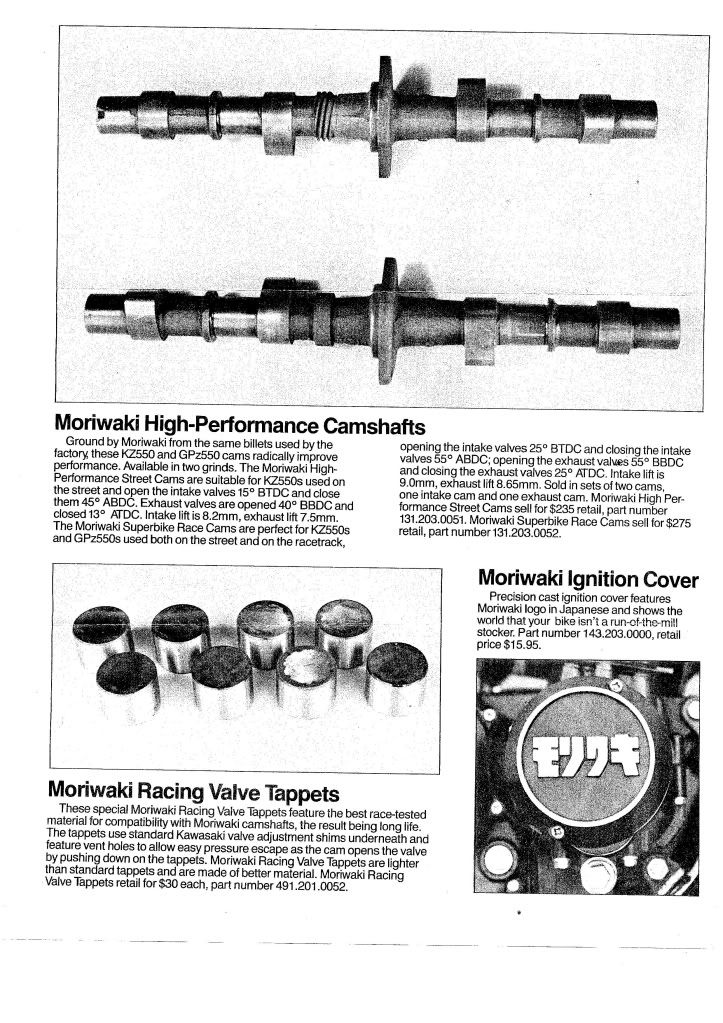
Dale's Moriwaki Ad
gpz5503.jpg


gave specs for both KZ550/GPz550 Street & Race Cams. No idea what year it was published etc. & not the specs for the cams that are installed in my GPz550.

For the street cams the ad states, the Intake opens 15 BTDC & closes 45 ABDC. Exhaust valves are opened 40BBDC & closed 13 ATDC. The intake lift is 8.2mm (close to mine 8.25 Actual) while the exhaust lift is 7.5mm (much less).

The race cams are more aggressive . . . feel free to review the Pdf

I am thinking the logical step is to use the Street Intake Open & Close figures of Open 15 BTDC & close 45 ABDC because the 8.2mm intake lift is closest to the actual lift of 8.25mm.

Makes sense right?
 
Last edited:
Week End Update for 9/28: Dialing in the cams . . . applying Loctite to the intake cam sprocket bolt. Kevin Cameron would approve.


Used the Web Cam pdf this time, .050 either side of cam lobe etc. Used the vice grip clamp & indicator for the first time. This method took forever to get repeatable measurements because the swivel arm would not stay locked in place.


I used the APE 12mm tool either side of TDC to find truth. The factory GPz TDC mark was spot on.


I set both Intake & Exhaust to 105 C/L. I found installing the Moriwaki Exhaust cam very difficult even when using the extended vice grips to compressing the cam into the head. Unlike my Suzuki which has Andrews cams and pretty much snaps into place, the Moriwaki cams took 4-5 repetitions with the vice grip to get fully seated. The uneven pressure of the cam ended up stripping out several more cam bearing threads. Crappy design for both Suzuki & Kawi DOHC . . . I should have replaced them all with M6 helicoils when the head was disassembled.


New Plugs & Wires
 
I got interested the other night and went into the garage to look at my modified 81 Cam Chain tensioner and unmolested 82 cam chain tensioner I bought from Joe Whelan shown side by side. When I took apart the modified 81 tensioner I found the perpendicular crosswedge & spring which puts the force on the main plunger were both removed.


This photo of the modified 81 Cam Chain tensioner is fully extended


This photo of the modified 81 Cam Chain tensioner is fully retracted which takes some force to compress. From what I can see now, the bolt screwed in the back of the 81 Cam Chain tensioner prevented the plunger from backing away from the Cam Chain Rear Guide. The bolt did not push the plunger solidly in against the Rear Guide causing accelerated wear as I once thought.


I will be installing the 82 Cam Chain tensioner with a new main plunger spring shown side by side with the old ones


I will be jumping around a bit here because waiting for more parts from Powersports Warehouse . . . These guys are cheaper but very slow on delivery with no communication
icon_smile_disapprove.gif


Installing the Countershaft sprocket cover


New release spring too . . . After reading the manual's procedure on adjusting the clutch cable, I finally got the clutch to work but only after turning the adjusting screw on the C/S cover out all the way & then turning CW 1/2 turn??? The manual states loosen everything and turn the screw in CW. What ever it works


Using FJ1200 starter solenoid cable for the battery ground & Siemens PBX Battery back up cable for positive battery cable


I don't know where the White with Black trace wire connects to (Right of my thumb)? This wire comes off the Fuse Block mounted behind the gas tank.


Picture of Coil Wiring . . . much cleaner


Other side


C/S Cover installed, Allen heads securing all the engine covers. I was missing a 12mm washer seen behind the shift lever.


my 82 GPz1100 worm gear adjust backwards also....really had me cornfused....

I am glad I am not the only one. I like the GPz clutch cable routing

Here are the latest photos, I spent an hour rummaging through Advanced Auto Parts thermostat gaskets looking for one that was close to the intake manifold. Only required a little dremel modification


Before there was only one gasket on the engine side and gobs of red RTV sealing the boots. Those adapter plates were home made too. The workmanship is interesting . . .we will see if its air tight


Got the 27mm Flatslides installed, the new OEM throttle cables open and close fully with plenty of slack


Last edited:
Looking awesome Steve! Amazing work! Please record a video after you get it going!:D
 
Looking awesome Steve! Amazing work! Please record a video after you get it going!:D

Ed, I still have not tackled reinstalling those stainless steel bezel rings on the speedo & tach . . . that might be the hardest job of all. :sorrow:
 
10/18 Progress: Meter Assembly . . . broke the original trip reset wheel trying to remove the covers. That knob screws on CW and is never meant to be removed.


Finished the Tachometer. Right of the Tachometer is a roller chain pin I got from the Ford Norfolk Assembly plant. During summer shut down, they were replacing a section of worn chain used to move F150's along the assembly line. I asked a pipefitter if I could have the used pin. He said sure . . . that thing must be hardened to hell because when you hit something with it the other pieces always bends.


New speedo & tach cables. The tach cable is from Motion Pro and too long:mad:


Ops Check: The horn button does not operate the horn & the headlamp indicator light is On.
 
Last edited:
Back
Top