• Required reading for all forum users!!!

    Welcome!
    Register to access the full functionality of the GSResources forum. Until you register and activate your account you will not have full forum access, nor will you be able to post or reply to messages.

    A note to new registrants...
    All new forum registrations must be activated via email before you have full access to the forum.

    A Special Note about Email accounts!
    DO NOT SIGN UP USING hotmail, outlook, gmx, sbcglobal, att, bellsouth or email.com. They delete our forum signup emails.

    A note to old forum members...
    I receive numerous requests from people who can no longer log in because their accounts were deleted. As mentioned in the forum FAQ, user accounts are deleted if you haven't logged in for the past 6 months. If you can't log in, then create a new forum account. If you don't get an error message, then check your email account for an activation message. If you get a message stating that the email address is already in use, then your account still exists so follow the instructions in the forum FAQ for resetting your password.

    Have you forgotten your password or have a new email address? Then read the forum FAQ for details on how to reset it.

    Any email requests for "can't log in anymore" problems or "lost my password" problems will be deleted. Read the forum FAQ and follow the instructions there - that's what we have one for...

  • Returning Visitors

    If you are a returning visitor who never received your confirmation email, then odds are your email provider is blockinig emails from our server. The only thing that can be done to get around this is you will have to try creating another forum account using an email address from another domain.

    If you are a returning visitor to the forum and can't log in using your old forum name and password but used to be able to then chances are your account is deleted. Purges of the databases are done regularly. You will have to create a new forum account and you should be all set.

Advice needed: Comprehensive Tool Set

  • Thread starter Thread starter 1MoreX
  • Start date Start date
1

1MoreX

Guest
Hi GS-ers,

As I have mentioned on the boards previously, I picked up a 1982 GS1100E recently. I specifically bought the bike (which is running, but with lots of "issues") as a way to launch an 18 months project to learn motorcycle mechanics. I figure the minimal cost of the bike, parts and supplies and the expense of getting properly set up with tools and such to do the work is the "tuition" for this self-directed learning adventure. I have absolutely no knowledge or experience in this area. None, nada, zippo. I am literally starting from scratch, no prior experience, no tools, no skills :lol:. I am currently organizing my work space and am just about ready to acquire mechanics tools. I have questions about this that I thought the experienced mechanics on this board may be able to help with:

Tool Set: For someone new to mechanics there is an overwhelming number of choices in this area. What I am interested in is purchasing a tool set that is comprehensive enough to do all of the maintenance and repair jobs imaginable on my GS1100E, and my other bike on the road: 1982 GS1100L. For simplicity purposes, I have narrowed my search to Craftsman tool sets. But even with this narrowing, there are still many choices. Here are a few examples: 230 piece inch and metric mechanics set ($99); 207 piece metric and inch with impact sockets ($199.99); 215 piece all metric set ($299.99). For someone new to all of this, it is impossible to figure out what to buy. My goal is to purchase what I need to accomplish the above, nothing more and nothing less. After I buy this set, I don't want to have to run out to get a tool to add to the set. OTOH, I don't want to buy anything I don't need. I would like to purchase what I need in the least expensive way possible (without buying cheap tools that would not last or for some other reason are less functional). I will not be doing any work like welding, boring, painting, wiring, etc. For now, I'll leave that type of work to others.

Questions:

* If you were just starting out as a DIY mechanics learner and needed a comprehensive tool set for the work detailed above, what would you purchase?

* What other tools are "must have" from the get-go that generally are not included in the standard sets sold by Craftsman?

Finally, in an other area, I am trying to find the least expensive way to lift the bike. I have seen the hydraulic lifts for sale on-line. They look great, but man, they are expensive (much more than what I paid for this project bike!). Is a MC jack the best alternative to at least get the bike up a foot or so? Are there other way to accomplish this?

Thanks in advance for you advice!

Terry
 
I have a lot less experience than lots of others but don't think that the ideal tool set exists. It also is going to completely depend on what you are doing. Rebuilding an engine is completely different then just regular maintenance or from taking the bike apart for clean up and paint and putting it back together and needs an entire set of specialty tools. If you're painting, then you need equipment for that, if you're doing the top end you'll need hones, lapping tools, etc.

On top of that it's likely that you'll run into situations like snapping bolts or damaging threads and then might want to get left handed drill bits or taps to rethread holes. Or maybe you'll want a welder so you can weld a nut on. Lots of different scenarios and unexpected things you might encounter that will require you to "go out" and get more tools and however you want to go about attacking that issue might dictate what equipment to use.

Here are the things that come to mind for me that are necessary. I don't see a need to spend hundreds on a "kit" when my $20 wrench set and $20 socket set have been perfectly adequate. They're not professional grade but for my purposes have pretty much no shortcomings.
1. Wrench set
2. Socket set
3. Torque wrench
4. Handheld impact driver (must have)
5. MULTIMETER!!
6. Wiring stuff/Decent crimper (vintageconnections.com)
7. Feeler gauges for checking valves

I'm sure others have lots to add.
 
Last edited:
"It also is going to completely depend on what you are doing."-- sam000lee

Thanks, Sam, for the helpful reply.

I thought I was pretty clear above about the work I expect to be doing, but in case I wasn't here it is summarized: "What I am interested in is purchasing a tool set that is comprehensive enough to do all of the maintenance and repair jobs imaginable on my GS1100E, and my other bike on the road: 1982 GS1100L....I will not be doing any work like welding, boring, painting, wiring, etc. For now, I'll leave that type of work to others."

I really won't know exactly what I will need to do with the engine until I get in it an learn by exploring it... I do intend to dig into the engine, does it need to be rebuilt? I have no idea and won't until I start on it. ...but first up is the carbs. I have been spending about an hour a night for the last few weeks study and learning all I can about carbs. Clymers, shop manual, owners manual, youtube, Bass' site, these boards, etc. all great sources for learning. W

What I don't think I want to do is buy tools as I need them because I think that would be the more expensive route in the long run, I could be wrong about that? Your thoughts? Where did you buy your tools listed in numbers 1,2,3,4,5, & 7 in your reply. $20 wrench set and $20 sockets sound good to me as long as the work well and will hold up.

BTW, I have really enjoyed your travel thread! What a great trip!

Thanks
 
I second the above list.
You do not need SAE (inch) sockets or wrenches, so any combo with SAE sockets/wrenches is wasted money.
I would say that a 3/8" and 1/2" socket drivers are good to have. Torque wrenches in ft/lbs (for larger nuts, essential) and inch/lbs (for smaller nuts, optional as long as you have a sense of what is called for).

You should not shy away from electrical stuff. At the minimum, a multimeter can at least point you in the right direction for troubleshooting.

A set of tire irons if you are going to replace tires.

JIS screwdrivers are handy.

A set of metric allen wrenches are good to have especially if you start replacing JIS screws with easier to work on allen bolts.

As you get further into the bike, you'll find the need for some specialty tools (i.e. snap rings tools, ...)
 
get JIS screwdrivers.


Do not use Craftsman phillips screwdrivers. JIS & phillips screws are slightly different. Most of those old buggered up screws are because someone used a phillips screwdriver.

Thanks Mark and jabcb. Re: JIS and Phillips, I didn't know there was difference. After your suggestions I found this excellent youtube video that describes how they are different:

https://www.youtube.com/watch?v=gEwVUZr5xxQ
 
You only need metric tools so sets that contain SAE and metric tools contain stuff you don't need. Here's what I'd think you'd need:


  • metric sockets and wrenches ranging from 6mm to 24mm or so. In 10mm to 19mm it is nice to have both regular and deep sockets. In larger size sockets it makes sense to buy deep impact sockets instead of regular depth sockets.
  • compression and expansion snap ring pliers
  • JIS screwdrivers
  • phillips and flat screwdrivers
  • torque wrenches (probably a 1/4, 3/8 and 1/2 drive) with a maximum range of 150 ft-lbs and a minimum of 5 ft-lbs
  • digital caliper
  • die and tap set
  • multimeter
  • gasket scraper
  • magnetic retrieval tool
  • dykes
  • wire stripper/crimp tool
  • needle nose pliers
  • chain tool
  • hand impact
  • electric or air impact (200 ft-lbs) or 1/2 or 3/4 inch breaker bar and appropriate pipe.
  • cable luber
  • 1/4, 3/8 and 1/2 ratchets
  • 1/4 and 3/8 stubby ratchets
  • ratchet adapters (1/4, 3/8, 1/2 and 3/4)
  • ratchet extensions (1/4. 3/8, 1/2)
  • needle and plier head vise grips
  • rubber mallets
  • metric allen keys and t-handles
  • dremel with cut wheel.
  • hemostats
  • compression tester
  • feeler gauges and spark plug gapping tool
  • picks
  • bernzomatic torch
  • parts cleaner bath and brushes
  • ultrasonic cleaner
  • electric drill, drill bits
  • 5" vise

With respect to a lift, the most economical and flexible approach is to buy an engine hoist. Under frame jacks are inexpensive but don't lift high enough to eliminate having to work off the floor. A $300 Harbor Freight lift table is well worth the investment in my book. I should have bought one decades earlier than I did.

While you might want to buy everything to be able to do all the mechanical work on a bike, when you look at the amount of tools you need, you might find and incremental approach to tool acquisition more palatable. There are other tools which I haven't listed which may be required to do what you want to do. Things like rotor pullers can sometimes be MacGyvvered, but other times you end up really needing the proper tool.
 
A lot of what is in those sets is overkill for what you are going to do on your bike but it can be a good start. I think this is better way to start:

1/4" drive ratchet with at least a short extension (medium is helpful too)
Metric 1/4" drive sockets from 5mm to 15mm
3/8" drive ratchet with at least a short extension (medium is okay)
Metric 3/8" drive sockets from 10mm to 19mm
1/2" drive ratchet with a medium extension
17mm, 19mm, and 21mm 1/2"-drive sockets to start
Metric combination wrenches from 6mm to 19mm
Screwdrivers - Philips and Standard; JIS is helpful but many of us change them out to socket head or Philips
If you go to socket head screws than a decent set of T-handle allen wrenches
5/8" Spark Plug socket
32mm socket for your front sprocket and a 24mm socket or wrench for your rear axle nut
Small toolbox to start
cheap multimeter from Harbor Freight to start
Small and large adjustable wrench
Pliers - needle nose and standard
Others as needed which you'll run into over time

Craftsman are a great set of tools in my opinion but I have always used them so I am a bit biased. Others will have other preferences
 
Last edited:
A lot of what is in those sets is overkill for what you are going to do on your bike but it can be a good start. I think this is better way to start:

1/4" drive ratchet with at least a short extension (medium is helpful too)
Metric 1/4" drive sockets from 5mm to 15mm
3/8" drive ratchet with at least a short extension (medium is okay)
Metric 3/8" drive sockets from 10mm to 19mm
1/2" drive ratchet with a medium extension
17mm, 19mm, and 21mm 1/2"-drive sockets to start
Metric combination wrenches from 6mm to 19mm
Screwdrivers - Philips and Standard; JIS is helpful but many of us change them out to socket head or Philips
If you go to socket head screws than a decent set of T-handle allen wrenches
5/8" Spark Plug socket
32mm socket for your front sprocket and a 24mm socket or wrench for your rear axle nut
Small toolbox to start
cheap multimeter from Harbor Freight to start


Craftsman are a great set of tools in my opinion but I have always used them so I am a bit biased. Others will have other preferences

Pliers - needle nose and standard

Scott's made a good and reasonable list here to start with, with the addition of feeler gauges. Just go to Harbor Freight and get what you need. It's plenty good enough for the home gamer. I've been through two top end rebuilds with my HF tools, and none of them have failed me. Well, there was that impact driver bit that shattered on the first use, but that didn't really stop what I was doing that day. I just switched to a regular bit. Anyhow, add more tools as you need them. When you start getting into the jobs that require something more specialized, folks here can coach you on tool for those jobs. No need to spend the money now.

HF has a bike lift that a few people have snagged when they get one of the big HF coupons. So far, I've been content to use a stool to lower myself to the bike instead of lifting it. Other people have built stout wooden tables they roll the bike onto. Personal preference.

The sockets and wrenches I keep in the garage are color-coded by size. That's pretty handy. The finish isn't super durable like chrome, but it's plenty good enough. The chrome-plated set I used before got moved to a travelling set. Oh yes, you should have a travelling set if you plan to get very far from home.

There's something special about riding a bike whose guts you know intimately. It does take a while to get there though.
 
Wow, great responses Ray, Scott, Dogma. Very helpful. I will do as advised and start with the shortened list in order to start on the carb rebuild and other basic maintenance. But I've printed out the longer list Ray provided in order to have it for later, when I dig into other task on the bike.

"There's something special about riding a bike whose guts you know intimately. It does take a while to get there though" --Dogma

No doubt! I expect to have plenty of screw ups along the way, but that's part of learning something new!

Thanks again for all of your help, all. Terry
 
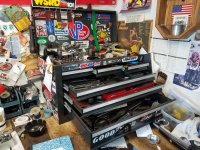
Don't forget about a house to keep all your tools in. I have a medium size toolbox. Three smaller top drawers and three larger drawers. It keeps my tools organized pretty good. However, it may not look like it in the picture. Haha
 

Attachments

  • 20171014_104345.jpg
    20171014_104345.jpg
    101.8 KB · Views: 0
Half of any set you never use. I goto thrift stores/pawn shops/yard sales and build as needed....tons of orphaned sockets and wrenches out there . The silly organized boxes never survive here and I spend as much time sorting spilled ones as using most of them so remove and store the useless away in a box somewhere...

Not exactly sure of your bike-get your calipers and see but I'll guess you need start with 8,10,12,14,sometimes 17. Best to get 6 sided sockets/box wrenches rather than 12. Look for metric allen wrenches that SUIT the ones you really have.

#2 JIS you will likely use most. You can grind plain jane phillips type to a duller angle in a pinch for smaller screws but having good JIS #1 and #3 as well is better.
You will want an impact driver, torque wrenches big (ft/lbs) AND small (inch/lbs)
 
Last edited:
oh- and get some dropcloths--heavy white cotton like painters use...or bedsheet cut as distant 2nd best. One goes on the floor to catch all the screws that otherwise bounce, roll, or sink in dirt (or are carried off by spiders?) depending on your "shop floor"... also COVER the tank and seat and whatever else is vulnerable. You are going to be tempted to put tools on these... A magnetic tray is really handy especially with vinyl covers on the magnets (easy to clean of magno-debris they attract)

Collect some containers to put dissassemblies in. Ice cream pails or many others....

Multimeter mentioned but also if you are doing any electrics you will eventually want wire strippers,crimpers and the connectors that fit the crimper...man , it's a heap.

One member had a brilliant idea- two sets of tools one on each side of the bike! You want a travel-kit on the bike so this is not difficult and anyways informs as to what you will want the most in emrg.
 
Collect some containers to put dissassemblies in. Ice cream pails or many others....

Good one, especially if you're doing a bunch of projects at once. Get some of the plastic food storage containers with lids and label them.

Air compressor with a good strong blow gun, Impact wrench, and a well lit solid work table and maybe a small vice.

getting properly set up with tools and such to do the work is the "tuition" for this self-directed learning adventure. I have questions about this that I thought the experienced mechanics on this board may be able to help with:

Looks like schools in ! Your weekend homework is to read this....

http://members.dslextreme.com/users/bikecliff/

There will be a test on monday
wink.png
.


Last edited:
IMOP 1/2" dr ratchet is not necessary. I do the majority of work with 3/8 and 1/4" dr stuff. You will need a few specific 1/2" dr sockets, such as 19, 21,24,27 and 32. Get a 1/2 breaker bar. Get 1/2 to 3/8 adaptor. Also get 3/8 to 1/4" adaptor.
If you do not have a compressor then get a mid grade electric impact gun, preferably battery powered. I seem to grab the electric impact gun most times over the air driven one. The air driven gun is used for clutch and rotor work mostly, the electric is more than adequate for the rest and it is less cumbersome with no hose.

Get a dead blow hammer also and maybe a brass hammer along with brass drifts.

As someone already said make sure you get 6 point sockets.

The majority of work can be down with a surprisingly small selection of tools on these bikes.
 
I don't see that anyone mentioned the Suzuki valve shim tool

really, trying to be comprehensive is difficult. I've been buying tools since 1969 and I bought some more 2 weeks ago. There's always some other tool you need
 
"As someone already said make sure you get 6 point sockets."

Thanks, will do.
 
The higher grade Harbor Freight tools are pretty good these days, and they are cheaper than Craftsman. Sears sold off Craftsman a while back and most everything is made in China anyway.

One of my most used sets is a 1/4" ratchet with a rack of metric sockets.
 
The only way to know all of the tools you're going to need for a job is to first buy a crystal ball.

But if you want to be well-prepared at least, I heartily recommend Harbor Freight for hand tools. No, they aren't the best thing that you can possibly get. But they are cheap, will last longer than you think and they have a lifetime warranty. Shy away from their power tools and anything that requires precision, however.

Here's a list of tools that I use almost all the time:


Metric socket set, 1/4" drive (around 4mm to 12mm)
Metric socket set, 3/8" drive (around 10mm to 24mm or so)
Metric socket set, 1/2" drive
1/4" ratchet
3/8" ratchet
1/2" breaker bar
socket extension set for all three sizes above
Metric cominbation wrench set, 8mm to 24mm or so
Spark plug socket set (or metric deep-well set)
Adjustable wrench ("crescent wrench")
vice grips, three sizes
dead-blow hammer
putty knives
impact driver
A set of decent phillips and standard screwdrivers
A pick and hook set
left-hand drill bits


Other tools that you'll have to buy online or elsewhere:


JIS driver (or just grind about 1mm off the end of a #2 phillips bit)
metric feeler gauges
carb synch tool
carb adjustment screwdriver
auxilliary gas tank
multimeter
torque wrench
 
You have a pretty comprehensive list so I won't try to add anything. Props to you for taking a course in experience. You will be amazed at what you can accomplish. 18 months from now, you'll look back and laugh at all the things you thought were too difficult that you can now do in your sleep.

Let the journey begin!
 
Back
Top