• Required reading for all forum users!!!

    Welcome!
    Register to access the full functionality of the GSResources forum. Until you register and activate your account you will not have full forum access, nor will you be able to post or reply to messages.

    A note to new registrants...
    All new forum registrations must be activated via email before you have full access to the forum.

    A Special Note about Email accounts!
    DO NOT SIGN UP USING hotmail, outlook, gmx, sbcglobal, att, bellsouth or email.com. They delete our forum signup emails.

    A note to old forum members...
    I receive numerous requests from people who can no longer log in because their accounts were deleted. As mentioned in the forum FAQ, user accounts are deleted if you haven't logged in for the past 6 months. If you can't log in, then create a new forum account. If you don't get an error message, then check your email account for an activation message. If you get a message stating that the email address is already in use, then your account still exists so follow the instructions in the forum FAQ for resetting your password.

    Have you forgotten your password or have a new email address? Then read the forum FAQ for details on how to reset it.

    Any email requests for "can't log in anymore" problems or "lost my password" problems will be deleted. Read the forum FAQ and follow the instructions there - that's what we have one for...

  • Returning Visitors

    If you are a returning visitor who never received your confirmation email, then odds are your email provider is blockinig emails from our server. The only thing that can be done to get around this is you will have to try creating another forum account using an email address from another domain.

    If you are a returning visitor to the forum and can't log in using your old forum name and password but used to be able to then chances are your account is deleted. Purges of the databases are done regularly. You will have to create a new forum account and you should be all set.

gs250 head gasket mismatch?

Mr.Vroom

Forum Apprentice
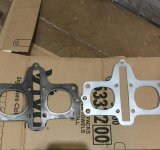
Hi everyone, i am doing a rebuild on my 1980 gs250. I had needed a new head gasket. so like every part I buy I took the number off the parts site and put it into the eBay search bar. When I received the gasket i noticed that its different then the old one. the old one had some kind of sealant coating on it, but this one is just smooth. Will I need to buy gasket sealant for it. What is the best kind?
Gs250 head gaskets.jpg
 
The new gasket is likely correct, called a MLS or Multi-layered steel gasket, and I believe is what you get now from Suzuki when you order a OEM head gasket. If you look at the edge you may see 3 or 4 layers sandwiched together. It's what I got from Suzuki for my bike. The old one I scraped off looked like your old one. It's best practice to also replace the base gasket at this point, as you've disturbed it's seal by unbolting the head. If base gasket is not replaced, chances of it leaking after reassembly are high. Probably not what you wanted to hear. At least you only have two pistons w/rings to wrangle back into the barrels. Good time to inspect rings and cylinder bores as well. Don't forget to perform a valve clearance adjustment before you button it all up.

Your factory service or Haynes manual should show no sealant, but check to be sure. You may find a manual on BikeCliff's Website.
 
Last edited:
mine was layered metal like your new one from the oem
dis seem to have a grey residue or even paint on it
it had been reused once so maybe that why.
 
Ok that's great! I have already finished the cylinders and pistons, with no big damages and a lack of new pistons, I had to reuse them. But if you let me pick your brain a bit, what's the main benefit of the MLS gasket? Does the multiple layers push against the head to seal it?
 
iirc correctly they are embossed and the high bits get squished down and deform to form a tighter seal especially around the cylinder holes.
The original has a ring but appears to be fibre which one assumes can crumble and blow out.
 
That shiny stuff is a coating that aids in sealing, so be careful with it. Head gaskets are installed dry; no oil, grease, sealers, potions, unguents, etc. and wipe the head and cylinder with clean paper towels soaked in brake cleaner to ensure they are clean. Don't use solvents on the gasket, but make sure it's clean.

The MLS construction is also better at dealing with the expansion and contraction of heat cycles since the layers can slide a little.
 
Thanks! i would not have thought of wiping down with brake cleaner. But there happens to be old gunky stuff left over from the old gasket and scrubing with nylon brush and penetrating oil has not worked. What would take that off? I don't really want to have to get the head resurfaced it seems to be within spec.
 
I use roloc fine abrasive discs in an air-powered angle grinder. Wash and clean extremely well after, of course. There are also bristle style rolocs for gasket removal that have a good reputation, but I haven't tried them personally.

However, it is EXTREMELY easy to go too far with these in pursuit of that perfect, shiny bare metal surface. This is something of an advanced skill you have to learn if you're going to use these things. I have a neighbor who absolutely ruined the jugs on his Harley by spending hours with wire brushes on a drill. About two minutes with rolocs and a deft, light touch would have done the job. By the time he consulted me it was too late.

Bear in mind that much of the surface area of the gasket isn't sealing anything. The head gasket has to seal a ring around each cylinder, the tunnel in the middle, and the four oil passages at the corners. So you don't really need to worry as much as you might think about the appearance of the in-between areas.

A pattern sort of "printed" in the metal by the old gasket, or even most pitting from corrosion is no concern; actual gasket material stuck to the aluminum is what you need to remove.

You do need to get more aggressive with these old gaskets than nylon brushes; careful patient scraping with razor blades will do the job, but you cannot press hard, scrape at a steep angle, or get in a hurry or you'll gouge the surface. Carbide gasket scrapers can also be very useful if used with discipline and patience.

The old gasket removal sprays that contained methylene chloride have been banned for years, and the new formulas are entirely useless.

One thing that can help, at least a little bit, with softening ancient gaskets is a heat gun; the aluminum parts soak up a lot of heat quickly, but it can help sometimes.
 
Last edited:
I use roloc fine abrasive discs in an air-powered angle grinder. Wash and clean extremely well after, of course. There are also bristle style rolocs for gasket removal that have a good reputation, but I haven't tried them personally.

However, it is EXTREMELY easy to go too far with these in pursuit of that perfect, shiny bare metal surface. This is something of an advanced skill you have to learn if you're going to use these things. I have a neighbor who absolutely ruined the jugs on his Harley by spending hours with wire brushes on a drill. About two minutes with rolocs and a deft, light touch would have done the job. By the time he consulted me it was too late.

Bear in mind that much of the surface area of the gasket isn't sealing anything. The head gasket has to seal a ring around each cylinder, the tunnel in the middle, and the four oil passages at the corners. So you don't really need to worry as much as you might think about the appearance of the in-between areas.

A pattern sort of "printed" in the metal by the old gasket, or even most pitting from corrosion is no concern; actual gasket material stuck to the aluminum is what you need to remove.

You do need to get more aggressive with these old gaskets than nylon brushes; careful patient scraping with razor blades will do the job, but you cannot press hard, scrape at a steep angle, or get in a hurry or you'll gouge the surface. Carbide gasket scrapers can also be very useful if used with discipline and patience.

The old gasket removal sprays that contained methylene chloride have been banned for years, and the new formulas are entirely useless.

One thing that can help, at least a little bit, with softening ancient gaskets is a heat gun; the aluminum parts soak up a lot of heat quickly, but it can help sometimes.

Thanks, I ended up using some little scoth brite rotary pads on a dermal, I picked the finest grit and went slowly, i think i got it cleaned up good enough. Thanks
 
Back
Top