• Required reading for all forum users!!!

    Welcome!
    Register to access the full functionality of the GSResources forum. Until you register and activate your account you will not have full forum access, nor will you be able to post or reply to messages.

    A note to new registrants...
    All new forum registrations must be activated via email before you have full access to the forum.

    A Special Note about Email accounts!
    DO NOT SIGN UP USING hotmail, outlook, gmx, sbcglobal, att, bellsouth or email.com. They delete our forum signup emails.

    A note to old forum members...
    I receive numerous requests from people who can no longer log in because their accounts were deleted. As mentioned in the forum FAQ, user accounts are deleted if you haven't logged in for the past 6 months. If you can't log in, then create a new forum account. If you don't get an error message, then check your email account for an activation message. If you get a message stating that the email address is already in use, then your account still exists so follow the instructions in the forum FAQ for resetting your password.

    Have you forgotten your password or have a new email address? Then read the forum FAQ for details on how to reset it.

    Any email requests for "can't log in anymore" problems or "lost my password" problems will be deleted. Read the forum FAQ and follow the instructions there - that's what we have one for...

  • Returning Visitors

    If you are a returning visitor who never received your confirmation email, then odds are your email provider is blockinig emails from our server. The only thing that can be done to get around this is you will have to try creating another forum account using an email address from another domain.

    If you are a returning visitor to the forum and can't log in using your old forum name and password but used to be able to then chances are your account is deleted. Purges of the databases are done regularly. You will have to create a new forum account and you should be all set.

Help with carb sync

  • Thread starter Thread starter glstine
  • Start date Start date
G

glstine

Guest
I have a post on here about problems I was having with my bike dying at idle. Since then I have dipped my carbs, installed new o-rings from cycleorings (boots and boot orings are only about 1 yr old), adjusted valves, checked compression (135,135,130,140 after valves adjusted). I also put in new NGK spark plugs. Spark is good and I did the coil relay mod last year and have only a 0.1V loss at the coils.

The bike will start up pretty easy and idle, but sputters badly over 2.5-3k rpms, particularly under load. Also the #2 and #4 spark plugs show running rich and the #1 and #3 plugs appear to be lean. So I think I must have some carb sync/fuel delivery issue.

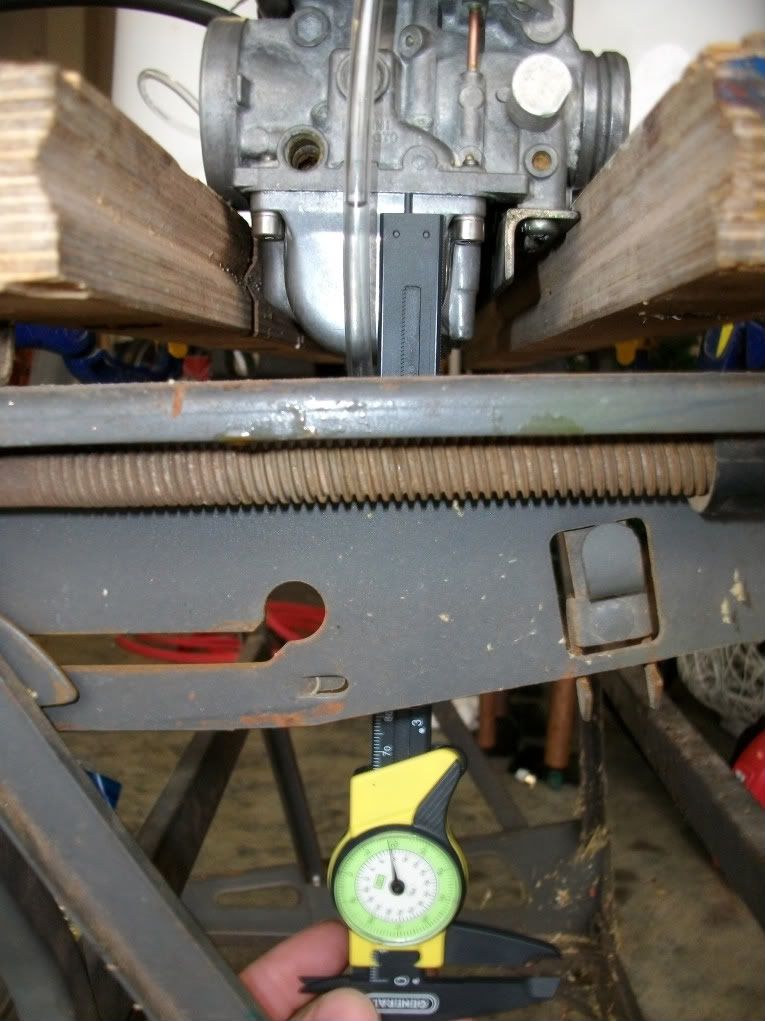
I built a gauge to check the fuel level in the float bowls using a 3/16" barb that I threaded and some clear tubing.
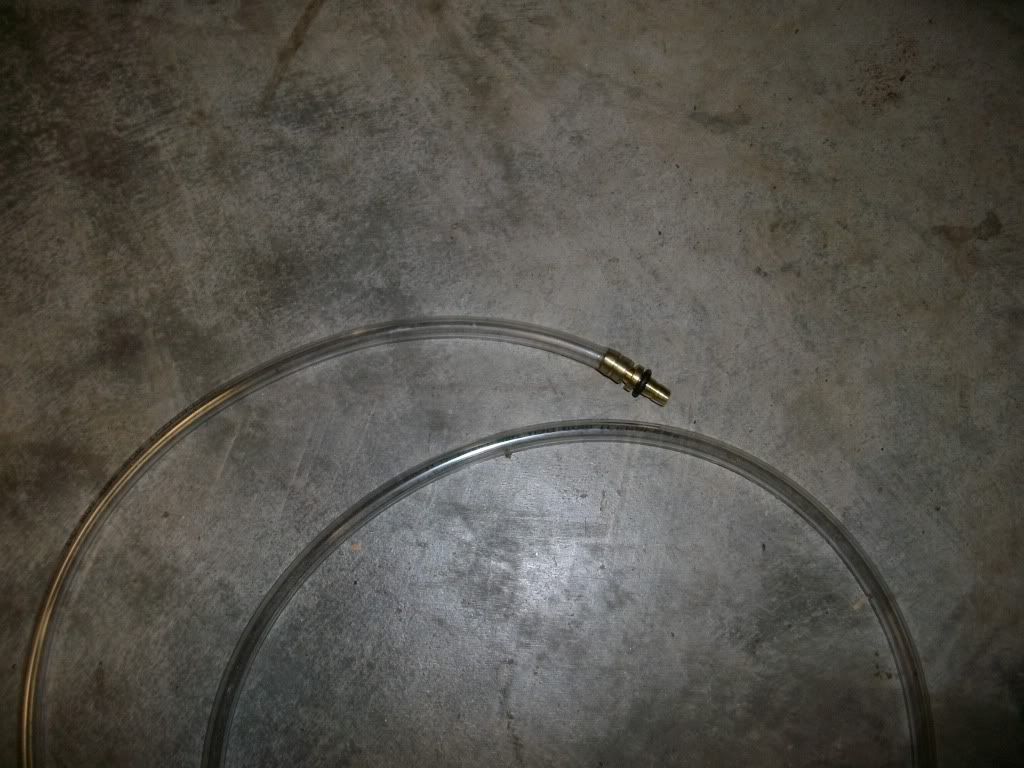
SANY0234.jpg


I set up on a work bench using clear tubing for the fuel line so I could see the fuel and checked the level of the gas in the float bowls.
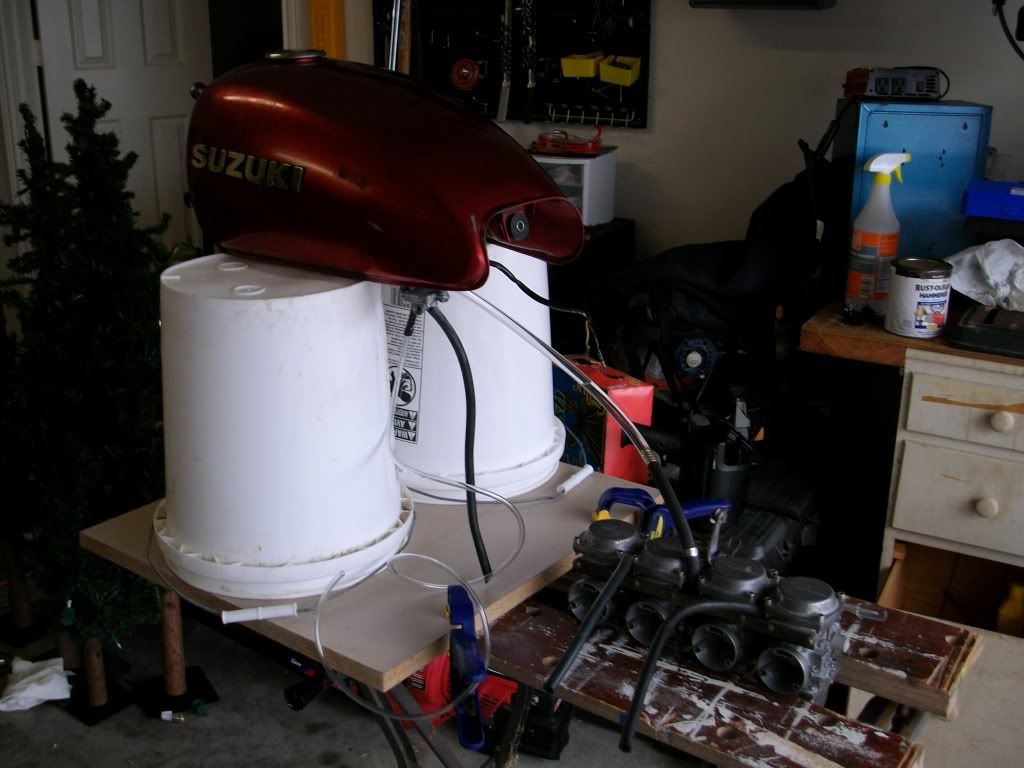
SANY0241.jpg

SANY0243.jpg


I found the #1 carb fuel level was low so I adjusted the float and all 4 carbs were within the 4.5 to 5.5 mm limit in the service manual.

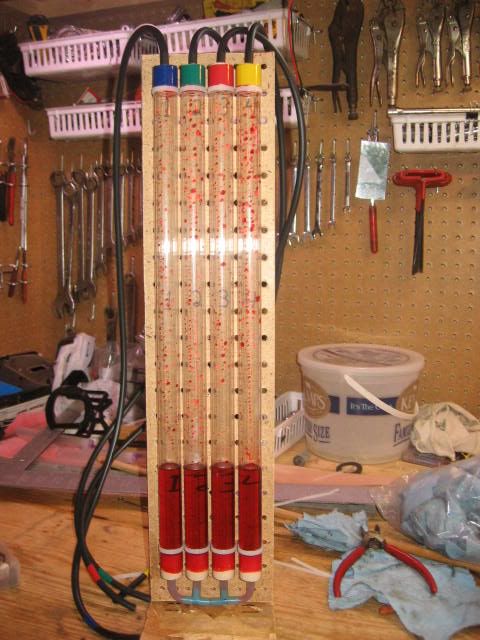
I installed the carbs and tried to set the idle mixture screws for max rpms. Not really being able to tell a difference I reset them all and decided to go ahead and try to sync the carbs with the gauge I built. I did some research and found a few threads on forums where people had reported good results using a gauge like this:
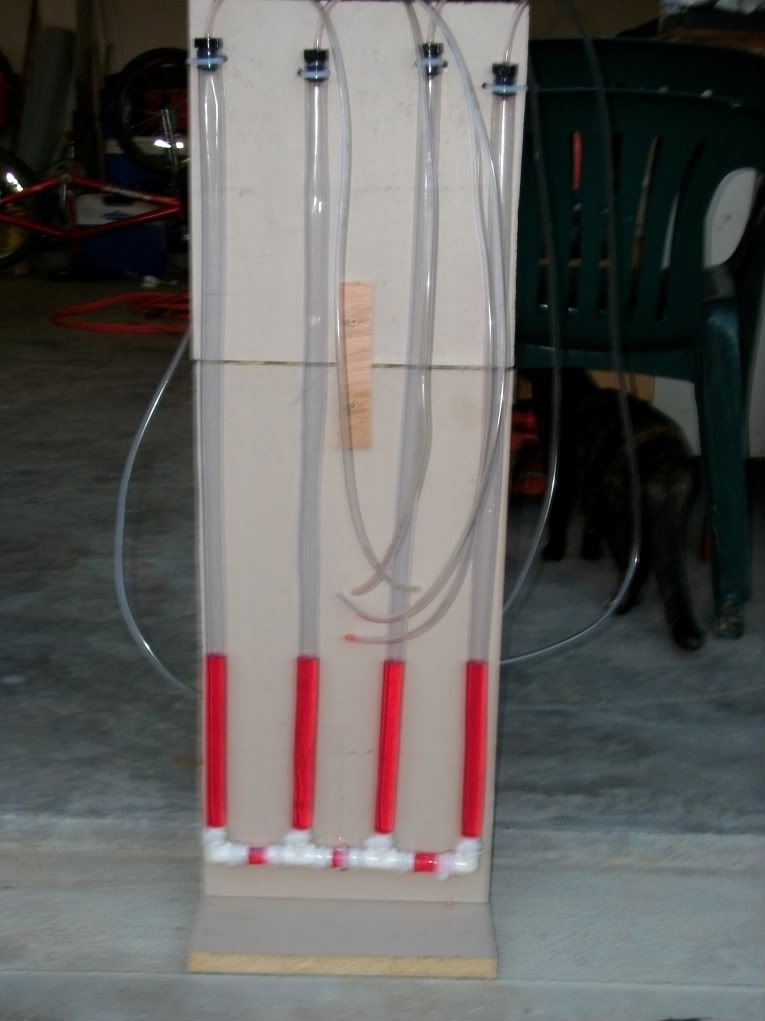
SANY0248.jpg


The gauge is made of 2'-3" long pieces of 5/8" ID tubing filled partially with Marvel Mystery Oil (was going to use ATF, but had the MMO and it appears to have about the same specific gravity and I figured it was safe if it got sucked into the engine). 3/16" tubing connects these tubes to the intake boots and I used pilot jets as flow restrictors.

On starting #4 immediately started sucking all the fluid up, so I shut it down. I decided to omit #4 for the time being and plugged it off. Started the bike and then #2 started doing the same thing. Since they are sucking in the fluid so fast I can't get a chance to attempt any adjusting. These are also the two cylinders that show running rich, I'm assuming that has to do with them having significantly more vacuum than the other two cylinders.

Any advice on how to proceed from here?
 
I don't think that sync gauge will work since there is no reservoir. I've seen gauges where there is a U section for checking balance between two cylinders, and in that case you don't need a reservoir, but the way your gauge is plumbed there is not enough fluid. Also if you build a reservoir you will need much longer tubes since the specific gravity of the oil is much lower than mercury, or even water for that matter, so you need long tubes to allow the fluid to go up.

Edit: found this photo showing a similar sync gauge. Note that there is a fifth tube full of fluid which will act as a reservoir.

23770d1223233492-homemade-carburetor-synchronizer-carb-1.jpg
 
Last edited:
I did bench sync the carbs. The layout of the gauge is similar to another one I found on line that didn't have the side reservoir and actually had shorter tube that reportedly worked fine, I may try to re-work it with longer tubes and a side reservoir though just try to get something that works. I need to get this figured out, we are starting to get nice weather again. It's getting frustrating, the bike was running fine for 3000 miles prior to this.
 
Since you have come this far, why not just bite the bullet and purchase a carb synchronizer. Perhaps there is a member near you that will let you borrow one. The reason your tool is sucking the fluid up is because the tube are way too short. You would probably need tubes that are 8 feet high or higher with that setup. Most of the mercury setup have a reservoir in the bottom and small restricters installed in the tubes leading to the engine.

Here is a link to one that a guy built for a 4cylinder bike

http://forums.sohc4.net/index.php?topic=58677.0

Note he needed 40 feet of tubing.
 
Since you have come this far, why not just bite the bullet and purchase a carb synchronizer. Perhaps there is a member near you that will let you borrow one. The reason your tool is sucking the fluid up is because the tube are way too short. You would probably need tubes that are 8 feet high or higher with that setup. Most of the mercury setup have a reservoir in the bottom and small restricters installed in the tubes leading to the engine.

Here is a link to one that a guy built for a 4cylinder bike

http://forums.sohc4.net/index.php?topic=58677.0

Note he needed 40 feet of tubing.

No way man, glstine has done a great job so far with his gauge he just needs to tweak the design in order to get it to work. Don't give up, figure out what's wrong and go from there.
 
You said it yourself Ed, the tubes are too short. I'm not saying he has done a bad job, I provided him a link on how to fix his or construct a new one.
 
I don't think that sync gauge will work since there is no reservoir. I've seen gauges where there is a U section for checking balance between two cylinders, and in that case you don't need a reservoir, but the way your gauge is plumbed there is not enough fluid. Also if you build a reservoir you will need much longer tubes since the specific gravity of the oil is much lower than mercury, or even water for that matter, so you need long tubes to allow the fluid to go up.

Edit: found this photo showing a similar sync gauge. Note that there is a fifth tube full of fluid which will act as a reservoir.

23770d1223233492-homemade-carburetor-synchronizer-carb-1.jpg
Ummmm, he is saying he built one LIKE the picture, not a pic of what he built. Thats what I got out of it.
After fiddling around and buying the hoses and fittings, you might have been able to buy a proper gauge. With a LOT less frustration
 
Last edited:
The Motion Pro sync gauge uses a fluid very similar to antifreeze, which has a higher specific gravity than oil. If the OP can build in a reservior, and extend the tubes that thing should work. Adding some restrictors into the tubes is a good idea too, that way if fluid shoots up and into the engine, only a little bit will get though.
 
FYI the spec gravity for the ATF @60 degrees F is 0.89, water is 1.0, ethylene glycol is 1.13 and mercury is 13.57. This should clarify why the tubes need to be so long.
 
For reference this is the gauge I used as a model. Reportedly successful on an 84 venture. His tubes were 3/4" ID and 19 1/2" long.

gauge.jpg


I've spent about $25 on building this gauge for the tubing and fittings, so if I can get it to work it is quite a bit cheaper than a morgan gauge. I will extend the tubing with the fluid and see what happens.
 
I haven't put much tought into this yet but I think the diameter of the tubes being larger makes a difference. That should require more vacuum to pull the fluid out of the tube since the volume increased, so did the weight. Is that correct?
 
That is the beauty of using liquid. Although there might be more weight in the larger tube, there is also more surface area for the vacuum to act on, and it balances out. You could actually mix the sizes and use unequal size tubing for each column and it would still read right. The trick with these home-built systems is getting the right length.

One other point to consider for those that are thinking of building their own manometer: do you ever anticipate the need to go mobile? How hard is is going to be to fold up 10 feet of liquid-filled tubing to take it over to a buddy's house to work on his bike?

.
 
I'm trying to understand this

Without the reservoir wouldn't the fluid either get sucked right into the engine and after it got warm just flatten the hoses?
I would think you would need some sort of restricted air flow to keep either from happening.
Just asking
 
One other point to consider for those that are thinking of building their own manometer: do you ever anticipate the need to go mobile? How hard is is going to be to fold up 10 feet of liquid-filled tubing to take it over to a buddy's house to work on his bike?

.
That's the reason I use a vacuum gauge; it fits in a 6"x6"x5" plastic case.
 
Well the gauge actually works, I just had to get it a little closer to start with, although I think rigid tubing would work better for the part with the fluid. Think I'm going to get a carbtune anyways when I can.

Anyway I'm still having trouble with the bike. #2 and #4 are really rich at idle and puff out a bit of white smoke. I had to turn the idle mixture screws all the way in on these two and they are still rich. Turning them out at all causes the smoke to increase and the idle gets rougher.

Under no load the bike idles ok and revs fine despite being rich on 2 and 4. However, under load it is still sputtering and lacking power from take off.

Any ideas on why 2 and 4 are running rich even with the idle mixture screws all the way in and why it has no power under load? I've done everything I can think of.
 
Did you verify the sizes of your jetting when you had the carbs apart ? Sometimes PO's will switch them out. Also, if you do take them out, get a magnifying glass and ensure they haven't been drilled out.:)
 
Jets are stock. I raised the float height on 2 and 4 (from 0.88" to 0.94"). Now 4 doesn't smoke if the idle mixture screw is all the way in, 2 still smokes a little. I made a video of the bike running to see if maybe someone on here may be able to tell something from the way it sounds. Keep in mind I don't have a stock exhaust they are individual turned out pipes with mufflers on 2 and 3 and just pieces of metal that look like leaves on the inside of 1 and 4. I really like the look of the pipes but hate the sound, to loud for me. Also, you may want to close your eyes watching it, I just hung the camera off my wrist so the video is a little crazy.

http://www.youtube.com/watch?v=OP9f0hfPXk8
 
Yowza. :eek: It sounds like it's only running on two cylinders half the time.

You may have ignition problems along with your fuel problems. :o

By the way, increasing the numbers on your float height actually lowers the floats. You have to remember that they are set while the carbs are upside down, so increasing the number is moving the float farther from the carb. When you turn the carbs back right side up, the floats are still farther from the carb body, meaning lower.

.
 
Back
Top