• Required reading for all forum users!!!

    Welcome!
    Register to access the full functionality of the GSResources forum. Until you register and activate your account you will not have full forum access, nor will you be able to post or reply to messages.

    A note to new registrants...
    All new forum registrations must be activated via email before you have full access to the forum.

    A Special Note about Email accounts!
    DO NOT SIGN UP USING hotmail, outlook, gmx, sbcglobal, att, bellsouth or email.com. They delete our forum signup emails.

    A note to old forum members...
    I receive numerous requests from people who can no longer log in because their accounts were deleted. As mentioned in the forum FAQ, user accounts are deleted if you haven't logged in for the past 6 months. If you can't log in, then create a new forum account. If you don't get an error message, then check your email account for an activation message. If you get a message stating that the email address is already in use, then your account still exists so follow the instructions in the forum FAQ for resetting your password.

    Have you forgotten your password or have a new email address? Then read the forum FAQ for details on how to reset it.

    Any email requests for "can't log in anymore" problems or "lost my password" problems will be deleted. Read the forum FAQ and follow the instructions there - that's what we have one for...

  • Returning Visitors

    If you are a returning visitor who never received your confirmation email, then odds are your email provider is blockinig emails from our server. The only thing that can be done to get around this is you will have to try creating another forum account using an email address from another domain.

    If you are a returning visitor to the forum and can't log in using your old forum name and password but used to be able to then chances are your account is deleted. Purges of the databases are done regularly. You will have to create a new forum account and you should be all set.

How to avoid Starter Clutch Disaster Modification

Lever

Lever

I like that!!! A nice, big easy to see and grad lever. What more could you ask for?
G
 
Longer screws with springs now installed. Just did a weekend ride away, and had only one minor instance of kickback. Will now retard it an extra degree and see if it's totally eliminated.

At least for my 1166, I find that keeping the battery charged up significantly reduces the kick back. When the battery is low it is much more prevelant.

That would be because of the slower cranking speed, methinks.
 
Ground the Area where the Ignition swing weights contacted on my kat , just a smidge , and slotted the holes so I could have it more retarded at start , but the springs allow it to advance as normal.
A lot of the drag racers over here in Oz have been doing it for years on high compression motors.
Easy to do , not a single extra part , and absolutely foolproof.
 
That's great mate, good work!
May I ask, How many degrees further have you retarded the timing for start-up?
I tried retarding the timing (by rotating the base-plate) by about 3 deg. initially, but was still getting kickback. It was eliminated when I went to 5 deg.
 
Have never measured the degrees, contact area was filed down about 0.5mm, and then slotted holes and rotated until it was on standard timing setting for higher revs. Will try to find some more details and post them over the weekend.
 
A simple delay can be created by placing a latching relay into the ignition wiring. The relay would be normally open an so there would be not power to ignition until the relay is initiated but then the ignition circuit would remain powered because the relay will remain latched until the ignition switch is turned off.

Initiating the relay by means of an alternate flashing unit such as a Tridon EL13A and using the second circuit would mean that the flasher would energize when the starter button is operated. The delay between energizing the first circuit and second would mean that the relay controlling the latching relay for the ignition would not close and latch until about 1 second. After the relay is latched, the continued operation of the signal flashing relay would be irrelevant.

There are other ways to accomplish this but this is one way in which it can be done with simple, off the shelf components. I did a delay for something on some boats in a similar manner many decades ago.....but memory fails.;)

Offered in case it is useful to someone, not out of the suggestion that it is superior to the other offerings.

If memory serves, there were some plug-in ignition delay modules on the market in the 1970's for dealing with the same kinds of issues affecting high compression engines. An electronic delay operated during cranking might be a simple solution. Any delay circuit in conjunction with a latching relay (any relay with a lead from the normally open switched terminal to the energizing coil) should do what is wanted.
 
OK,
I am getting ready to implement option #2, my bike is an 82 GS 1100L, my question. Is the switch shown in the op the same as the one on my bike and is the procedure the same ?

Thanks in advance !
 
Last edited:
Here is a picture, Any input would be much help at this point.

Thanks !
 
Last edited:
I looked at your schematic for option 5 but I'm not sure I understand it ?
Are you really taking the ground connection of the CDI to the + 12V through the starter switch ?
Isn't the whole CDI box connected to the ground connection ?
When you release the starter switch you are grounding the CDI box through the starter solenoid thus allowing the sparks to be produced.
So in fact you are counting on the inertia of the crankshaft to keep rotating the engine until a spark ignites the engine.
What's the voltage drop across the solenoid ?
Doesn't that weaken the spark ?
 
I looked at your schematic for option 5 but I'm not sure I understand it ?
Are you really taking the ground connection of the CDI to the + 12V through the starter switch ?
Isn't the whole CDI box connected to the ground connection ?
When you release the starter switch you are grounding the CDI box through the starter solenoid thus allowing the sparks to be produced.
So in fact you are counting on the inertia of the crankshaft to keep rotating the engine until a spark ignites the engine.
What's the voltage drop across the solenoid ?
Doesn't that weaken the spark ?
All very good questions John ;I think you do understand it. :)

This is basically another simpler way of implementing the OLD Option #3 in the write up. inhibiting spark while cranking and yes that relies on the inertia to keep the engine running till you get that first spark and then VROOM. This method uses no relays where as the older design used two relays.

I have to confess of not knowing exactly why this works. As I have posted a member here who upon installing a SSPB with headlamp cutout suspected that the SSPB had something to do with cutting out spark. As it turned out his bike ad been wired this way every since he had owned it and he had never realized the behavior before the SSPB install. Presumably checking out the headlamp cutout is what focused his attention to realize the PO modifications. Based on that I would say it is a viable approach for some bikes using the OEM ignitor. I can not say I strongly recommend it, but it is worth a shot if you are so inclined. The headlamp cutout is probably much more universal solution.

With respect to the grounds, again I don't know other than it was said to work without any notice of degradation. :) The solenoid is 3-4 ohms and the coils are 3-4 ohms so that would cut the coil voltage in 1/2 if the coils actually grounded through the B/W coming from the ignitor. I cant help but think that would be noticeable. :) So my guess is that the B/W is only a signal ground and the rest of the coil current actually goes through the case. The signal ground is probably in series with bias circuits that are in the 10's of Kohms and so 3-4 ohms is nothing.

This would not work with a Dyna -S for example as the Dyna-S ground through to the engine from the ignition timing plate. It would not work with points as they do the same. Perhaps a Dyna-2000 or such would have a similar working.

I would however, strongly recommend the headlamp cutout and even perhaps the use of LED's for all signals and probably LED for the headlamp. This all helps provide more amperage to spin the motor faster during cranking.
 
All very good questions John ;I think you do understand it. :)

This is basically another simpler way of implementing the OLD Option #3 in the write up. inhibiting spark while cranking and yes that relies on the inertia to keep the engine running till you get that first spark and then VROOM. This method uses no relays where as the older design used two relays.

I have to confess of not knowing exactly why this works. As I have posted a member here who upon installing a SSPB with headlamp cutout suspected that the SSPB had something to do with cutting out spark. As it turned out his bike ad been wired this way every since he had owned it and he had never realized the behavior before the SSPB install. Presumably checking out the headlamp cutout is what focused his attention to realize the PO modifications. Based on that I would say it is a viable approach for some bikes using the OEM ignitor. I can not say I strongly recommend it, but it is worth a shot if you are so inclined. The headlamp cutout is probably much more universal solution.

With respect to the grounds, again I don't know other than it was said to work without any notice of degradation. :) The solenoid is 3-4 ohms and the coils are 3-4 ohms so that would cut the coil voltage in 1/2 if the coils actually grounded through the B/W coming from the ignitor. I cant help but think that would be noticeable. :) So my guess is that the B/W is only a signal ground and the rest of the coil current actually goes through the case. The signal ground is probably in series with bias circuits that are in the 10's of Kohms and so 3-4 ohms is nothing.

This would not work with a Dyna -S for example as the Dyna-S ground through to the engine from the ignition timing plate. It would not work with points as they do the same. Perhaps a Dyna-2000 or such would have a similar working.

I would however, strongly recommend the headlamp cutout and even perhaps the use of LED's for all signals and probably LED for the headlamp. This all helps provide more amperage to spin the motor faster during cranking.
It's definitely not a very orthodox way of doing things but if it works why not ?
The headlamp cutout is not required for European models as there is a separate switch for them.
I propose to measure the resistance between the B/W lead and the CDI casing to ensure it's only a "signal" ground but you must be right as the solenoid is no longer activated when you release the starter button.
The piece of genious here is that the CDI box gets the full battery voltage as soon as you release the starter button.
The downside is that the engine will only start when you release the starter button...
I will try it as my GS 1000 has proven quite difficult to start since I installed the 1085 Wiseco kit.
Many thanks for documenting all this:)
 
Last edited:
I used option 2 with my 1085 Yosh in my 1000. Very simple mod with the results that are required. Bike starts smoothly every time, whereas before it was a constant kickback.

I also run a 8 cell ballistic lithium battery, which is SUPPOSED to be adequate cranking power, but is not with the increased compression ratio I guess. However the mod makes starting possible with the inadequate cranking amps with the 8 cell.
 
In the end, I went with modification #2.
The way I did it consisted in simply switching the White/Orange leads at the plug level coming out of the right switch assy.
The W/O lead with an orange plastic band brings the switched +12V to the "engine stop" switch before going to the "starter switch".
By switching the leads as described the W/O lead with the orange plastic band now feeds directly the "starter switch" and the "engine stop" switch.
I don't know if this will work on US models?
 
In the end, I went with modification #2.
The way I did it consisted in simply switching the White/Orange leads at the plug level coming out of the right switch assy.
The W/O lead with an orange plastic band brings the switched +12V to the "engine stop" switch before going to the "starter switch".
By switching the leads as described the W/O lead with the orange plastic band now feeds directly the "starter switch" and the "engine stop" switch.
I don't know if this will work on US models?

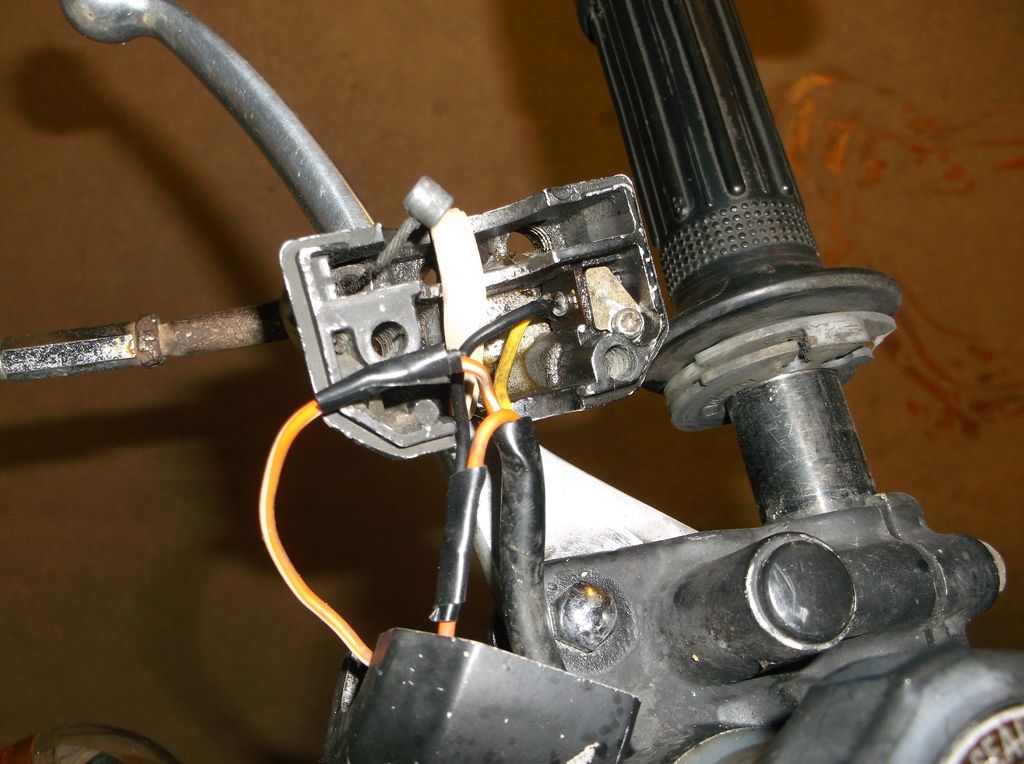
In most cases you should be able to do everything in the right hand switch. Here is a picture of a jumper I made in on a 1980 GS750E.


attachment.php
 
option #2.

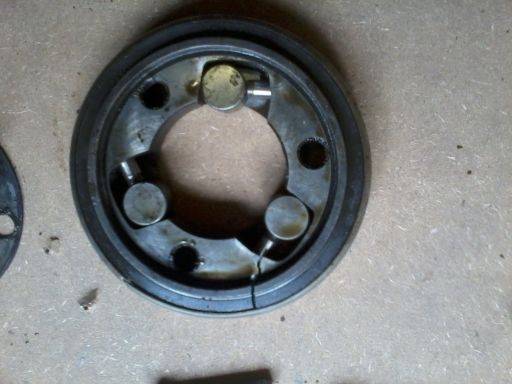
after doing this to two starter clutches:


150627_002_zpsxjifzkke.jpg


i happened across this thread. i finally got around to doing option 2 from the first post. a de-solder, a snip, a strip and a couple quick solders. i didn't even have to take the switches out. starting is smooth as silk now.


DSCF1102_zps83mnkwyq.jpg
 
option #2.

after doing this to two starter clutches:


150627_002_zpsxjifzkke.jpg

Ouch; what bike and how is it charging? If the bike cranks over slow then kick back is much more likely. Headlamp cutout helps as well.
 
Back
Top