• Required reading for all forum users!!!

    Welcome!
    Register to access the full functionality of the GSResources forum. Until you register and activate your account you will not have full forum access, nor will you be able to post or reply to messages.

    A note to new registrants...
    All new forum registrations must be activated via email before you have full access to the forum.

    A Special Note about Email accounts!
    DO NOT SIGN UP USING hotmail, outlook, gmx, sbcglobal, att, bellsouth or email.com. They delete our forum signup emails.

    A note to old forum members...
    I receive numerous requests from people who can no longer log in because their accounts were deleted. As mentioned in the forum FAQ, user accounts are deleted if you haven't logged in for the past 6 months. If you can't log in, then create a new forum account. If you don't get an error message, then check your email account for an activation message. If you get a message stating that the email address is already in use, then your account still exists so follow the instructions in the forum FAQ for resetting your password.

    Have you forgotten your password or have a new email address? Then read the forum FAQ for details on how to reset it.

    Any email requests for "can't log in anymore" problems or "lost my password" problems will be deleted. Read the forum FAQ and follow the instructions there - that's what we have one for...

  • Returning Visitors

    If you are a returning visitor who never received your confirmation email, then odds are your email provider is blockinig emails from our server. The only thing that can be done to get around this is you will have to try creating another forum account using an email address from another domain.

    If you are a returning visitor to the forum and can't log in using your old forum name and password but used to be able to then chances are your account is deleted. Purges of the databases are done regularly. You will have to create a new forum account and you should be all set.

I have paint gun & compressor, what else do i need?

  • Thread starter Thread starter Suzuki_Don
  • Start date Start date
MAC that's BRILLIANT. This information you have provided here is so much help. I am going to go through this thread and copy the relevant bits and make up a tutorial for myself to use. I'll put it in an ordered arrangement so when I am doing the spray job I will just have to follow logical sequences as laid down.

One more question: I have read that the strokes should be up & down or top to bottom if you like. If that is the case how do I go about spray painting a tank. It will be an older GS tank ('77 model). Do I spray the top from end to end first and then come down each side until it is all coated. Do I just do a single coverage as I have explained or do I go over it a couple of times?

Thanks again MAC for the great info you have supplied to date and I look forward to more from you.

Thanks to all the others that have contributed their knowledge as well.
 
MAC that's BRILLIANT. This information you have provided here is so much help. I am going to go through this thread and copy the relevant bits and make up a tutorial for myself to use. I'll put it in an ordered arrangement so when I am doing the spray job I will just have to follow logical sequences as laid down.

Glad I could help.

One more question: I have read that the strokes should be up & down or top to bottom if you like. If that is the case how do I go about spray painting a tank. It will be an older GS tank ('77 model). Do I spray the top from end to end first and then come down each side until it is all coated. Do I just do a single coverage as I have explained or do I go over it a couple of times?

Paint direction is a very hotly debated topic, most painters spray along the horizontal axis, sweeping side to side over the part. Yet, I know painters who swear by the up&down method.

As far as I am concerned, it is all for moot since most of them don't even sand the part properly before paint to ensure maximum paint retention on the part. I always keep in mind how the part is going to be positioned while painting, and sand the part so that the sanding direction will be level with the floor. This helps to prevent our friend Mr. Flow Indicator from making an appearance. This of it like each time you pass the sand paper across the surface of the part, you are building in ledges for the paint to sit on, kind of like the terraced gardens in asian, if you follow. The general rule of thumb here is to think of how the paint would run off of the surface, and sand perpendicular to that direction.

Once that sanding is done properly, you can spray the part in whatever direction you wish, up, down, sideways, diagonal, twirling, ever twirling, whichever, it makes no difference since the paint has the parrallel to the floor sanding ledges to rest on.

When I paint tanks, I usually try to hang them from the forward mount if at all possible. For me this makes it much easier to get the front of the tank, and make sure the rest of the paint goes on nicely.

After hanging, I would go around any of the detail areas, such as gas cap lip, edges of seams, and mounts with a light coat of paint to make sure they get the attention, and paint film build required. These areas must be sanded properly, and get a good build of paint to keep the paint from flaking off down the road.

I would then be able to paint the front of the tank, and then go from top to bottom (front to back), and the added bonus of this method is that you can easily paint the underside of the tank just as easily as the top. Care must be taken to not run the paint when painting like this, and good to excellent lighting is a must!

If you prefer to paint the tank sitting like it does while on the bike, make sure to sand it so it is getting horizontal lines across it from front to back, and side to side on the top, then paint the underside first, so it can be set down for painting the top once the bottom is tack-free. This can be harder to paint in this position without getting runs, simply because the lower edges of the tank are not readily accessible, and will tend to get over-saturated with paint.

I have attached a poorly marked image showing how I would paint the tank if it had to be set down on the lower edges for painting. First, do the light coat around the detail areas, gas cap, and edges, then paint the front face, then go front to back(or back to front) down the center of the tank to split it in two halves, and work your way back and forth down the sides of the tank. Generally, we are looking for each "stripe" of the paint coat to have around a 25-50% overlap (depending on the paint type, and the spray pattern of your gun) with the previous movement, this will help it all knit together to give consistent coverage.

Remember how heavy you want each coat to be, and try to keep the spray gun a consistent distance from the part and I am sure you will have minimal trouble. If you feel you need practice before touching the parts, try and find something with a lot of curves and different faces on it to paint to get the feel for it. I would rather put down a run on a $2 kids toy from a yard sale or thrift store, than on prepped parts.

Thanks again MAC for the great info you have supplied to date and I look forward to more from you.

No problem at all, I am glad I could help a fellow GSR'r. (sp?) :-k
If you have any other questions, feel free to ask, and good luck and Godspeed.
 
Last edited:
cold air has more water than hot, hot air is dry

not really. the warmer the air the more moisture it can absorb. that's why when hot air gets to your cold beer bottle taken out of the fridge the bottle surface becomes wet.
 
Two more questions if I may:

1. If the petrol tank has a reasonable coat of paint on it and I just want to fix a few stone chips or very small dents and change colour, then is it necessary to sand the tank right back to metal all over as you see in a lot of the videos and pics on various sites? If you don't have to sand it all the way back to metal then what needs to be done to prepare the tank for painting? Do you still need a primer? Which is best?

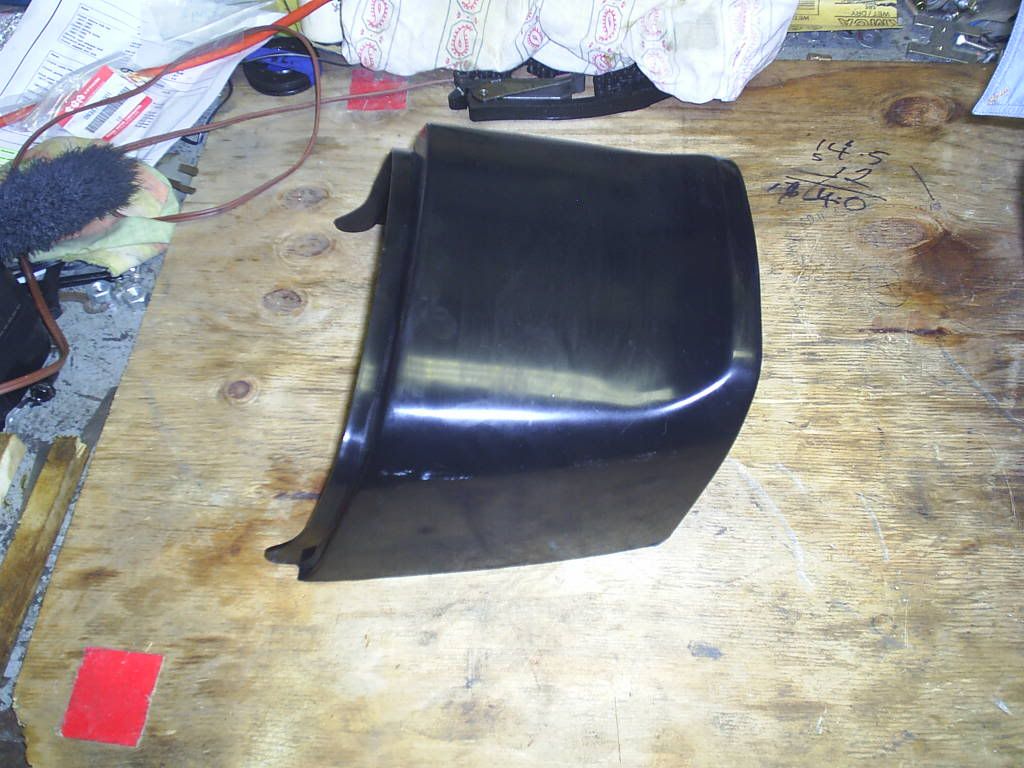
2. If spraying a new part that is plastic as in the duck tail part below, is there a process or any special preparation, or product used to bind the primer to the plastic? This piece bought brand new feels really shiny and slippery to the touch?


S3010044.jpg
 
Chip repair

Chip repair

Two more questions if I may:
1. If the petrol tank has a reasonable coat of paint on it and I just want to fix a few stone chips or very small dents and change colour, then is it necessary to sand the tank right back to metal all over as you see in a lot of the videos and pics on various sites? If you don't have to sand it all the way back to metal then what needs to be done to prepare the tank for painting? Do you still need a primer? Which is best?

It is not necessary to take the tank right down to bare metal, what you would be doing then is called "spot repair". However, if the chip are right down to the metal, you will need to level the chipped area to the height of the surrounding paint, by either doing some careful filling of the chip with some surfacing putty, or by taking down the level of the paint surrounding the chip by sanding.

Both methods will work, but can yield dramatically different results depending on the preperation. When doing either type, I find it easier to sand the entire piece to be worked on, then do the repair. This ensures that everything will stick, since you have already roughed up the area, and if you need to extend the original repair area, you don't need to redo any sanding since the entire piece is already done. This saves time, and make sure to wear some nitrile or latex gloves while handling sanded parts, to keep the oils from your hands from transferring to the part, and soaking into the freshly opened surface. Fingerprints are NOT your friend!

Whenever I paint a vehicle I go over it one last time with a fine sanding sponge on "fingerprint patrol". Anywhere that it has been touched will have a small amount of residue transferred to the surface, and it can ruin your day when everything looks perfect, except for that one tiny spot where the paint pushes away from a fingerprint, usually right in the middle of the largest open area on the part.

I usually give the chipped area a sanding with some sanding sponge to give the putty something to grab on to, and then skim over the chip with surfacing putty. Surfacing putty sands quickly and easily, so be careful when sanding it smooth to match the height with the rest of the surface. If possible, use a high grit sand paper, say 600-800, on a sanding block, moving it back and forth over the putty while keeping the block as flat on the surface as possible. Be careful to not apply too much pressure since sanding could pull the putty right out of the depression if the paper really gets a hold of it while sanding.

Once sanded smooth and flat with the height of the rest of the surface, you should be able to clearly see the outline of the chip, and where the surfacing putty has filled. Follow this up with some primer (2-3 coats to seal the repair, sanding in between coat to disguise the profile of the repair), and you are ready for paint.

You could also take down the level of the surrounding paint to match up with the chip, but I don't recommend this method, it will open up more of the old paint and primer, and could cause a halo effect around the repair area when painting if not sealed properly.

If you decide to go this route, the area around the repair must be sanded down with a sanding block, usually with the same 600-800 grit paper. You will be applying more pressure to remove the old paint and primer.

Feather the edge so that it extends at least as far away from the repair as the repair is wide. In essence, what you are doing here is creating a new face on the part, one that is hopefully not too far off from the original level of the paint. The greater the difference in height between the chip and the topcoat, the more likely the repair will be visible.

If using this method, once the edge is feathered out, cover with surfacing putty, and try to recreate the level of the original surface with carefull sanding with a block similar to option #1. Seal up the repaired area with 2-3 coats of primer, finish sand with a sponge, and get ready for paint.

Make sure when using either repair option, that you let the primer fully flash off between coats, and give it a light sand in between coats of primer, this will help hide the ring around the repair by giving it a more uniform surface. I usually would feather the edge of the primer over the repair back about 20-40%, and recoat it on the next coat of primer. Once again, we are trying to disguise where the repair was done as much as possible. When sanded, primed, sanded, primed, sanded, primed, then finish sanded, the repair should look like a smoothly feathered blotch over the original sanded paint finish, and it should not have any distinct edging to it, whatever edges you see now will be magnified once the paint is applied, so try and get things as smooth as possible.

When doing a dent repair, scuff the inside of the depression with a low grit paper, like a 60 or 80 grit to rough it up so the filler really sticks in there. I use fiberglass to fill dents, most people use a bondo type polyester filler. If using a polyester filler, make sure to go over it with fiberglass to seal it! Polyester fillers are NOT waterproof, and turn into a hard sponge. They will draw in moisture, and will rust the metal behind them until they pop the filler right out. You can seal it with a surfacer, this is different than primer! Surfacers are specifically meant to go over primers, to completely seal the repair area. Once filled, sealed, and sanded smooth, proceed with priming and paint as usual.

2. If spraying a new part that is plastic as in the duck tail part below, is there a process or any special preparation, or product used to bind the primer to the plastic? This piece bought brand new feels really shiny and slippery to the touch?

What you have there is a fresh from the mold, injection molded plastic part. There will be a film of mold release agent over the surface of the part. Give the part a nice hot sponge bath in soapy water. Dish soap works the best, and leaves little to no residue. Once the part is clean, put on your nitrile or latex gloves, and give the plastic a light scuffing with a fine sanding sponge, or you could wet sand it with 1000 grit paper.

Plastic and paint don't stick to each other very well unless an adhesion promoter is used. I prefer the PPG sponge and wipe adhesion promoter, but it is a one use item, so after you open it, whatever isn't used, get disposed of since it will not keep once opened. One set (sponge and wipe) is enough to clean and prep 1-2 full size plastic bumper covers for a car, so unless you have a complete set of new plastics to paint, it's not really cost effective, but it does a great job.

Adhesion promoter is also available in a spray can, a little pricey, but more cost effective in the long term if you only need to paint one or two parts in the short term.

Either will work, and is mandatory to paint plastics and not have to worry about the paint flaking off the first time it is flexed. Do not use self-etch primer on plastics unless it is formulated for plastics! Metal self-etch doesn't really stop eating away at plastic, whenever it gets hot, it keeps working away, and will loosen your paint and cause flaking.

When your part is coated with adhesion promoter as per instructions on the can/bag/whatever, let it set up as per instructions, and then prime/paint as usual.

if you have any more questions, feel free to ask, and remember to take tons of pics!

EDIT: Primers are generally based off of the same chemistry, so most primers will do the trick for you, even the old style laquer primer will work well. Just don't try and use primer to fill a stone chip, this will not work since the primer contracts when curing, and will cause nothing but headaches down the road when an overly thick spot of primer delaminates from the surface and voila, the chip reappears.

Hope this helps,
 
Last edited:
It is not necessary to take the tank right down to bare metal, what you would be doing then is called "spot repair". However, if the chip are right down to the metal, you will need to level the chipped area to the height of the surrounding paint, by either doing some careful filling of the chip with some surfacing putty, or by taking down the level of the paint surrounding the chip by sanding.

Both methods will work, but can yield dramatically different results depending on the preperation. When doing either type, I find it easier to sand the entire piece to be worked on, then do the repair. This ensures that everything will stick, since you have already roughed up the area, and if you need to extend the original repair area, you don't need to redo any sanding since the entire piece is already done. This saves time, and make sure to wear some nitrile or latex gloves while handling sanded parts, to keep the oils from your hands from transferring to the part, and soaking into the freshly opened surface. Fingerprints are NOT your friend!

Whenever I paint a vehicle I go over it one last time with a fine sanding sponge on "fingerprint patrol". Anywhere that it has been touched will have a small amount of residue transferred to the surface, and it can ruin your day when everything looks perfect, except for that one tiny spot where the paint pushes away from a fingerprint, usually right in the middle of the largest open area on the part.

I usually give the chipped area a sanding with some sanding sponge to give the putty something to grab on to, and then skim over the chip with surfacing putty. Surfacing putty sands quickly and easily, so be careful when sanding it smooth to match the height with the rest of the surface. If possible, use a high grit sand paper, say 600-800, on a sanding block, moving it back and forth over the putty while keeping the block as flat on the surface as possible. Be careful to not apply too much pressure since sanding could pull the putty right out of the depression if the paper really gets a hold of it while sanding.

Once sanded smooth and flat with the height of the rest of the surface, you should be able to clearly see the outline of the chip, and where the surfacing putty has filled. Follow this up with some primer (2-3 coats to seal the repair, sanding in between coat to disguise the profile of the repair), and you are ready for paint.

You could also take down the level of the surrounding paint to match up with the chip, but I don't recommend this method, it will open up more of the old paint and primer, and could cause a halo effect around the repair area when painting if not sealed properly.

If you decide to go this route, the area around the repair must be sanded down with a sanding block, usually with the same 600-800 grit paper. You will be applying more pressure to remove the old paint and primer.

Feather the edge so that it extends at least as far away from the repair as the repair is wide. In essence, what you are doing here is creating a new face on the part, one that is hopefully not too far off from the original level of the paint. The greater the difference in height between the chip and the topcoat, the more likely the repair will be visible.

If using this method, once the edge is feathered out, cover with surfacing putty, and try to recreate the level of the original surface with carefull sanding with a block similar to option #1. Seal up the repaired area with 2-3 coats of primer, finish sand with a sponge, and get ready for paint.

Make sure when using either repair option, that you let the primer fully flash off between coats, and give it a light sand in between coats of primer, this will help hide the ring around the repair by giving it a more uniform surface. I usually would feather the edge of the primer over the repair back about 20-40%, and recoat it on the next coat of primer. Once again, we are trying to disguise where the repair was done as much as possible. When sanded, primed, sanded, primed, sanded, primed, then finish sanded, the repair should look like a smoothly feathered blotch over the original sanded paint finish, and it should not have any distinct edging to it, whatever edges you see now will be magnified once the paint is applied, so try and get things as smooth as possible.

When doing a dent repair, scuff the inside of the depression with a low grit paper, like a 60 or 80 grit to rough it up so the filler really sticks in there. I use fiberglass to fill dents, most people use a bondo type polyester filler. If using a polyester filler, make sure to go over it with fiberglass to seal it! Polyester fillers are NOT waterproof, and turn into a hard sponge. They will draw in moisture, and will rust the metal behind them until they pop the filler right out. You can seal it with a surfacer, this is different than primer! Surfacers are specifically meant to go over primers, to completely seal the repair area. Once filled, sealed, and sanded smooth, proceed with priming and paint as usual.


What you have there is a fresh from the mold, injection molded plastic part. There will be a film of mold release agent over the surface of the part. Give the part a nice hot sponge bath in soapy water. Dish soap works the best, and leaves little to no residue. Once the part is clean, put on your nitrile or latex gloves, and give the plastic a light scuffing with a fine sanding sponge, or you could wet sand it with 1000 grit paper.

Plastic and paint don't stick to each other very well unless an adhesion promoter is used. I prefer the PPG sponge and wipe adhesion promoter, but it is a one use item, so after you open it, whatever isn't used, get disposed of since it will not keep once opened. One set (sponge and wipe) is enough to clean and prep 1-2 full size plastic bumper covers for a car, so unless you have a complete set of new plastics to paint, it's not really cost effective, but it does a great job.

Adhesion promoter is also available in a spray can, a little pricey, but more cost effective in the long term if you only need to paint one or two parts in the short term.

Either will work, and is mandatory to paint plastics and not have to worry about the paint flaking off the first time it is flexed. Do not use self-etch primer on plastics unless it is formulated for plastics! Metal self-etch doesn't really stop eating away at plastic, whenever it gets hot, it keeps working away, and will loosen your paint and cause flaking.

When your part is coated with adhesion promoter as per instructions on the can/bag/whatever, let it set up as per instructions, and then prime/paint as usual.

if you have any more questions, feel free to ask, and remember to take tons of pics!

EDIT: Primers are generally based off of the same chemistry, so most primers will do the trick for you, even the old style laquer primer will work well. Just don't try and use primer to fill a stone chip, this will not work since the primer contracts when curing, and will cause nothing but headaches down the road when an overly thick spot of primer delaminates from the surface and voila, the chip reappears.

Hope this helps,
Wow You need to write abook or at least put a thread together under Popular technical information. It might pop up better on searchs that way. Nice contribution. I'm only a back yard bondo guy so it is nice to see what the pro's do. :o
 
I am with Jim on this +100. Your technical knowledge is helping so much. As has been said it's great to have a professional giving such great advice -- I am learning on a daily basis.

It may be a little while before I start anything, so pictures may be a while. I am currently trying to get my motor back into the frame and unfortunately everything has to be prioritised.
 
"I'm not sure why but it seems that the close one just gets blown though."-NESSISM

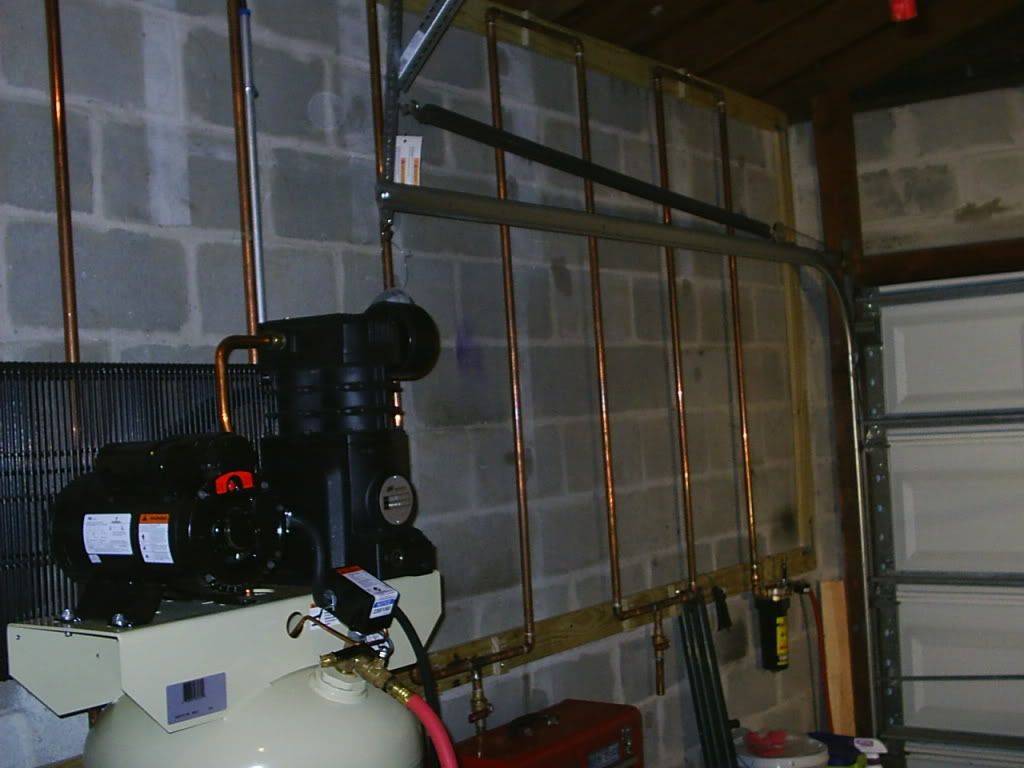
You are right on the money brother. I just bough a IR 18.1 CFM compressor and thought I could simply put my Devilbiss C3 water trap system right next to the tank and be good. It's a $150 system so I thought it would work perfectly. Not so, the air coming out of the compressor outlet is so hot, it's vaporized and hasn't condensed enough for the trap to catch it. I went on a few painting forums and "they" recommend about 50 ft min.of hard lines to allow the air to cool down in order for the water trap to do its job (copper is best (Type L is the heavy duty), followed by copper type M, Gavanized steel, black steel). About $200.00 in type L copper pipe, fittings, solder, torch, wood for a frame, and many other ods and ends (including wiring stuff too) you see this "condensor" I built to condense the water before it hits my trap (It wasn't my design, I copied someone elses and added 10 more feet of copper, the other guy had 40 feet).

Here's a pic


CONDENSERANDWATERTRAP.jpg
 
"I'm not sure why but it seems that the close one just gets blown though."-NESSISM

You are right on the money brother. I just bough a IR 18.1 CFM compressor and thought I could simply put my Devilbiss C3 water trap system right next to the tank and be good. It's a $150 system so I thought it would work perfectly. Not so, the air coming out of the compressor outlet is so hot, it's vaporized and hasn't condensed enough for the trap to catch it. I went on a few painting forums and "they" recommend about 50 ft min.of hard lines to allow the air to cool down in order for the water trap to do its job (copper is best (Type L is the heavy duty), followed by copper type M, Gavanized steel, black steel). About $200.00 in type L copper pipe, fittings, solder, torch, wood for a frame, and many other ods and ends (including wiring stuff too) you see this "condensor" I built to condense the water before it hits my trap (It wasn't my design, I copied someone elses and added 10 more feet of copper, the other guy had 40 feet).

Here's a pic


CONDENSERANDWATERTRAP.jpg

Looks more like a front for a moonshine operation :-$

BTW, do you get a temperature gradiant across the pipes? Warm at the compressor and cool at the condensor?
 
Last edited:
"Looks more like a front for a moonshine operation :-$"

Well-look like I'll have an idea for a second business if the painting thing fails :p

As far as temp gradient, thats right. It's so cool at the end of the 50' run that the Camair C3 has no problem catching all the water!
 
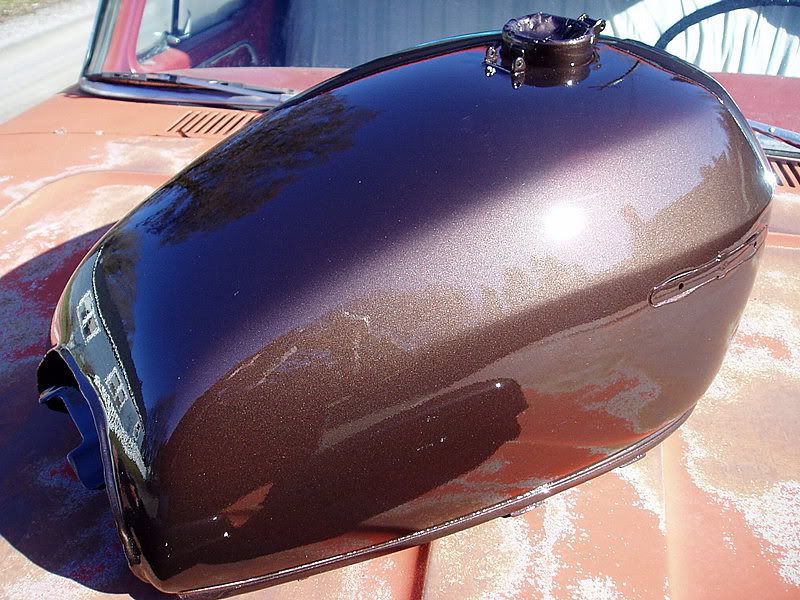
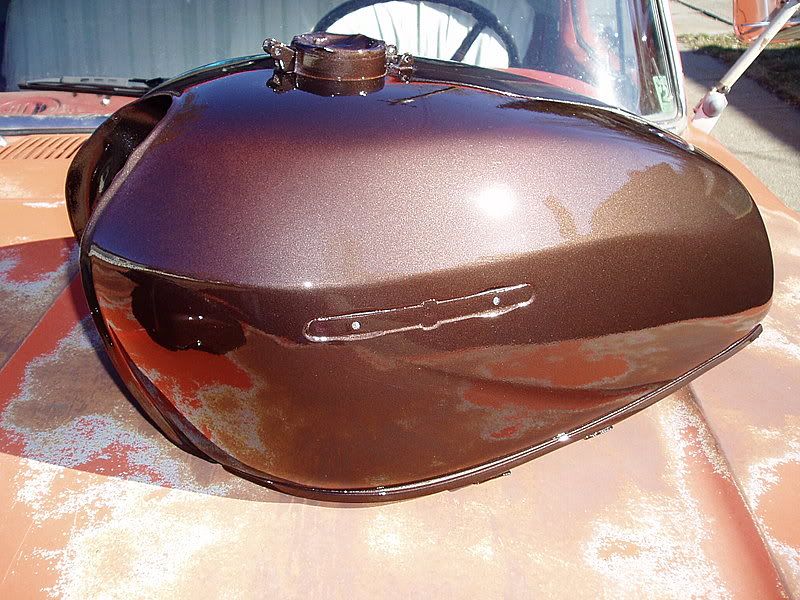
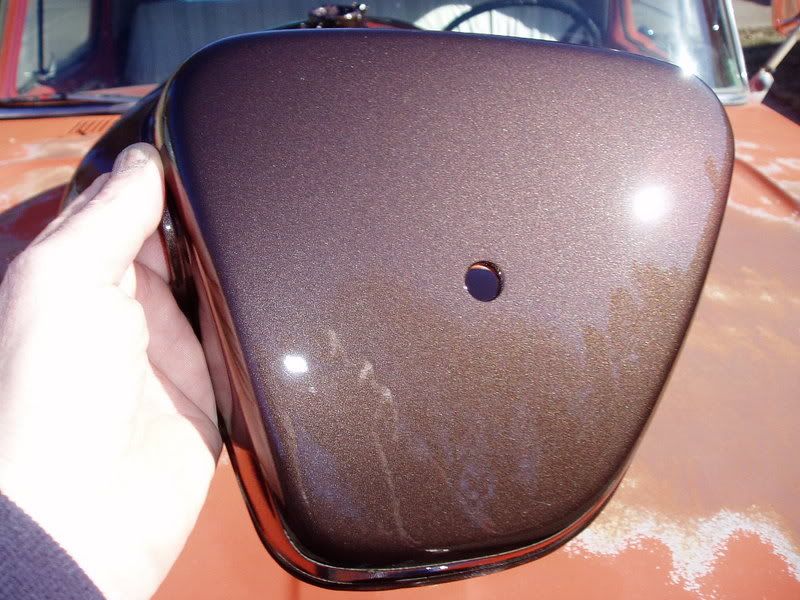
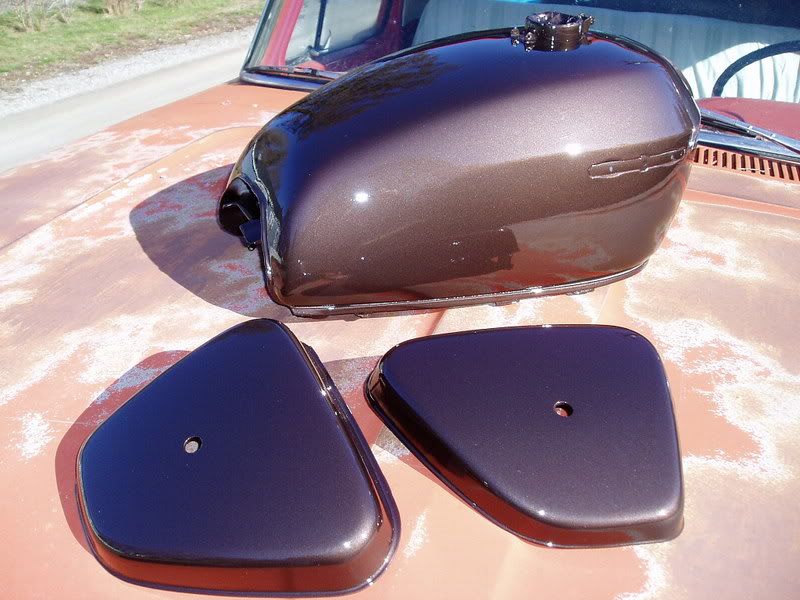
I agree with 90% of the instructions on this thread, and would add a few of my own. If you're spraying a metallic color, you're gonna have to clear coat it if you want any shine or depth to it. Spray a metallic in all directions, criss-cross it, up and down, end to end, side to side. This gets the metallic to lay down evenly. It's also sprayed a little dryer than a solid color. Solids don't need to be as dry or carefully laid out. If you spray a metallic really wet, or in the same direction, that's when you get the dreaded tiger-stripes. Standing back will lay the metallic on top, wetter will bury it a little. The clear coat is what brings it all together. The clear is what gives it the depth and shine, and, protects the metallic. There's no difference in BC/CC or single stage finishes when done. I've done a ton of single stage solid colors, and when properly finish sanded and polished, they look every bit as deep and lustrous as anything sprayed with a clear coat. Clear is really only needed for metallics and candies because you can't sand them w/o disturbing the way they lay. So many people forgo finish sanding and polishing. That's fine if you're satisfied, but the results go from good to great when you do. Today's modern polyurethane paints are very flexible just the way they are, they really don't need flex agents and such for plastic parts. I've had great success just prepping plastic parts exactly like metal parts, priming, block sanding, and painting them all the same. When spraying a single stage, you can buy active reducer which basically has the hardener in the reducer. If you're going to use BC/CC, then you have to buy the hardener for the clear separate. Single stage costs half as much as using clear, but if you want a beautiful metallic finish, you gotta go with clear. Also no need to sand between coats. You're just sanding off what you just put on that way. If your surface is prepped correctly, you won't have sand scratches or imperfections to worry about. Spray the amount you want with 15-20 minutes inbetween and you're good to go. If you get dirt in it, then maybe a little sanding will be necessary after it has an hour to set, but generally, spray 3-4 coats of color, (then the same amount of clear if it's a metallic) let it dry overnight, open it up with 600 the next day, let it breathe for a couple days, finish wet sanding it with progressively finer grits up to 2,000, polish, viola. Here's a few pics of a '74 Honda CB 450 with a brown metallic that I sprayed last night with these techniques. Just needs scuffing with 600, stripes painted, clear coated some more then finish sanded and polished.

P1010342.jpg


P1010343.jpg


P1010339.jpg


P1010337.jpg
 
Last edited:
Back
Top