• Required reading for all forum users!!!

    Welcome!
    Register to access the full functionality of the GSResources forum. Until you register and activate your account you will not have full forum access, nor will you be able to post or reply to messages.

    A note to new registrants...
    All new forum registrations must be activated via email before you have full access to the forum.

    A Special Note about Email accounts!
    DO NOT SIGN UP USING hotmail, outlook, gmx, sbcglobal, att, bellsouth or email.com. They delete our forum signup emails.

    A note to old forum members...
    I receive numerous requests from people who can no longer log in because their accounts were deleted. As mentioned in the forum FAQ, user accounts are deleted if you haven't logged in for the past 6 months. If you can't log in, then create a new forum account. If you don't get an error message, then check your email account for an activation message. If you get a message stating that the email address is already in use, then your account still exists so follow the instructions in the forum FAQ for resetting your password.

    Have you forgotten your password or have a new email address? Then read the forum FAQ for details on how to reset it.

    Any email requests for "can't log in anymore" problems or "lost my password" problems will be deleted. Read the forum FAQ and follow the instructions there - that's what we have one for...

  • Returning Visitors

    If you are a returning visitor who never received your confirmation email, then odds are your email provider is blockinig emails from our server. The only thing that can be done to get around this is you will have to try creating another forum account using an email address from another domain.

    If you are a returning visitor to the forum and can't log in using your old forum name and password but used to be able to then chances are your account is deleted. Purges of the databases are done regularly. You will have to create a new forum account and you should be all set.

Is there a stage 1 or 2 jet kit available for 81 GS850?

  • Thread starter Thread starter nisom512
  • Start date Start date
N

nisom512

Guest
I was just wondering cause I just bought a GS850 and he said that he rejetted it but doesnt know what stage it was and I have never rejetted any thing before so if there is something to look for I dont know what.

I didnt really look much but on bikebandit and Dynojet websites I found a stage 3 kit for it. So I could only assume that, that is what he put in. but does any one have other ideas

So.....
1.how can I tell what jet kit is in there?
2.is there only a stage 3 kit available?
3.the bike has a 2x2into1 exhaust with stock air box how will this run with the kit in there?(the bike isnt running at up yet.)
 
how can I tell what jet kit is in there

When you open up the carbs, there should be numbers on the main jet. The number will tell you what size they are.

the bike has a 2x2into1 exhaust with stock air box how will this run with the kit in there?

No real way to answer this until you get it cleaned up and running. You don't even know if there is a kit in there or if its stock.

is there only a stage 3 kit available

Dynojet list a stage 3 kit for your engine.
 
When you open up the carbs, there should be numbers on the main jet. The number will tell you what size they are.


No real way to answer this until you get it cleaned up and running. You don't even know if there is a kit in there or if its stock.


Dynojet list a stage 3 kit for your engine.

Well I know there is a kit in there he just couldnt remember what stage it was.

Thank you for all the info.
Jake
 
jets for GS850

jets for GS850

Hi there Nisom512,

I have rejet and adjusted needles on many of these old beasts. As a rule, optimum jetting depends on airflow/back pressure, which is determined by air filter type and pipes. If you have a stock setup, you may benefit from a slightly elevated needle position, and one step up on pilot jets. But you may need no adjustment if you live at high altitude (say 5500-7000 feet), where you are all ready running more rich than a lower elevation. If you spend anytime really twisting the throttle ;) you might need bigger main jets as well.

Most GS models were jet somewhat lean particularly starting in 1980, and it can be really bad if you live at near sea level (really lean mixture due to higher air pressure). Do you experience any popping or backfiring (especially when cold), and does it need FULL choke to start even if it is kind of warm, parked for ten minutes? Another symptom is surging or coughing when running constant speed with constant throttle position, typically at moderate rpm under no real load (3000-4000rpm, level steady cruise). Any of these symptoms, and you are probably running lean. Even if the symptoms go away when it really is running at normal temp, you will benefit from some combination of rejetting and needle adjustment. Running a little rich after warmup won't hurt anything, but it will run more smoothly under most conditions.

If the bike starts easily when cold (with choke) and revs off idle smoothly without choke within a minute or so, you probably don't need pilot jet change. If there is any hesitation in transition to midrange (1500-3000rpm), you might benefit from one step higher on pilots, but particularly you probably need a slight needle shim (opens taper sooner). Popping, coughing, spitting ? Sound familiar? If these symtoms go away when it warms up, you are pretty close all ready. Optimum jetting will help low speed control in parking lots, and smooth rollon anywhere in the rpm range. If you don't have this all ready, you will be amazed that your bike can do this when it is jet right.

By the way, Stage 1 is defined as rejetting an unmodified airbox/exhaust setup to optimise your carbs for your elevation, whereas stage 2 is when you modify exhaust like cutting out baffles (or aftermarket header) and increase airflow into the carbs (pods, or at least high flow filter like K&N).

Some call it stage 1 when you adjust jets and needle positions for a header only, and when airbox is eliminated (replaced with filter pods) along with adding a header, call it stage 2. Another important variable is your altitude. I had an 850 in the Rockies (near mile high), and it ran great as stock. The same bike had fits at sea level, because it was just WAY too lean.

What symptoms are you experiencing??

One other question... Is this AFTER 1979 (CV carbs start in 1980) ??

To replace jets, BikeBandit sells them in sets of four, really cheap. You just need to determine how lean it is running. My 1982 GS1100G (CV carbs) now has pods and a Mac 4into1. It needed about a 2mm needle lift, #50 pilots (up from #40 OEM), and #140 main jets (up from #115 OEM). By the way, George Lesho put #42.5 pilots in there, and it was still way too lean!
 
clarification

clarification

I was just wondering cause I just bought a GS850 and he said that he rejetted it but doesnt know what stage it was and I have never rejetted any thing before so if there is something to look for I dont know what.

I didnt really look much but on bikebandit and Dynojet websites I found a stage 3 kit for it. So I could only assume that, that is what he put in. but does any one have other ideas

So.....
1.how can I tell what jet kit is in there?
2.is there only a stage 3 kit available?
3.the bike has a 2x2into1 exhaust with stock air box how will this run with the kit in there?(the bike isnt running at up yet.)

Please forgive me my previous answer. i didn't notice the title of your post (year), that it had been rejet. Now I read your post more carefully. How does the bike run now? To decide if you need rejetting...

First thing is to observe running characteristics.. I've heard people describe too rich as "washy". I would call it faultering and not making as much power as it should, and it might get worse when it is warm (when it needs less fuel to run well). Lean conditions I all ready described. If you are really not sure, maybe you have a dealer or dyno tuner around that has the "sniffer" to see if you are spewing more unburnt hydrocarbons than usual.

Once you have an idea of how it is running in the three circuits-pilot at idle and near idle, needle almost everywhere else, and main jet when you are trying to outrun the cops ;)

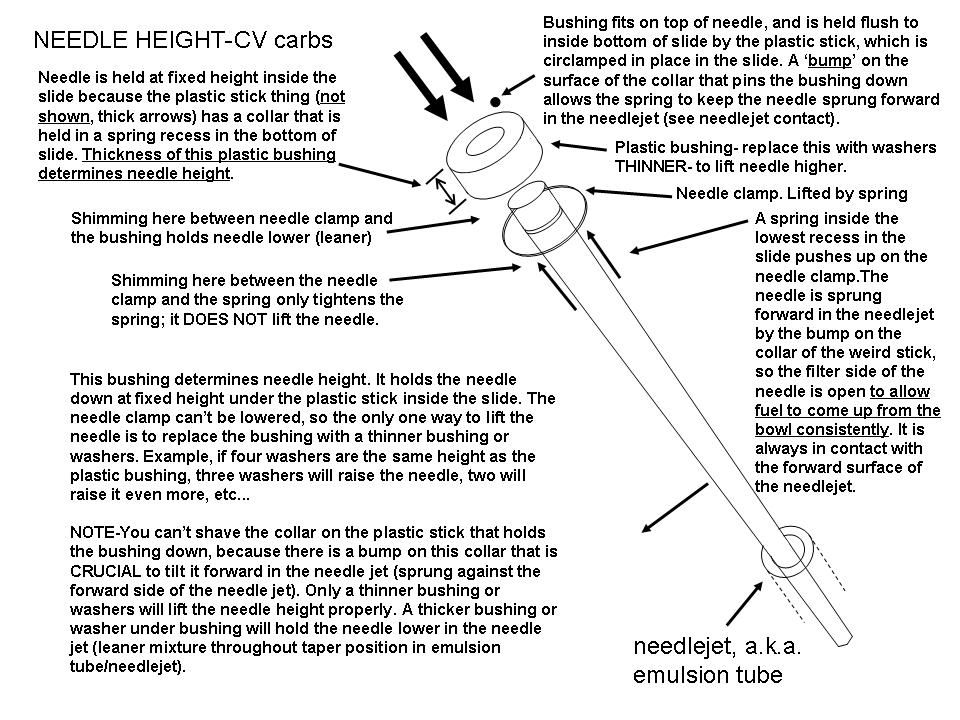
Then take out the carbs (OK, I see it is an 81, so CVs). You'll need to pull at least one pilot to see if you can read the size on it. The mains are stamped on the exposed outer side (bottom). Needle reshim is more involved, because you have to remove diaphram covers, remove the retainer ring in the slide and check to see if the previous owner replaced the little teflon bushing between the needle clamp and long plastic stick/needle pusher thing (ABOVE the small needle clamp ring/circlamp on the needle itself).

I recently (FINALLY) got jetting perfect on my 821100G, and it definitely needed needles lifted slightly. What a difference. If you want to lift the needles, replace the plastic bushing with a thinner bushing or washers (radio shack has a nice assortment pack). Thinner bushing or three little washers allow the needle to be held down at a higher position (less low). Shimming between the spring and needle clamp just tightens the spring, doing nothing to needle height. On VM carbs, that's where you shim, but on the CVs, you have to replace the bushing with a thinner bushing or washer that stack up to a shorter shim than the bushing. It WORKs!

I have a good clear PDF document that shows the thinner shim to lift the needle. It is not the same as it works on the VMs, where you shim BELOW the tiny circlamp on the needle itself.
 
wow thanks for all the info. I will be rebuilding the carbs over the next couple of weeks and will revert to this several times. thank you for the info.
 
post a PDF? help please

post a PDF? help please

I have a PDF with a clear diagram of the CV needlejet with a description of the bushing that holds the needle down, and how to lift the needle. Can someone help me post it?

Nisom512...There is a Sticky at the top of this Technical info section in the Bike Maintenance section that has specs called carb oem spec.... Your 850 may have the #115 mains (unless changed). #40 pilots (1982) or #42.5 pilots (1980) are listed. These will give you starting specifications.

I'll try to get the needle bushing PDF posted. This was a mystery until I took it apart and figured out that a thinner bushing is needed to lift the needle. I used three washers, which was a couple of mm thinner that the bushing, lifting the needle that much (2mm). I understand that you can also just buy a bigger size emulsion tube (needlejet), but this works and it is free (and adjustable!).
 
I recently (FINALLY) got jetting perfect on my 821100G, and it definitely needed needles lifted slightly. What a difference. If you want to lift the needles, replace the plastic bushing with a thinner bushing or washers (radio shack has a nice assortment pack). Thinner bushing or three little washers allow the needle to be held down at a higher position (less low). Shimming between the spring and needle clamp just tightens the spring, doing nothing to needle height. On VM carbs, that's where you shim, but on the CVs, you have to replace the bushing with a thinner bushing or washer that stack up to a shorter shim than the bushing. It WORKs!

I have a good clear PDF document that shows the thinner shim to lift the needle. It is not the same as it works on the VMs, where you shim BELOW the tiny circlamp on the needle itself.


I finally converted the PDF into a JPEG. It got slightly screwed up, but it is still readable. This is a diagram of the needle assembly on the BS series CV carbs , with instructions about 'shimming'. It is very different from VM series needle shimming:

CVneedleheightDiagram.jpg
 
Back
Top