• Required reading for all forum users!!!

    Welcome!
    Register to access the full functionality of the GSResources forum. Until you register and activate your account you will not have full forum access, nor will you be able to post or reply to messages.

    A note to new registrants...
    All new forum registrations must be activated via email before you have full access to the forum.

    A Special Note about Email accounts!
    DO NOT SIGN UP USING hotmail, outlook, gmx, sbcglobal, att, bellsouth or email.com. They delete our forum signup emails.

    A note to old forum members...
    I receive numerous requests from people who can no longer log in because their accounts were deleted. As mentioned in the forum FAQ, user accounts are deleted if you haven't logged in for the past 6 months. If you can't log in, then create a new forum account. If you don't get an error message, then check your email account for an activation message. If you get a message stating that the email address is already in use, then your account still exists so follow the instructions in the forum FAQ for resetting your password.

    Have you forgotten your password or have a new email address? Then read the forum FAQ for details on how to reset it.

    Any email requests for "can't log in anymore" problems or "lost my password" problems will be deleted. Read the forum FAQ and follow the instructions there - that's what we have one for...

  • Returning Visitors

    If you are a returning visitor who never received your confirmation email, then odds are your email provider is blockinig emails from our server. The only thing that can be done to get around this is you will have to try creating another forum account using an email address from another domain.

    If you are a returning visitor to the forum and can't log in using your old forum name and password but used to be able to then chances are your account is deleted. Purges of the databases are done regularly. You will have to create a new forum account and you should be all set.

Looking for any GS shaft drive indepth experience

Redman

Forum Guru
Super Site Supporter
Past Site Supporter
82 GS1100GK 80K miles

Has been having gear noise increasing over last couple years.
Myself, lacking in musical ability, I can not describe if a function of engine rpm or if road mph.
BUt I do know that when change front gear box lube it does quite down the whine some for a while. And the drain lube does have some golden-shiny flecks in it.

Now in recent weeks I have been noticing something of a small shutter sometime when let off the throttle. Happens more at higher rpm. Just a short little shutter, somewhat like ran over a mini-rumble strip, but not comming from the tires.
I can imagine some worn gears somewhere that have some lash that has to be taken up the other way from power on to power off decelerating .... and I can also imagine someday that something is going to go >>ka grunch<< and I'll be coasting to side of the road, with I-dont-know-all-what busted up.

Anybody have similar expereince....?

What replacement parts should I be looking for...?
Or is such a failure gonna blow apart the entire gear box / engine case...?

.
 
Last edited:
I'm working real hard to avoid any in depth experience on the suzuki shafty drivetrain. The 650 layout is different from the others, but they both have a dog clutch/ spring to absorb drivetrain shock, as in mismatch of engine speed to wheel speed. At 55 Kmiles, I've noticed that if I let out clutch in 1st abit quick, I can feel/hear this shock mechanism in action - otherwise it's not noticeable.
If this mechanism wears too much, the secondary bevel drive gears take a beating , maybe those flecks that you find are from the gears themselves. Hopefully, they wear to the point where the noise drives you crazy, before anything else.
Since new parts are unavailable, your choices are limited....
 
I hope you can coast to a stop safely if something happens. On my 1981 GS650L I don't believe that the spring mechanism will wear to much, it is pretty robust. I did how ever break the collar on the gear right at the spring and that took me a while to find the broken collar on the gear. Releasing the spring tension using a tailstock on a lathe allowed me to find the break. There was no noise before it broke and the bike would go through all the gears while on the center stand, but would not budge an inch on 2 wheels. Had me stumped for a bit.
 
Try HERE From ArchiveBy GSShopper 1000
http://www.thegsresources.com/_foru...econdary-Drive-Bearing-Replacement&highlight=
http://www.thegsresources.com/_foru...ndary-drive-quot-driven-quot-shims&highlight=

likely other good things too. I read quite a few things when I had to get in there for secondary drive repair ("zooks syndrome")

Added: Speculating on the sunny-side....if things are going wrong it may show up easily by checking tooth contact. This is a way you might diagnose easily without a complete teardowns-I'm thinking contact will be changing if things are coming loose in bearings etc...Or :) It might be just wanting a removal of or a thinner shim normal wear? (but metal flakes are never a good thing :(
 
Last edited:
Dave, why don't you PM Steve and Brian W directly with your question?
I haven't put enough mileage on mine to have problems yet.
 
Last edited:
Here and in person, I've seen two failure modes:

1) The output flange breaks off

2) The bearing at the rear of the secondary drive fails -- basically, the bearing supporting the output flange.

Quite often, these also lead to gear oil leaking into the swingarm boot.

You can diagnose either one by peeling back the rubber boot at the front of the swingarm and wiggling stuff with a large screwdriver. If you can get the output flange to move around at all (other than rotating normally, of course), it has failed.

And yes, it is possible to remove the secondary gearset with the engine still in the frame.
 
a_2wD7ShQvPLnccOqxxviPpJ547s8hPek96SWtVyOX2RCMr2XT-60Zz2vfcx26rmn6gFslBJEC7IrPiWqqytKsc9Za-Oppj4Mm6qJi08fPMp3CkDwzhhe-pgVPSI14IWkgUk_eFtsiE'
IGC96vfCZyuKmIaGyiz-movwWqjYMdF2HIX8RuQaoqTePqTbZ-4JPGSXswmBhwDhPFCpXU28_a_dUD85n6qmeTQmodbpbtigEZMgjxI2fCfS5ZacV87Ij4V6-oFEFoQ1RxgLHBZKems


J8mChAgZjWGzu3o8ys55-tVprzOBkrc9NR9UXbhd3ck7ci9qHDyAKLQKSc6MWZBF-Ygd1_CwEeXWe1F9gHgk9kywGWoYKBaIV9JSFiWQq3meJj41kI5WgrfCSDBoOJbCE7Hxy-XPouU


Ql7dHvk5anS-PBM4AvHoUuvOdZhf0s4CavnxZbgbbX0yW1LyvnQ9O_TvINflYhurQ9bQZ6aeDUBLYvYDUcUCxy1jCVgSoa1_iUUv4hGXCHZer0Q49UOmdNzr3u8Ye73e8Cd_VPxFpoQ
 
...
have a dog clutch/ spring to absorb drivetrain shock, as in mismatch of engine speed to wheel speed......

Thanks.
Am not finding such in info I have on GS1100G (&GK).
ALthough I do know that the 650s have some things unique to the 650s....

.
 
I hope you can coast to a stop safely if something happens. .......

I have been pondering that myself.....

Need to look into "color on the gear".... not understanding at the moment.

.
 
Here and in person, I've seen two failure modes:

1) The output flange breaks off

2) The bearing at the rear of the secondary drive fails -- basically, the bearing supporting the output flange.

Quite often, these also lead to gear oil leaking into the swingarm boot.

You can diagnose either one by peeling back the rubber boot at the front of the swingarm and wiggling stuff with a large screwdriver. If you can get the output flange to move around at all (other than rotating normally, of course), it has failed.

And yes, it is possible to remove the secondary gearset with the engine still in the frame.


Thanks Brian,

Thanks for sharing your expereince and knowlodge. I an trying to study your comments here in great detail.
But, I am comming to the conclusion that I will first need to learn some more about all this.
Such as first learn what all is in there, and what those parts are called.
And what is in where, and what is accessable by doing what. And what comes apart where. (THese exploded views are not good for that....)

Am starting by looking here
27E25AE.jpg


Ot45jWy.jpg


CB9sedf.jpg


Hum.... that section and the section on transmission of my Clymers manual is clean. Most all other sections have greasy smudges ..... some significance there.
I have always said "I never want to see transmission gears".

At the moment, I begine with learning "Primary", verses "secondary" verses "final".... I had always thought of only "front" and "rear".... so that tells you of where I am on the learning curve.

Other thing: The clymer manual says about "many special tools and considerable expertise". (Maybe I should not have read that.)

I shall investigate this all more.
 
Last edited:
Try HERE From ArchiveBy GSShopper 1000
http://www.thegsresources.com/_foru...econdary-Drive-Bearing-Replacement&highlight=
http://www.thegsresources.com/_foru...ndary-drive-quot-driven-quot-shims&highlight=

likely other good things too. I read quite a few things when I had to get in there for secondary drive repair ("zooks syndrome")

Added: Speculating on the sunny-side....if things are going wrong it may show up easily by checking tooth contact. This is a way you might diagnose easily without a complete teardowns-I'm thinking contact will be changing if things are coming loose in bearings etc...Or :) It might be just wanting a removal of or a thinner shim normal wear? (but metal flakes are never a good thing :(

Thanks.

Good material to help in my learning.

Is that what I looked at, but had the photobucket problem... and then was comments about updating that... but not seeing those comments now....

...
 
What do you see when you peel back the boot on the swingarm and look and wiggle things?

The problems that have been seen are with the output side, which is everything on the top half of the "Secondary Bevel Gear Assembly" diagram. This is all one assembly held together by the nut #17 on the shaft, the top half of #1.

One of the problems I was talking about was the large bearing at the end, #12 in that diagram. If this bearing gets damaged or fails, it will also take out the seal.

I think the more common issue, or the root of the issue that will also damage the bearing and other parts, is when the threaded part of the shaft (two shafts are marked #1; I'm talking about the top one) breaks off. The output flange (#15) is still engaged with the splines and can't really go anywhere, and the nut is trapped between the output flange and the driveshaft flange. But without the nut keeping tension and holding everything together, it makes noise and clunks and will soon destroy itself. That shudder on decel is the bit that concerns me -- it's one of the symptoms of this issue.

Diagnosis is easy. Peel back the swingarm boot and look and poke and wiggle things. Wiggle the output flange around with a screwdriver or small prybar. Any motion other than normal smooth rotation means it's stuffed, knackered, cabbaged.

You can replace the output side of these gears as a unit with the engine in the frame -- remove the swingarm, and it's held in with four bolts. You may need to loosen the engine mounting bolts a squidge to create a little clearance. It also may help to loosen the nearby case bolts a little. A little symmetrical prying and it'll slide out.

What to replace it with is another matter -- it's hard to find just this unit on the ol' FleaBay by itself, but a little part number research may be needed to wident the pool of compatible donors. I know, for example, that the output flange and driveshafts are verrrrrrry slightly different but incompatible on the early GS850 (79-81) vs the later (82+) models. Guess how I learned this... But anyway, I've pulled this assembly out of an '83 engine and transplanted it into an '82 with no issues.

Other than the potential for the threaded part to break, this is an enormously robust mechanism and the gears are ridiculously oversized. They should never really develop detectable wear or need reshimming.

Not sure about the 1100G/GK/GL models and what interchanges, but a few minutes rummaging through the parts fiches should make it clear.
 
Last edited:
Thanks.

Good material to help in my learning.

Is that what I looked at, but had the photobucket problem... and then was comments about updating that... but not seeing those comments now....

...


Redman,here. I made a PDF INCLUDING pix and put it on Google Drive you (or anyone else) should be able to get it... You might have to look around for the "download as pdf" -I can't tell what the page looks like in other browsers than firefox but so far has worked when I put stuff there. Any Problems report back as I haven't tested.

https://drive.google.com/file/d/0B3KPMO1yGVgrWS00Mnl5MWZCOHc/view?usp=sharing
 
Redman,here. I made a PDF INCLUDING pix and put it on Google Drive you ..........
Looks good. Have it stored. Thanks.


What do you see when you peel back the boot on the swingarm and look and wiggle things?

.............
Brian and All,
Thanks.

Have been working extra overtime and extra days. Wife has been gone a few days.

Have some time this afternoon.
Bushes well over due for trimming. Lawn needs mowed. Garage needs to be re-stained. Dishes piled up in sink. Laundry baskets full. But that all can wait.

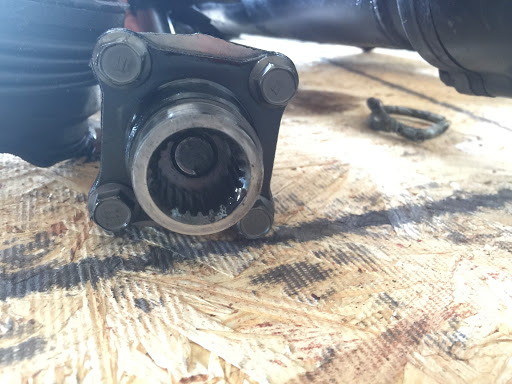
Got out into the garage and got the boot pulled back, some.
O5BS3K6.jpg

A few drops of thick black oil dripped out, does smell like the gear oil, and is some, but not alot, black thicker stuff in bpttom of the boot.
But everythihng inside looks clean (before I got my greasy fingers in there), so the oil was just on bottom of the boot.

Could get fingers on things, can turn/spin a just a bit before it is trying to turn the wheel.
Could not make any up/down or side/to/side klunking around.

Will see what else I can observe.

>> later note.

If got fingers from both hands in there, can try harder to push things up/down and side-to-side, all seemed good there, but... could push things back and forth (rear to front), a good 3/8th inch.... maybe that is terrible... eh? Or maybe not, I see on part fisch digaram that are splines there to allow for such.... but that is just my ignorant guess.

.
 
Last edited:
.......................................................
........................................................................ But without the nut keeping tension and holding everything together, it makes noise and clunks and will soon destroy itself. That shudder on decel is the bit that concerns me -- it's one of the symptoms of this issue.....................

Ah, the shuddering on decell is getting worse (maybe 3 hundred miles), now instead of just a occassional brief (1/2 second) shudder on decell, is a more frequent occurance on decell and last longer maybe a full second or so. But no klunking sound, just the prevalent whine/whirr/widdle sound (that I cant say is rpm or speed related).

I still need to understand this better. Thanks for the great explaination. I do need to study it again, some more, again.
Am starting to see how the output portion of this is something of one unit.

Is the "destroy itself" include destroying more than "itself"....? As in, I should not take a chance on that happening?

(I have had one van and one car that both had gear whine from rear end differentail, in both cases every mechanic said it can do that for 10s and 10s of thousand miles without a problem, might just get louder. Maybe that experience is causing me to be too casual about this. )
 
Last edited:
When my '83 started whining I pulled the drive bevel gear out and found the driven gear was loose.
Lost all preload from the stud breaking off.
The drive gear is easy to remove and gives you a little window to see whats going on in there. If it has damage to it you can bet the driven has also.
 
Ok, am starting to understand this better.
Am better correlating what see in microfisch with what is what on the bike, and learning the names.

ggP5ErW.jpg


THe "Drive" gear/assembly is driven by the transmission (transmission and shaft not in diagram so I sketched that in. that was the main thing I was missing).
The "Drive" gear/assemmbly drives the "Driven" gear/assembly.
THe "Drive" gear/assembly is more like part of the transmisson, and goes across the back of the engine. ( I will not see that unless pull engine and split cases, which is why I have always said that I never want to see my own transmission gears.)

The "Driven" gear/assembly drives the flange (15)that bolts up to the drive shaft u-joint.
The "Driven" gear/asembly is what points back toward the shaft, and can be accessed by pulling rear wheel, and taking off the drive shaft.

Okay, that is what others have said already .... but I was getting tripped up by the names and not understanding where the transmission entered into all this.

The Driven gear housing (18) and mounting bolts (22) are what can see when first pull back the boot, can be seen there by my thumb in my photo.

The flange (15) is what can get my fingers on when stick fingers in the boot.

Okay, now can better interpret and understand what folks are saying.

.
 
Last edited:
Back
Top