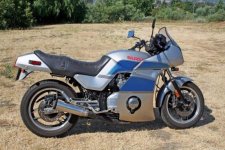
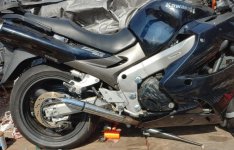
I used the Regulator/Rectifier off of a Kawasaki KZ "Something Huge". It's a massive unit with heat sink fins. That takes care of any heat under Ohm's Law( P/IxE) I put it in the battery box bay, making a special bracket to hold it, removing the useless tool tray, all the stuff fits in the tail piece. I haven't a problem in 15 years with it, and the extra voltage is nice. I use Iridium Spark plugs, which seem to give a better combustion, but that could be psychological. I just replaced the clutch, and at 120 mph, that bike is biting really hard. I realized it had been slipping, just didn't notice it. The wiring loom on that bike has too many feet of extra wiring. I haven't had to touch anything else. I purchased 2 extra CDI units at $35 bucks ea., when people didn't know that the one for that bike was a one year model, now they are insanely expensive, but my stock one works great.
Suzuki grounds the bike to the engine with a bolt attached to a painted engine. They relied on the threads to provide ground. This is problematic. The threads corrode The area under the bolt head should have been bare metal. On my bike I sanded off the paint, put a new bolt in, and that fixed the grounding problems. The problem with too many grounds is that you get Voltage Drops, and the grounds may not be grounding at all the same levels. I used to work on aircraft, and those Piper Cubs, made of Steel Tube and cloth were really hard to ground. Some people would run a block of copper, and solder a bunch of grounds to it, and then wonder why their radio sounded like crap. The proper way is to use insulated sheets of copper, with one bolt connecting all the sheets for conducting, and all grounds go to that one bolt. This prevents Hysteresis (just like it sounds, the electrons don't know which way to go) but having one point prevents this, and your radio becomes completely silent. I repaired a Piper Super Cub that had a Garmin Radio Stack that cost more than the plane, artificial Horizon, the works, but Garmin did the ground bad. After I fixed it, we turned it on, and all the lights came on but there was no sound, we did a Tower call in test, and they replied loud and clear. The same thing applies to a motorcycle, all the grounds should go to one spot, and then to the battery negative. It would make the components last longer and corrode less.
My bike is a survivor. I have 40K miles on it, I purchased it new. I can imagine I should be putting in valve stem oil seals soon, but it doesn't smoke, and I am meticulous about oil changes. I have always used Valvoline oil. I use that in all the car I flip. I used to rebuild and flip Mercedes Benz's a lot. Presently I have a '73 M.G. Midget that I blueprinted the motor, added forged pistons, 10 degree more duration Kent Cam, and a Side Draft DCOE 40 Weber Cam. I also have a Mallory Dual Point Distributor for it.
I also own a Honda CB400F with a Kaz Yoshima 458 c.c. Stage III engine in it. I was clocked at 135 mph on that bike, I was a lot thinner then, 14,500 r.p.m.red line. That bike has 8K on the engine, Gold anodized aluminum D.I.D. rims and aluminum Koni shocks. It's in storage, pickled away in my Barn. Kaz also turned my stock carbs into Hollow Throttle bodies and flow benched the head to the exhaust he hand bent for me. The bike is from 1975, not for sale, going to my son, as is my Suzuki and my ZZR1200. My brother in law met Kazio Yoshima at a trade show, and I got an in that way, and ended up with one gem of a CB400F. It has a lot of other mods, too many too list.