• Required reading for all forum users!!!

    Welcome!
    Register to access the full functionality of the GSResources forum. Until you register and activate your account you will not have full forum access, nor will you be able to post or reply to messages.

    A note to new registrants...
    All new forum registrations must be activated via email before you have full access to the forum.

    A Special Note about Email accounts!
    DO NOT SIGN UP USING hotmail, outlook, gmx, sbcglobal, att, bellsouth or email.com. They delete our forum signup emails.

    A note to old forum members...
    I receive numerous requests from people who can no longer log in because their accounts were deleted. As mentioned in the forum FAQ, user accounts are deleted if you haven't logged in for the past 6 months. If you can't log in, then create a new forum account. If you don't get an error message, then check your email account for an activation message. If you get a message stating that the email address is already in use, then your account still exists so follow the instructions in the forum FAQ for resetting your password.

    Have you forgotten your password or have a new email address? Then read the forum FAQ for details on how to reset it.

    Any email requests for "can't log in anymore" problems or "lost my password" problems will be deleted. Read the forum FAQ and follow the instructions there - that's what we have one for...

  • Returning Visitors

    If you are a returning visitor who never received your confirmation email, then odds are your email provider is blockinig emails from our server. The only thing that can be done to get around this is you will have to try creating another forum account using an email address from another domain.

    If you are a returning visitor to the forum and can't log in using your old forum name and password but used to be able to then chances are your account is deleted. Purges of the databases are done regularly. You will have to create a new forum account and you should be all set.

Valve clearance, Valve seats, small oil leak, low compression, please help.

  • Thread starter Thread starter Rahmanberrada
  • Start date Start date
R

Rahmanberrada

Guest
Hi everyone,

I purchased a 1982 Gs650G 2 weeks ago with 12,000 miles in good running condition and am currently working on making sure everything works CORRECTLY.
Here is a list of what has been done to it:

- Fuel tank professionally De-rusted.
- New petcock installed.
- Ran 2 fuel tanks with 2oz of Marvel's Mystery oil in each.
- Performed an oil change and added 4oz of seafoam to loosen up all gunk and carbon in the engine. Will perform another oil change tomorrow (total of 300 miles on the first oil change)
- Completely rebuilt the carburetors back to OEM Spec.
- Changed the intake boots and air filter (No current air leaks)
- Soaked the cylinders in Marvels Mystery oil overnight (all cylinders were low on compression), Will perform another test soon to see if compression went up.
- Reset the timing chain Tensioner
- Carbs are synchronized
- Timing is check and set correctly
- Checked all valve clearances --> the following are the results of the calve clearances and questions to follow:

5 out 8 clearances were on point. 3 were not.
Cylinder 1 intake and exhaust were both too tight
Cylinder 4 Intake was too tight.
I know that you are supposed to change the shims in order to get the clearance back to spec, I also know that is the clearance is too big, you will get excessive noise, and if it is too small, you might be losing power.
I have a technician who is performing the work with me for free (labor of love, and is also a great friend of mine) my question is as follows:

- the feeler gauges that I have only go down to 0.03mm and that is too big the current gap.
- Tech says that I should leave it as is because of the following: -- in the early 1980s, Leaded gasoline was being phased out in the US and Unleaded gasoline was being phased in. Given that lead was also used as a lubricant, we are contemplating that the 1982 GS650G was meant to be used with leaded gasoline and that the valve seats were not hardened and therefore the valves are being pushed into the head and that is what is causing the gad\clearance is get smaller.
If we were to change the shim to a smaller size in order to increase the clearance and bring it back to spec, this will only make the problem bigger by allowing more room for the valve to dig into the head.

Other things to consider, every time I check the spark plug on Cylinder 1 (Which has both the intake and exhaust gaps too small) there seems to be a little bit of oil on the plug.) The oil is not enough to cause any smoke but something for you guys to know as you help me figure out the issue here.


Can anyone give any feedback to my problem please, any information is greatly appreciated. :)
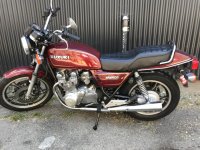
 

Attachments

  • IMG_1528.jpg
    IMG_1528.jpg
    100.4 KB · Views: 0
As for the oil, it's time for the next compression check to compare to the first
An oily plug can indicate time for rings or a failed valve guide.
I think all Suzuki 4 stroke engines had hardened seats to accomodate unleaded fuel, hopefully someone here can confirm. To little clearance will get you a burned valve. Best play to run is get 'em in spec as a rule.
on another note... great looking bike.
 
"Labor of love" or not, he is not doing you any favors by offering you advice like that. The specified clearance is VERY small. In fact, the maximum clearance is only the thickness of a piece of paper. The minimum is about one third of that. If you can't fit your 0.03 feeler, you might have NO clearance, which means that the valve does not spend enough (any?) time on the seat to cool off. This will burn the valves and likely damage the head. You are far better off with LARGER clearance, many of us will go up to 0.10 as a maximum.

Also have to ask: did you check the clearances properly? Using the FACTORY manual? :-k
All the manuals have a goofy picture saying 'the cams must be in one of these positions to check clearances', but the factory manual is the only one that goes a step farther to say that you align the lobes in a certain position, then check BOTH valves on that side. Rotate the crank 180?, the next two valves are lined up. Rotate another 180?, the third pair is lined up. A final 180? rotation will line up the last pair. If you didn't do it that way, please do yourself and your bike a favor, go back and do it right.

How did you "completely rebuild the carbs back to OEM spec"?
Hopefully you did not get rebuild kits. If you did, they are NOT "to OEM spec".

.
 
If a valve stays open just a little bit it will burn. Zero clearance is bad. Even if the lead story were true the way to fix it is additives for the fuel or having new valve seats put in the head. Leaving the clearances a bit loose is no big deal. It's safe and maybe shifts the power distribution curve a bit.
An easy way to tell the difference between too tight for the feeler and zero clearance is to see if the bucket can rotate freely under the 'tight' lobe.
It's important to follow the manual procedure to the letter. Many old hands will instinctively want to point the lobe away from the bucket but Suzuki are quite specific in the method. The camshaft has some movement and depending on how and where it feels the valve spring forces the clearances are different.
It's not clear what sequence you did all the work on the bike and whether the carbs were balanced or just bench synched but just remember that if valve clearances change or sticky rings free up and improve compression the carbs will need a balance check as the airflow is now different.

As for the oil on No. 1. The two main ways oil finds it's way into cylinders is either the rings are sticking and not sweeping the oil or there is a valve stem leaking. Stuck rings is consistent with low compression if a wet test makes it better. What compression numbers did you get wet and/or dry? That motor is probably in original condition and the seals on the valve stems could be hardening up. One way to check for leaky exhaust stem is to remove a header and have a look in the port at the valve. If it's not smoking it's probably best to ignore it for the time being. When it needs doing you will have smoke for a minute or two at startup and then it clears.

You don't say anything about the electrical system. Get to posplayrs sig and start doing tests. You will save yourself a whole lot of trouble by ensuring that the charging system is not going to self destruct and that the voltage drops at the ign, kill switch and fusebox are minimised. Ninety percent of carb trouble is electrical :)

Good luck with it
 
Last edited:
I've got nothing to add other than to be sure to seek out Basscliff's website and get a copy of the factory Suzuki manual for your bike. Inside you will learn the answer to the fuel question and how to position the cams properly during valve adjustment. Dollars to donuts your mechanic positioned the cams wrong and you have more tight valves than he thinks. Oh, and the Kawasaki KZ engines, which the GS engines are based off of, use valve clearances up to double that which Suzuki specified. In other words, you can safely extend the valve clearance range upwards from .08mm to .12mm or even more safely. And no, the valves won't hammer into the seats. The valve acceleration is based on the angle of the cam ramp shape, not based on the base circle clearance.
 
Answers to the 1st 4 comments:

Scratch,
Thanks for your input on the hardened seats, we tried looking at pictures of the gs650g heads online as well as contact the dealership to see if they had any comments or info on it and we can't seem to find any. The only reason we didn't take the head off is because this is my daily rider vehicle and we didn't have enough time that day to perform that operation.

Steve,
It might have been my fault regarding the clearances as it was 98 degrees out yesterday and i rode the bike for about 45 minutes to get to his place where we did the clearance check, he warned me about making sure the bike was cold but also wants me to learn on it. That being said, he did say that it should be checked when the engine is cold, I am at home today and will perform the check again with the manual in hand. I was too ambitious last night and wanted to get as much done as possible.
Regarding the advice he gave, it wasn't a "JUST FORGET ABOUT IT" comment as much as : Let's make sure we eliminate the possibility of any other issues before we open up the head.
We also have 2 other bikes were working on (1982 Gs650GL and 1081 Gs650G) that are in bad shape and will take time to redo.
The Carbs were REBUILT by a shop from the last owner, We didn't rebuild them as much as tear them apart and thoroughly clean them again, I misspoke.

Brendan W,
Checking today to make sure the test is done again according the manual.
Also, that did you mean by 90% of carb trouble is electrical?

Nessism,
I do have an electronic as well as paperback copy of the manual, good to know that the clearances can go as high, This is all new to me as I recently started getting into motorcycle and am falling in love with the maintenance part of it, of course as well as riding!

Thanks again for all your inputs, :)
 
Checking today to make sure the test is done again according the manual.
Also, that did you mean by 90% of carb trouble is electrical?

Tongue in cheek comment. However a lot of poor running/starting, especially cold, is simply down to insufficient coil voltage and some people will tear down a set of carbs before checking the voltage at the coil supply plugs.
 
I am going to make a few comments and insert them in your post. :-k
Answers to the 1st 4 comments:

Scratch,
Thanks for your input on the hardened seats, we tried looking at pictures of the gs650g heads online as well as contact the dealership to see if they had any comments or info on it and we can't seem to find any. The only reason we didn't take the head off is because this is my daily rider vehicle and we didn't have enough time that day to perform that operation.
Please keep in mind that if you remove the head, you shoud also remove the cylinders to replace the base gasket. Even if you exercise extreme caution while removing the head, you WILL disturb the base gasket. The general concensus here is that you should use OEM gaskets. Others might be acceptable, including Vesrah and Cometic, but we all agree that you should NEVER use Athena gaskets.

Steve,
It might have been my fault regarding the clearances as it was 98 degrees out yesterday and i rode the bike for about 45 minutes to get to his place where we did the clearance check, he warned me about making sure the bike was cold but also wants me to learn on it. That being said, he did say that it should be checked when the engine is cold, I am at home today and will perform the check again with the manual in hand. I was too ambitious last night and wanted to get as much done as possible.
Even if you have not run the bike for a full week, if you push the starter button to hear it run just before you check the clearances, it's already too warm to check them accurately. I don't know if anyone has bothered to check cold clearances, then warm up the engine to see which way they change, and how much, we just adjust them COLD.
Regarding the advice he gave, it wasn't a "JUST FORGET ABOUT IT" comment as much as : Let's make sure we eliminate the possibility of any other issues before we open up the head.
There is no need to "open up the head" to adjust valve clearance. You already have the valve cover off, it's just a matter of choosing which method you are going to use to remove the shims. I would also suggest you take advantage of the offer in my signature.

We also have 2 other bikes were working on (1982 Gs650GL and 1081 Gs650G) that are in bad shape and will take time to redo.
The Carbs were REBUILT by a shop from the last owner, We didn't rebuild them as much as tear them apart and thoroughly clean them again, I misspoke.
You never know what a shop will do, they are just as likely to throw in "carb rebuild kits". Easy way to check is to look at the main jet to see if it is genuine Mikuni. It will have a trademark of two squares, one inside the other.

Brendan W,
Checking today to make sure the test is done again according the manual.
Also, that did you mean by 90% of carb trouble is electrical?

Nessism,
I do have an electronic as well as paperback copy of the manual, good to know that the clearances can go as high, This is all new to me as I recently started getting into motorcycle and am falling in love with the maintenance part of it, of course as well as riding!

Thanks again for all your inputs, :)
 
……....- Tech says that I should leave it as is because of the following: -- in the early 1980s, Leaded gasoline was being phased out in the US and Unleaded gasoline was being phased in. Given that lead was also used as a lubricant, we are contemplating that the 1982 GS650G was meant to be used with leaded gasoline and that the valve seats were not hardened and therefore the valves are being pushed into the head and that is what is causing the gad\clearance is get smaller.

In all the Factory Service Manuals that I have seen, the recommended fuel to use is actually "unleaded or low-lead gasoline".

I suspect that your technician friend is thinking of cars with cast-iron cylinder heads, in which the valve seats were not separate inserts, but just machined into the head itself. In this case he is correct that the lead in the fuel acted as a lubricant, and that the use of unleaded fuel could lead to accelerated valve seat wear.

However, the alloy cylinder heads of our GS's have separate valve seat inserts which are not really prone to wear from using unleaded fuel, and that is why the factory recommended the use of unleaded fuel. Significant damage will however be caused by too small valve clearances which will result in burnt valves, as others have described.

I suggest that you should not be too hasty in deciding that the cylinder head needs to be removed (just to inspect the valve seats??). First get all the maintenance done correctly and ride the bike as much as possible. With only 12,000 miles on the clock, the bike has been standing for long periods of time. Regular use will free up the piston rings again and burn away possible accumulations of carbon. Only then should you decide if it is necessary to remove the head, based on measurement of compression; oil usage; general performance; etc. Having done only 12,000 miles, it should really not be necessary to remove the head unless there has been damage from burnt valves etc.

Good luck!
 
Back
Top