• Required reading for all forum users!!!

    Welcome!
    Register to access the full functionality of the GSResources forum. Until you register and activate your account you will not have full forum access, nor will you be able to post or reply to messages.

    A note to new registrants...
    All new forum registrations must be activated via email before you have full access to the forum.

    A Special Note about Email accounts!
    DO NOT SIGN UP USING hotmail, outlook, gmx, sbcglobal, att, bellsouth or email.com. They delete our forum signup emails.

    A note to old forum members...
    I receive numerous requests from people who can no longer log in because their accounts were deleted. As mentioned in the forum FAQ, user accounts are deleted if you haven't logged in for the past 6 months. If you can't log in, then create a new forum account. If you don't get an error message, then check your email account for an activation message. If you get a message stating that the email address is already in use, then your account still exists so follow the instructions in the forum FAQ for resetting your password.

    Have you forgotten your password or have a new email address? Then read the forum FAQ for details on how to reset it.

    Any email requests for "can't log in anymore" problems or "lost my password" problems will be deleted. Read the forum FAQ and follow the instructions there - that's what we have one for...

  • This forum is for placing reviews for parts, accessories, gear and service as it relates to your GS motorcycle. The key here is "GS Related". There is a bit of latitude here but we don't want to see a review on Maytag washers just because that's what you use to clean your riding jacket in.

    Keep your review as factual as possible and please refrain from personal attacks. Posted articles will be reviewed by the Editors and may be removed at their discretion.

    So let's make this a useful addition to the forum! A special pat on the back goes to Hap Call for coming up with this great idea.

    The views expressed in this forum are those of the authors and do not necessarily reflect the views of "The GSResources" or the editors.

  • Returning Visitors

    If you are a returning visitor who never received your confirmation email, then odds are your email provider is blockinig emails from our server. The only thing that can be done to get around this is you will have to try creating another forum account using an email address from another domain.

    If you are a returning visitor to the forum and can't log in using your old forum name and password but used to be able to then chances are your account is deleted. Purges of the databases are done regularly. You will have to create a new forum account and you should be all set.

Vesrah Gasket Set Failure

#1. overheating rubber totally cooked to stiff solid (350++ F. degrees)

Nope. The engine ran beautifully, still runs beautifully, and has never overheated in the slightest.


#2. under torque - due to not re-torquing after multiple heat cycles - the cylinders moved between the head and case block breaking the brittle overheated paper.

Nope. The gasket was not overheated, and the cylinder head was faithfully re-torqued at the specified mileages.


#3 over torque can do similar effects to the base gasket too.

Nope.


I have used veshrah for many many years. I have torn down my own engines years after the build- kawasaki dealership work order history - air and liquid cooled engines- to have all o rings in plyable condition and lots of work scraping the base gasket that sealed itself to the aluminum.

I have also used Vesrah many times with excellent results. The reason I posted originally is that this is a recent and surprising change for the worse in the quality of their materials and manufacturing. I have no way of knowing if its an isolated case, or just one bad lot.


I have yet to have any complaints to the quality of the vesrah product.
never got a bad set in over 18 years.

See above. Now you've seen a credible complaint, a couple of them, and I definitely got bad parts, specifically the o-rings. I suspect there are many other bad sets out there as well.


heat and pressure will turn coal into diamonds. heat and pressure damaged your gaskets and o rings. (or lack of proper pressure)

Nope, shoddy materials destroyed the o-rings and the gasket. The engine was never over heated, and nothing was ever over- or under-torqued.

As I posted above, the cam chain tunnel o-ring crumbled to powder when touched. Yes, it was properly installed. No, I did not attack it with a blow torch at any point. To be fair, this area was not leaking -- the head gasket was sufficient to seal it.

However, the o-rings at the rear corners were badly swollen, and the base gasket was extremely brittle, and shattered to pieces at a touch -- more brittle than I've seen any OEM gasket, even on engines 30 years old.

The corner o-rings swelled and softened to the point that they crumpled inward and allowed oil to contact the base gasket, whereupon the oil started seeping from a crack in the brittle base gasket.

After sitting on my bench overnight, the o-rings returned to a more normal size, but were still damaged. I have compared new Suzuki o-rings directly with new Vesrah o-rings, and the vesrah o-rings are smaller in diameter and thickness. The Suzuki o-rings I installed fit perfectly in the space available, while Vesrah o-rings have excess room around the o-rings.


One other possibility you didn't mention was chemical attack. At no point was there anything except clean engine oil in my bike, and no, there was never a gasoline leak or any gas in the oil for any reason. No harsh chemicals were ever used to clean the bike, nor was a hot engine ever sprayed with cold water. The bike was ridden daily and perfectly maintained, although I will admit that I rarely clean it.


better luck next time and get rid of the haynes/clymer toilet paper books- they cause more trouble than they solve for non trained technitions.

Nope. The manuals had nothing to do with poor o-ring and gasket materials, and their instructions and specs for installation and torquing the gaskets, o-rings, cylinders, and head are identical to the factory manual. I am far from inexperienced.

Luck's got nothing to do with it and there won't be a next time -- I will not purchase any more Vesrah gasket kits, and I carefully described my experiences here so that others may have the information to make their decisions.

My conclusion based on many past good experiences with Vesrah gasket kits is that Vesrah recently started using shoddy materials in parts of their gasket kits, and therefore should not be used. You can use the information I've presented and make your own conclusions.

Perhaps they've fixed the problems, and perhaps they haven't. It's not worth the risk to me, and I've since learned that the Suzuki gasket kit is far more complete as well as higher quality, and is thus a much better value. Suzuki gaskets also fit much better.

I actually have an unopened Vesrah gasket kit that I bought when I was preparing to fix the base gasket leak. When I disassembled the engine and found the defects, I ordered OEM gaskets and o-rings before reassembling the engine.

I don't feel that I can ethically sell a potentially defective gasket kit to anyone else, so it remains on my shelf unopened. I might use one of the case gaskets from the kit at some point, but never any of the internal gaskets or o-rings.

(But if after reading all this, someone is still convinced that Vesrah gaskets are high quality, I'll make you a great deal on that Vesrah kit... :D )

I installed Suzuki o-rings and base gaskets last September and the base gasket area has remained oil-tight for the last 6,000+ miles. This rules out the casting or gasket surface defect theory.

However, I made the poor decision of installing a Cometic head gasket since I could not source a Suzuki head gasket at the time, and the shoddy Cometic head gasket is now weeping around the corners where the oil passages are. So far, not enough to drip on the ground, but enough to make the sides of the engine dirty. I'll get annoyed enough to replace the head gasket with a Suzuki OEM item at some point soon.
 
Last edited:
So now I have a question... gasket sets for my '81 450 are now discontinued and I've had no luck finding a NOS one at this point.

I believe I can get Athena ones pretty easily here in Aus, but I also have yet to finish compiling the list of all internal gaskets individually to see if I can get NOS ones.

So if I can't source NOS ones, what's the best option? Get some gasket paper and cut my own? Athena?
 
The paper gaskets from all the established names seem to be ok. It's the head gaskets and rubber seals that seem to be causing problems. Having said that, I've used Athena sets quite a few times and they've been fine with everything (though not 100% complete - the odd seal etc missing).
 
Thanks Hampshirehog. I've done searches around here and have found mixed results and opinions on Athena.

Anyways, I'll finish my gasket list and see what I can get NOS first. Won't be cheap in the short term, but might solve a lot of frustration down the track.
 
Replaced a leaky head gasket on the 550 with a Vesrah less than a year ago. Sunday we looked down at Ryan's boots after he had ridden it a little bit - they were very shiney. Uh-oh. Took a look and sure enough - leaking - on both left and right sides. #$(*#&
 
Last edited:
I have no experience making gaskets, but I have five years making rubber sealing devices. When we introduced a new product for an OEM, Asian copy cats would have a look-alike on the market within a few months. Those parts were in no way equivalent to what we made. The problems with Brian's gaskets were probably from making them using the wrong materials. I'm guessing that the gasket set wasn't made by Vesrah, but by a different company, one with the same ethics as those who put melamine in infant formula or who made poisonous wall board. Supply chains can be long. Suzuki buys directly from the manufacturer, no warehouse or other supplier in between. The after market is more complex. Retailers look for the lowest price from distributors, and some distributor might buy their parts from other distributors. There are many opportunities to put crap in the supply chain.
 
I usually just lurk here, but thought I?d jump into this discussion.

Up to last year I worked for Federal-Mogul as the vehicle testing manager for the friction group, with friends in other divisions like the sealing group that includes Fel-Pro, a gasket company many should know from the auto side. I?m also cert?ed as a master auto / truck / school bus / engine machinist in the ASE program, so unlike some managers / engineers, I?ve got a clue. F-M is a very large aftermarket supplier, but is also a supplier to the OE manufacturers as well.

The state of replacement auto and related industry parts is truly a mess. For about the last 8 years the aftermarket industry has been in a terrific (horrific?) price pressure mode, not only from customers but from OE manufacturers as well. This has caused many aftermarket suppliers to look to cheaper sources of components. Some aftermarket companies buy parts from a secondary source, private labeling the parts in their own boxes. If they made their own parts, in some cases to stay competitive they may have abandoned their tooling and equipment to purchase items that they no longer could competitively make. This also happens when tooling wears out, and you have to make a decision if it?s worth the capital to invest in new tooling for the market. With older vehicles, it may not be worth it due to overall sales, and then you go to the secondary manufacturing source.

Even the OE?s feel the pressure of replacement parts, and as an OE supplier, we were asked to source some of our parts from Asia or India to keep the dealers competitive to aftermarket sources. As stated in this thread, many people do not want to pay the higher dealer prices and go to the aftermarket. As I noted earlier, this has been going on for more then a half dozen years, not just with the current crisis.

A number of people have been talking about O-Rings that have failed, with some comments about heat, chemicals or age playing into the situation. I?ll throw out another concern, were the O-Rings made from the correct material? Rubber isn?t just rubber and many reading this also know it. Here is a chart from McMaster that is a good example to illustrate my point. Most likely the ABC Gasket Company is a stamping company that punches out gaskets from sheet material it buys, and it probably buys the O-Rings from an outside source. Hopefully the source always supplied the parts with the correct compound for the application. But maybe ABC went to a new, lower cost supplier who isn?t supplying what they said they would. If ABC Gasket wanted to test the rubber for the correct compound, it would probably cost them all the profit for a year on those kits just to see if the O-Rings were right.

One of the reasons that OE parts are costly is that the OE companies do test the supplier?s parts for compliance. The other thing I can tell you is that the manufacturing tolerances are different between OE and aftermarket, another reason for cost.

Now there are some aftermarket parts that are better then the OE parts they replace. The aftermarket can be a great place where a supplier does not have to go through six to twelve months of testing to prove out a component when it has experience that a similar product works better in another similar applications. A quick tooling change or material spec change can take care of this.

Another situation that I have to mention that is really growing are counterfeit parts. This first hit OE companies but is now just as prevalent for the aftermarket companies as well. The sophistication of small private companies to manufacture exact looking parts in exact looking packaging has become very, very good. OE suppliers have needed to go to levels were slight product imperfections are actually identification marks, not only on the boxes but also on the actual parts themselves. Aftermarket companies are following

Getting off the soapbox, a supplier mentioned in this thread may have had an issue without knowing it. And unfortunately the way that they will find out is from customer complaints, either private people or mechanics. Also unfortunately the only way for us to know if there are problems is threads like this. But then ?we? are the testing source for the aftermarket company, at replacement part cost or no charge to them.
 
Excellent info, "Toys"!

It's pretty obvious that the o-rings that failed in my gasket set were made from the wrong material. And compared side by side with OEM items, they are obviously poorly dimensioned and molded.


I've found lots of differences between aftermarket parts quality for cars, too, because of the factors you mention. Many people just want to slap the cheapest possible part in there and hope it makes it down the driveway.

The extremely cheap Valucraft brake parts at Autozone, for example, scare the heck out of me. This is not the place to skimp like that, but lots of people do.
 
Thanks. But Tom's comments precided mine. And he doesn't get as wordy.
 
Great info guys, thanks.

So, do we stick with OEM, paying more but still risk getting counterfeit products, or go with aftermarket and increase the risk of inferior products?

I guess if gasket sets are offered at considerably lower prices than the median, you should remain sceptical/steer clear of them.

Not a very comforting situation for engine rebuilders, that's for sure!
 
It's been a while, but the 850 is now back on the road. I decided not to do a full strip down, as it still has only 87,000 kms aboard.

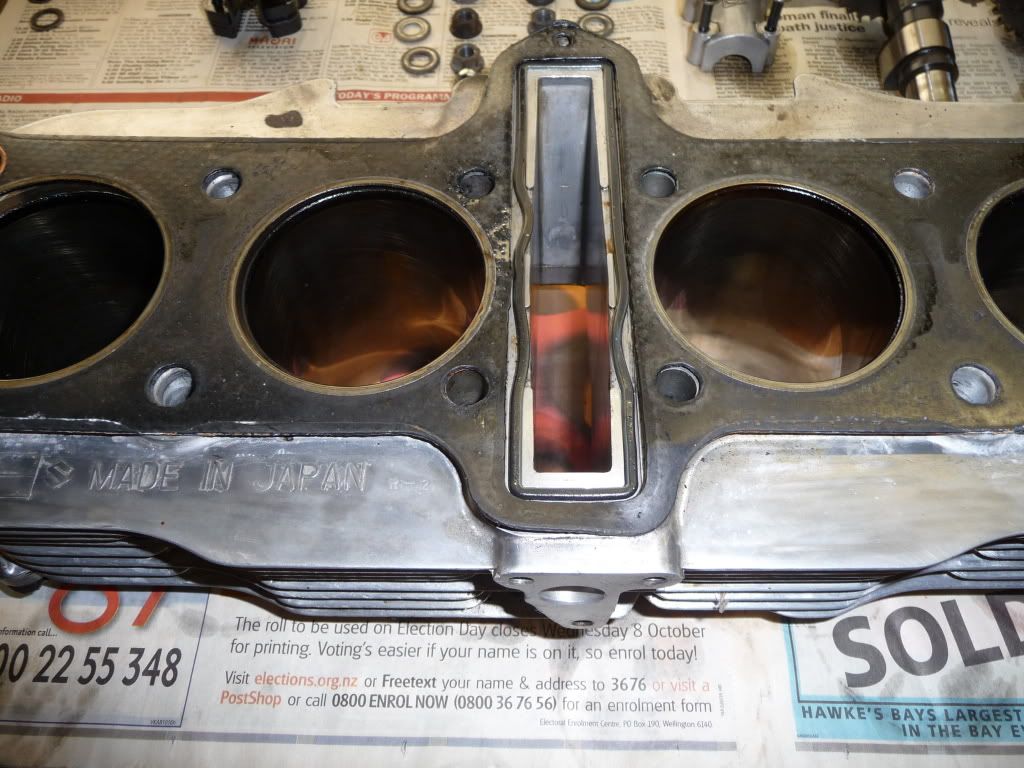
Here's a pic of the Vesrah head gasket and the controversial cam chain tunnel
o-ring.
P1000169.jpg


You can see the shape that resulted in it's poor sealing. The oil seepage around #2 pot has caused the gasket material to break down, to a point where it would eventually have failed.

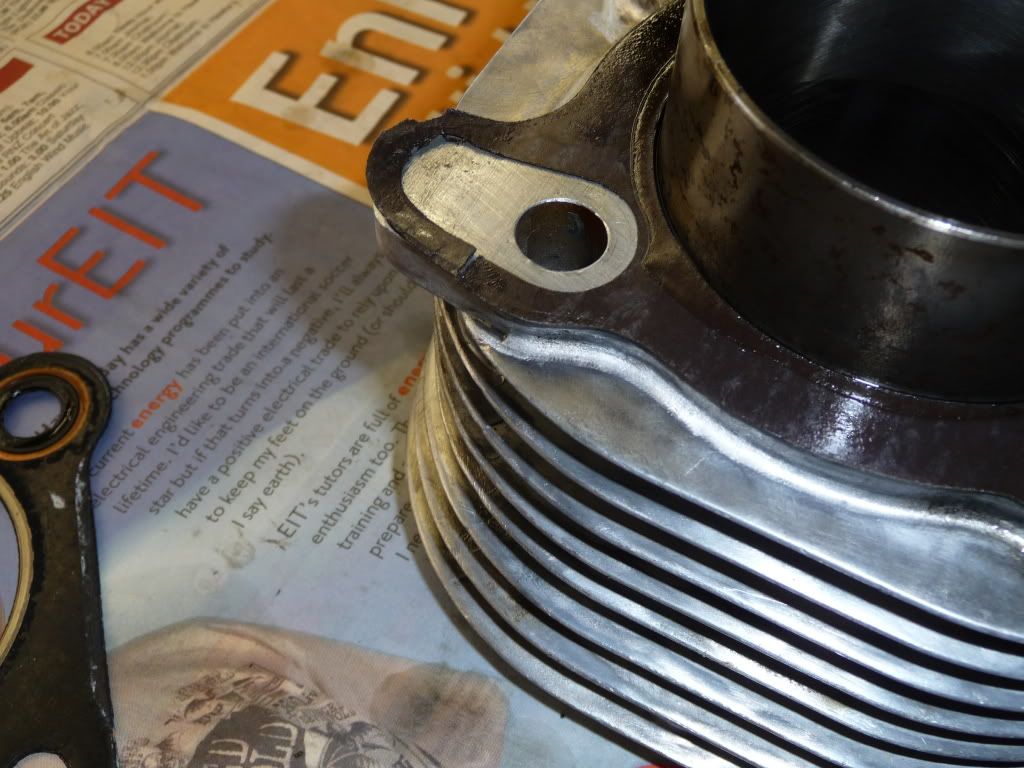
And the pic of the o-ring gasket area that failed.
P1000176.jpg

I did find this area to have a 0.002" out of true at the apex surface. The gasket material has started to fray/dissolve in this area. The tear drop o-ring was distorted and allowing oil to directly contact this area.

All surfaces needed checking. I found very little warppage or distortion, but the cylinder surfaces both had scratches/grooves on them from rough clean ups by past owners. That 0.002" low spot needed attention too.
So, I pressed the sleeves out and resurfaced both faces on a surface table which had #320 wet and dry adhered to it with double faced tape. 0.002" was removed from both faces and the sleeves were pressed back in place. The top of the sleeves now protrude 0.002" above the deck, but that's an advantage to counter the differing expansion rates between the iron sleeves and the ali cylinder assy. Any excess left proud at normal running temps will produce greater sealing pressure too.

After much discussion on this board and with other reputable mechanics, I decided to run with the MLS Cometic head gasket and the OEM base gasket and o-rings. Because the MLS gaskets completely cover the cam tunnel o-ring area, I decided to use some high temp Permatex sealant in the groove instead of the o-ring and just fit the gasket over it.

The bike's now done 100 kms since the rebuild, with no signs of any base or head gasket leaks. I have a very true head surface, which should help avoid oil seepage.

I will keep everyone informed of any changes as the Kms amass.

Now, do I re-torque which is supposedly now not required, or do I go through
the usual process after the first 1000 kms. I believe that the MLS head gasket probably doesn't need it, but what about the base gasket? I think I'll do a re-torque, for the benefit of the base gasket.

Unlike Brian, I have been impressed with the quality of my MLS, so far.
 
An engine gasket set is the last place to skimp. The time involved plus the other investments (milling, valve work, ect) more than warrant putting in AT LEAST OEM. I have done plenty (automotive) of engine work. V8s are on thing, as they are considerably overbuilt, but high compression, close tolerance fours work too hard. I'm new to the motorcycle realm, but do know that these little buggars have even less room for error. And with most of the machines on here in the 30 year range, still running, it is apparent that the stock parts have earned their cred
 
On my Cometic MLS head gasket, I found that the gasket didn't lie flat -- sitting on a flat table, it was at least 10mm above the surface in places -- the positioning holes and bolt holes were not placed correctly (although I don't see how they could have been placed accurately if the thing wouldn't lie flat). The cam chain tunnel area of the gasket was also uneven and poorly made. In addition, there were no seals at the corner oil passages.

Even when I received the gasket in the shrink-wrapped packaging, it was not lying flat. I'm honestly not sure why they let this out of their shop.

As I said, I got in a hurry and stupidly installed this obviously defective POS anyway. I had to use a Dremel with a sanding drum to touch up several places and get it to fit.

Did I just get a Cometic made on a Friday afternoon or Monday morning, or was yours also like this?
 
torque and re torque after 3 heat cycles??

torque and re torque after 3 heat cycles??

yep , it is always the gasket's fault. never the hands that assembled the engine.

I am going to guess there are some assembly secrets you have not paid to learn if these high quality products are fouling your program up.
 
It's been a while, but the 850 is now back on the road. I decided not to do a full strip down, as it still has only 87,000 kms aboard.

All surfaces needed checking. I found very little warppage or distortion, but the cylinder surfaces both had scratches/grooves on them from rough clean ups by past owners. That 0.002" low spot needed attention too.
So, I pressed the sleeves out and resurfaced both faces on a surface table which had #320 wet and dry adhered to it with double faced tape. 0.002" was removed from both faces and the sleeves were pressed back in place. The top of the sleeves now protrude 0.002" above the deck, but that's an advantage to counter the differing expansion rates between the iron sleeves and the ali cylinder assy. Any excess left proud at normal running temps will produce greater sealing pressure too.

After much discussion on this board and with other reputable mechanics, I decided to run with the MLS Cometic head gasket and the OEM base gasket and o-rings. Because the MLS gaskets completely cover the cam tunnel o-ring area, I decided to use some high temp Permatex sealant in the groove instead of the o-ring and just fit the gasket over it.

The bike's now done 100 kms since the rebuild, with no signs of any base or head gasket leaks. I have a very true head surface, which should help avoid oil seepage.

I will keep everyone informed of any changes as the Kms amass.


I believe the failure on the base gasket is the oblong O-rings at the oil feed passages, not from the small piece of gasket around the O-ring which don?t really do anything other than act as a spacer.

Regarding surfacing the head without the liners installed, I believe this is a mistake. Any decent machine shop can skim the cylinder to cut the aluminum and iron liners at the same time. This is how Suzuki built the engine so you are taking a big risk by having the liners sticking out. Don?t take me wrong, I truly hope your engine does not leak but when people do unconventional things a RED flag goes up in my head.
 
On my Cometic MLS head gasket, I found that the gasket didn't lie flat -- sitting on a flat table, it was at least 10mm above the surface in places -- the positioning holes and bolt holes were not placed correctly (although I don't see how they could have been placed accurately if the thing wouldn't lie flat). The cam chain tunnel area of the gasket was also uneven and poorly made. In addition, there were no seals at the corner oil passages.

Even when I received the gasket in the shrink-wrapped packaging, it was not lying flat. I'm honestly not sure why they let this out of their shop.

As I said, I got in a hurry and stupidly installed this obviously defective POS anyway. I had to use a Dremel with a sanding drum to touch up several places and get it to fit.

Did I just get a Cometic made on a Friday afternoon or Monday morning, or was yours also like this?

You may have got a Monday gasket, but I'm picking it got damaged somewhere in transit to you. You should have returned it for a replacement.

The damage was probably caused by a third party and as a consequence, Cometic have born the blunt of the bad publicity. Vesrah have also received the same treatment probably through no fault of them, but purely through some pirate company copying their product using inferior quality materials.

Surface integrity is quite important for reliable sealing, just as gasket composition and trueness is.

I'm keeping an open mind on the MLS gaskets. I've had good local feedback about them.
 
I believe the failure on the base gasket is the oblong O-rings at the oil feed passages, not from the small piece of gasket around the O-ring which don?t really do anything other than act as a spacer.

Regarding surfacing the head without the liners installed, I believe this is a mistake. Any decent machine shop can skim the cylinder to cut the aluminum and iron liners at the same time. This is how Suzuki built the engine so you are taking a big risk by having the liners sticking out. Don?t take me wrong, I truly hope your engine does not leak but when people do unconventional things a RED flag goes up in my head.

Yes, the o-rings were both undersized and out of shape when the base gasket failed. However, it only failed on the left oil way, which did have a 0.002" low spot on the surface, where it leaked.

I doubt there'll be a problem with the sleeves sitting 0.002' proud of the deck. Natural expansion rate differences between the two metals will reduce this.
Consider that many radical tuners/drag racers use metal o-rings to seal the bore when running high CR's. These can sit 0.006" proud of the block surface. Sure, the contact point is narrower, but my height difference is 1/3 less too.

Nothing ventured, nothing gained!!
 
You may have got a Monday gasket, but I'm picking it got damaged somewhere in transit to you. You should have returned it for a replacement.

The damage was probably caused by a third party and as a consequence, Cometic have born the blunt of the bad publicity.

No, it was definitely NOT damaged in shipping. It was manufactured incorrectly, in several quite obvious ways as outlined above. It was also lacking corner seals.

Cometic should not have shipped that embarrassing piece of crap, but they did. You are correct that I should have sent it back immediately (with a note saying "You must be joking..."), but I was dumb enough to fix it up with a Dremel and install it -- I had no other available options at that time since the Vesrah kit I had was suspect and the Suzuki head gasket was on extended backorder (they do seem to be available now).

I will be fair -- the Cometic head gasket is sealing compression just fine, but it's leaking oil at the corners. Not a steady stream or a lot of oil, and I've ridden a lot of miles with it seeping, but I'll have to fix it sooner or later.

I'm not knocking the MLS concept, materials or technology, or Cometic's other products. I am knocking Cometic's pathetic quality control.
 
No, it was definitely NOT damaged in shipping. It was manufactured incorrectly, in several quite obvious ways as outlined above. It was also lacking corner seals.

Cometic should not have shipped that embarrassing piece of crap, but they did. You are correct that I should have sent it back immediately (with a note saying "You must be joking..."), but I was dumb enough to fix it up with a Dremel and install it -- I had no other available options at that time since the Vesrah kit I had was suspect and the Suzuki head gasket was on extended backorder (they do seem to be available now).

I will be fair -- the Cometic head gasket is sealing compression just fine, but it's leaking oil at the corners. Not a steady stream or a lot of oil, and I've ridden a lot of miles with it seeping, but I'll have to fix it sooner or later.

I'm not knocking the MLS concept, materials or technology, or Cometic's other products. I am knocking Cometic's pathetic quality control.

You are the best judge of the gasket condition from the manufacturer.

Cometic didn't design their MLS gaskets with oil seals on the corner studs, that's why they are missing. If you look closely at their design, these are the only holes that don't have a over lapping sealing ring manufactured between the outer layers. I guess they have found this allows the individual layers to flex better during heat cycles, reducing their tendency to leak. Lets hope they're right.:-k
How many more heat cycles before a re-torque??
 
Back
Top