• Required reading for all forum users!!!

    Welcome!
    Register to access the full functionality of the GSResources forum. Until you register and activate your account you will not have full forum access, nor will you be able to post or reply to messages.

    A note to new registrants...
    All new forum registrations must be activated via email before you have full access to the forum.

    A Special Note about Email accounts!
    DO NOT SIGN UP USING hotmail, outlook, gmx, sbcglobal, att, bellsouth or email.com. They delete our forum signup emails.

    A note to old forum members...
    I receive numerous requests from people who can no longer log in because their accounts were deleted. As mentioned in the forum FAQ, user accounts are deleted if you haven't logged in for the past 6 months. If you can't log in, then create a new forum account. If you don't get an error message, then check your email account for an activation message. If you get a message stating that the email address is already in use, then your account still exists so follow the instructions in the forum FAQ for resetting your password.

    Have you forgotten your password or have a new email address? Then read the forum FAQ for details on how to reset it.

    Any email requests for "can't log in anymore" problems or "lost my password" problems will be deleted. Read the forum FAQ and follow the instructions there - that's what we have one for...

  • Returning Visitors

    If you are a returning visitor who never received your confirmation email, then odds are your email provider is blockinig emails from our server. The only thing that can be done to get around this is you will have to try creating another forum account using an email address from another domain.

    If you are a returning visitor to the forum and can't log in using your old forum name and password but used to be able to then chances are your account is deleted. Purges of the databases are done regularly. You will have to create a new forum account and you should be all set.

Wheel balancing, first time

  • Thread starter Thread starter Guest
  • Start date Start date
G

Guest

Guest
I made a balancing device modeled after Brian Wringers, but it doesn't work well. The wheel bearings do all of the moving. In the photo, one bead has been loosened from the rim. My goal is to find how well the wheel was/is balanced with the old tire. I've spun it about ten times, different speeds, both directions, and it always stops very close to this position. Now note the position of the balance weight: It is near the top! And that is a pretty big weight for a wheel this size, I think.

1) Is there any reason why breaking loose one bead would change the balance?

2) Is there any reason to not use the wheel bearings for checking balance, as long as it turns smoothly, with little effort?

3) Any ideas on the strange balance position?
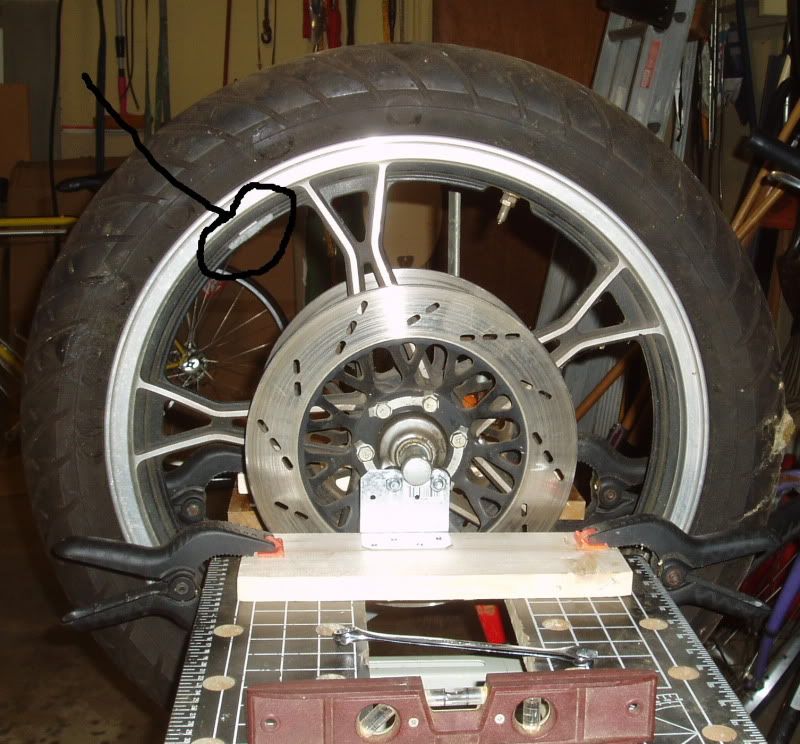
2010-09-28funnybalancepointedited.jpg
 
I always just install the wheels on the axles without calipers or chain mounted. It's worked well for me. You may have a bearing that's going south causing the wheel to stop in the same place each time.
 
BTW, balance shouldn't be bothered by the bead not being seated. The wheel and tire weigh what they weigh.
 
Or you may genuinely have a heavy spot at the bottom. :oops:

By the way, there is no need to spin it at "varying speeds". Just spin it enough for it to overcome friction in the grease in the bearings and do a full two or three revolutions. Give it just a little tug, enough to get it to rotate about 90 degrees. If it had a heavy spot, it will reverse direction and go back to it. If it is nearly balanced, it will "hunt" a bit to decide where it's going to stop. When it IS balanced, short tugs like that will cause random stopping points.

Spinning at higher speeds only increases the time it takes for it to stop. :o

Now to answer your questions:
1) Yes, breaking a bead loose will allow the tire to settle, causing an imbalance. If the tire is not fully seated, there is no telling which way it's flopping or how much.

2) In theory, you want zero friction. In practice, not all of us have the spare parts lying around to build little bearing jigs for tire balancing. I simply support the wheel between two jackstands, using the axle it usually runs on.

3) Nothing really strange about that, you just need some weight at the 12 or 1 o'clock position to finish it out.

.
 
Either they didn't have enough weights, or a weight has fallen off since it was balanced, or whoever balanced it didn't give a rat's ass, or the tire has changed since it was last balanced.
All good reasons to stick with beads.
 
1) Is there any reason why breaking loose one bead would change the balance?

Not a big difference. But old tires can and do develop imbalances. Distance from the rim can make a difference, so I'd inflate the tire as normal to seat the bead and then balance it. However, see below...


2) Is there any reason to not use the wheel bearings for checking balance, as long as it turns smoothly, with little effort?

Sometimes the skate bearings turn easier, and sometimes the axle bearings turn easier. The reason for the balancer setup with the skate bearings is so that you always have as low friction as possible.

Also, it's pretty common for the skate bearings to get a little bit of grit in them that makes them harder to turn under load. Make sure yours spin very freely. I found seven or eight out of a set of twenty that were acceptable.

With this setup, I can very consistently balance to within half a 1/4 ounce wheel weight -- far more precision than is needed.


3) Any ideas on the strange balance position?

Again, tires can and do develop greater imbalances as they wear, so this isn't at all unusual. If you were planning on keeping this tire, you'd want to inflate it to seat the bead, remove the old weights entirely, and balance from there. You'd likely end up with a larger weight just to the right of the current weight. I usually use masking tape to add test weights, then stick on the correct number.

If you end up adding a lot of weight, sometimes it's best to break the beads again, rotate the tire 90 or 180 degrees, and rebalance -- by relocating the tire's heavy spot, you usually end up adding less weight.

To get the smallest possible amount of weight, you could balance the bare rim, then mount the tire, find the tire's true light spot, relocate the tire's true light spot to the wheel's true heavy spot, then rebalance the assembly. A lot of work, if you ask me...

When it's time to install new tires, you'll want to remove the old tire entirely, then locate and mark the true heavy spot on the bare rim -- this very often is not the valve stem on vintage wheels (modern era wheels are somewhat more consistent). Then, mount the new tire's light spot (usually marked with a yellow dot) next to the wheel's heavy spot and balance the assembly from there.

If you're mounting a new tire that's perfectly balanced from the factory (like the Avon RoadRiders) then you can just balance the bare wheel, mount the tire, and go ride. I've mounted dozens of RoadRiders, and they've all been spot-on.

If your new tire does not have a balance dot, but you're not sure whether it's factory balanced, then balance the bare wheel, mount the tire, and re-check.


I'm going to avoid stepping into the whole DynaBeads holy war, other than to say that I use wheel weights and will continue to do so.
 
Last edited:
Thanks for all the replies. To estimate bearing friction, I moved the wheel 90 degrees either direction and released. The resting positions were about 15 degrees apart (estimation, not measurement). There is a region of about 45 degrees where bearing friction is high enough that the wheel doesn't move when released. Also, when I move the wheel about 180 degrees, there is a dead region. Since the wheel never stops there from a spin, I'm guessing that the heavy spot is so close to TDC at that point that the pull of gravity has too low a lateral component to rotate the wheel at all.

I used skate board bearings. A set of 8 was $10. All seem to spin freely. Should roller blade bearings be any different? It seems to me that the major problem with my balancing rig isn't the bearings, but aligning the bearings on both sides of the wheel. Or, the sensitivity to alignment could indicate that the bearings are just not good enough.

Anyway, it is time to order balance pads, mark the wheel, and finish removing the tire.
 
To eliminate the effects of bearing friction, you can wiggle the axle back and forth slightly.

But if you're getting consistent results, don't worry about it.

Why are you balancing with an old tire half-mounted? Just practicing? :confused:
 
To eliminate the effects of bearing friction, you can wiggle the axle back and forth slightly.

But if you're getting consistent results, don't worry about it.

Why are you balancing with an old tire half-mounted? Just practicing? :confused:

Because I'm quite picky about many things. After I broke the first bead loose, I realized that I did not know the balance point with the old tire on. That is the sort of thing (not knowing something potentially useful) that can easily keep me awake at night.

I ordered stick-on weights yesterday from American Motorcycle Tire. I'll probably resume tire removal this afternoon. The first bead came off easily with a big C clamp, but the second bead resists. So I'll try a home-made tool I've seen either on GSR or some other internet site.

The old tires will be scrapped.
 
If one side of the bead has broken loose, stick a piece of wood between the c clamp and rim on that side so the clam is pushing against the rim and the side you want to break loose. Otherwise, your effort is wasted by compressing the rubber on the side that's already broken loose.
 
??????????????????

??????????????????

:confused:Hang on one sec. If i have read correctly you have said the bead is broken on one side and no one has picked up on the fact that when the bead is broken a very large part of a very heavy item is sitting closer to the centre of the circle. Of course its going to change the balance!!!!!!!!!!!!!!!!! It will make that area "lighter" resulting in the wheel stopping in the position it has. This is how you balance the wheel. Spin that sucker to allow you to see if the bead is sitting evenly. Let it stop in its natural position with no weights on the rim at all. Mark/grab the wheel in the 12 oclock position and bring it down the 9 or 3 oclock position depending on where is more comfortable. Add weight to ONLY that area until your marked area stays at that 3/9 oclock position. Dont spin it anymore and there is no need to spin it anymore just keep adding weight till it stays in that position. If it rolls up add weight, if it rolls down cut/remove some weight off. Simply as that. If you using Suzuki weight (30 grams it is) as in that picture and need to use two place one on one side and the otherweight on the otheside. A trick to using less weight (with tubless rims) was to find the heaviest spot of the empty (no tyre) wheel first and place some tape in that area so you can put the dot on the tyre next to the taped section. No dot?, dont worry about this step. Just because the valve is there doesnt meant its the heaviest spot. If you have weight in different areas that wheel was balance wrong. Dont care what anyone says. 15 yrs or more just doing wheels makes me a lil expert. So its spin, check, wait to stop, grap 12 oclock, hold 3 or 9 oclock, add weight there (and only there) till it stays there, Simply
Side note......We always removed the standard axle and used our own machined axles elimating the chance of a slightly bent owners axle and friction from speedo drives. That setup allowed the wheel more movement as it normally spun on the stand bearings and not the wheel bearings which have one or 2 dust seals and packed with grease in each bearing. On a well setup system even the removal of one cush drive rubber upset the balance.

KatatLakesidemid90s.jpg


Raceready.jpg
 
Last edited:
If one side of the bead has broken loose, stick a piece of wood between the c clamp and rim on that side so the clam is pushing against the rim and the side you want to break loose. Otherwise, your effort is wasted by compressing the rubber on the side that's already broken loose.

Already tried that. The clamp on the tire side just slides down the sidewall.

:confused:Hang on one sec. If i have read correctly you have said the bead is broken on one side and no one has picked up on the fact that when the bead is broken a very large part of a very heavy item is sitting closer to the centre of the circle. Of course its going to change the balance!!!!!!!!!!!!!!!!! It will make that area "lighter" resulting in the wheel stopping in the position it has. This is how you balance the wheel. Spin that sucker to allow you to see if the bead is sitting evenly. Let it stop in its natural position with no weights on the rim at all. Mark/grab the wheel in the 12 oclock position and bring it down the 9 or 3 oclock position depending on where is more comfortable. Add weight to ONLY that area until your marked area stays at that 3/9 oclock position. Dont spin it anymore and there is no need to spin it anymore just keep adding weight till it stays in that position. If it rolls up add weight, if it rolls down cut/remove some weight off. Simply as that. If you using Suzuki weight (30 grams it is) as in that picture and need to use two place one on one side and the otherweight on the otheside. A trick to using less weight (with tubless rims) was to find the heaviest spot of the empty (no tyre) wheel first and place some tape in that area so you can put the dot on the tyre next to the taped section. No dot?, dont worry about this step. Just because the valve is there doesnt meant its the heaviest spot. If you have weight in different areas that wheel was balance wrong. Dont care what anyone says. 15 yrs or more just doing wheels makes me a lil expert. So its spin, check, wait to stop, grap 12 oclock, hold 3 or 9 oclock, add weight there (and only there) till it stays there, Simply
Side note......We always removed the standard axle and used our own machined axles elimating the chance of a slightly bent owners axle and friction from speedo drives. That setup allowed the wheel more movement as it normally spun on the stand bearings and not the wheel bearings which have one or 2 dust seals and packed with grease in each bearing. On a well setup system even the removal of one cush drive rubber upset the balance.

Thanks for the advice. I think what you wrote ends up being pretty close to the middle of what everyone else here wrote. Your experience reaffirms their comments.

One thing I've learned from the experience is that alignment of the bearings, actually being used while balancing, really matters. I think that, if I were to be doing this often (running through a set of tires more than every several years), I'd spend the $130 on a rudimentary truing stand, so that I could remove the effect of the bikes axle and bearing.
 
And go to the wreckers/breakers with a screw driver and ask/buy some genuine Suzuki wheels weights for you mag wheel. Best couple of dollars you will spend. Make sure there is "S" and the weight on the lead to comfirm there Suzuki ones and not fake. All 1979- 1984 mag wheel take the same weights. FYI... even a Hayabusa cush drive rubber is the same as a GS 750 one. Hows that for using the use out the same design. LOL
 
So Sharpy... are you working for Tyres for Bikes? Or did you previously? Or were they sponsors? If you're still working there, I'll come hassle you down the track for some good tyres (not looking for a discount either).

Mainly I'm subscribing to this thread though because I've never balanced wheels before and there's some damn good advice here by the looks! :)
 
Made some of those ball bearing axle supports but the regular wheel bearings had lower friction so now I just use the Suzuki axle supported on some automotive jack stands. Using new wheel bearings makes a big difference; an out of balance wheel will turn on it's own without throwing the wheel at all.

My guess is the wheel in question was never properly balanced, or some of the weights fell off.
 
Last edited:
Because I'm quite picky about many things. ..., I realized that I did not know the balance point with the old tire on. ... The old tires will be scrapped.
If the old tires will be scrapped, what difference does it make where it used to balance? :-k


... I think that, if I were to be doing this often (running through a set of tires more than every several years), I'd spend the $130 on a rudimentary truing stand, ...
I have four bikes in my own stable that I keep on the road. Between them and other bikes that I work on, I mount at least two sets of tires every year, usually a few more. I have yet to justify spending ANY money on a truing stand, however "rudimentary" it might be.


... I just use the Suzuki axle supported on some automotive jack stands. ...
Seems to me I have seen that method mentioned somewhere recently. :-k
... I simply support the wheel between two jackstands, using the axle it usually runs on.
...

:D

.
 
Seems to me I have seen that method mentioned somewhere recently. :-k
.

Not trying to steal your thunder Steve, just mentioning how I do it. Apparently we use the same technique.:D

I suggest checking balance of the wheel before mounting up the tire. That way you will know how much weight is simply offsetting the wheel vs. tire. Another thing is to try rotating the tire on the wheel 90 degrees or so if the assembly is taking more than 50 grams of weight. You may have to spin the tire a number of times before you find the best spot where the least amount of balance weight can be used.
 
Not trying to steal your thunder Steve, just mentioning how I do it. Apparently we use the same technique.:D
Don't worry, I did not feel that any thunder was stolen. :D

It's just nice to see that I am not alone in my ways. :-\\\

.
 
Back
Top