• Required reading for all forum users!!!

    Welcome!
    Register to access the full functionality of the GSResources forum. Until you register and activate your account you will not have full forum access, nor will you be able to post or reply to messages.

    A note to new registrants...
    All new forum registrations must be activated via email before you have full access to the forum.

    A Special Note about Email accounts!
    DO NOT SIGN UP USING hotmail, outlook, gmx, sbcglobal, att, bellsouth or email.com. They delete our forum signup emails.

    A note to old forum members...
    I receive numerous requests from people who can no longer log in because their accounts were deleted. As mentioned in the forum FAQ, user accounts are deleted if you haven't logged in for the past 6 months. If you can't log in, then create a new forum account. If you don't get an error message, then check your email account for an activation message. If you get a message stating that the email address is already in use, then your account still exists so follow the instructions in the forum FAQ for resetting your password.

    Have you forgotten your password or have a new email address? Then read the forum FAQ for details on how to reset it.

    Any email requests for "can't log in anymore" problems or "lost my password" problems will be deleted. Read the forum FAQ and follow the instructions there - that's what we have one for...

  • Returning Visitors

    If you are a returning visitor who never received your confirmation email, then odds are your email provider is blockinig emails from our server. The only thing that can be done to get around this is you will have to try creating another forum account using an email address from another domain.

    If you are a returning visitor to the forum and can't log in using your old forum name and password but used to be able to then chances are your account is deleted. Purges of the databases are done regularly. You will have to create a new forum account and you should be all set.

'79 GS1000S - 1085 Wiseco Kit - overheats at low speeds

  • Thread starter Thread starter IanR
  • Start date Start date
With my 1166 at CR=10.25:1 premium is a must. I dont know what the CR is for the 1085 kit but I'm guessing he needs to run premium else .....

Jim
My 78 has a 1085 and burns regular. That may be because my machinist spent an evening cc ing the head and chamfering the edges of the combustion chamber, which eliminates a hot spot and slightly lowers the CR
 
Jim
My 78 has a 1085 and burns regular. That may be because my machinist spent an evening cc ing the head and chamfering the edges of the combustion chamber, which eliminates a hot spot and slightly lowers the CR


Wiseco say the [FONT=Arial, Helvetica, sans-serif]K1085 is a 10.25:1 same as the 16V 1166 so I don't know other than mine will run on regular but will also ping. Talk to Bill about headwork on his 1166 that he blew up on the way back from Lost Coast on the rally to Mt Shasta. He was running regular and he barely made it back to Highway 101 before it finally gave up.
Could have been the gas, or could have been an overzealous machinist skimmed his head too much.
[/FONT]
 
I added Fjbj40 to the list of people reporting reduction in operating oil temperature after installation of a SERIES R/R. This is somewhat of a first ! Most other people I know, having done so, have had such results with the Compufire SERIES R/R and generally on a 16V 1100E. In principle any SERIES R/R and bike close to thermal overload (Big Blocks especially) should see the benefit.

If your bike already runs cool (under 240 degF) then the series R/R will probably do little. If the bike runs at a steady rate (not talking about a short term dash) at an elevated temperature (270+ degF like the OP describes) the small differential of the SERIES R/R is enough to drop your operating temp. It is a pretty fine balance.

The bike
1979 GS1000S, with Standard pipes (yes proper originals), and standard airbox and filter with lid on, Dynateck Electronic ignition (I've put a strobe light on the timing and it appears fine going fully advance at around 3500rpm).

The change
I've recently added a Wiseco 1085 piston kit. The bike runs like a train - lots of power, no flat spots, no hesitations up to redline, idles well.

The problem
If I ride for about 20-30 minutes at 60-80km/h 35-50mph on a COOL day with no stop-start traffic the oil temp gradually keeps rising (this model is the one with the oil temp guage) until it reaches almost 170C (around 330 deg F) before I stop and let it cool down. If I take it onto the freeway or non-urban roads and ride at around 100Km/h (60mph) or above the temp drops to around 100 deg C (212 deg F) or less.

Fjbj40 confirms temp reductions using the SH-775 and on a 8V no less. :)


http://www.thegsresources.com/_forum/showthread.php?161397-Compu-Fire-SERIES-R-R-Install


HIGHLY RECOMMENDED FOR A Warm Running 16V GS1100/1150. For you naysayers out there. There is a significant temperature drop if you are running stock in the 250-270 degF range (My 1166 went down to 210-220 degF max).

Aprilla but shows back to back temperature drops

UPDATE; Wheat dog has confirmed a nominal 30 degF drop in operating temp for an 83 GS1100ED with 1166 kit after making this change over to the Compufire-Fire R/R
Installed Compufire RR - Way Cool!!

Chef1366 temperature drop results GS1100 with 1229.
http://www.thegsresources.com/_forum/showpost.php?p=2009372&postcount=50

Katman did an install
Compufire "series"
regulator / rectifier
Reduces engine oil temp.
http://www.parts.suzuki-katana.com/

I run a RR off a Goldwing, sh775, it also sits out in the air just above the swingarm on my 1085. It definitely helped with the temps, as you stated.
http://www.thegsresources.com/_foru...overheats-at-low-speeds&p=2192818#post2192818


For the OP, you might just give it a try. 20degF drops are not unusual and they only get larger drops the worse the problem.
 
Last edited:
A quick update: I took my bike to a motorcyle workshop where they seem to know what they are doing with older bikes like ours - they build and race bikes of similar ages.

They put it on the dyno, stuck a small diameter copper tube well down the RH exhaust pipe and analysed the exhaust gases.

They showed me that the bike is running well, with a slightly rich mixture right across the range of throttle openings. They suggested that I should leave the jets were they are and install an oil cooler.

So that's what I'm going to do. I'll let you know how I go.
 
A BB even properly jetted and it runs hot? Who would have thunk ?


you will probably have stator issues unless you put in a series R /r. You might consider doing that first before the cooler.
 
Last edited:
Bigger bore- check, Bigger cams-check, Bigger valves-check, Bigger ports-check made way more heat. Bigger cooler-check made way less heat. I not that brainy but i do know its cooler.....


A BB even properly jetted and it runs hot? Who would have thunk ?


you will probably have stator issues unless you put in a series R /r. You might consider doing that first before the cooler.

Back when I used to be more 'involved', I used to rewind stators with a polyimide coated magnet wire. This was the highest thermal rating available. The lowest rating is 105 C for Formvar and other low buck 'varnish' wire insulations. The next class is 150C and then 180C and finally 220C+. It's my contention that if Suzuki had specified Polyimide in the beginning there would have been far fewer or no stator 'issues'. You would still be able to fry a R/R if your battery/grounds was hooped, but the stator would be happy to sentence it to death.

I had a friend who went through several stock stators on his GS1000G, which he had loaded down with all the crap he could accumulate plus GF and bags and heated whatsits, and liked to do long trips through the desert in a hurry. I wound him a stator and that ended the problem. I ran my own rewinds on various GSs and never had one fail.

I think that the windings get hot and fry the insulation and then it shorts out, either to itself - low output - or to the frame - game over. I also potted mine in high end epoxy laminating resin. It's a big PIA but the way I saw it, only once.

I have no idea what sort of insulation the rewinders are using these days. If you are interested in this sort of thing you can look up Magnet Wire Services [MWS] in Westlake Village, California, LA area. They have some charts regarding insulation type properties. My thoughts were that by the time my oil got to 150C or about 300F the stator would be somewhat [???] above that so why not go for 220C and get real about the fact that this thing is operating in really hot oil and then generating more heat on its own.

Series regulators are inevitably going to reduce the heat generated, but even then the environment the stator is in is past the theoretical limit of low end insulation. The wire cost is so low even when you buy the best that I wouldn't bother with the low temp stuff, plus it seems less tough and flexible.

I have no idea if you can buy directly from MWS or not, but they may lead you to those who resell in smaller quantities.
 
Back when I used to be more 'involved', I used to rewind stators with a polyimide coated magnet wire. This was the highest thermal rating available. The lowest rating is 105 C for Formvar and other low buck 'varnish' wire insulations. The next class is 150C and then 180C and finally 220C+. It's my contention that if Suzuki had specified Polyimide in the beginning there would have been far fewer or no stator 'issues'. You would still be able to fry a R/R if your battery/grounds was hooped, but the stator would be happy to sentence it to death.

I had a friend who went through several stock stators on his GS1000G, which he had loaded down with all the crap he could accumulate plus GF and bags and heated whatsits, and liked to do long trips through the desert in a hurry. I wound him a stator and that ended the problem. I ran my own rewinds on various GSs and never had one fail.

I think that the windings get hot and fry the insulation and then it shorts out, either to itself - low output - or to the frame - game over. I also potted mine in high end epoxy laminating resin. It's a big PIA but the way I saw it, only once.

I have no idea what sort of insulation the rewinders are using these days. If you are interested in this sort of thing you can look up Magnet Wire Services [MWS] in Westlake Village, California, LA area. They have some charts regarding insulation type properties. My thoughts were that by the time my oil got to 150C or about 300F the stator would be somewhat [???] above that so why not go for 220C and get real about the fact that this thing is operating in really hot oil and then generating more heat on its own.

Series regulators are inevitably going to reduce the heat generated, but even then the environment the stator is in is past the theoretical limit of low end insulation. The wire cost is so low even when you buy the best that I wouldn't bother with the low temp stuff, plus it seems less tough and flexible.

I have no idea if you can buy directly from MWS or not, but they may lead you to those who resell in smaller quantities.

A different insulating material may very well have helped the OEM situation with crispy stators. One thing you mentioned about epoxy coatings that I see seldom echoed around here: The epoxy coating is required not so much for insulation but to immobilize the windings. It is common knowledge in motor design that the individual windings need to be immobilized so that the EMF force does not work the windings into a point of failure. The epoxy is used to do just this. This is the electrosport stator for the GS1100E and which ever other bikes cross fit to it. This is a lot more than just a thin shellacking to create an insulating barrier. The wire is encased in what looks like an epoxy to immobilize it.

I wonder if with the increase stator longevity we will likely experience with the SERIES R/R's , that will we be seeing more stator failures not due to burning but due to mechanical failure. With a thin clear coat, and a SHUNT R/R the stator was not going to last long and it is not unexpected. Now with the SERIES R/Rs and lower electrical stress, the mechanical stress is still the same and maybe this might start to creep up on stators which are not epoxy encased as this Electrosport is.


attachment.php


I should mention that you can see the start of heat damage to this stator. This was pre Compufire for me and after only a 250 mile ride out Hwy 33 from Ojai CA. At the time I figured I needed to do something and I added the oil sprayer(brass fitting at 2:00 oclock).

From an efficiency standpoint, it makes not much sense to use SHUNT but on the other hand, any potential power savings do not matter much either. However the cooler running engines is not something you can get back with a different epoxy. I know my 1166 and others have dropped 20-30 degF under similar operating conditions after the install of the SERIES R/R.

To be even more specific, when my 1100 was stock and on a relatively mild and foggy day the temp still world run up to 270 deg F as per the meter. After the BB this got much worse probably adding at least 10-15 degrees F for similar conditions. After the SERIES R/R, even riding in 95 degF heat, the engine seldom got much over 220 degF (230 at max).
 
Last edited:
Bigger bore- check, Bigger cams-check, Bigger valves-check, Bigger ports-check made way more heat. Bigger cooler-check made way less heat. I not that brainy but i do know its cooler.....


Nice and Clean :) and Cool and Hot at the same time :cool:
 
A lot of experts weighed in on this thread; So how come my 1100G has no problem with overheating.
Except for comp. ratio not much difference?
Did Suzuki note this problem and mod the 1100G engine to run cooler?
 
A lot of experts weighed in on this thread; So how come my 1100G has no problem with overheating.
Except for comp. ratio not much difference?
Did Suzuki note this problem and mod the 1100G engine to run cooler?
perhaps it is not obvious enough; the running temperature is based on a net balance between heat generation and heat dissipation. Small changes on either side can swing the results.
 
You still have the factory cylinder wall thickness. The bikes in the thread have all been bored out.
 
Rob, I'd be grateful if you could show me what the oil cooler arrangement is on your bike. I see that for the 1150s the oil lines appear to come off the oil filter cap, which look like they use the same 3 stud arrangement as on my GS1000S. I'd prefer this method to replacing the oil pressure switch plate and bringing the oil lines from behind the engine.

1100e's were designed with the addition of an oil cooler in mind. There are two bolts right next to the oil filter cover, one on either side near the bottom. The cooler lines go right there.

Unfortunately, I do not think the 1000's were designed like that.

BTW, I had to replace my stock oil filter cover with an 1150 one.
attachment.php


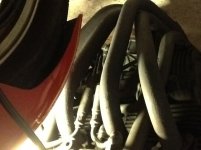
Sorry it's upside down, but I think this one shows the best how the two lines from the cooler just go down a few inches to either side of the filter cover. A big convenience for 1100e owners.
 

Attachments

  • image.jpg
    image.jpg
    70.2 KB · Views: 0
Rob, I'd be grateful if you could show me what the oil cooler arrangement is on your bike. I see that for the 1150s the oil lines appear to come off the oil filter cap, which look like they use the same 3 stud arrangement as on my GS1000S. I'd prefer this method to replacing the oil pressure switch plate and bringing the oil lines from behind the engine.

My old Z1 had what I thought was a logical routing of the oil cooler lines. The PO (or PPO) turned the cooler upside down so the input and output were on the top. He then just ran the lines back over the top of the engine in the gas tank tunnel.

The only thing I can't figure out is why no one else does that.
 
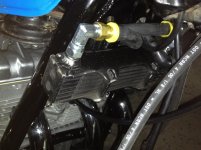
An oil cooler was exactly what the doctor ordered! On a slow speed ride through traffic today the oil temperature barely reached 100C (212F). On the same ride a few days ago, with no oil cooler, I saw it reach 150C+ (300F+) and it was still climbing before I stopped.

Based on my experience, if you are putting a big bore kit in your 1000cc 8V you should also install an oil cooler - and it does not have to be a big one as you can see from the photo below. I sourced mine from an unknown model of Kawasaki.

Thanks everyone for your contributions to this thread.

attachment.php
 

Attachments

  • IMG_1732.jpg
    IMG_1732.jpg
    90.4 KB · Views: 0
If we have two bikes, one stock and one modified w/big bore kit, and run them both at 75 mph, both should run at the same temperature. The heat generated is in relationship to the amount of power being produced. Just because one bike has the ability to make more power, that doesn't mean that it will run hotter at every given power output. Ray's comment about higher compression making more heat is valid as it relates to big bore kitted bikes though. I'm not sure if that means it will automatically run hotter all the time though. The hot rod engine will require less throttle application at any given speed is all. And thinner cylinder walls shouldn't make the engine run hotter either. If anything the thick liners will reduce the ability of the engine to move heat away from the pistons. A thinner liner will transfer heat more easily to the cooler outside aluminum fins.
 
Last edited:
Back
Top